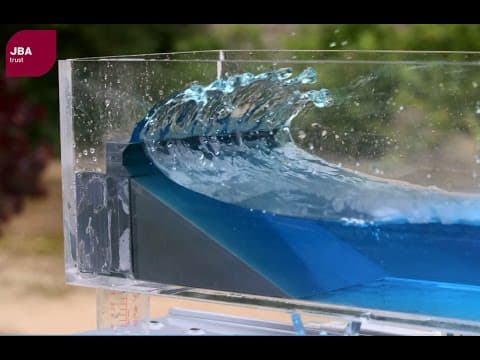
[0:15]Hi, I'm Dan from JBA and what we've got here today are the JBA Trust physical models. So we're going to be looking at some of these physical models that are used for training and education in coastal and flood risk management. The one that we've got here today is the wave tank. Now, the wave tank is usually used because in these situations, in the coastal environment, it gets really complicated, and we can't always solve this through analytical equations. Now, whilst it's very easy to predict how big waves are going to be in the offshore, when they start to move towards the coastline, all sorts of things happen to them. They start to interact with the bathymetry, coastal reefs and headlands. We get processes like shoaling and refraction and diffraction, we get depth-induced breaking. That means by the time our waves actually get to the coastline, they're quite different to what they were offshore. And it's these nearshore waves that we're really interested in, because it's these nearshore waves that are going to interact with our coastal structures. They're going to lead to erosion, they're going to lead to wave overtopping, and eventually inundation or flooding of the communities that are sitting behind them. So, what we've got here today with the wave tank, we're going to demonstrate the different defenses that we can use. We're going to propagate five waves towards each of the defenses, and we're going to calculate how much waves are going to overtop the defenses. We're going to capture this, we're going to measure it, and we're going to see the different performance levels of all of the different structures. Now our first situation we're going to represent is our beach environment. Now normally, when waves arrive at a beach, they're going to break and they're going to roll up and down the beach face and there's not going to be any problem. Now, today, though, we're going to we've filled up the tank a little bit more, and we're representing a storm surge. Now, this means that there's deeper water, bigger waves are going to be arriving at our coast, and they've got the ability to roll up and down the beach, but they can also go over the dunes and inundate all the communities behind. So, the first thing we're going to do, we're going to send our five waves down. We're going to have a look what happens.
[2:17]And what we saw is that even though the waves were breaking, there was still enough energy for them to roll up over the dunes, and in this case, fill up our reservoir. But in real life, that would have meant that any houses or properties or communities behind the defense would have been completely flooded. And really that isn't an acceptable situation for us. So, this is around the time where we bring in our coastal engineers. All right. Now, we've just reset our tank and now we can start testing some of our different defenses. Now if there's only a little bit of wave overtopping, we can usually get away with just a vertical wall. If it's small in nature, it can easily just be set behind the dunes like we've just done there. Or even incorporate into some dunes, and that will essentially just provide another impermeable barrier to wave overtopping. Now, we'll have a look how it goes.
[3:15]Now, we did get still some overtopping, but it was a lot less than before. And we'll have a look how much we've actually got. Now, what we've got here, we'll call that about 50 mil. And while it's only a little amount in our physical tank, this could easily be say, 50 liters per second in real life. This is the sort of a volume that will start leading to some problems, but still, it's better than if there was nothing behind there at all. And what we want to do now is see if we can try and improve the situation even more. So now we're ready to start designing some of our defenses. Now the first thing we have to think about is what is the beach going to be like in the future. Now, unfortunately, when we're designing our structures, they have to last, you know, 50, 100 years from now. So, we have to assume a lot of the time that the beach is going to be very eroded or receding in those times, and we don't actually have any sand left. So, we design to assume the worst-case conditions. So our small wall has now turned into a really large wall. The crest height is the same, but all of the sand, all the sediment, all the beach in front of it has now gone. And this is what we're going to test first. How is that small wall going to perform under the same waves that we've just run? So, we'll send our five waves down. Now, this time we saw larger waves coming in. That's because they weren't breaking on the beach. They've actually hit the wall under really impulsive conditions. Now what we can do now is actually see how much wave overtopping happened and how much extra water that we've got. Now, by removing the beach, we've now got about 70 mils of overtopping. Now, this is the exact same structural conditions, but we've just now got no wave breaking in front of the structure. So this is really important for our designs, but now we can use this as a base case to imagine this is what the conditions are going to be like a hundred years from now. And now we can start changing the structural conditions to see if we can improve the situation. Now, the next defense we're going to check and test is our slope revetment. Now, this is about a one and two, also known as a dike. And what we're going to do is we're going to put it in front of our defense. Now the argument is that we're going to now induce more breaking against it, the waves are then going to be smaller when they hit our defense and it's going to have a better performance. All right. Now, we'll run our five waves through the tank. And what we've actually seen there, is by putting the slope in front of the structure, we've actually made the overtop and worse. Where we thought the waves would break and dissipate their energy, they're actually hitting the structure, breaking right on it, and using it as a ramp to get over the the defense itself.
[6:17]Now, we'll just see how much water that we've got. Now, what we've got is a completely full beaker, so we've made it consistently worse. I'll get that one back. Now, this is one of the common myths that we see, that people think putting small slopes in front of a vertical wall is going to improve the situation. And what we find is about a one in two, one in one and a half, is one of the worst conditions that we can get in relation to overtopping. Now, there are a few ways that we can improve this coastal defense without changing any of the sediment properties or the slope in front of it. The best way is to use a recurve wall. Now, the beauty of this is it's not any higher or larger in the structure. But it's got this unique shape. Now this unique shape allows the water to come up, actually get captured in here and then shot back out to sea. And because of the the nature of this, there's going to be less waves coming over the defense. Now, we can show this by simply removing our vertical wall and clipping in our recurve. Now what we're going to do now is run our five waves again and see if there's any difference.
[7:29]And this time, what we've seen are the waves are actually getting shot back out to sea. There's probably the same amount of wave energy going up, but it's all returning out. So, in terms of our safety and the the inundation behind the defenses, it's a lot better. And in fact, there was no water that actually came over at all. So something as simple as a recurve wall is a great way, a very cost-efficient way to improve a coastal flooding situation. Now, the next defense we're going to be testing is our stepped revetment. Now, this is at the same slope as our other revetment, except the only difference is, this is essentially it's got steps. And we're going to see if these steps are going to change the performance of the defense. I've got that locked in, and we'll run our five waves.
[8:31]Now, there was still a lot of overtopping. That's because we've still got that same gradient, that same slope that's letting the waves run up and hit the structure with a little bit more power.
[9:02]Now, we're going to have a look if there's any other options that we can do. Now, our last defense we're going to test today is our rock armor. This is all scaled down to fit into our model, but essentially, it's representing a rubble mount structure that can go in in place of the the vertical structures altogether. Now we'll put it in our tank. Now we're going to run our five waves. And what we've found is actually the rock armor is a really good defense.
[9:41]It allows the wave energy to be absorbed, when the waves come up, they'll hit a rock, they'll go left, right, up, down, they'll hit another rock, they'll have to squeeze through gaps and change direction.
[9:54]And all the time they're really dissipating their energy. And when we have a look at the performance, we can see we've got very little, maybe about 5 mil. Rock armor is really effective. Now, it's also cheap, but it has its drawbacks. It covers up the beach, we get oyster growth. So, it's always not the best option. So out of all of these, we've tested the rock armor, the stepped revetment, the sloped revetment, and the recurve wall. We've found that all of these will have different performances, they can be handy in different situations. And it's always up to these physical tanks to test these environments and understand how each of them are going to react. And it's only when we actually get them tested in these situations that we're going to be able to do a cost-benefit analysis or an economic appraisal to find the best way that we're going to protect our coastline. Now, another thing we can look at is going further offshore. And in this situation, we've gone for a nearshore breakwater. Now, in reality, we can build a breakwater as high as we want, but it's going to be very expensive. We can completely block the waves if we want to, but it's going to also be unsightly. So, in this case, we've got a submerged breakwater and this one will actually sit under the water. Let's put her in. And now this way, we're going to actually start to try and stop the wave energy before it hits our defense. So now, again, we'll run our five waves. And even though the the vertical wall before was one of the worst performing, by doing something offshore, we've now prevented all the wave overtopping.
[11:36]And the benefits of this is means we've still got our beach, we've still got our area where we can go and enjoy, walk our dogs, but we're not having any of the drawbacks of having the rock armor in there. Now building this offshore looks like a really good idea, but of course it has its a large cost associated with it as well. So, this is when we have to start thinking about the economics. Is it worth spending more money in an offshore environment or a little bit less money on the beach environment? So, it's been a pleasure today showing you the JBA Trust wave tank and how it can be used to demonstrate wave processes and wave overtopping. And if you want to see the tank in person, or for any more information, just get in touch with us via our website.


