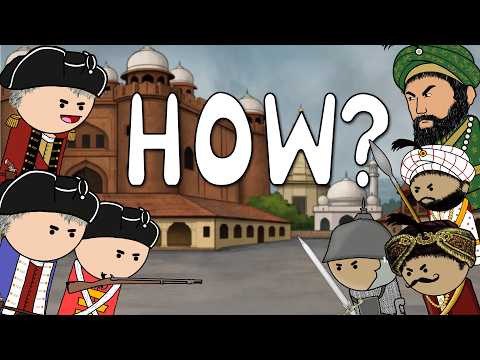
[0:00]India, a land of incredible wealth, vibrant cultures, and seriously good spices. Yummers! For centuries, everyone wanted a piece of it, but no one wanted a piece quite as aggressively as The British. Picture this: it's the year 1600. The Brits are obsessed with spices, textiles, and all the cool stuff India has to offer. But getting it is a pain. You have to sail all the way around Africa. Super inconvenient, and extremely expensive for the government to conduct these trade expeditions. So a bunch of rich guys got together and were like, "Who needs the government? We're rich!" Exactly! We'll create our own private company to trade. And so it was, they got together, pooled their cash and formed the East India Company. Hey, we want to trade spices and textiles from the East. No way, the crown can't afford that! Now, who said anything about the crown? We will pay with our own money!
[1:00]And we'll even pay you a whole lot of taxes. And Queen Elizabeth I was totally on board. The company initially targeted the Spice Islands in Indonesia, but the Dutch already established power and influence there, so their focus shifted towards India. And in 1608, they arrived at Surat and traveled all the way inland to Agra to meet the Mughal Emperor, Jahangir. We want trading rights in the West. No, the Portuguese are already there. So what? Get out! So they went east, where Mughal influence was less. After four years, they came back, wrecked a bunch of Portuguese ships, gave the emperor lots of gifts, and got their trading rights. Yeah, boy. So initially, the EIC was just a trading company. They set up factories along the coast, which were more like fortified warehouses. Their initial goal? Trade. Spices, cotton, silk, all that good stuff. And maybe build a few forts for protection, you understand. Don't worry about that, mate. It's just for protection. But here's the thing about just trading: it quickly becomes We need to protect our trade routes! Which becomes, "We need our own private army!" Okay. Which quickly spirals into, "Let's just take over everything!" They saw the Mughal Empire, which was the most powerful state in the world at the time, and thought, "We can take them!" Sir Josiah Child ordered the EIC forces to try and conquer Mughal ports. Imagine a tiny chihuahua trying to mug a fully grown armored bear. That's what this was. The resulting conflict, known as the Child's War, was less of a war and more of a total humiliating annihilation. The Mughals seized the EIC's assets, blockaded their ports, and sent the little company packing. The EIC was completely defeated, utterly bankrupt, and their officials were begging for mercy. The emperor forgave them after imposing a heavy fine and told them to behave like good boys in the future. The EIC swallowed their pride, paid the massive fine, and got back to trading. But the lesson stuck: Don't mess with the Mughals when they're strong. So, they decided to simply wait. And waiting was precisely what paid off. Because shortly after this little spat, the mighty Emperor Aurangzeb died in 1707. Suddenly, the central power was weak, and every regional governor, called a Nawab, started saying, "Hey, wait a minute. Maybe I should be in charge of my own place." This created the glorious messy situation the EIC had been waiting for. A power vacuum and widespread regional chaos. Now, instead of facing one massive empire, they faced dozens of squabbling smaller states. The EIC strategy instantly shifted from conquer to divide and profit. Suddenly, the company wasn't just trading. They were getting involved in local politics, siding with one prince against another, offering protection in exchange for trade concessions, or just outright land. They quickly realized that the Indian rulers, for all their wealth, were often disunited. The EIC was a master at playing Indian rulers against each other, and it went something like this: Your Highness, that guy over there seems to have a lot of cannons. Wouldn't it be a shame if you didn't have even more cannons? For a small fee and maybe a few trading concessions, my boys can help you out! The EIC became the ultimate hired muscle. They recruited Indians and trained them in European discipline and tactics. These men were called sepoys. They were better organized, better trained, and always backed the side that promised them the most tax revenue and land. The Nawab of Bengal started to notice this. He wasn't very amused by a foreign trading company acting like they owned his territory and refusing to pay proper taxes. So, you wanted to see us? You think I don't know about you guys not paying proper taxes? Yes. Pay your taxes or I will kick you out of my territory.
[5:13]So, in 1756, Siraj ud-Daulah marched his massive army on Calcutta and easily captured the fort. This incident included the infamous Black Hole of Calcutta, where many British prisoners were confined in a tiny, suffocating guard room. A shocking event that provided the EIC with the perfect emotional excuse for war. Robert Clive, an ambitious EIC officer, wanted revenge. But instead of fighting directly, he chose bribery. Clive secretly made a deal with Mir Jafar, Siraj ud-Daulah's commander-in-chief. Jafar wasn't exactly thrilled with his career, so Clive offered him a promotion: become Nawab of Bengal. In return, Jafar's army would not fight. At the Battle of Plassey, that's exactly what happened. Mir Jafar and his troops stood still. Siraj ud-Daulah's army, despite being much larger, was completely defeated. He was removed and later killed. Mir Jafar was installed as a puppet ruler. The East India Company now controlled Bengal, one of India's richest regions, and they milked it hard. With control came taxation. The EIC started collecting trade duties and land revenue, and they were ruthless about it. They needed money for their wars, their administration, and their massive profits and shareholders back home. This heavy taxation led to immense suffering, like the devastating Bengal Famine of 1770, which killed millions. The British Parliament eventually started to get a little nervous about this company that was basically running an empire. They tried to impose some reforms, but it was mostly about making sure the British government got a bigger slice of the pie. Not really about helping the Indian people. The East India Company kept expanding through conquest and subsidiary alliances. And it went something like this: "You don't need to pay and maintain your army anymore. We will protect you with our army instead." That's so cool! But what do I give you in return? Oh, nothing big! Just give us some money regularly. Oh, and if you don't, we will take a portion of your land. No big deal, we will call it an alliance! This made the rulers dependent on the EIC for any sort of protection. The company also fought major wars against Indian powers. In the south, they defeated Mysore under Tipu Sultan. In central India, they defeated the Marathas. Each victory brought more territory, resources, and control. They also expanded through annexation. If a ruler died without a male heir, they'd often declare the state lapsed and just take it. If a state was misgoverned by their standards, of course, they'd take it. Basically, if you had something they wanted, they'd find a reason to take it. This one's got good cotton. Let's say their ruler has poor administrative hygiene. That usually works. By the early 19th century, the company controlled a vast swath of India. Its power was enormous, and they made a ton of profit, often at the expense of Indian industries and resources, including traditional hand-woven textiles. The East India Company's policies: heavy taxation, land confiscations, and constant expansion created deep resentment. The breaking point came in 1857 with the Indian Rebellion, often called the Sepoy Mutiny. The immediate spark was the greased rifle cartridges, rumored to contain animal fat offensive to both Hindu and Muslim sepoys. You want us to bite these cartridges open? Yes, how else are you gonna load your rifles? But this is greased with cow and pig fat! Our religion forbids that! I missed the part where that's my problem. This was the final straw. Mangal Pandey, a sepoy, famously defied orders. His defiance became a powerful symbol of resistance, and the rebellion spread like wildfire across northern India. Delhi, Kanpur, Lucknow, key cities became battlegrounds. Indian princes, dispossessed landowners, and ordinary people joined the fight against the company. It was brutal on both sides. Massacres, sieges, desperate fighting. The British eventually managed to crush the rebellion, but it was a close call. They realized that the company was no longer fit to rule directly. It was too corrupt, too insensitive, and too prone to triggering massive uprisings. The British government finally said, "Alright, this is too much. You guys almost lost us an entire subcontinent!" So in 1858, the East India Company was formally dissolved. The British government took direct control of India, beginning the British Raj. Like and subscribe for part 2!


