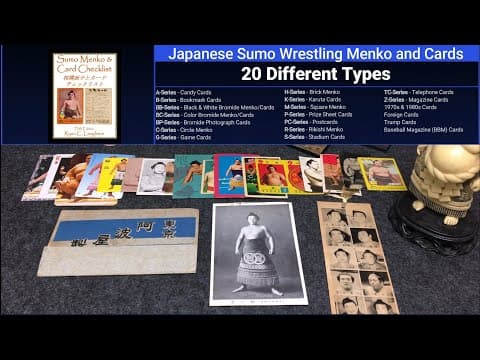
[0:20]Genki genki fellow Sumo card collectors. I hope everybody's having a great weekend. Um things are uh getting pretty interesting over in Japan as far as this uh March tournament. A lot of Riki actually have uh COVID, so it'd be interesting to see which ones actually still compete, who might be Qjo and uh and and really if if we are going to have a tournament. I've heard rumors out there we might not. Uh but I think uh at least most of the Riki will be nice and healthy by time the tournament start. So hopefully that's the case. But uh but certainly getting excited for uh for that. I do have fantasy sumo card game cards coming in the mail here this week, hopefully on Monday and I'll get those out this uh this following weekend. Pretty excited about that and I'll get more information on our channel, the BBM Sumo card collectors group on Facebook. If you're interested in that, just time in. Take a look. Uh we might have a a slot or two still open for those interested. Okay. Well, today, I wanted to give everybody an overview of uh Sumo cards. Really the top, not top, really the 20 sumo card types that are out there. Uh I just recently released my fifth edition of the book, um Sumo, Menko and Card checklist, which, which has all 20 of these described in there. It's 16 series give them, they're really kind of a type, if you will, and I'll I'll explain that in a little bit, but uh, but really there are 20 different kinds of sumo Menko and cards that are out there.
[2:15]So and and really they're in order of how I present them in my book.
[2:24]Um So, not any particular order, really, other than just kind of alphabetical by the the Roman characters. Um so, that's that's really how I'm going to present them today. Uh and so, hopefully, that makes sense to everybody and uh and hopefully, everybody enjoys the video. Without further ado, let's go ahead and step into the first one. First series of cards that we have are A series cards or candy cards. And these are cards that were issued in gum packs, candy packs, or anything that was just associated with candy and distribution. So here we have the A602 set. This is the 1960 Kabaya candy. This is Sakiwaki Anyama, and so you can see here, issued by Kabaya, which was a candy manufacturer or confectioner in Japan. Popular uh in the, I believe, probably from 40s, maybe even a little bit earlier, all the way up through the 60s and and through the early 70s. So, you can see here, um you what you'd do for this particular set, you would, um you would redeem them. Um you've got numbers on the front, uh you can see a 100 here, but you would collect so many of them and if you've got uh the top prize, right, uh I can't quite read what that says, but you would redeem them for that prize. So, these are actually really hard to find any A series cards, just because uh a lot of them were deemed uh or destroyed. uh all along the way of collecting. So, um, yeah, uh again, a very difficult set to find. Um and certainly a very difficult series to find. So, if you find any of these, uh certainly pick them up. The next series I have are B series cards or these are really bookmark cards. I've only been able to catalog a few of them. Um very difficult. Again, I don't think very popular, so there's just a few made, at least as far as I could tell. This here is the B562 or the 1956 Shiori Series 2 set. There was a two series in 1956. This being the second one. Uh there was photographs of each of the Riki, Sakiwatori, on the bookmarks. Um and then the third bookmark actually had a Dohyoiri of the of the Fuyozen at the time. But you can see here, you got Matsunobori, Wakano Hana, um Asashio, uh Tokitsu Yama. So, uh I've I've cataloged these. Um in again, in the book as the B series. Again, I think I've only seen about four or five of them, so, um if you can find any, uh certainly pick those up as well. The next series is the BB series. These are black and white Bromide Menko and cards. So this is where you start blending, um styles, was in the uh in the 1950s where you started blending Bromide with Menko to get these Bromide Menko cards. They used the halftone printing process on the front. So again, it wasn't a silver Bromide process, as I'll explain here in just a minute. But then if it blended that with the Menko style. You can see Guchokipa or uh, Rocks or paper. You've got the fighting number on the bottom and just stylistically Menko. So, these are black and white Bromide, uh more popular in the 1950s. This one happens to be the BB574 or 19 uh 57 Maru Ichishi Sagari 7 black and white set. This is Yokozuna Kagami Sato here, card number um 2514000. And so, this is a very difficult set to find, but you can see, uh about the little bit about smaller than the size of a regular card. Um but uh but printed on thin paper stock. You can see bend here, but we're were used to play Menko and so that's why we've categorized them as the Bromide, black and white Bromide Menko and cards. Okay and similarly, we have the color Bromide Menko and cards. Uh just as you saw with the black and white Bromide Menko and cards. This is the BC series. Uh this is uh this is a representative of this series. Um this is the BC591-1 set. So, the 1959 Maruya Kimari 6 set type 1. So, these are the ones with the gray paper stock on the back and green ink. There are several different versions of this and types. There's some with a brown ink on the back and some with a tan paper stock. So I've been able to type three different variations of this set. This is a Mayagashida Kashiwato, future Yokozuna in the 1960s. And so, again, um you start to blend uh the styles of Bromide onto Menko and you get these Bromide Menko and cards. Uh series. And you can see the Guchokipa, you've got the Kimarite here in the middle and then you've got the fighting number at the bottom. Very popular. This is the most common series of Menko out there, so pretty easy to find all all sorts of sets from this series.
[7:33]Okay, next we have the BP series of cards. These are the Silver Bromide Photograph cards.
[7:46]And uh these were actually photographs printed on card stock, uh period or photographic uh card stock. And then they were not meant to play any games but they were really uh meant to collect, uh put in scrapbooks, put in photo albums and really uh really collect. Very popular in the 1940s. Extremely popular, in fact, they were the dominant form of of cards in the 19 uh 1940s.
[8:14]And these are printed using the silver Bromide photograph property where you would you would expose silver Bromide on photographic paper, you'd get your image, then you would freeze that from any further, um really, um exposure. And then you would wash away that that uh Bromide leaving really the silver on the paper. And you can see here, uh you know, it reflects and you can see that the the black areas are really actually just dark silver exposed on the paper. And most of these are blank backed. Um but uh but this is a very common representative set here with the BP422 or 1942, four column full name Bromide set. You can see the four columns of statistics, full name. You've got the full Shikona here. Uh and then this happens to be as everybody probably recognize is uh Yokozuna Futabayama. And so, very popular. You're going to see hundreds and hundreds of these in the 1940s, dozens and dozens of different sets. In fact, there's so many of them, I haven't even been able to catalog them all. Very difficult to catalog, as you can tell, with a having a blank back. So, but but really a fun set to collect and you get some great images of of Riki from the 1940s.
[16:09]A unique uh card. These are Prize cards, prize sheet cards. They were only issued on prize sheets. And so, as you win, um a prize from a regular Menko, you would go to the prize sheet and you get to choose a a free prize card. So, these were meant, again, not issued in packs or tobacco packs or boxes. They were issued strictly on a prize sheet. This happens to be the P571, um set or the 1957 Madukami prize cards. You got Mayagashi Danayamo. So, again, these are these are categorized as P series cards and you'll see that in the upper left hand corner. What you're looking for for these, again, printed on pretty thin paper, but what you're looking for is is these. Somewhere where the um the glue stuck to the card and then to the price sheet. So, that'll pretty much tell you if you've got a prize card here. Um so, many of these are still easy to find. Um And again, because it they they were meant to be collected really, not meant to be used in the game or at all. Very similar to the BP series where you're meant to collect them and put them in albums. Very similar what you would do with these prize cards because they were a little bit bigger um than a regular Menko. So, there you go. Those are P series cards. Very uh, I guess, common and should be recognizable. PC series cards or postcard series. Very popular in the 20s and 30s were postcards to issue pictures of your favorite wrestler. Um to again, should be very recognizable. Many of them will say postcard and and they'll be recognized as as a postcard. A place for a stamp, you can see here. Um This one, obviously, unused. Many of them are black and white, but you do on occasion get colored ones. Those are pretty cool. This happens to be the PC361 set or 1936 Saikado Postcard set. This is a Judyo Sachin Sato. And um, uh these are pretty common. Actually, kind of expensive, you know, you're going to pay five to ten bucks per card, per postcard, uh at auction. But they are actually fairly common. If you go on any auction site, you're going to see dozens of different kinds of postcards on them. I haven't dove into these a lot in my book. You know, on occasion, I'll pick them up if they're a good price. But just because they are pretty spendy, they are still pretty popular. I haven't been able to categorize or catalog a lot of them. But um, but uh, yeah, just the die cut. Uh really makes these extremely unique.
[19:40]You can see here on the back, you've got uh typical Menko. You've got your Shikona in the middle. This one doesn't have the Guchokipa mark, but you've got the fighting number, you've got the fighting, you've got the rank, you've got height and weight. You've got um fighting words on the left there. So just a really cool uh R series. Uh never passes up if you can find them, especially from the 1930s. So there you go, R series. Okay, how's everybody doing out there? Hopefully, you're sticking with me. Just a few more to go through. But the next one I wanted to highlight is R series. Everybody loves the R series, and you'll see why here in just a second. Uh you can see these are the die cut uh in the shape of the uh the Sumo wrestler and very unique. Everybody loves R series or Riki series Menko. Um This one happens to be from 1939. It's the R392 set or the 1939 Riki 45 set. Type 1. This even happens to have purple ink on the back. I think there's one that has a blue ink on the back. So, this is the R392-1 set. This happens to be Myagashida Rogoku. Um but again, uh these were extremely popular in the 30s and 40s and into the 50s. And again, uh not difficult to find. Certainly some of the older ones are more difficult to find, but um, but uh, yeah, just the die cut uh really makes these extremely unique. You can see here on the back, you've got uh typical Menko. You've got your Shikona in the middle. This one doesn't have the Guchokipa mark, but you've got the fighting number, you've got the fighting, you've got the rank, you've got height and weight. You've got um fighting words on the left there. So, just a really cool uh R series. Uh never passes up if you can find them, especially from the 1930s. So, there you go, R series.
[21:39]Okay. How's everybody doing out there? Hopefully, you're sticking with me. Just a few more to go through. But the next one I wanted to highlight is R series. Everybody loves the R series, and you'll see why here in just a second. Uh you can see these are the die cut uh in the shape of the uh the Sumo wrestler and very unique. Everybody loves R series or Riki series Menko. Um This one happens to be from 1939. It's the R392 set or the 1939 Riki 45 set. Type 1. This even happens to have purple ink on the back. I think there's one that has a blue ink on the back. So, this is the R392-1 set. This happens to be Myagashida Rogoku. Um but again, uh these were extremely popular in the 30s and 40s and into the 50s. And again, uh not difficult to find. Certainly some of the older ones are more difficult to find, but um, but uh, yeah, just the die cut uh really makes these extremely unique. You can see here on the back, you've got uh typical Menko. You've got your Shikona in the middle. This one doesn't have the Guchokipa mark, but you've got the fighting number, you've got the fighting, you've got the rank, you've got height and weight. You've got um fighting words on the left there. So, just a really cool uh R series. Uh never passes up if you can find them, especially from the 1930s. So, there you go, R series.
[23:13]Okay. How's everybody doing out there? Hopefully, you're sticking with me. Just a few more to go through. But the next one I wanted to highlight is R series. Everybody loves the R series, and you'll see why here in just a second. Uh you can see these are the die cut uh in the shape of the uh the Sumo wrestler and very unique. Everybody loves R series or Riki series Menko. Um This one happens to be from 1939. It's the R392 set or the 1939 Riki 45 set. Type 1. This even happens to have purple ink on the back. I think there's one that has a blue ink on the back. So, this is the R392-1 set. This happens to be Myagashida Rogoku. Um but again, uh these were extremely popular in the 30s and 40s and into the 50s. And again, uh not difficult to find. Certainly some of the older ones are more difficult to find, but um, but uh, yeah, just the die cut uh really makes these extremely unique. You can see here on the back, you've got uh typical Menko. You've got your Shikona in the middle. This one doesn't have the Guchokipa mark, but you've got the fighting number, you've got the fighting, you've got the rank, you've got height and weight. You've got um fighting words on the left there. So, just a really cool uh R series. Uh never passes up if you can find them, especially from the 1930s. So, there you go, R series.
[24:47]Okay. How's everybody doing out there? Hopefully, you're sticking with me. Just a few more to go through. But the next one I wanted to highlight is R series. Everybody loves the R series, and you'll see why here in just a second. Uh you can see these are the die cut uh in the shape of the uh the Sumo wrestler and very unique. Everybody loves R series or Riki series Menko. Um This one happens to be from 1939. It's the R392 set or the 1939 Riki 45 set. Type 1. This even happens to have purple ink on the back. I think there's one that has a blue ink on the back. So, this is the R392-1 set. This happens to be Myagashida Rogoku. Um but again, uh these were extremely popular in the 30s and 40s and into the 50s. And again, uh not difficult to find. Certainly some of the older ones are more difficult to find, but um, but uh, yeah, just the die cut uh really makes these extremely unique. You can see here on the back, you've got uh typical Menko. You've got your Shikona in the middle. This one doesn't have the Guchokipa mark, but you've got the fighting number, you've got the fighting, you've got the rank, you've got height and weight. You've got um fighting words on the left there. So, just a really cool uh R series. Uh never passes up if you can find them, especially from the 1930s. So, there you go, R series.
[26:25]Okay. How's everybody doing out there? Hopefully, you're sticking with me. Just a few more to go through. But the next one I wanted to highlight is R series. Everybody loves the R series, and you'll see why here in just a second. Uh you can see these are the die cut uh in the shape of the uh the Sumo wrestler and very unique. Everybody loves R series or Riki series Menko. Um This one happens to be from 1939. It's the R392 set or the 1939 Riki 45 set. Type 1. This even happens to have purple ink on the back. I think there's one that has a blue ink on the back. So, this is the R392-1 set. This happens to be Myagashida Rogoku. Um but again, uh these were extremely popular in the 30s and 40s and into the 50s. And again, uh not difficult to find. Certainly some of the older ones are more difficult to find, but um, but uh, yeah, just the die cut uh really makes these extremely unique. You can see here on the back, you've got uh typical Menko. You've got your Shikona in the middle. This one doesn't have the Guchokipa mark, but you've got the fighting number, you've got the fighting, you've got the rank, you've got height and weight. You've got um fighting words on the left there. So, just a really cool uh R series. Uh never passes up if you can find them, especially from the 1930s. So, there you go, R series.
[28:03]Okay. How's everybody doing out there? Hopefully, you're sticking with me. Just a few more to go through. But the next one I wanted to highlight is R series. Everybody loves the R series, and you'll see why here in just a second. Uh you can see these are the die cut uh in the shape of the uh the Sumo wrestler and very unique. Everybody loves R series or Riki series Menko. Um This one happens to be from 1939. It's the R392 set or the 1939 Riki 45 set. Type 1. This even happens to have purple ink on the back. I think there's one that has a blue ink on the back. So, this is the R392-1 set. This happens to be Myagashida Rogoku. Um but again, uh these were extremely popular in the 30s and 40s and into the 50s. And again, uh not difficult to find. Certainly some of the older ones are more difficult to find, but um, but uh, yeah, just the die cut uh really makes these extremely unique. You can see here on the back, you've got uh typical Menko. You've got your Shikona in the middle. This one doesn't have the Guchokipa mark, but you've got the fighting number, you've got the fighting, you've got the rank, you've got height and weight. You've got um fighting words on the left there. So, just a really cool uh R series. Uh never passes up if you can find them, especially from the 1930s. So, there you go, R series.
[29:42]Okay. How's everybody doing out there? Hopefully, you're sticking with me. Just a few more to go through. But the next one I wanted to highlight is R series. Everybody loves the R series, and you'll see why here in just a second. Uh you can see these are the die cut uh in the shape of the uh the Sumo wrestler and very unique. Everybody loves R series or Riki series Menko. Um This one happens to be from 1939. It's the R392 set or the 1939 Riki 45 set. Type 1. This even happens to have purple ink on the back. I think there's one that has a blue ink on the back. So, this is the R392-1 set. This happens to be Myagashida Rogoku. Um but again, uh these were extremely popular in the 30s and 40s and into the 50s. And again, uh not difficult to find. Certainly some of the older ones are more difficult to find, but um, but uh, yeah, just the die cut uh really makes these extremely unique. You can see here on the back, you've got uh typical Menko. You've got your Shikona in the middle. This one doesn't have the Guchokipa mark, but you've got the fighting number, you've got the fighting, you've got the rank, you've got height and weight. You've got um fighting words on the left there. So, just a really cool uh R series. Uh never passes up if you can find them, especially from the 1930s. So, there you go, R series.
[31:20]Okay. How's everybody doing out there? Hopefully, you're sticking with me. Just a few more to go through. But the next one I wanted to highlight is R series. Everybody loves the R series, and you'll see why here in just a second. Uh you can see these are the die cut uh in the shape of the uh the Sumo wrestler and very unique. Everybody loves R series or Riki series Menko. Um This one happens to be from 1939. It's the R392 set or the 1939 Riki 45 set. Type 1. This even happens to have purple ink on the back. I think there's one that has a blue ink on the back. So, this is the R392-1 set. This happens to be Myagashida Rogoku. Um but again, uh these were extremely popular in the 30s and 40s and into the 50s. And again, uh not difficult to find. Certainly some of the older ones are more difficult to find, but um, but uh, yeah, just the die cut uh really makes these extremely unique. You can see here on the back, you've got uh typical Menko. You've got your Shikona in the middle. This one doesn't have the Guchokipa mark, but you've got the fighting number, you've got the fighting, you've got the rank, you've got height and weight. You've got um fighting words on the left there. So, just a really cool uh R series. Uh never passes up if you can find them, especially from the 1930s. So, there you go, R series.
[32:58]Okay. How's everybody doing out there? Hopefully, you're sticking with me. Just a few more to go through. But the next one I wanted to highlight is R series. Everybody loves the R series, and you'll see why here in just a second. Uh you can see these are the die cut uh in the shape of the uh the Sumo wrestler and very unique. Everybody loves R series or Riki series Menko. Um This one happens to be from 1939. It's the R392 set or the 1939 Riki 45 set. Type 1. This even happens to have purple ink on the back. I think there's one that has a blue ink on the back. So, this is the R392-1 set. This happens to be Myagashida Rogoku. Um but again, uh these were extremely popular in the 30s and 40s and into the 50s. And again, uh not difficult to find. Certainly some of the older ones are more difficult to find, but um, but uh, yeah, just the die cut uh really makes these extremely unique. You can see here on the back, you've got uh typical Menko. You've got your Shikona in the middle. This one doesn't have the Guchokipa mark, but you've got the fighting number, you've got the fighting, you've got the rank, you've got height and weight. You've got um fighting words on the left there. So, just a really cool uh R series. Uh never passes up if you can find them, especially from the 1930s. So, there you go, R series.
[34:36]Okay. How's everybody doing out there? Hopefully, you're sticking with me. Just a few more to go through. But the next one I wanted to highlight is R series. Everybody loves the R series, and you'll see why here in just a second. Uh you can see these are the die cut uh in the shape of the uh the Sumo wrestler and very unique. Everybody loves R series or Riki series Menko. Um This one happens to be from 1939. It's the R392 set or the 1939 Riki 45 set. Type 1. This even happens to have purple ink on the back. I think there's one that has a blue ink on the back. So, this is the R392-1 set. This happens to be Myagashida Rogoku. Um but again, uh these were extremely popular in the 30s and 40s and into the 50s. And again, uh not difficult to find. Certainly some of the older ones are more difficult to find, but um, but uh, yeah, just the die cut uh really makes these extremely unique. You can see here on the back, you've got uh typical Menko. You've got your Shikona in the middle. This one doesn't have the Guchokipa mark, but you've got the fighting number, you've got the fighting, you've got the rank, you've got height and weight. You've got um fighting words on the left there. So, just a really cool uh R series. Uh never passes up if you can find them, especially from the 1930s. So, there you go, R series.
[36:14]Okay. How's everybody doing out there? Hopefully, you're sticking with me. Just a few more to go through. But the next one I wanted to highlight is R series. Everybody loves the R series, and you'll see why here in just a second. Uh you can see these are the die cut uh in the shape of the uh the Sumo wrestler and very unique. Everybody loves R series or Riki series Menko. Um This one happens to be from 1939. It's the R392 set or the 1939 Riki 45 set. Type 1. This even happens to have purple ink on the back. I think there's one that has a blue ink on the back. So, this is the R392-1 set. This happens to be Myagashida Rogoku. Um but again, uh these were extremely popular in the 30s and 40s and into the 50s. And again, uh not difficult to find. Certainly some of the older ones are more difficult to find, but um, but uh, yeah, just the die cut uh really makes these extremely unique. You can see here on the back, you've got uh typical Menko. You've got your Shikona in the middle. This one doesn't have the Guchokipa mark, but you've got the fighting number, you've got the fighting, you've got the rank, you've got height and weight. You've got um fighting words on the left there. So, just a really cool uh R series. Uh never passes up if you can find them, especially from the 1930s. So, there you go, R series.
[37:52]Okay. How's everybody doing out there? Hopefully, you're sticking with me. Just a few more to go through. But the next one I wanted to highlight is R series. Everybody loves the R series, and you'll see why here in just a second. Uh you can see these are the die cut uh in the shape of the uh the Sumo wrestler and very unique. Everybody loves R series or Riki series Menko. Um This one happens to be from 1939. It's the R392 set or the 1939 Riki 45 set. Type 1. This even happens to have purple ink on the back. I think there's one that has a blue ink on the back. So, this is the R392-1 set. This happens to be Myagashida Rogoku. Um but again, uh these were extremely popular in the 30s and 40s and into the 50s. And again, uh not difficult to find. Certainly some of the older ones are more difficult to find, but um, but uh, yeah, just the die cut uh really makes these extremely unique. You can see here on the back, you've got uh typical Menko. You've got your Shikona in the middle. This one doesn't have the Guchokipa mark, but you've got the fighting number, you've got the fighting, you've got the rank, you've got height and weight. You've got um fighting words on the left there. So, just a really cool uh R series. Uh never passes up if you can find them, especially from the 1930s. So, there you go, R series.
[39:30]Okay. How's everybody doing out there? Hopefully, you're sticking with me. Just a few more to go through. But the next one I wanted to highlight is R series. Everybody loves the R series, and you'll see why here in just a second. Uh you can see these are the die cut uh in the shape of the uh the Sumo wrestler and very unique. Everybody loves R series or Riki series Menko. Um This one happens to be from 1939. It's the R392 set or the 1939 Riki 45 set. Type 1. This even happens to have purple ink on the back. I think there's one that has a blue ink on the back. So, this is the R392-1 set. This happens to be Myagashida Rogoku. Um but again, uh these were extremely popular in the 30s and 40s and into the 50s. And again, uh not difficult to find. Certainly some of the older ones are more difficult to find, but um, but uh, yeah, just the die cut uh really makes these extremely unique. You can see here on the back, you've got uh typical Menko. You've got your Shikona in the middle. This one doesn't have the Guchokipa mark, but you've got the fighting number, you've got the fighting, you've got the rank, you've got height and weight. You've got um fighting words on the left there. So, just a really cool uh R series. Uh never passes up if you can find them, especially from the 1930s. So, there you go, R series.
[41:08]Okay. How's everybody doing out there? Hopefully, you're sticking with me. Just a few more to go through. But the next one I wanted to highlight is R series. Everybody loves the R series, and you'll see why here in just a second. Uh you can see these are the die cut uh in the shape of the uh the Sumo wrestler and very unique. Everybody loves R series or Riki series Menko. Um This one happens to be from 1939. It's the R392 set or the 1939 Riki 45 set. Type 1. This even happens to have purple ink on the back. I think there's one that has a blue ink on the back. So, this is the R392-1 set. This happens to be Myagashida Rogoku. Um but again, uh these were extremely popular in the 30s and 40s and into the 50s. And again, uh not difficult to find. Certainly some of the older ones are more difficult to find, but um, but uh, yeah, just the die cut uh really makes these extremely unique. You can see here on the back, you've got uh typical Menko. You've got your Shikona in the middle. This one doesn't have the Guchokipa mark, but you've got the fighting number, you've got the fighting, you've got the rank, you've got height and weight. You've got um fighting words on the left there. So, just a really cool uh R series. Uh never passes up if you can find them, especially from the 1930s. So, there you go, R series.
[42:46]Okay. How's everybody doing out there? Hopefully, you're sticking with me. Just a few more to go through. But the next one I wanted to highlight is R series. Everybody loves the R series, and you'll see why here in just a second. Uh you can see these are the die cut uh in the shape of the uh the Sumo wrestler and very unique. Everybody loves R series or Riki series Menko. Um This one happens to be from 1939. It's the R392 set or the 1939 Riki 45 set. Type 1. This even happens to have purple ink on the back. I think there's one that has a blue ink on the back. So, this is the R392-1 set. This happens to be Myagashida Rogoku. Um but again, uh these were extremely popular in the 30s and 40s and into the 50s. And again, uh not difficult to find. Certainly some of the older ones are more difficult to find, but um, but uh, yeah, just the die cut uh really makes these extremely unique. You can see here on the back, you've got uh typical Menko. You've got your Shikona in the middle. This one doesn't have the Guchokipa mark, but you've got the fighting number, you've got the fighting, you've got the rank, you've got height and weight. You've got um fighting words on the left there. So, just a really cool uh R series. Uh never passes up if you can find them, especially from the 1930s. So, there you go, R series.
[44:24]Okay. How's everybody doing out there? Hopefully, you're sticking with me. Just a few more to go through. But the next one I wanted to highlight is R series. Everybody loves the R series, and you'll see why here in just a second. Uh you can see these are the die cut uh in the shape of the uh the Sumo wrestler and very unique. Everybody loves R series or Riki series Menko. Um This one happens to be from 1939. It's the R392 set or the 1939 Riki 45 set. Type 1. This even happens to have purple ink on the back. I think there's one that has a blue ink on the back. So, this is the R392-1 set. This happens to be Myagashida Rogoku. Um but again, uh these were extremely popular in the 30s and 40s and into the 50s. And again, uh not difficult to find. Certainly some of the older ones are more difficult to find, but um, but uh, yeah, just the die cut uh really makes these extremely unique. You can see here on the back, you've got uh typical Menko. You've got your Shikona in the middle. This one doesn't have the Guchokipa mark, but you've got the fighting number, you've got the fighting, you've got the rank, you've got height and weight. You've got um fighting words on the left there. So, just a really cool uh R series. Uh never passes up if you can find them, especially from the 1930s. So, there you go, R series.
[46:02]Okay. How's everybody doing out there? Hopefully, you're sticking with me. Just a few more to go through. But the next one I wanted to highlight is R series. Everybody loves the R series, and you'll see why here in just a second. Uh you can see these are the die cut uh in the shape of the uh the Sumo wrestler and very unique. Everybody loves R series or Riki series Menko. Um This one happens to be from 1939. It's the R392 set or the 1939 Riki 45 set. Type 1. This even happens to have purple ink on the back. I think there's one that has a blue ink on the back. So, this is the R392-1 set. This happens to be Myagashida Rogoku. Um but again, uh these were extremely popular in the 30s and 40s and into the 50s. And again, uh not difficult to find. Certainly some of the older ones are more difficult to find, but um, but uh, yeah, just the die cut uh really makes these extremely unique. You can see here on the back, you've got uh typical Menko. You've got your Shikona in the middle. This one doesn't have the Guchokipa mark, but you've got the fighting number, you've got the fighting, you've got the rank, you've got height and weight. You've got um fighting words on the left there. So, just a really cool uh R series. Uh never passes up if you can find them, especially from the 1930s. So, there you go, R series.
[47:40]Okay. How's everybody doing out there? Hopefully, you're sticking with me. Just a few more to go through. But the next one I wanted to highlight is R series. Everybody loves the R series, and you'll see why here in just a second. Uh you can see these are the die cut uh in the shape of the uh the Sumo wrestler and very unique. Everybody loves R series or Riki series Menko. Um This one happens to be from 1939. It's the R392 set or the 1939 Riki 45 set. Type 1. This even happens to have purple ink on the back. I think there's one that has a blue ink on the back. So, this is the R392-1 set. This happens to be Myagashida Rogoku. Um but again, uh these were extremely popular in the 30s and 40s and into the 50s. And again, uh not difficult to find. Certainly some of the older ones are more difficult to find, but um, but uh, yeah, just the die cut uh really makes these extremely unique. You can see here on the back, you've got uh typical Menko. You've got your Shikona in the middle. This one doesn't have the Guchokipa mark, but you've got the fighting number, you've got the fighting, you've got the rank, you've got height and weight. You've got um fighting words on the left there. So, just a really cool uh R series. Uh never passes up if you can find them, especially from the 1930s. So, there you go, R series.
[49:18]Okay. How's everybody doing out there? Hopefully, you're sticking with me. Just a few more to go through. But the next one I wanted to highlight is R series. Everybody loves the R series, and you'll see why here in just a second. Uh you can see these are the die cut uh in the shape of the uh the Sumo wrestler and very unique. Everybody loves R series or Riki series Menko. Um This one happens to be from 1939. It's the R392 set or the 1939 Riki 45 set. Type 1. This even happens to have purple ink on the back. I think there's one that has a blue ink on the back. So, this is the R392-1 set. This happens to be Myagashida Rogoku. Um but again, uh these were extremely popular in the 30s and 40s and into the 50s. And again, uh not difficult to find. Certainly some of the older ones are more difficult to find, but um, but uh, yeah, just the die cut uh really makes these extremely unique. You can see here on the back, you've got uh typical Menko. You've got your Shikona in the middle. This one doesn't have the Guchokipa mark, but you've got the fighting number, you've got the fighting, you've got the rank, you've got height and weight. You've got um fighting words on the left there. So, just a really cool uh R series. Uh never passes up if you can find them, especially from the 1930s. So, there you go, R series.
[50:56]Okay. How's everybody doing out there? Hopefully, you're sticking with me. Just a few more to go through. But the next one I wanted to highlight is R series. Everybody loves the R series, and you'll see why here in just a second. Uh you can see these are the die cut uh in the shape of the uh the Sumo wrestler and very unique. Everybody loves R series or Riki series Menko. Um This one happens to be from 1939. It's the R392 set or the 1939 Riki 45 set. Type 1. This even happens to have purple ink on the back. I think there's one that has a blue ink on the back. So, this is the R392-1 set. This happens to be Myagashida Rogoku. Um but again, uh these were extremely popular in the 30s and 40s and into the 50s. And again, uh not difficult to find. Certainly some of the older ones are more difficult to find, but um, but uh, yeah, just the die cut uh really makes these extremely unique. You can see here on the back, you've got uh typical Menko. You've got your Shikona in the middle. This one doesn't have the Guchokipa mark, but you've got the fighting number, you've got the fighting, you've got the rank, you've got height and weight. You've got um fighting words on the left there. So, just a really cool uh R series. Uh never passes up if you can find them, especially from the 1930s. So, there you go, R series.
[52:34]Okay. How's everybody doing out there? Hopefully, you're sticking with me. Just a few more to go through. But the next one I wanted to highlight is R series. Everybody loves the R series, and you'll see why here in just a second. Uh you can see these are the die cut uh in the shape of the uh the Sumo wrestler and very unique. Everybody loves R series or Riki series Menko. Um This one happens to be from 1939. It's the R392 set or the 1939 Riki 45 set. Type 1. This even happens to have purple ink on the back. I think there's one that has a blue ink on the back. So, this is the R392-1 set. This happens to be Myagashida Rogoku. Um but again, uh these were extremely popular in the 30s and 40s and into the 50s. And again, uh not difficult to find. Certainly some of the older ones are more difficult to find, but um, but uh, yeah, just the die cut uh really makes these extremely unique. You can see here on the back, you've got uh typical Menko. You've got your Shikona in the middle. This one doesn't have the Guchokipa mark, but you've got the fighting number, you've got the fighting, you've got the rank, you've got height and weight. You've got um fighting words on the left there. So, just a really cool uh R series. Uh never passes up if you can find them, especially from the 1930s. So, there you go, R series.
[54:12]Okay. How's everybody doing out there? Hopefully, you're sticking with me. Just a few more to go through. But the next one I wanted to highlight is R series. Everybody loves the R series, and you'll see why here in just a second. Uh you can see these are the die cut uh in the shape of the uh the Sumo wrestler and very unique. Everybody loves R series or Riki series Menko. Um This one happens to be from 1939. It's the R392 set or the 1939 Riki 45 set. Type 1. This even happens to have purple ink on the back. I think there's one that has a blue ink on the back. So, this is the R392-1 set. This happens to be Myagashida Rogoku. Um but again, uh these were extremely popular in the 30s and 40s and into the 50s. And again, uh not difficult to find. Certainly some of the older ones are more difficult to find, but um, but uh, yeah, just the die cut uh really makes these extremely unique. You can see here on the back, you've got uh typical Menko. You've got your Shikona in the middle. This one doesn't have the Guchokipa mark, but you've got the fighting number, you've got the fighting, you've got the rank, you've got height and weight. You've got um fighting words on the left there. So, just a really cool uh R series. Uh never passes up if you can find them, especially from the 1930s. So, there you go, R series.
[55:50]Okay. How's everybody doing out there? Hopefully, you're sticking with me. Just a few more to go through. But the next one I wanted to highlight is R series. Everybody loves the R series, and you'll see why here in just a second. Uh you can see these are the die cut uh in the shape of the uh the Sumo wrestler and very unique. Everybody loves R series or Riki series Menko. Um This one happens to be from 1939. It's the R392 set or the 1939 Riki 45 set. Type 1. This even happens to have purple ink on the back. I think there's one that has a blue ink on the back. So, this is the R392-1 set. This happens to be Myagashida Rogoku. Um but again, uh these were extremely popular in the 30s and 40s and into the 50s. And again, uh not difficult to find. Certainly some of the older ones are more difficult to find, but um, but uh, yeah, just the die cut uh really makes these extremely unique. You can see here on the back, you've got uh typical Menko. You've got your Shikona in the middle. This one doesn't have the Guchokipa mark, but you've got the fighting number, you've got the fighting, you've got the rank, you've got height and weight. You've got um fighting words on the left there. So, just a really cool uh R series. Uh never passes up if you can find them, especially from the 1930s. So, there you go, R series.
[57:28]Okay. How's everybody doing out there? Hopefully, you're sticking with me. Just a few more to go through. But the next one I wanted to highlight is R series. Everybody loves the R series, and you'll see why here in just a second. Uh you can see these are the die cut uh in the shape of the uh the Sumo wrestler and very unique. Everybody loves R series or Riki series Menko. Um This one happens to be from 1939. It's the R392 set or the 1939 Riki 45 set. Type 1. This even happens to have purple ink on the back. I think there's one that has a blue ink on the back. So, this is the R392-1 set. This happens to be Myagashida Rogoku. Um but again, uh these were extremely popular in the 30s and 40s and into the 50s. And again, uh not difficult to find. Certainly some of the older ones are more difficult to find, but um, but uh, yeah, just the die cut uh really makes these extremely unique. You can see here on the back, you've got uh typical Menko. You've got your Shikona in the middle. This one doesn't have the Guchokipa mark, but you've got the fighting number, you've got the fighting, you've got the rank, you've got height and weight. You've got um fighting words on the left there. So, just a really cool uh R series. Uh never passes up if you can find them, especially from the 1930s. So, there you go, R series.
[59:06]Okay. How's everybody doing out there? Hopefully, you're sticking with me. Just a few more to go through. But the next one I wanted to highlight is R series. Everybody loves the R series, and you'll see why here in just a second. Uh you can see these are the die cut uh in the shape of the uh the Sumo wrestler and very unique. Everybody loves R series or Riki series Menko. Um This one happens to be from 1939. It's the R392 set or the 1939 Riki 45 set. Type 1. This even happens to have purple ink on the back. I think there's one that has a blue ink on the back. So, this is the R392-1 set. This happens to be Myagashida Rogoku. Um but again, uh these were extremely popular in the 30s and 40s and into the 50s. And again, uh not difficult to find. Certainly some of the older ones are more difficult to find, but um, but uh, yeah, just the die cut uh really makes these extremely unique. You can see here on the back, you've got uh typical Menko. You've got your Shikona in the middle. This one doesn't have the Guchokipa mark, but you've got the fighting number, you've got the fighting, you've got the rank, you've got height and weight. You've got um fighting words on the left there. So, just a really cool uh R series. Uh never passes up if you can find them, especially from the 1930s. So, there you go, R series.
[1:00:44]Okay. How's everybody doing out there? Hopefully, you're sticking with me. Just a few more to go through. But the next one I wanted to highlight is R series. Everybody loves the R series, and you'll see why here in just a second. Uh you can see these are the die cut uh in the shape of the uh the Sumo wrestler and very unique. Everybody loves R series or Riki series Menko. Um This one happens to be from 1939. It's the R392 set or the 1939 Riki 45 set. Type 1. This even happens to have purple ink on the back. I think there's one that has a blue ink on the back. So, this is the R392-1 set. This happens to be Myagashida Rogoku. Um but again, uh these were extremely popular in the 30s and 40s and into the 50s. And again, uh not difficult to find. Certainly some of the older ones are more difficult to find, but um, but uh, yeah, just the die cut uh really makes these extremely unique. You can see here on the back, you've got uh typical Menko. You've got your Shikona in the middle. This one doesn't have the Guchokipa mark, but you've got the fighting number, you've got the fighting, you've got the rank, you've got height and weight. You've got um fighting words on the left there. So, just a really cool uh R series. Uh never passes up if you can find them, especially from the 1930s. So, there you go, R series.
[1:02:22]Okay. How's everybody doing out there? Hopefully, you're sticking with me. Just a few more to go through. But the next one I wanted to highlight is R series. Everybody loves the R series, and you'll see why here in just a second. Uh you can see these are the die cut uh in the shape of the uh the Sumo wrestler and very unique. Everybody loves R series or Riki series Menko. Um This one happens to be from 1939. It's the R392 set or the 1939 Riki 45 set. Type 1. This even happens to have purple ink on the back. I think there's one that has a blue ink on the back. So, this is the R392-1 set. This happens to be Myagashida Rogoku. Um but again, uh these were extremely popular in the 30s and 40s and into the 50s. And again, uh not difficult to find. Certainly some of the older ones are more difficult to find, but um, but uh, yeah, just the die cut uh really makes these extremely unique. You can see here on the back, you've got uh typical Menko. You've got your Shikona in the middle. This one doesn't have the Guchokipa mark, but you've got the fighting number, you've got the fighting, you've got the rank, you've got height and weight. You've got um fighting words on the left there. So, just a really cool uh R series. Uh never passes up if you can find them, especially from the 1930s. So, there you go, R series.
[1:04:00]Okay. How's everybody doing out there? Hopefully, you're sticking with me. Just a few more to go through. But the next one I wanted to highlight is R series. Everybody loves the R series, and you'll see why here in just a second. Uh you can see these are the die cut uh in the shape of the uh the Sumo wrestler and very unique. Everybody loves R series or Riki series Menko. Um This one happens to be from 1939. It's the R392 set or the 1939 Riki 45 set. Type 1. This even happens to have purple ink on the back. I think there's one that has a blue ink on the back. So, this is the R392-1 set. This happens to be Myagashida Rogoku. Um but again, uh these were extremely popular in the 30s and 40s and into the 50s. And again, uh not difficult to find. Certainly some of the older ones are more difficult to find, but um, but uh, yeah, just the die cut uh really makes these extremely unique. You can see here on the back, you've got uh typical Menko. You've got your Shikona in the middle. This one doesn't have the Guchokipa mark, but you've got the fighting number, you've got the fighting, you've got the rank, you've got height and weight. You've got um fighting words on the left there. So, just a really cool uh R series. Uh never passes up if you can find them, especially from the 1930s. So, there you go, R series.
[1:05:38]Okay. How's everybody doing out there? Hopefully, you're sticking with me. Just a few more to go through. But the next one I wanted to highlight is R series. Everybody loves the R series, and you'll see why here in just a second. Uh you can see these are the die cut uh in the shape of the uh the Sumo wrestler and very unique. Everybody loves R series or Riki series Menko. Um This one happens to be from 1939. It's the R392 set or the 1939 Riki 45 set. Type 1. This even happens to have purple ink on the back. I think there's one that has a blue ink on the back. So, this is the R392-1 set. This happens to be Myagashida Rogoku. Um but again, uh these were extremely popular in the 30s and 40s and into the 50s. And again, uh not difficult to find. Certainly some of the older ones are more difficult to find, but um, but uh, yeah, just the die cut uh really makes these extremely unique. You can see here on the back, you've got uh typical Menko. You've got your Shikona in the middle. This one doesn't have the Guchokipa mark, but you've got the fighting number, you've got the fighting, you've got the rank, you've got height and weight. You've got um fighting words on the left there. So, just a really cool uh R series. Uh never passes up if you can find them, especially from the 1930s. So, there you go, R series.
[1:07:16]Okay. How's everybody doing out there? Hopefully, you're sticking with me. Just a few more to go through. But the next one I wanted to highlight is R series. Everybody loves the R series, and you'll see why here in just a second. Uh you can see these are the die cut uh in the shape of the uh the Sumo wrestler and very unique. Everybody loves R series or Riki series Menko. Um This one happens to be from 1939. It's the R392 set or the 1939 Riki 45 set. Type 1. This even happens to have purple ink on the back. I think there's one that has a blue ink on the back. So, this is the R392-1 set. This happens to be Myagashida Rogoku. Um but again, uh these were extremely popular in the 30s and 40s and into the 50s. And again, uh not difficult to find. Certainly some of the older ones are more difficult to find, but um, but uh, yeah, just the die cut uh really makes these extremely unique. You can see here on the back, you've got uh typical Menko. You've got your Shikona in the middle. This one doesn't have the Guchokipa mark, but you've got the fighting number, you've got the fighting, you've got the rank, you've got height and weight. You've got um fighting words on the left there. So, just a really cool uh R series. Uh never passes up if you can find them, especially from the 1930s. So, there you go, R series.
[1:08:54]Okay. How's everybody doing out there? Hopefully, you're sticking with me. Just a few more to go through. But the next one I wanted to highlight is R series. Everybody loves the R series, and you'll see why here in just a second. Uh you can see these are the die cut uh in the shape of the uh the Sumo wrestler and very unique. Everybody loves R series or Riki series Menko. Um This one happens to be from 1939. It's the R392 set or the 1939 Riki 45 set. Type 1. This even happens to have purple ink on the back. I think there's one that has a blue ink on the back. So, this is the R392-1 set. This happens to be Myagashida Rogoku. Um but again, uh these were extremely popular in the 30s and 40s and into the 50s. And again, uh not difficult to find. Certainly some of the older ones are more difficult to find, but um, but uh, yeah, just the die cut uh really makes these extremely unique. You can see here on the back, you've got uh typical Menko. You've got your Shikona in the middle. This one doesn't have the Guchokipa mark, but you've got the fighting number, you've got the fighting, you've got the rank, you've got height and weight. You've got um fighting words on the left there. So, just a really cool uh R series. Uh never passes up if you can find them, especially from the 1930s. So, there you go, R series.
[1:10:32]Okay. How's everybody doing out there? Hopefully, you're sticking with me. Just a few more to go through. But the next one I wanted to highlight is R series. Everybody loves the R series, and you'll see why here in just a second. Uh you can see these are the die cut uh in the shape of the uh the Sumo wrestler and very unique. Everybody loves R series or Riki series Menko. Um This one happens to be from 1939. It's the R392 set or the 1939 Riki 45 set. Type 1. This even happens to have purple ink on the back. I think there's one that has a blue ink on the back. So, this is the R392-1 set. This happens to be Myagashida Rogoku. Um but again, uh these were extremely popular in the 30s and 40s and into the 50s. And again, uh not difficult to find. Certainly some of the older ones are more difficult to find, but um, but uh, yeah, just the die cut uh really makes these extremely unique. You can see here on the back, you've got uh typical Menko. You've got your Shikona in the middle. This one doesn't have the Guchokipa mark, but you've got the fighting number, you've got the fighting, you've got the rank, you've got height and weight. You've got um fighting words on the left there. So, just a really cool uh R series. Uh never passes up if you can find them, especially from the 1930s. So, there you go, R series.
[1:12:10]Okay. How's everybody doing out there? Hopefully, you're sticking with me. Just a few more to go through. But the next one I wanted to highlight is R series. Everybody loves the R series, and you'll see why here in just a second. Uh you can see these are the die cut uh in the shape of the uh the Sumo wrestler and very unique. Everybody loves R series or Riki series Menko. Um This one happens to be from 1939. It's the R392 set or the 1939 Riki 45 set. Type 1. This even happens to have purple ink on the back. I think there's one that has a blue ink on the back. So, this is the R392-1 set. This happens to be Myagashida Rogoku. Um but again, uh these were extremely popular in the 30s and 40s and into the 50s. And again, uh not difficult to find. Certainly some of the older ones are more difficult to find, but um, but uh, yeah, just the die cut uh really makes these extremely unique. You can see here on the back, you've got uh typical Menko. You've got your Shikona in the middle. This one doesn't have the Guchokipa mark, but you've got the fighting number, you've got the fighting, you've got the rank, you've got height and weight. You've got um fighting words on the left there. So, just a really cool uh R series. Uh never passes up if you can find them, especially from the 1930s. So, there you go, R series.
[1:13:48]Okay. How's everybody doing out there? Hopefully, you're sticking with me. Just a few more to go through. But the next one I wanted to highlight is R series. Everybody loves the R series, and you'll see why here in just a second. Uh you can see these are the die cut uh in the shape of the uh the Sumo wrestler and very unique. Everybody loves R series or Riki series Menko. Um This one happens to be from 1939. It's the R392 set or the 1939 Riki 45 set. Type 1. This even happens to have purple ink on the back. I think there's one that has a blue ink on the back. So, this is the R392-1 set. This happens to be Myagashida Rogoku. Um but again, uh these were extremely popular in the 30s and 40s and into the 50s. And again, uh not difficult to find. Certainly some of the older ones are more difficult to find, but um, but uh, yeah, just the die cut uh really makes these extremely unique. You can see here on the back, you've got uh typical Menko. You've got your Shikona in the middle. This one doesn't have the Guchokipa mark, but you've got the fighting number, you've got the fighting, you've got the rank, you've got height and weight. You've got um fighting words on the left there. So, just a really cool uh R series. Uh never passes up if you can find them, especially from the 1930s. So, there you go, R series.
[1:15:26]Okay. How's everybody doing out there? Hopefully, you're sticking with me. Just a few more to go through. But the next one I wanted to highlight is R series. Everybody loves the R series, and you'll see why here in just a second. Uh you can see these are the die cut uh in the shape of the uh the Sumo wrestler and very unique. Everybody loves R series or Riki series Menko. Um This one happens to be from 1939. It's the R392 set or the 1939 Riki 45 set. Type 1. This even happens to have purple ink on the back. I think there's one that has a blue ink on the back. So, this is the R392-1 set. This happens to be Myagashida Rogoku. Um but again, uh these were extremely popular in the 30s and 40s and into the 50s. And again, uh not difficult to find. Certainly some of the older ones are more difficult to find, but um, but uh, yeah, just the die cut uh really makes these extremely unique. You can see here on the back, you've got uh typical Menko. You've got your Shikona in the middle. This one doesn't have the Guchokipa mark, but you've got the fighting number, you've got the fighting, you've got the rank, you've got height and weight. You've got um fighting words on the left there. So, just a really cool uh R series. Uh never passes up if you can find them, especially from the 1930s. So, there you go, R series.
[1:17:04]Okay. How's everybody doing out there? Hopefully, you're sticking with me. Just a few more to go through. But the next one I wanted to highlight is R series. Everybody loves the R series, and you'll see why here in just a second. Uh you can see these are the die cut uh in the shape of the uh the Sumo wrestler and very unique. Everybody loves R series or Riki series Menko. Um This one happens to be from 1939. It's the R392 set or the 1939 Riki 45 set. Type 1. This even happens to have purple ink on the back. I think there's one that has a blue ink on the back. So, this is the R392-1 set. This happens to be Myagashida Rogoku. Um but again, uh these were extremely popular in the 30s and 40s and into the 50s. And again, uh not difficult to find. Certainly some of the older ones are more difficult to find, but um, but uh, yeah, just the die cut uh really makes these extremely unique. You can see here on the back, you've got uh typical Menko. You've got your Shikona in the middle. This one doesn't have the Guchokipa mark, but you've got the fighting number, you've got the fighting, you've got the rank, you've got height and weight. You've got um fighting words on the left there. So, just a really cool uh R series. Uh never passes up if you can find them, especially from the 1930s. So, there you go, R series.
[1:18:42]Okay. How's everybody doing out there? Hopefully, you're sticking with me. Just a few more to go through. But the next one I wanted to highlight is R series. Everybody loves the R series, and you'll see why here in just a second. Uh you can see these are the die cut uh in the shape of the uh the Sumo wrestler and very unique. Everybody loves R series or Riki series Menko. Um This one happens to be from 1939. It's the R392 set or the 1939 Riki 45 set. Type 1. This even happens to have purple ink on the back. I think there's one that has a blue ink on the back. So, this is the R392-1 set. This happens to be Myagashida Rogoku. Um but again, uh these were extremely popular in the 30s and 40s and into the 50s. And again, uh not difficult to find. Certainly some of the older ones are more difficult to find, but um, but uh, yeah, just the die cut uh really makes these extremely unique. You can see here on the back, you've got uh typical Menko. You've got your Shikona in the middle. This one doesn't have the Guchokipa mark, but you've got the fighting number, you've got the fighting, you've got the rank, you've got height and weight. You've got um fighting words on the left there. So, just a really cool uh R series. Uh never passes up if you can find them, especially from the 1930s. So, there you go, R series.
[1:20:20]Okay. How's everybody doing out there? Hopefully, you're sticking with me. Just a few more to go through. But the next one I wanted to highlight is R series. Everybody loves the R series, and you'll see why here in just a second. Uh you can see these are the die cut uh in the shape of the uh the Sumo wrestler and very unique. Everybody loves R series or Riki series Menko. Um This one happens to be from 1939. It's the R392 set or the 1939 Riki 45 set. Type 1. This even happens to have purple ink on the back. I think there's one that has a blue ink on the back. So, this is the R392-1 set. This happens to be Myagashida Rogoku. Um but again, uh these were extremely popular in the 30s and 40s and into the 50s. And again, uh not difficult to find. Certainly some of the older ones are more difficult to find, but um, but uh, yeah, just the die cut uh really makes these extremely unique. You can see here on the back, you've got uh typical Menko. You've got your Shikona in the middle. This one doesn't have the Guchokipa mark, but you've got the fighting number, you've got the fighting, you've got the rank, you've got height and weight. You've got um fighting words on the left there. So, just a really cool uh R series. Uh never passes up if you can find them, especially from the 1930s. So, there you go, R series.
[1:21:58]Okay. How's everybody doing out there? Hopefully, you're sticking with me. Just a few more to go through. But the next one I wanted to highlight is R series. Everybody loves the R series, and you'll see why here in just a second. Uh you can see these are the die cut uh in the shape of the uh the Sumo wrestler and very unique. Everybody loves R series or Riki series Menko. Um This one happens to be from 1939. It's the R392 set or the 1939 Riki 45 set. Type 1. This even happens to have purple ink on the back. I think there's one that has a blue ink on the back. So, this is the R392-1 set. This happens to be Myagashida Rogoku. Um but again, uh these were extremely popular in the 30s and 40s and into the 50s. And again, uh not difficult to find. Certainly some of the older ones are more difficult to find, but um, but uh, yeah, just the die cut uh really makes these extremely unique. You can see here on the back, you've got uh typical Menko. You've got your Shikona in the middle. This one doesn't have the Guchokipa mark, but you've got the fighting number, you've got the fighting, you've got the rank, you've got height and weight. You've got um fighting words on the left there. So, just a really cool uh R series. Uh never passes up if you can find them, especially from the 1930s. So, there you go, R series.
[1:23:36]Okay. How's everybody doing out there? Hopefully, you're sticking with me. Just a few more to go through. But the next one I wanted to highlight is R series. Everybody loves the R series, and you'll see why here in just a second. Uh you can see these are the die cut uh in the shape of the uh the Sumo wrestler and very unique. Everybody loves R series or Riki series Menko. Um This one happens to be from 1939. It's the R392 set or the 1939 Riki 45 set. Type 1. This even happens to have purple ink on the back. I think there's one that has a blue ink on the back. So, this is the R392-1 set. This happens to be Myagashida Rogoku. Um but again, uh these were extremely popular in the 30s and 40s and into the 50s. And again, uh not difficult to find. Certainly some of the older ones are more difficult to find, but um, but uh, yeah, just the die cut uh really makes these extremely unique. You can see here on the back, you've got uh typical Menko. You've got your Shikona in the middle. This one doesn't have the Guchokipa mark, but you've got the fighting number, you've got the fighting, you've got the rank, you've got height and weight. You've got um fighting words on the left there. So, just a really cool uh R series. Uh never passes up if you can find them, especially from the 1930s. So, there you go, R series.
[1:25:14]Okay. How's everybody doing out there? Hopefully, you're sticking with me. Just a few more to go through. But the next one I wanted to highlight is R series. Everybody loves the R series, and you'll see why here in just a second. Uh you can see these are the die cut uh in the shape of the uh the Sumo wrestler and very unique. Everybody loves R series or Riki series Menko. Um This one happens to be from 1939. It's the R392 set or the 1939 Riki 45 set. Type 1. This even happens to have purple ink on the back. I think there's one that has a blue ink on the back. So, this is the R392-1 set. This happens to be Myagashida Rogoku. Um but again, uh these were extremely popular in the 30s and 40s and into the 50s. And again, uh not difficult to find. Certainly some of the older ones are more difficult to find, but um, but uh, yeah, just the die cut uh really makes these extremely unique. You can see here on the back, you've got uh typical Menko. You've got your Shikona in the middle. This one doesn't have the Guchokipa mark, but you've got the fighting number, you've got the fighting, you've got the rank, you've got height and weight. You've got um fighting words on the left there. So, just a really cool uh R series. Uh never passes up if you can find them, especially from the 1930s. So, there you go, R series.
[1:26:52]Okay. How's everybody doing out there? Hopefully, you're sticking with me. Just a few more to go through. But the next one I wanted to highlight is R series. Everybody loves the R series, and you'll see why here in just a second. Uh you can see these are the die cut uh in the shape of the uh the Sumo wrestler and very unique. Everybody loves R series or Riki series Menko. Um This one happens to be from 1939. It's the R392 set or the 1939 Riki 45 set. Type 1. This even happens to have purple ink on the back. I think there's one that has a blue ink on the back. So, this is the R392-1 set. This happens to be Myagashida Rogoku. Um but again, uh these were extremely popular in the 30s and 40s and into the 50s. And again, uh not difficult to find. Certainly some of the older ones are more difficult to find, but um, but uh, yeah, just the die cut uh really makes these extremely unique. You can see here on the back, you've got uh typical Menko. You've got your Shikona in the middle. This one doesn't have the Guchokipa mark, but you've got the fighting number, you've got the fighting, you've got the rank, you've got height and weight. You've got um fighting words on the left there. So, just a really cool uh R series. Uh never passes up if you can find them, especially from the 1930s. So, there you go, R series.
[1:28:30]Okay. How's everybody doing out there? Hopefully, you're sticking with me. Just a few more to go through. But the next one I wanted to highlight is R series. Everybody loves the R series, and you'll see why here in just a second. Uh you can see these are the die cut uh in the shape of the uh the Sumo wrestler and very unique. Everybody loves R series or Riki series Menko. Um This one happens to be from 1939. It's the R392 set or the 1939 Riki 45 set. Type 1. This even happens to have purple ink on the back. I think there's one that has a blue ink on the back. So, this is the R392-1 set. This happens to be Myagashida Rogoku. Um but again, uh these were extremely popular in the 30s and 40s and into the 50s. And again, uh not difficult to find. Certainly some of the older ones are more difficult to find, but um, but uh, yeah, just the die cut uh really makes these extremely unique. You can see here on the back, you've got uh typical Menko. You've got your Shikona in the middle. This one doesn't have the Guchokipa mark, but you've got the fighting number, you've got the fighting, you've got the rank, you've got height and weight. You've got um fighting words on the left there. So, just a really cool uh R series. Uh never passes up if you can find them, especially from the 1930s. So, there you go, R series.
[1:30:08]Okay. How's everybody doing out there? Hopefully, you're sticking with me. Just a few more to go through. But the next one I wanted to highlight is R series. Everybody loves the R series, and you'll see why here in just a second. Uh you can see these are the die cut uh in the shape of the uh the Sumo wrestler and very unique. Everybody loves R series or Riki series Menko. Um This one happens to be from 1939. It's the R392 set or the 1939 Riki 45 set. Type 1. This even happens to have purple ink on the back. I think there's one that has a blue ink on the back. So, this is the R392-1 set. This happens to be Myagashida Rogoku. Um but again, uh these were extremely popular in the 30s and 40s and into the 50s. And again, uh not difficult to find. Certainly some of the older ones are more difficult to find, but um, but uh, yeah, just the die cut uh really makes these extremely unique. You can see here on the back, you've got uh typical Menko. You've got your Shikona in the middle. This one doesn't have the Guchokipa mark, but you've got the fighting number, you've got the fighting, you've got the rank, you've got height and weight. You've got um fighting words on the left there. So, just a really cool uh R series. Uh never passes up if you can find them, especially from the 1930s. So, there you go, R series.
[1:31:46]Okay. How's everybody doing out there? Hopefully, you're sticking with me. Just a few more to go through. But the next one I wanted to highlight is R series. Everybody loves the R series, and you'll see why here in just a second. Uh you can see these are the die cut uh in the shape of the uh the Sumo wrestler and very unique. Everybody loves R series or Riki series Menko. Um This one happens to be from 1939. It's the R392 set or the 1939 Riki 45 set. Type 1. This even happens to have purple ink on the back. I think there's one that has a blue ink on the back. So, this is the R392-1 set. This happens to be Myagashida Rogoku. Um but again, uh these were extremely popular in the 30s and 40s and into the 50s. And again, uh not difficult to find. Certainly some of the older ones are more difficult to find, but um, but uh, yeah, just the die cut uh really makes these extremely unique. You can see here on the back, you've got uh typical Menko. You've got your Shikona in the middle. This one doesn't have the Guchokipa mark, but you've got the fighting number, you've got the fighting, you've got the rank, you've got height and weight. You've got um fighting words on the left there. So, just a really cool uh R series. Uh never passes up if you can find them, especially from the 1930s. So, there you go, R series.
[1:33:24]Okay. How's everybody doing out there? Hopefully, you're sticking with me. Just a few more to go through. But the next one I wanted to highlight is R series. Everybody loves the R series, and you'll see why here in just a second. Uh you can see these are the die cut uh in the shape of the uh the Sumo wrestler and very unique. Everybody loves R series or Riki series Menko. Um This one happens to be from 1939. It's the R392 set or the 1939 Riki 45 set. Type 1. This even happens to have purple ink on the back. I think there's one that has a blue ink on the back. So, this is the R392-1 set. This happens to be Myagashida Rogoku. Um but again, uh these were extremely popular in the 30s and 40s and into the 50s. And again, uh not difficult to find. Certainly some of the older ones are more difficult to find, but um, but uh, yeah, just the die cut uh really makes these extremely unique. You can see here on the back, you've got uh typical Menko. You've got your Shikona in the middle. This one doesn't have the Guchokipa mark, but you've got the fighting number, you've got the fighting, you've got the rank, you've got height and weight. You've got um fighting words on the left there. So, just a really cool uh R series. Uh never passes up if you can find them, especially from the 1930s. So, there you go, R series.
[1:35:02]Okay. How's everybody doing out there? Hopefully, you're sticking with me. Just a few more to go through. But the next one I wanted to highlight is R series. Everybody loves the R series, and you'll see why here in just a second. Uh you can see these are the die cut uh in the shape of the uh the Sumo wrestler and very unique. Everybody loves R series or Riki series Menko. Um This one happens to be from 1939. It's the R392 set or the 1939 Riki 45 set. Type 1. This even happens to have purple ink on the back. I think there's one that has a blue ink on the back. So, this is the R392-1 set. This happens to be Myagashida Rogoku. Um but again, uh these were extremely popular in the 30s and 40s and into the 50s. And again, uh not difficult to find. Certainly some of the older ones are more difficult to find, but um, but uh, yeah, just the die cut uh really makes these extremely unique. You can see here on the back, you've got uh typical Menko. You've got your Shikona in the middle. This one doesn't have the Guchokipa mark, but you've got the fighting number, you've got the fighting, you've got the rank, you've got height and weight. You've got um fighting words on the left there. So, just a really cool uh R series. Uh never passes up if you can find them, especially from the 1930s. So, there you go, R series.
[1:36:40]Okay. How's everybody doing out there? Hopefully, you're sticking with me. Just a few more to go through. But the next one I wanted to highlight is R series. Everybody loves the R series, and you'll see why here in just a second. Uh you can see these are the die cut uh in the shape of the uh the Sumo wrestler and very unique. Everybody loves R series or Riki series Menko. Um This one happens to be from 1939. It's the R392 set or the 1939 Riki 45 set. Type 1. This even happens to have purple ink on the back. I think there's one that has a blue ink on the back. So, this is the R392-1 set. This happens to be Myagashida Rogoku. Um but again, uh these were extremely popular in the 30s and 40s and into the 50s. And again, uh not difficult to find. Certainly some of the older ones are more difficult to find, but um, but uh, yeah, just the die cut uh really makes these extremely unique. You can see here on the back, you've got uh typical Menko. You've got your Shikona in the middle. This one doesn't have the Guchokipa mark, but you've got the fighting number, you've got the fighting, you've got the rank, you've got height and weight. You've got um fighting words on the left there. So, just a really cool uh R series. Uh never passes up if you can find them, especially from the 1930s. So, there you go, R series.
[1:38:18]Okay. How's everybody doing out there? Hopefully, you're sticking with me. Just a few more to go through. But the next one I wanted to highlight is R series. Everybody loves the R series, and you'll see why here in just a second. Uh you can see these are the die cut uh in the shape of the uh the Sumo wrestler and very unique. Everybody loves R series or Riki series Menko. Um This one happens to be from 1939. It's the R392 set or the 1939 Riki 45 set. Type 1. This even happens to have purple ink on the back. I think there's one that has a blue ink on the back. So, this is the R392-1 set. This happens to be Myagashida Rogoku. Um but again, uh these were extremely popular in the 30s and 40s and into the 50s. And again, uh not difficult to find. Certainly some of the older ones are more difficult to find, but um, but uh, yeah, just the die cut uh really makes these extremely unique. You can see here on the back, you've got uh typical Menko. You've got your Shikona in the middle. This one doesn't have the Guchokipa mark, but you've got the fighting number, you've got the fighting, you've got the rank, you've got height and weight. You've got um fighting words on the left there. So, just a really cool uh R series. Uh never passes up if you can find them, especially from the 1930s. So, there you go, R series.
[1:39:56]Okay. How's everybody doing out there? Hopefully, you're sticking with me. Just a few more to go through. But the next one I wanted to highlight is R series. Everybody loves the R series, and you'll see why here in just a second. Uh you can see these are the die cut uh in the shape of the uh the Sumo wrestler and very unique. Everybody loves R series or Riki series Menko. Um This one happens to be from 1939. It's the R392 set or the 1939 Riki 45 set. Type 1. This even happens to have purple ink on the back. I think there's one that has a blue ink on the back. So, this is the R392-1 set. This happens to be Myagashida Rogoku. Um but again, uh these were extremely popular in the 30s and 40s and into the 50s. And again, uh not difficult to find. Certainly some of the older ones are more difficult to find, but um, but uh, yeah, just the die cut uh really makes these extremely unique. You can see here on the back, you've got uh typical Menko. You've got your Shikona in the middle. This one doesn't have the Guchokipa mark, but you've got the fighting number, you've got the fighting, you've got the rank, you've got height and weight. You've got um fighting words on the left there. So, just a really cool uh R series. Uh never passes up if you can find them, especially from the 1930s. So, there you go, R series.
[1:41:34]Okay. How's everybody doing out there? Hopefully, you're sticking with me. Just a few more to go through. But the next one I wanted to highlight is R series. Everybody loves the R series, and you'll see why here in just a second. Uh you can see these are the die cut uh in the shape of the uh the Sumo wrestler and very unique. Everybody loves R series or Riki series Menko. Um This one happens to be from 1939. It's the R392 set or the 1939 Riki 45 set. Type 1. This even happens to have purple ink on the back. I think there's one that has a blue ink on the back. So, this is the R392-1 set. This happens to be Myagashida Rogoku. Um but again, uh these were extremely popular in the 30s and 40s and into the 50s. And again, uh not difficult to find. Certainly some of the older ones are more difficult to find, but um, but uh, yeah, just the die cut uh really makes these extremely unique. You can see here on the back, you've got uh typical Menko. You've got your Shikona in the middle. This one doesn't have the Guchokipa mark, but you've got the fighting number, you've got the fighting, you've got the rank, you've got height and weight. You've got um fighting words on the left there. So, just a really cool uh R series. Uh never passes up if you can find them, especially from the 1930s. So, there you go, R series.
[1:43:12]Okay. How's everybody doing out there? Hopefully, you're sticking with me. Just a few more to go through. But the next one I wanted to highlight is R series. Everybody loves the R series, and you'll see why here in just a second. Uh you can see these are the die cut uh in the shape of the uh the Sumo wrestler and very unique. Everybody loves R series or Riki series Menko. Um This one happens to be from 1939. It's the R392 set or the 1939 Riki 45 set. Type 1. This even happens to have purple ink on the back. I think there's one that has a blue ink on the back. So, this is the R392-1 set. This happens to be Myagashida Rogoku. Um but again, uh these were extremely popular in the 30s and 40s and into the 50s. And again, uh not difficult to find. Certainly some of the older ones are more difficult to find, but um, but uh, yeah, just the die cut uh really makes these extremely unique. You can see here on the back, you've got uh typical Menko. You've got your Shikona in the middle. This one doesn't have the Guchokipa mark, but you've got the fighting number, you've got the fighting, you've got the rank, you've got height and weight. You've got um fighting words on the left there. So, just a really cool uh R series. Uh never passes up if you can find them, especially from the 1930s. So, there you go, R series.
[1:44:50]Okay. How's everybody doing out there? Hopefully, you're sticking with me. Just a few more to go through. But the next one I wanted to highlight is R series. Everybody loves the R series, and you'll see why here in just a second. Uh you can see these are the die cut uh in the shape of the uh the Sumo wrestler and very unique. Everybody loves R series or Riki series Menko. Um This one happens to be from 1939. It's the R392 set or the 1939 Riki 45 set. Type 1. This even happens to have purple ink on the back. I think there's one that has a blue ink on the back. So, this is the R392-1 set. This happens to be Myagashida Rogoku. Um but again, uh these were extremely popular in the 30s and 40s and into the 50s. And again, uh not difficult to find. Certainly some of the older ones are more difficult to find, but um, but uh, yeah, just the die cut uh really makes these extremely unique. You can see here on the back, you've got uh typical Menko. You've got your Shikona in the middle. This one doesn't have the Guchokipa mark, but you've got the fighting number, you've got the fighting, you've got the rank, you've got height and weight. You've got um fighting words on the left there. So, just a really cool uh R series. Uh never passes up if you can find them, especially from the 1930s. So, there you go, R series.
[1:46:28]Okay. How's everybody doing out there? Hopefully, you're sticking with me. Just a few more to go through. But the next one I wanted to highlight is R series. Everybody loves the R series, and you'll see why here in just a second. Uh you can see these are the die cut uh in the shape of the uh the Sumo wrestler and very unique. Everybody loves R series or Riki series Menko. Um This one happens to be from 1939. It's the R392 set or the 1939 Riki 45 set. Type 1. This even happens to have purple ink on the back. I think there's one that has a blue ink on the back. So, this is the R392-1 set. This happens to be Myagashida Rogoku. Um but again, uh these were extremely popular in the 30s and 40s and into the 50s. And again, uh not difficult to find. Certainly some of the older ones are more difficult to find, but um, but uh, yeah, just the die cut uh really makes these extremely unique. You can see here on the back, you've got uh typical Menko. You've got your Shikona in the middle. This one doesn't have the Guchokipa mark, but you've got the fighting number, you've got the fighting, you've got the rank, you've got height and weight. You've got um fighting words on the left there. So, just a really cool uh R series. Uh never passes up if you can find them, especially from the 1930s. So, there you go, R series.
[1:48:06]Okay. How's everybody doing out there? Hopefully, you're sticking with me. Just a few more to go through. But the next one I wanted to highlight is R series. Everybody loves the R series, and you'll see why here in just a second. Uh you can see these are the die cut uh in the shape of the uh the Sumo wrestler and very unique. Everybody loves R series or Riki series Menko. Um This one happens to be from 1939. It's the R392 set or the 1939 Riki 45 set. Type 1. This even happens to have purple ink on the back. I think there's one that has a blue ink on the back. So, this is the R392-1 set. This happens to be Myagashida Rogoku. Um but again, uh these were extremely popular in the 30s and 40s and into the 50s. And again, uh not difficult to find. Certainly some of the older ones are more difficult to find, but um, but uh, yeah, just the die cut uh really makes these extremely unique. You can see here on the back, you've got uh typical Menko. You've got your Shikona in the middle. This one doesn't have the Guchokipa mark, but you've got the fighting number, you've got the fighting, you've got the rank, you've got height and weight. You've got um fighting words on the left there. So, just a really cool uh R series. Uh never passes up if you can find them, especially from the 1930s. So, there you go, R series.
[1:49:44]Okay. How's everybody doing out there? Hopefully, you're sticking with me. Just a few more to go through. But the next one I wanted to highlight is R series. Everybody loves the R series, and you'll see why here in just a second. Uh you can see these are the die cut uh in the shape of the uh the Sumo wrestler and very unique. Everybody loves R series or Riki series Menko. Um This one happens to be from 1939. It's the R392 set or the 1939 Riki 45 set. Type 1. This even happens to have purple ink on the back. I think there's one that has a blue ink on the back. So, this is the R392-1 set. This happens to be Myagashida Rogoku. Um but again, uh these were extremely popular in the 30s and 40s and into the 50s. And again, uh not difficult to find. Certainly some of the older ones are more difficult to find, but um, but uh, yeah, just the die cut uh really makes these extremely unique. You can see here on the back, you've got uh typical Menko. You've got your Shikona in the middle. This one doesn't have the Guchokipa mark, but you've got the fighting number, you've got the fighting, you've got the rank, you've got height and weight. You've got um fighting words on the left there. So, just a really cool uh R series. Uh never passes up if you can find them, especially from the 1930s. So, there you go, R series.
[1:51:22]Okay. How's everybody doing out there? Hopefully, you're sticking with me. Just a few more to go through. But the next one I wanted to highlight is R series. Everybody loves the R series, and you'll see why here in just a second. Uh you can see these are the die cut uh in the shape of the uh the Sumo wrestler and very unique. Everybody loves R series or Riki series Menko. Um This one happens to be from 1939. It's the R392 set or the 1939 Riki 45 set. Type 1. This even happens to have purple ink on the back. I think there's one that has a blue ink on the back. So, this is the R392-1 set. This happens to be Myagashida Rogoku. Um but again, uh these were extremely popular in the 30s and 40s and into the 50s. And again, uh not difficult to find. Certainly some of the older ones are more difficult to find, but um, but uh, yeah, just the die cut uh really makes these extremely unique. You can see here on the back, you've got uh typical Menko. You've got your Shikona in the middle. This one doesn't have the Guchokipa mark, but you've got the fighting number, you've got the fighting, you've got the rank, you've got height and weight. You've got um fighting words on the left there. So, just a really cool uh R series. Uh never passes up if you can find them, especially from the 1930s. So, there you go, R series.
[1:53:00]Okay. How's everybody doing out there? Hopefully, you're sticking with me. Just a few more to go through. But the next one I wanted to highlight is R series. Everybody loves the R series, and you'll see why here in just a second. Uh you can see these are the die cut uh in the shape of the uh the Sumo wrestler and very unique. Everybody loves R series or Riki series Menko. Um This one happens to be from 1939. It's the R392 set or the 1939 Riki 45 set. Type 1. This even happens to have purple ink on the back. I think there's one that has a blue ink on the back. So, this is the R392-1 set. This happens to be Myagashida Rogoku. Um but again, uh these were extremely popular in the 30s and 40s and into the 50s. And again, uh not difficult to find. Certainly some of the older ones are more difficult to find, but um, but uh, yeah, just the die cut uh really makes these extremely unique. You can see here on the back, you've got uh typical Menko. You've got your Shikona in the middle. This one doesn't have the Guchokipa mark, but you've got the fighting number, you've got the fighting, you've got the rank, you've got height and weight. You've got um fighting words on the left there. So, just a really cool uh R series. Uh never passes up if you can find them, especially from the 1930s. So, there you go, R series.
[1:54:38]Okay. How's everybody doing out there? Hopefully, you're sticking with me. Just a few more to go through. But the next one I wanted to highlight is R series. Everybody loves the R series, and you'll see why here in just a second. Uh you can see these are the die cut uh in the shape of the uh the Sumo wrestler and very unique. Everybody loves R series or Riki series Menko. Um This one happens to be from 1939. It's the R392 set or the 1939 Riki 45 set. Type 1. This even happens to have purple ink on the back. I think there's one that has a blue ink on the back. So, this is the R392-1 set. This happens to be Myagashida Rogoku. Um but again, uh these were extremely popular in the 30s and 40s and into the 50s. And again, uh not difficult to find. Certainly some of the older ones are more difficult to find, but um, but uh, yeah, just the die cut uh really makes these extremely unique. You can see here on the back, you've got uh typical Menko. You've got your Shikona in the middle. This one doesn't have the Guchokipa mark, but you've got the fighting number, you've got the fighting, you've got the rank, you've got height and weight. You've got um fighting words on the left there. So, just a really cool uh R series. Uh never passes up if you can find them, especially from the 1930s. So, there you go, R series.
[1:56:16]Okay. How's everybody doing out there? Hopefully, you're sticking with me. Just a few more to go through. But the next one I wanted to highlight is R series. Everybody loves the R series, and you'll see why here in just a second. Uh you can see these are the die cut uh in the shape of the uh the Sumo wrestler and very unique. Everybody loves R series or Riki series Menko. Um This one happens to be from 1939. It's the R392 set or the 1939 Riki 45 set. Type 1. This even happens to have purple ink on the back. I think there's one that has a blue ink on the back. So, this is the R392-1 set. This happens to be Myagashida Rogoku. Um but again, uh these were extremely popular in the 30s and 40s and into the 50s. And again, uh not difficult to find. Certainly some of the older ones are more difficult to find, but um, but uh, yeah, just the die cut uh really makes these extremely unique. You can see here on the back, you've got uh typical Menko. You've got your Shikona in the middle. This one doesn't have the Guchokipa mark, but you've got the fighting number, you've got the fighting, you've got the rank, you've got height and weight. You've got um fighting words on the left there. So, just a really cool uh R series. Uh never passes up if you can find them, especially from the 1930s. So, there you go, R series.
[1:57:54]Okay. How's everybody doing out there? Hopefully, you're sticking with me. Just a few more to go through. But the next one I wanted to highlight is R series. Everybody loves the R series, and you'll see why here in just a second. Uh you can see these are the die cut uh in the shape of the uh the Sumo wrestler and very unique. Everybody loves R series or Riki series Menko. Um This one happens to be from 1939. It's the R392 set or the 1939 Riki 45 set. Type 1. This even happens to have purple ink on the back. I think there's one that has a blue ink on the back. So, this is the R392-1 set. This happens to be Myagashida Rogoku. Um but again, uh these were extremely popular in the 30s and 40s and into the 50s. And again, uh not difficult to find. Certainly some of the older ones are more difficult to find, but um, but uh, yeah, just the die cut uh really makes these extremely unique. You can see here on the back, you've got uh typical Menko. You've got your Shikona in the middle. This one doesn't have the Guchokipa mark, but you've got the fighting number, you've got the fighting, you've got the rank, you've got height and weight. You've got um fighting words on the left there. So, just a really cool uh R series. Uh never passes up if you can find them, especially from the 1930s. So, there you go, R series.
[1:59:32]Okay. How's everybody doing out there? Hopefully, you're sticking with me. Just a few more to go through. But the next one I wanted to highlight is R series. Everybody loves the R series, and you'll see why here in just a second. Uh you can see these are the die cut uh in the shape of the uh the Sumo wrestler and very unique. Everybody loves R series or Riki series Menko. Um This one happens to be from 1939. It's the R392 set or the 1939 Riki 45 set. Type 1. This even happens to have purple ink on the back. I think there's one that has a blue ink on the back. So, this is the R392-1 set. This happens to be Myagashida Rogoku. Um but again, uh these were extremely popular in the 30s and 40s and into the 50s. And again, uh not difficult to find. Certainly some of the older ones are more difficult to find, but um, but uh, yeah, just the die cut uh really makes these extremely unique. You can see here on the back, you've got uh typical Menko. You've got your Shikona in the middle. This one doesn't have the Guchokipa mark, but you've got the fighting number, you've got the fighting, you've got the rank, you've got height and weight. You've got um fighting words on the left there. So, just a really cool uh R series. Uh never passes up if you can find them, especially from the 1930s. So, there you go, R series.
[2:01:10]Okay. How's everybody doing out there? Hopefully, you're sticking with me. Just a few more to go through. But the next one I wanted to highlight is R series. Everybody loves the R series, and you'll see why here in just a second. Uh you can see these are the die cut uh in the shape of the uh the Sumo wrestler and very unique. Everybody loves R series or Riki series Menko. Um This one happens to be from 1939. It's the R392 set or the 1939 Riki 45 set. Type 1. This even happens to have purple ink on the back. I think there's one that has a blue ink on the back. So, this is the R392-1 set. This happens to be Myagashida Rogoku. Um but again, uh these were extremely popular in the 30s and 40s and into the 50s. And again, uh not difficult to find. Certainly some of the older ones are more difficult to find, but um, but uh, yeah, just the die cut uh really makes these extremely unique. You can see here on the back, you've got uh typical Menko. You've got your Shikona in the middle. This one doesn't have the Guchokipa mark, but you've got the fighting number, you've got the fighting, you've got the rank, you've got height and weight. You've got um fighting words on the left there. So, just a really cool uh R series. Uh never passes up if you can find them, especially from the 1930s. So, there you go, R series.
[2:02:48]Okay. How's everybody doing out there? Hopefully, you're sticking with me. Just a few more to go through. But the next one I wanted to highlight is R series. Everybody loves the R series, and you'll see why here in just a second. Uh you can see these are the die cut uh in the shape of the uh the Sumo wrestler and very unique. Everybody loves R series or Riki series Menko. Um This one happens to be from 1939. It's the R392 set or the 1939 Riki 45 set. Type 1. This even happens to have purple ink on the back. I think there's one that has a blue ink on the back. So, this is the R392-1 set. This happens to be Myagashida Rogoku. Um but again, uh these were extremely popular in the 30s and 40s and into the 50s. And again, uh not difficult to find. Certainly some of the older ones are more difficult to find, but um, but uh, yeah, just the die cut uh really makes these extremely unique. You can see here on the back, you've got uh typical Menko. You've got your Shikona in the middle. This one doesn't have the Guchokipa mark, but you've got the fighting number, you've got the fighting, you've got the rank, you've got height and weight. You've got um fighting words on the left there. So, just a really cool uh R series. Uh never passes up if you can find them, especially from the 1930s. So, there you go, R series.
[2:04:26]Okay. How's everybody doing out there? Hopefully, you're sticking with me. Just a few more to go through. But the next one I wanted to highlight is R series. Everybody loves the R series, and you'll see why here in just a second. Uh you can see these are the die cut uh in the shape of the uh the Sumo wrestler and very unique. Everybody loves R series or Riki series Menko. Um This one happens to be from 1939. It's the R392 set or the 1939 Riki 45 set. Type 1. This even happens to have purple ink on the back. I think there's one that has a blue ink on the back. So, this is the R392-1 set. This happens to be Myagashida Rogoku. Um but again, uh these were extremely popular in the 30s and 40s and into the 50s. And again, uh not difficult to find. Certainly some of the older ones are more difficult to find, but um, but uh, yeah, just the die cut uh really makes these extremely unique. You can see here on the back, you've got uh typical Menko. You've got your Shikona in the middle. This one doesn't have the Guchokipa mark, but you've got the fighting number, you've got the fighting, you've got the rank, you've got height and weight. You've got um fighting words on the left there. So, just a really cool uh R series. Uh never passes up if you can find them, especially from the 1930s. So, there you go, R series.
[2:06:04]Okay. How's everybody doing out there? Hopefully, you're sticking with me. Just a few more to go through. But the next one I wanted to highlight is R series. Everybody loves the R series, and you'll see why here in just a second. Uh you can see these are the die cut uh in the shape of the uh the Sumo wrestler and very unique. Everybody loves R series or Riki series Menko. Um This one happens to be from 1939. It's the R392 set or the 1939 Riki 45 set. Type 1. This even happens to have purple ink on the back. I think there's one that has a blue ink on the back. So, this is the R392-1 set. This happens to be Myagashida Rogoku. Um but again, uh these were extremely popular in the 30s and 40s and into the 50s. And again, uh not difficult to find. Certainly some of the older ones are more difficult to find, but um, but uh, yeah, just the die cut uh really makes these extremely unique. You can see here on the back, you've got uh typical Menko. You've got your Shikona in the middle. This one doesn't have the Guchokipa mark, but you've got the fighting number, you've got the fighting, you've got the rank, you've got height and weight. You've got um fighting words on the left there. So, just a really cool uh R series. Uh never passes up if you can find them, especially from the 1930s. So, there you go, R series.
[2:07:42]Okay. How's everybody doing out there? Hopefully, you're sticking with me. Just a few more to go through. But the next one I wanted to highlight is R series. Everybody loves the R series, and you'll see why here in just a second. Uh you can see these are the die cut uh in the shape of the uh the Sumo wrestler and very unique. Everybody loves R series or Riki series Menko. Um This one happens to be from 1939. It's the R392 set or the 1939 Riki 45 set. Type 1. This even happens to have purple ink on the back. I think there's one that has a blue ink on the back. So, this is the R392-1 set. This happens to be Myagashida Rogoku. Um but again, uh these were extremely popular in the 30s and 40s and into the 50s. And again, uh not difficult to find. Certainly some of the older ones are more difficult to find, but um, but uh, yeah, just the die cut uh really makes these extremely unique. You can see here on the back, you've got uh typical Menko. You've got your Shikona in the middle. This one doesn't have the Guchokipa mark, but you've got the fighting number, you've got the fighting, you've got the rank, you've got height and weight. You've got um fighting words on the left there. So, just a really cool uh R series. Uh never passes up if you can find them, especially from the 1930s. So, there you go, R series.
[2:09:20]Okay. How's everybody doing out there? Hopefully, you're sticking with me. Just a few more to go through. But the next one I wanted to highlight is R series. Everybody loves the R series, and you'll see why here in just a second. Uh you can see these are the die cut uh in the shape of the uh the Sumo wrestler and very unique. Everybody loves R series or Riki series Menko. Um This one happens to be from 1939. It's the R392 set or the 1939 Riki 45 set. Type 1. This even happens to have purple ink on the back. I think there's one that has a blue ink on the back. So, this is the R392-1 set. This happens to be Myagashida Rogoku. Um but again, uh these were extremely popular in the 30s and 40s and into the 50s. And again, uh not difficult to find. Certainly some of the older ones are more difficult to find, but um, but uh, yeah, just the die cut uh really makes these extremely unique. You can see here on the back, you've got uh typical Menko. You've got your Shikona in the middle. This one doesn't have the Guchokipa mark, but you've got the fighting number, you've got the fighting, you've got the rank, you've got height and weight. You've got um fighting words on the left there. So, just a really cool uh R series. Uh never passes up if you can find them, especially from the 1930s. So, there you go, R series.
[2:10:58]Okay. How's everybody doing out there? Hopefully, you're sticking with me. Just a few more to go through. But the next one I wanted to highlight is R series. Everybody loves the R series, and you'll see why here in just a second. Uh you can see these are the die cut uh in the shape of the uh the Sumo wrestler and very unique. Everybody loves R series or Riki series Menko. Um This one happens to be from 1939. It's the R392 set or the 1939 Riki 45 set. Type 1. This even happens to have purple ink on the back. I think there's one that has a blue ink on the back. So, this is the R392-1 set. This happens to be Myagashida Rogoku. Um but again, uh these were extremely popular in the 30s and 40s and into the 50s. And again, uh not difficult to find. Certainly some of the older ones are more difficult to find, but um, but uh, yeah, just the die cut uh really makes these extremely unique. You can see here on the back, you've got uh typical Menko. You've got your Shikona in the middle. This one doesn't have the Guchokipa mark, but you've got the fighting number, you've got the fighting, you've got the rank, you've got height and weight. You've got um fighting words on the left there. So, just a really cool uh R series. Uh never passes up if you can find them, especially from the 1930s. So, there you go, R series.
[2:12:36]Okay. How's everybody doing out there? Hopefully, you're sticking with me. Just a few more to go through. But the next one I wanted to highlight is R series. Everybody loves the R series, and you'll see why here in just a second. Uh you can see these are the die cut uh in the shape of the uh the Sumo wrestler and very unique. Everybody loves R series or Riki series Menko. Um This one happens to be from 1939. It's the R392 set or the 1939 Riki 45 set. Type 1. This even happens to have purple ink on the back. I think there's one that has a blue ink on the back. So, this is the R392-1 set. This happens to be Myagashida Rogoku. Um but again, uh these were extremely popular in the 30s and 40s and into the 50s. And again, uh not difficult to find. Certainly some of the older ones are more difficult to find, but um, but uh, yeah, just the die cut uh really makes these extremely unique. You can see here on the back, you've got uh typical Menko. You've got your Shikona in the middle. This one doesn't have the Guchokipa mark, but you've got the fighting number, you've got the fighting, you've got the rank, you've got height and weight. You've got um fighting words on the left there. So, just a really cool uh R series. Uh never passes up if you can find them, especially from the 1930s. So, there you go, R series.
[2:14:14]Okay. How's everybody doing out there? Hopefully, you're sticking with me. Just a few more to go through. But the next one I wanted to highlight is R series. Everybody loves the R series, and you'll see why here in just a second. Uh you can see these are the die cut uh in the shape of the uh the Sumo wrestler and very unique. Everybody loves R series or Riki series Menko. Um This one happens to be from 1939. It's the R392 set or the 1939 Riki 45 set. Type 1. This even happens to have purple ink on the back. I think there's one that has a blue ink on the back. So, this is the R392-1 set. This happens to be Myagashida Rogoku. Um but again, uh these were extremely popular in the 30s and 40s and into the 50s. And again, uh not difficult to find. Certainly some of the older ones are more difficult to find, but um, but uh, yeah, just the die cut uh really makes these extremely unique. You can see here on the back, you've got uh typical Menko. You've got your Shikona in the middle. This one doesn't have the Guchokipa mark, but you've got the fighting number, you've got the fighting, you've got the rank, you've got height and weight. You've got um fighting words on the left there. So, just a really cool uh R series. Uh never passes up if you can find them, especially from the 1930s. So, there you go, R series.
[2:15:52]Okay. How's everybody doing out there? Hopefully, you're sticking with me. Just a few more to go through. But the next one I wanted to highlight is R series. Everybody loves the R series, and you'll see why here in just a second. Uh you can see these are the die cut uh in the shape of the uh the Sumo wrestler and very unique. Everybody loves R series or Riki series Menko. Um This one happens to be from 1939. It's the R392 set or the 1939 Riki 45 set. Type 1. This even happens to have purple ink on the back. I think there's one that has a blue ink on the back. So, this is the R392-1 set. This happens to be Myagashida Rogoku. Um but again, uh these were extremely popular in the 30s and 40s and into the 50s. And again, uh not difficult to find. Certainly some of the older ones are more difficult to find, but um, but uh, yeah, just the die cut uh really makes these extremely unique. You can see here on the back, you've got uh typical Menko. You've got your Shikona in the middle. This one doesn't have the Guchokipa mark, but you've got the fighting number, you've got the fighting, you've got the rank, you've got height and weight. You've got um fighting words on the left there. So, just a really cool uh R series. Uh never passes up if you can find them, especially from the 1930s. So, there you go, R series.
[2:17:30]Okay. How's everybody doing out there? Hopefully, you're sticking with me. Just a few more to go through. But the next one I wanted to highlight is R series. Everybody loves the R series, and you'll see why here in just a second. Uh you can see these are the die cut uh in the shape of the uh the Sumo wrestler and very unique. Everybody loves R series or Riki series Menko. Um This one happens to be from 1939. It's the R392 set or the 1939 Riki 45 set. Type 1. This even happens to have purple ink on the back. I think there's one that has a blue ink on the back. So, this is the R392-1 set. This happens to be Myagashida Rogoku. Um but again, uh these were extremely popular in the 30s and 40s and into the 50s. And again, uh not difficult to find. Certainly some of the older ones are more difficult to find, but um, but uh, yeah, just the die cut uh really makes these extremely unique. You can see here on the back, you've got uh typical Menko. You've got your Shikona in the middle. This one doesn't have the Guchokipa mark, but you've got the fighting number, you've got the fighting, you've got the rank, you've got height and weight. You've got um fighting words on the left there. So, just a really cool uh R series. Uh never passes up if you can find them, especially from the 1930s. So, there you go, R series.
[2:19:08]Okay. How's everybody doing out there? Hopefully, you're sticking with me. Just a few more to go through. But the next one I wanted to highlight is R series. Everybody loves the R series, and you'll see why here in just a second. Uh you can see these are the die cut uh in the shape of the uh the Sumo wrestler and very unique. Everybody loves R series or Riki series Menko. Um This one happens to be from 1939. It's the R392 set or the 1939 Riki 45 set. Type 1. This even happens to have purple ink on the back. I think there's one that has a blue ink on the back. So, this is the R392-1 set. This happens to be Myagashida Rogoku. Um but again, uh these were extremely popular in the 30s and 40s and into the 50s. And again, uh not difficult to find. Certainly some of the older ones are more difficult to find, but um, but uh, yeah, just the die cut uh really makes these extremely unique. You can see here on the back, you've got uh typical Menko. You've got your Shikona in the middle. This one doesn't have the Guchokipa mark, but you've got the fighting number, you've got the fighting, you've got the rank, you've got height and weight. You've got um fighting words on the left there. So, just a really cool uh R series. Uh never passes up if you can find them, especially from the 1930s. So, there you go, R series.
[2:20:46]Okay. How's everybody doing out there? Hopefully, you're sticking with me. Just a few more to go through. But the next one I wanted to highlight is R series. Everybody loves the R series, and you'll see why here in just a second. Uh you can see these are the die cut uh in the shape of the uh the Sumo wrestler and very unique. Everybody loves R series or Riki series Menko. Um This one happens to be from 1939. It's the R392 set or the 1939 Riki 45 set. Type 1. This even happens to have purple ink on the back. I think there's one that has a blue ink on the back. So, this is the R392-1 set. This happens to be Myagashida Rogoku. Um but again, uh these were extremely popular in the 30s and 40s and into the 50s. And again, uh not difficult to find. Certainly some of the older ones are more difficult to find, but um, but uh, yeah, just the die cut uh really makes these extremely unique. You can see here on the back, you've got uh typical Menko. You've got your Shikona in the middle. This one doesn't have the Guchokipa mark, but you've got the fighting number, you've got the fighting, you've got the rank, you've got height and weight. You've got um fighting words on the left there. So, just a really cool uh R series. Uh never passes up if you can find them, especially from the 1930s. So, there you go, R series.
[2:22:24]Okay. How's everybody doing out there? Hopefully, you're sticking with me. Just a few more to go through. But the next one I wanted to highlight is R series. Everybody loves the R series, and you'll see why here in just a second. Uh you can see these are the die cut uh in the shape of the uh the Sumo wrestler and very unique. Everybody loves R series or Riki series Menko. Um This one happens to be from 1939. It's the R392 set or the 1939 Riki 45 set. Type 1. This even happens to have purple ink on the back. I think there's one that has a blue ink on the back. So, this is the R392-1 set. This happens to be Myagashida Rogoku. Um but again, uh these were extremely popular in the 30s and 40s and into the 50s. And again, uh not difficult to find. Certainly some of the older ones are more difficult to find, but um, but uh, yeah, just the die cut uh really makes these extremely unique. You can see here on the back, you've got uh typical Menko. You've got your Shikona in the middle. This one doesn't have the Guchokipa mark, but you've got the fighting number, you've got the fighting, you've got the rank, you've got height and weight. You've got um fighting words on the left there. So, just a really cool uh R series. Uh never passes up if you can find them, especially from the 1930s. So, there you go, R series.
[2:24:02]Okay. How's everybody doing out there? Hopefully, you're sticking with me. Just a few more to go through. But the next one I wanted to highlight is R series. Everybody loves the R series, and you'll see why here in just a second. Uh you can see these are the die cut uh in the shape of the uh the Sumo wrestler and very unique. Everybody loves R series or Riki series Menko. Um This one happens to be from 1939. It's the R392 set or the 1939 Riki 45 set. Type 1. This even happens to have purple ink on the back. I think there's one that has a blue ink on the back. So, this is the R392-1 set. This happens to be Myagashida Rogoku. Um but again, uh these were extremely popular in the 30s and 40s and into the 50s. And again, uh not difficult to find. Certainly some of the older ones are more difficult to find, but um, but uh, yeah, just the die cut uh really makes these extremely unique. You can see here on the back, you've got uh typical Menko. You've got your Shikona in the middle. This one doesn't have the Guchokipa mark, but you've got the fighting number, you've got the fighting, you've got the rank, you've got height and weight. You've got um fighting words on the left there. So, just a really cool uh R series. Uh never passes up if you can find them, especially from the 1930s. So, there you go, R series.
[2:25:40]Okay. How's everybody doing out there? Hopefully, you're sticking with me. Just a few more to go through. But the next one I wanted to highlight is R series. Everybody loves the R series, and you'll see why here in just a second. Uh you can see these are the die cut uh in the shape of the uh the Sumo wrestler and very unique. Everybody loves R series or Riki series Menko. Um This one happens to be from 1939. It's the R392 set or the 1939 Riki 45 set. Type 1. This even happens to have purple ink on the back. I think there's one that has a blue ink on the back. So, this is the R392-1 set. This happens to be Myagashida Rogoku. Um but again, uh these were extremely popular in the 30s and 40s and into the 50s. And again, uh not difficult to find. Certainly some of the older ones are more difficult to find, but um, but uh, yeah, just the die cut uh really makes these extremely unique. You can see here on the back, you've got uh typical Menko. You've got your Shikona in the middle. This one doesn't have the Guchokipa mark, but you've got the fighting number, you've got the fighting, you've got the rank, you've got height and weight. You've got um fighting words on the left there. So, just a really cool uh R series. Uh never passes up if you can find them, especially from the 1930s. So, there you go, R series.
[2:27:18]Okay. How's everybody doing out there? Hopefully, you're sticking with me. Just a few more to go through. But the next one I wanted to highlight is R series. Everybody loves the R series, and you'll see why here in just a second. Uh you can see these are the die cut uh in the shape of the uh the Sumo wrestler and very unique. Everybody loves R series or Riki series Menko. Um This one happens to be from 1939. It's the R392 set or the 1939 Riki 45 set. Type 1. This even happens to have purple ink on the back. I think there's one that has a blue ink on the back. So, this is the R392-1 set. This happens to be Myagashida Rogoku. Um but again, uh these were extremely popular in the 30s and 40s and into the 50s. And again, uh not difficult to find. Certainly some of the older ones are more difficult to find, but um, but uh, yeah, just the die cut uh really makes these extremely unique. You can see here on the back, you've got uh typical Menko. You've got your Shikona in the middle. This one doesn't have the Guchokipa mark, but you've got the fighting number, you've got the fighting, you've got the rank, you've got height and weight. You've got um fighting words on the left there. So, just a really cool uh R series. Uh never passes up if you can find them, especially from the 1930s. So, there you go, R series.
[2:28:56]Okay. How's everybody doing out there? Hopefully, you're sticking with me. Just a few more to go through. But the next one I wanted to highlight is R series. Everybody loves the R series, and you'll see why here in just a second. Uh you can see these are the die cut uh in the shape of the uh the Sumo wrestler and very unique. Everybody loves R series or Riki series Menko. Um This one happens to be from 1939. It's the R392 set or the 1939 Riki 45 set. Type 1. This even happens to have purple ink on the back. I think there's one that has a blue ink on the back. So, this is the R392-1 set. This happens to be Myagashida Rogoku. Um but again, uh these were extremely popular in the 30s and 40s and into the 50s. And again, uh not difficult to find. Certainly some of the older ones are more difficult to find, but um, but uh, yeah, just the die cut uh really makes these extremely unique. You can see here on the back, you've got uh typical Menko. You've got your Shikona in the middle. This one doesn't have the Guchokipa mark, but you've got the fighting number, you've got the fighting, you've got the rank, you've got height and weight. You've got um fighting words on the left there. So, just a really cool uh R series. Uh never passes up if you can find them, especially from the 1930s. So, there you go, R series.
[2:30:34]Okay. How's everybody doing out there? Hopefully, you're sticking with me. Just a few more to go through. But the next one I wanted to highlight is R series. Everybody loves the R series, and you'll see why here in just a second. Uh you can see these are the die cut uh in the shape of the uh the Sumo wrestler and very unique. Everybody loves R series or Riki series Menko. Um This one happens to be from 1939. It's the R392 set or the 1939 Riki 45 set. Type 1. This even happens to have purple ink on the back. I think there's one that has a blue ink on the back. So, this is the R392-1 set. This happens to be Myagashida Rogoku. Um but again, uh these were extremely popular in the 30s and 40s and into the 50s. And again, uh not difficult to find. Certainly some of the older ones are more difficult to find, but um, but uh, yeah, just the die cut uh really makes these extremely unique. You can see here on the back, you've got uh typical Menko. You've got your Shikona in the middle. This one doesn't have the Guchokipa mark, but you've got the fighting number, you've got the fighting, you've got the rank, you've got height and weight. You've got um fighting words on the left there. So, just a really cool uh R series. Uh never passes up if you can find them, especially from the 1930s. So, there you go, R series.
[2:32:12]Okay. How's everybody doing out there? Hopefully, you're sticking with me. Just a few more to go through. But the next one I wanted to highlight is R series. Everybody loves the R series, and you'll see why here in just a second. Uh you can see these are the die cut uh in the shape of the uh the Sumo wrestler and very unique. Everybody loves R series or Riki series Menko. Um This one happens to be from 1939. It's the R392 set or the 1939 Riki 45 set. Type 1. This even happens to have purple ink on the back. I think there's one that has a blue ink on the back. So, this is the R392-1 set. This happens to be Myagashida Rogoku. Um but again, uh these were extremely popular in the 30s and 40s and into the 50s. And again, uh not difficult to find. Certainly some of the older ones are more difficult to find, but um, but uh, yeah, just the die cut uh really makes these extremely unique. You can see here on the back, you've got uh typical Menko. You've got your Shikona in the middle. This one doesn't have the Guchokipa mark, but you've got the fighting number, you've got the fighting, you've got the rank, you've got height and weight. You've got um fighting words on the left there. So, just a really cool uh R series. Uh never passes up if you can find them, especially from the 1930s. So, there you go, R series.
[2:33:50]Okay. How's everybody doing out there? Hopefully, you're sticking with me. Just a few more to go through. But the next one I wanted to highlight is R series. Everybody loves the R series, and you'll see why here in just a second. Uh you can see these are the die cut uh in the shape of the uh the Sumo wrestler and very unique. Everybody loves R series or Riki series Menko. Um This one happens to be from 1939. It's the R392 set or the 1939 Riki 45 set. Type 1. This even happens to have purple ink on the back. I think there's one that has a blue ink on the back. So, this is the R392-1 set. This happens to be Myagashida Rogoku. Um but again, uh these were extremely popular in the 30s and 40s and into the 50s. And again, uh not difficult to find. Certainly some of the older ones are more difficult to find, but um, but uh, yeah, just the die cut uh really makes these extremely unique. You can see here on the back, you've got uh typical Menko. You've got your Shikona in the middle. This one doesn't have the Guchokipa mark, but you've got the fighting number, you've got the fighting, you've got the rank, you've got height and weight. You've got um fighting words on the left there. So, just a really cool uh R series. Uh never passes up if you can find them, especially from the 1930s. So, there you go, R series.
[2:35:28]Okay. How's everybody doing out there? Hopefully, you're sticking with me. Just a few more to go through. But the next one I wanted to highlight is R series. Everybody loves the R series, and you'll see why here in just a second.

![Thumbnail for Bruno Mars - Risk It All [Official Music Video] by Bruno Mars](/_next/image?url=https%3A%2F%2Fimg.youtube.com%2Fvi%2FlY5V4hSLWY8%2Fhqdefault.jpg&w=3840&q=75)