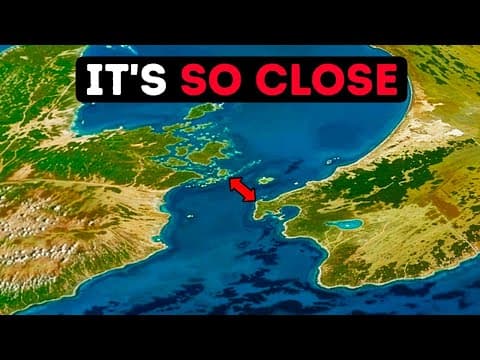
[0:00]In Asia, there's a bridge that is way longer than you'd think should even be possible. The HZMB stretches 34 miles over open water, which makes it the longest sea bridge in the world. So if something this massive can make it across rough waters, why can't New Zealand just build a bridge between its two main islands? After all, we're talking about a distance of just 14 miles. And a bridge like that could seriously change life for both locals and tourists. People could just hop in a car and drive from Wellington to Picton. No more ferry hassles, no more drawn-out trips, just one epic road journey with ocean views on both sides. Well, it turns out, everything. I mean, building a bridge there is technically possible, but there are a couple reasons why experts are like, "Hmm, maybe not." Let's start with the obvious, the distance. The North Island and the South Island are separated by Cook Strait. Like I said, it's 14 miles wide at its narrowest point. That's not much, true. Plus, we've got the HZMB bridge, proving that, yep, it is technically possible to build a bridge over the sea to cover that distance. But we can't ignore the fact that New Zealand's geography is, well, a whole different ball game. Cook Strait isn't exactly a calm, friendly stretch of water. It's deep, really deep. Parts of it drop to about 10,000 feet. That's like stacking seven Empire State buildings on top of each other. It's also a rough, moody stretch of ocean that loves tossing around ships like rubber ducks. In fact, quite a few have been wrecked in Cook Strait, and sadly, many lives were lost. You don't have to worry about it so much though, as the worst accidents happened a long time ago. The ships and ferries that cross it today are much safer. Even so, it'd be pretty hard to avoid getting seasick while crossing it. Things get even messier below the surface. The sea floor over there is uneven and unpredictable. What happens is that Cook Strait has opposing tides at each end, one where it meets the Tasman Sea and the other where it joins the Pacific Ocean. And they simply don't move together like you might expect. When the tide is high on one side, it's low on the other, and they're totally out of sync. So all that water rushes back and forth through the straight to balance things out, creating some really strong and messy currents in the middle. Then there's the weather. Cook Strait isn't just windy, it's probably one of the windiest places in the Southern Hemisphere. That's because it's located right in the middle of one of New Zealand's three big wind tunnels. Basically, there are places where the wind doesn't just come and go quickly. It sticks around, blowing hard for most of the year. And all of this happens because of something called the Roaring Forties. That's the name for the latitude band between 40 and 50 degrees south of the equator, where strong, persistent westerly winds are pretty common. Unlike the Northern Hemisphere, which has a lot of land at this latitude, the Southern Hemisphere is mostly ocean with just a few land masses, like New Zealand's South Island, Tasmania, and the southern tip of South America. So, these winds go wild because there's nothing to slow them down, and they just keep picking up speed. The gust there can reach up to 150 miles per hour. So, imagine trying to cross a bridge in a car when the wind is actively pushing against you. That's not just unpleasant, it's super dangerous. Drivers can easily lose control of their cars with the wind pushing them sideways. And, of course, that can lead to countless serious accidents. Now, let's talk about earthquakes. New Zealand sits right on the boundary of two massive tectonic plates, the Indo-Australian and Pacific plates. It's basically in the middle of a collision zone, and about 14,000 earthquakes happen in and around the country every year. Of those, only about 200 are big enough to be felt. Still, building a massive bridge under these conditions would require some serious genius-level engineering. With all that in mind, we can safely say that the whole bridge idea is off the table. But how about an underwater tunnel? Yep, that could work. It could be a great solution actually, no wind, no bad weather, and no earthquakes to deal with. There are a bunch of other advantages too. First, it would dramatically reduce travel time, cutting down the three to four-hour sailing trip between the North and South Islands. That same journey would probably only take about 40 minutes. Then, people wouldn't have to stress about all the ferry cancellations and delays because of bad weather. And most importantly, it's doable. I mean, look at the Channel Tunnel. It's an undersea tunnel connecting Southern England and Northern France. Japan did something similar with the Seikan Tunnel, which connects the islands of Honshu and Hokkaido. They are both huge projects, serving pretty much the same purpose. So why on earth isn't New Zealand already building this tunnel? Well, for the same reason we don't all live in luxury tree houses with personal robots, money. Estimates vary, but some experts think a project like this could cost anywhere from 10 to 20 billion dollars. To cover that kind of cost, they'd probably need to charge tolls for the next 100 years. And trust me, those tolls wouldn't be cheap. Other experts think it could actually cost more than that. Because, you see, we have to consider all the extra infrastructure. The narrowest point of Cook Strait is between the North Island and Arapaoa Island. That's one of the long, mountainous regions in the Marlborough Sounds, which is pretty remote. So it's not just about the cost of the bridge or tunnel itself. It's also the access roads, safety systems, maintenance, and evacuation plans. You can't just build a huge underwater tunnel and not plan for the occasional emergencies. And what would it actually be used for? Sure, there are people who travel between the islands, about a million passengers take the ferry every year. But that's not exactly the kind of traffic that justifies the most expensive infrastructure project in the country's history. Earlier, we talked about how England and Japan have similar underwater tunnels, but there's something to consider. The United Kingdom has a population of 69 million. Japan has even more, with around 123 million people. And in New Zealand, they've only got 5 million residents to pay for this project. So could they have a tunnel under Cook Strait? Sure they could. Should they? Oh, probably not. If you don't want to fly, the only other way to travel between the islands is by ferry. It's not ideal, but hey, it works. New Zealand has a total of five ships that transport people and vehicles across the islands. For tourists who aren't in a rush, it's perfect. You can cross the islands while taking in some of the most stunning views and spotting amazing wildlife. You'll start your trip in Wellington, and right from there, you'll see the rugged North Island coastline as you head out into open water. You might see different sea birds like gulls and turns, and as you get closer to the South Island, you might spot some gannets. If you're lucky, you could also catch a glimpse of the seal colonies off the coast. During the last hour of the trip, the ferry will slow down, giving you plenty of time to enjoy the green hills and calm waters. You will also approach Queen Charlotte Sound, a spot known for its wildlife. So keep an eye out for orcas, playful dolphins, and even penguins. Honestly, having a ferry instead of a tunnel might not be so bad after all. That's it for today. So, hey, if you pacified your curiosity, then give the video a like and share it with your friends. Or if you want more, just click on these videos and stay on the bright side.
Why There's No Bridge Between New Zealand’s Main Islands
BRIGHT SIDE
8m 35s1,366 words~7 min read
YouTube auto captions
Transcript source
YouTube auto captions
This transcript was extracted from YouTube's auto-generated caption track. The transcript below is server-rendered so it can be read, searched, cited, and shared without opening the original YouTube player.
Pull quotes
[0:00]In Asia, there's a bridge that is way longer than you'd think should even be possible.
[0:00]The HZMB stretches 34 miles over open water, which makes it the longest sea bridge in the world.
[0:00]So if something this massive can make it across rough waters, why can't New Zealand just build a bridge between its two main islands?
[0:00]And a bridge like that could seriously change life for both locals and tourists.
Use this transcript
Related transcript hubs
Watch on YouTube
Share
MORE TRANSCRIPTS


