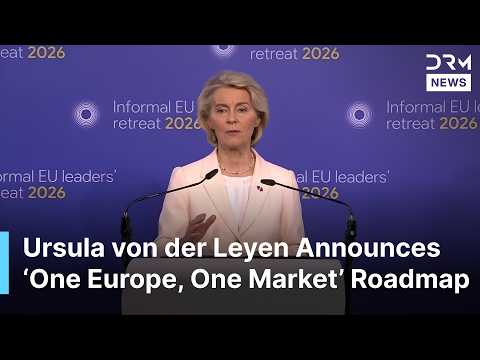
[0:00]this year. Thank you very much. Madam President. Yeah, thank you very much. One Europe, one market, this was indeed today the headline of the discussion, and this is our ambition. One Europe, one market, we want to be there at the end of 2027. We had an excellent discussion with the leaders today on the broader topic of competitiveness, and indeed to answer to this ambition. We have agreed that next European Council in March, I will present a one Europe, one market roadmap, an action plan that shows very detailed what are we going to do with timelines, with targets, and with a clear limit of time also to deliver. And the ambition is that we will have this document committed and agreed by not only the Commission, but also the two co-legislator, that is the European Council, and um, and the Parliament. Um, we have more or less five building blocks for this one market pact. The first is indeed reduce administrative burden. So this has different layers, and it has of course the European level, but also the national level. First of all, it was important to acknowledge 10 omnibus are on their way. Three have arrived at their destination, but seven are still on their way. So we need now the co-legislators really to speed up to bring them over the finish line, because this means 15 billion euros of cutting red tape for our um, for our companies, for our economy every year. Second, we will, after having done the omnibus and more will come, do a deep house cleaning on the A, um, present on this one a plan with first proposals. I said we will look at all levels. Um, we have to crack down on gold plating. Gold plating are these extra layers of legislation, uh European legislation, but done individual by member states, so that as an effect, you have European legislation, but 27 different realities in the member states. We want to crack down on this gold plating. This means less directives, and more regulations, because a regulation sets one clear goal for all 27. Um, and my ask is uh and was to the co-legislators, to propose and accept only strictly technical delegated acts or implementing acts. We have too many delegated acts and implementing acts, and these should only be technical definitions. We will introduce sunset clauses for laws, so that we also have a certain time, after which there's a sunset clause on a law and the um, legislator can decide on whether to continue or change completely the law. And finally, there will be once a year a report to the European Council on the simplification progress and on the cost reduction. That's the simplification, second building block is building one market. Indeed, um, when companies want to scale up in our market, they face difficulties because of the fragmentation that our market of 27 has. And therefore we will propose the 28th regime. EU Inc, we call it, before the March European Council. This is the principle that wherever you are in the European Union, you can digitally, um, within 48 hours, have an EU Inc. You can operate it completely digital, um, and it is one single and simple rule across the whole European Union, therefore the 28th regime. We also agreed, building one market, that not only needs to be there the 28th regime, but also the savings and investment union, to have one deep and liquid capital market. And here we agreed that we want to be done with phase one of the savings and investment union, that includes the market integration, the supervision and the securitization, by June, if there is not sufficient progress by then. We will consider to introduce enhanced cooperation, that is that at least nine member states, if they want, move forward faster and deciphers to be more ambitious. The enhanced cooperation theoretically is also very interesting for the 28th regime, because you can make it more ambitious, and if not all 27 immediately want to move on the 28th regime, we could go into the enhanced cooperation. Get me right. I preferred by 27, but it's these two enormously important building blocks that really have to advance now, and therefore there is as a uh fall back option, a potentially the enhanced cooperation. We need European champions, and therefore the merger guidelines. The draft will be presented in April, then comes the consultation with the member states, but we are very clear that we need European champion, that is merger guidelines that allow for the global market, and not only for the European market. And finally, we will present the industrial accelerator Act, including a European preference, um, before the next European Council for strategic sectors on the basis of solid economic analysis. The third pillar is building one energy market. Here, on one hand, we have to strengthen strengthen the infrastructure, mainly also the grid and the cross-border energy. The grids package is on the table of uh Council and Parliament. They are too in our roadmap for one market. We will have a timeline set for the grids package to be done and to be agreed. Um, we will implement European energy highways. The first energy highway has just been agreed, that is the Bornholm Island with the Baltic offshore wind, now connected to Denmark and to Germany, a huge improvement of offshore wind that was initially only national, but now can be used as European resource um of energy. So, infrastructure is one part. The other part is the um market design. Um, here we had an intense discussion about the effect that on average, you have, if you have renewables, last year, they cost 30, 34 euros per megawatt hour. Nuclear cost 50 to 60 euros per megawatt hour, and gas cost 100 euro per megawatt hour. And the discussion is intense why our merit order system, um, in the very end takes the most expensive resource, and this is the price setting mechanism then. We did not come to a conclusion, I want to be very clear on this one, but to the next European Council, I will bring different options and findings on whether it is time to move forward on the market design or whether we are still good on this market design. And we will come as planned and as it is in the law with uh an ETS review. Fourth, uh pillar is the digital. We agreed again here, the digital Networks Act, you mentioned the telecom merger possibility, that's in this DNA, Digital Networks Act. It's on the table. We will have timelines in the roadmap, so that it moves forward rapidly. The same goes for the European Business wallet, that will make it possible that you have a unique digital identity and a single channel of correspondence as company with governments and with all 27 governments in the European Union.
[9:15]An enormous step forward on digital simplification. Here too, there will be as of March, a timeline uh to to proceed. And finally, looking forward, there will be the proposal for tax sovereignty package. This includes a Chips Act 2.0, a Cloud and an AI Development Act. Um, last point on the digital, we also looked at the infrastructure that we need for high computing power. You know we have the AI factories, we will upgrade them to ecosystems of AI Gigafactories, and here too we discussed the enormous response that we got Europe-wide for our proposals, and this we will launch in June. Last but not least, an important pillar, this is not within the one market, but it is trade, which is of course of utmost importance for our market. Here uh the leaders um uh were very supportive on swift implementation of the newly agreed trade agreements. It is Indonesia, it is Mercosur, India and Switzerland, and of course very encouraging to continue the work with future agreements, be it ASEAN, Gulf states or Australia, for example. I finish here. Thank you very much. I will now open the floor for questions. The first one goes to Europe. Hello, I'm here. Rob for VRT Belgian television. Uh yesterday, industry leaders in Antwerp called for lower energy prices.


