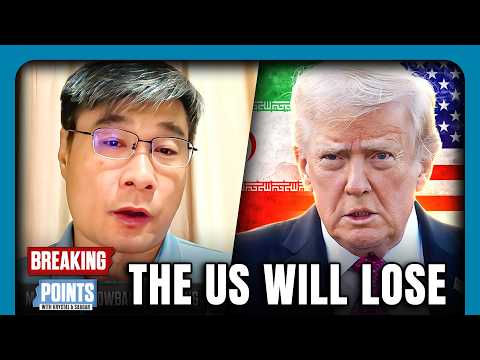
[0:00]All right guys, we've got yet another heavy hitter guest and first-time guest on the show, Professor Jang. He is the star of the popular YouTube channel Predictive History. He uses game theory to analyze past, current, and to predict uh future geopolitical events, and he joins us now. Professor, great to have you. Good to see you, sir. Thanks for inviting me. Yeah, of course. So, um, you know, for people who aren't familiar with your work, I wanted to show folks that back in uh 2024, you made three big predictions. One, that Trump would win. Two, that he would start a war with Iran, and three, that the US would lose that war. Let's take a listen to that. In this class, this semester, I'm making three big predictions, right? First is that Trump will win uh in November. Second is that, um, the United States will go to war against Iran, and the third big prediction is that the United States will lose this war, which will forever change the global order. So, obviously that last one is uh the only one who that is not yet come to fruition is quite a stunning prediction. You know, do you stand by it and what have you seen so far that leads you to sort of stand firm in that conclusion? So, um, given my analysis of how the war is progressing, I think that Iran has many more advantages over the United States. Um, the reality is that right now, um, it's a war of attrition between the United States and Iran, and the Iranians have been preparing 20 years for this conflict. In their escatology, in their religion, this is a war against the great Satan. They've had many um practice runs. Last June was a 12-day war when the Iranians were able to uh examine, analyze the strike capacities of both the Israelis and the Americans, and they've had a lot of time, eight months to prepare fully for um this new attack. Um, they uh through their proxies, the Hooties, Hezbollah, Hamas, and the Shia militias have been able to, um, really grasp the American mentality, and now they've have a pretty good strategy of how to weaken and ultimately destroy the American empire. So what uh the Iranians are doing is they're not they're waging war against the entire global economy. And so they are striking, um, the GCC countries, and not only only are they striking GCC countries, American bases, but they're going after the critical energy infrastructure of these bases, they've blocked out the Strel of Ho moves. And eventually, um, they will go after the water desalination plants, which is the life blood of these nations, because they don't have fresh water supply. In fact, uh the water desalination plants provides 60% of the um, GCC's water supply. So, if a drone, and you know, these drones cost $50,000. If they wiped out a these desalination plant in Riyadh, uh, Saudi Arabia, and it's a city of 10 million people, right? Um, they'd be out of water in two weeks. Um, in two weeks. And right now the Iranians have de facto closed off the Strel of Ho moves, and the GCC gets 90% of its food from, um, uh, the Strel of Ho moves. So, I know a lot of people are talking about the disruptions to the global economy, but right now the, uh, Iranians are actually threatening the very existence of Saudi Arabia, um, UAE, Bahrain, uh, Qatar. And what this is important is that, uh, the Gulf states are really the Lynchpin of the, um, American economy. So what they do is they sell petro dollars, and then they recycle the petro dollars back into the American economy for the investments in the stock market. And right now we know that the entire global entire American economy is propped up by AI investments and data centers, and a lot of that comes from, uh, the Gulf States. So, if, um, the, uh, Gulf states are no longer able to sell oil, and they're no longer able to finance, uh, AI, uh, this AI bubble in the United States, then this AI bubble will burst, and with it will will, um, uh, will will burst as well the entire American economy, which is really a financial ponzi scheme. So that's that's a dire situation that the Americans are facing right now. Yeah, I mean, to your point, sir, an Amazon data center was literally hit in the UAE, and now, of course, big tech companies, which were looking at the UAE as a major potential data center investment hub with cheap and abundant energy, probably going to be rethinking that. We also wanted to talk to you about munitions, uh, we can put this next one up here on the screen. The United States is racing to accomplish Iran Mission before Munitions run out. This is specifically around Interceptor mats. There's a famous video just from yesterday in Israel, which shows a single Iranian ballistic missile, which is being targeted by some 11 different interceptors, all of which miss. Most of those come from the United States, not to mention all of the different bases, the GCC countries that you just talked about. And the asymmetry of the cost, it's a million dollar for a missile, tens of millions per interceptor in some of these cases. With these munitions running out, how does that change the global picture? So you're in China, obviously, much of the stocks in Asia of the United States are likely to have to be cannibalized if this were to go on. How's that going to affect the global picture here? Right, so, um, my first point is that the United States military is not designed to fight a 21st century war. Remember the military Industrial Complex came to being after World War II, and was designed to fight the Cold War. And the Cold War was really about muscle flexing, about about who was able to send uh people up in space, was able to who was the first to get the person on the moon, who had the more uh complex, um, missile systems. And so the entire American military strategy revolves around very, uh, sophisticated technology that costs a lot of money to, uh, build, and that's what the, um, American air defense system is is basically. And that's why we're seeing this asymmetry, as you point out in in this war, where you have these million dollar missiles trying to take out these $50,000 drones, and it's not sustainable, uh, in the long term. And so what we're seeing is really the puncturing of the aura of invisibility and invincibility that sustained American hegemony for the past 20 years, um, especially after the collapse of the Soviet Union. And this is really a re-ordering of not just the global economy, uh, because this signals the collapse of the petro dollar and with it, um, the entire, uh, uh, US dollar-based, uh, reserve currency system. But also, um, global, uh, the global hegemony of the United States, we're moving towards a multipolar world. Professor, this morning, Secretary of War Pete Hegsaf, uh, was asked a question about potential ground troops, um, in Iran. He refused to rule out that possibility, and he said, you know, oh, well, we're not going to project to you what we will or will not do, we don't want to, you know, rule anything out, we will do what it takes. Do you think that America will end up, um, invading Iran from the ground since it's already becoming relatively clear they won't be able to accomplish the goal of regime change or even regime collapse using just air power alone? Right, so everyone says that the worst calamity that could happen to United States is if it were to send ground troops into Iran. At the same time, the United States are committed to regime change in Iran. We've never had an president in history where you were able to regime change from the air alone. You need ground troops. And so, unfortunately, what's going to happen over the next few months is that, uh, pressure will build on America to send ground troops, especially from the GCC countries and from Israel, which are being powered right now by, uh, the Iranians. So, remember that if the GCC countries, Saudi Arabia, uh, Qatar, UAE, Iran, if they go, then the petro dollar goes goes with them. So, the Americans need to protect these countries, and these countries are going to demand that, um, either the Americans bribe the Iranians to cease, and this this is like 500, okay? Or send ground troops to wipe out the Iranian threat once and for all. And I know that there's no political will for ground troops, uh, to be used against Iran among the American people. But remember that 78% of American people was against initial strikes against Iran in the first place. Right. And one of the things that really comes into question, I think, with all of this, sir, when we're looking at the geopolitical picture and the sacrificing in much of this, uh, from the United States on behalf of Israel, is kind of a question as to who and what wanted this. We were actually curious for your view on a disputed report here from the Washington Post. We can put it up here on the screen, uh F3. A push from the Saudis, Israel helped move Trump to attack Iran.
[9:37]Now this has been internally disputed by Saudi Arabia saying that they did not push the Trump administration to attack Iran. However, this is clearly an authorized leak from our own government trying to at least lay some of the blame on behalf of the GCC. What do you make of this analysis and of of this narrative that Saudi Arabia was also trying to be behind this push to bomb Iran? So I've always argued that both Saudi Arabia and Israel are heavily invested in regime change in Iran. In fact, Saudi Arabia sees Iran as much more of an extional crisis than Israel. Because remember, Israel still has nuclear weapons, and Israel is a very diverse, very sophisticated economy, whereas Saudi Arabia is completely reliant on oil. And it's always had problems with, um, Iran because Iran is a theocracy opposed to the Saudi monarchy, um, Iran funds and equips, uh, the Huthis, which have have been antagonistic towards Saudi Arabia for the longest time. And right now, the Saudi economy is suffering. It is, it's been trying to pivot towards more of a tourist economy. That's why they bought in Ronaldo, that's why they're switching to e-gaming. Uh, that's why they're being building something called a line, uh, Neom, and all these things are not working out. So, um, they need to be able to control, uh, the oil resources of the entire Middle East if they are to survive and thrive as a nation. So I do believe that this uh reporting is credible, even though it does, um, make Saudi Arabia look bad. But remember, Saudi Arabia says that they wanted peace, but they are helping the Israelis and the Americans attack Iran right now because they're allowing the, um, Israelis and Americans to use Saudi airspace. So help us understand, because it still feels to me like there are some pieces that don't totally add up. You had in advance of this war on Iran, you had top military brass up to the chairman of the Joint Chiefs of Staff saying, this is a really bad idea. Um, you know, we are not ready for this, you know, all the the math on the interceptors that's been talked about for for months at this point. And yet Trump still decided to go ahead. What is the calculus that he was making here that led him to take what, you know, already appears to be catastrophic actions? Right, okay. So this is the key question, why did they do this? And I think there are three possibilities, okay? And I think all three possibilities are valid. The first is that if Hubris, if you look at history, this is how empires behave. So, um, the Mandoro kidnapping was quick, successful, and it was adrenaline rush for Trump, and that made him overconfident in the capacity of the American military, okay? So Hubris is a factor, and we see this throughout history. Why did Hitler invade Stalin? Because he conquered Europe really easily, and he thought he was invincible, right? And that led to the destruction of the German army in, uh, the Soviet Union. So Hubris is a factor, then you have to look at internal political calculus. Where even though America does not benefit from this war against Iran, Trump himself personally benefits, why? Because the Saudis and Israelis are bribing him to, um, attack Iran. Remember that the Saudis invested $2 billion in the private equity fund of Jared Kushner, who is the son-in-law of Donald Trump, and the Israelis for Mary Ederson have been financing Trump's vocal career for. Right, so, uh, Merm Ederson, um, a few months back said that he will, um, put up 20, $50 million if Trump were to run a third term.
[13:30]So, Trump is thinking about a third term, and I think at the ballot box he probably won't get it, but if there's a war going on and you can delay elections, and you have emergency war powers, and people rally around the flag, then he, he probably will get a third term. The last factor that is very important is theology factor, where if you look at the Epstein files, it's clear that we are run by secret societies. It's clear that the world is run by these, uh, individuals who have a lot of power, we don't know who they are, but they control the military, they control the national security apparatus of, um, the United States. And they believe that Israel, this war in the Middle East, is key to the end times, including heaven on Earth.
[14:35]So it's almost like a script that they're following, even though it's, it doesn't make any Gical uh sense, okay? So I, I would say that these three are the best reasons why this is happening. Wow. Well, sir, uh, I hope you come back. This was very informative, I think for both of us. We deeply appreciate your time. Thank you. Thank you. Hey, if you like that video, hit the like button or leave a comment below. It really helps get the show to more people. And if you'd like to get the full show, ad-free and in your inbox every morning, you can sign up at breakingpoints.com. That's right. Get the full show, help support the future of independent media at breakingpoints.com.


