[0:03]In March of 1947, President Harry Truman delivered a speech regarding the potential fate of two nations, Greece and Turkey. Both were experiencing economic and political turmoil, and Truman concluded that the U.S. should do everything within its power to assist these nations. He feared that if Greece and Turkey were left to their own accord, they would become communist states. Truman believed communism must be halted and not allowed to spread to other nations. Many feel that this speech was the beginning of what became known as the Cold War. It effectively established the Truman doctrine as America's policy towards communism. The Truman doctrine was a policy of containment. This suggested that the U.S. would not try to eliminate communism, but instead simply confine it to the nations where communism already existed. The reason for the containment policy was known as the Domino Theory. Foreign policy experts believed that if one nation in a region fell to communism, nearby nations would fall as well, similar to Domino's falling upon each other. Financial aid to Greece and Turkey was one of the first actions of the Truman doctrine policy. The two nations were given more than $400 million to help rebuild their economy and firmly establish their government. However, this was just the beginning. In 1948, the U.S. began assisting other nations in Western Europe. The Marshall Plan, named after Secretary of State George Marshall, was a monetary assistance program. Over the course of four years, the nations of Western Europe were given more than $12 billion to aid in her building after the widespread destruction of World War II. This was done in the hopes that it would help these nations resist communism and prevent them from falling under Soviet influence. The Truman doctrine and the policy of containment were also responsible for the U.S. entry into multiple military conflicts throughout the 1950s, 60s, 70s, and even into the 80s. The most prominent being the Korean conflict and the Vietnam conflict. In both cases, the United States was attempting to prevent the spread of communism. This effort proved successful for South Korea, but it failed in Vietnam. Containment continued to be one of the dominant forms of dealing with the communist threat throughout the remainder of the Cold War.
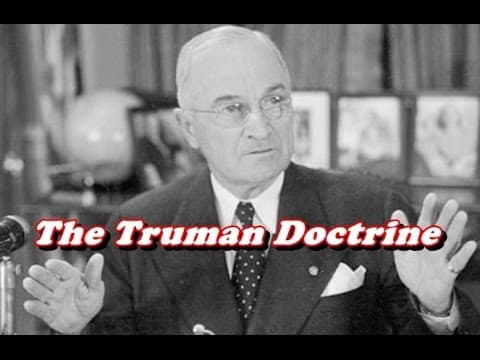
History Brief: The Truman Doctrine
Reading Through History
2m 59s380 words~2 min read
YouTube auto captions
Transcript source
YouTube auto captions
This transcript was extracted from YouTube's auto-generated caption track. The transcript below is server-rendered so it can be read, searched, cited, and shared without opening the original YouTube player.
Pull quotes
[0:03]In March of 1947, President Harry Truman delivered a speech regarding the potential fate of two nations, Greece and Turkey.
[0:03]Both were experiencing economic and political turmoil, and Truman concluded that the U.S.
[0:03]He feared that if Greece and Turkey were left to their own accord, they would become communist states.
[0:03]Truman believed communism must be halted and not allowed to spread to other nations.
Use this transcript
Related transcript hubs
Watch on YouTube
Share
MORE TRANSCRIPTS


