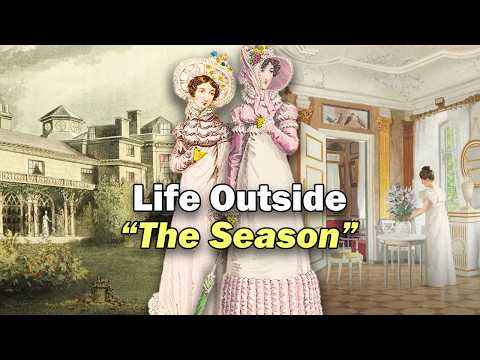
[0:00]The Regency era is often categorized by its relationship to wealth and excess. Being the setting for many classic novels like the works of Jane Austen, or modern stories of romance, tales of the Regency era involve all of the luxury and elegance that came with it. Beautiful ball gowns, elaborate parties, decadent food, and of course, all of the many rules surrounding courtship. We just love hearing about the lifestyle of history's elite. And at the center of it all was the social season. A time when the upper classes would flock to the city of London in order to partake in a whirlwind of social events that coincided with the sitting of Parliament. But once Parliament was in recess and they were done with all their socializing, partying, and matchmaking, how did the Regency Era nobility spend their time? Today, we're going to be answering that very question. So join me, dear viewers, as we explore the life of the Regency Elite outside the season.
[1:03]Although some members of the upper classes may have chosen to stay in the city for the warmer months, this was not always the most pleasant experience. And so, those who had the means would often vacate the city in favor of a more peaceful and cooler environment in the countryside. Though many families owned or rented a house in the city during the social season, their country estate was an important indicator of wealth, status and income. This was especially the case for members of the nobility, since country seats not only generated wealth, but were usually ancestral properties that had been within the family for generations, and they couldn't be sold or given away unless the family had no heir to inherit them. Depending on a family's means, these country homes could either be very modest or totally massive, operating more like a castle than a house. The grounds of a larger estate could span anywhere from 300 to a thousand acres, though this was usually only a small portion of the land that members of the nobility would use themselves. The rest was divided up for agricultural purposes, inhabited by tenants who would farm the land and provide the bulk of the landowner's income by paying rent. Country estates might have also included various facilities for the Lord and other inhabitants, like breweries, a chapel, or workshops for hired trades people. During the summer, the owner of the estate would have had their hands quite full with managing the land and assets. If he had sons or brothers, then certain duties might have been divided up amongst them. But he would also have assistance from his steward, who could help manage things when he was away or otherwise occupied. As the Lord of the estate, there were also certain expectations for taking care of those who lived on the land, like providing enough food, clothing and resources for their tenants and those in their employ. Country homes during the Regency ranged greatly when it came to their size, decadence, and history. The estate itself was often named after the land or architecture of the residence, involving names like lodge, manor, or abbey, depending on how it was designed. Estates that were named Park, for example, usually had expansive and well-maintained grounds. Since upper-class families were no strangers to showcasing their wealth, the country estate, especially the rooms that were used for hosting company, could have been quite luxurious, including expensive furniture, molded accents, and artwork on display. Although country houses varied in size, there were certain types of rooms that were standard for many. Lodging of course was a necessity, and would involve bedrooms for the inhabitants, as well as quarters for servants and sometimes even elaborate guest apartments for visiting nobility. Other rooms included a library, a study for the Lord of the house, a dining room, ballroom, and drawing room for hosting guests, as well as a small parlor for everyday use, and sometimes even a glass conservatory, which became popular for country houses during the late 1700s. One important thing to note, however, is that bathrooms did not make the list. Although by the Regency, a few houses may have had water closets attached to their most important bedrooms, indoor plumbing and flushing toilets weren't really a thing yet, so families relied on outhouses and chamber pots. Now, I bring this up because I just discovered that this time period had novelty chamber pots. Like this wonderful little piece from 1805, where you could do your business right onto a bust of Napoleon. Now, that's what I call hospitality.
[4:36]While the London social season meant going out, attending balls, and mingling in society, the summer months were a more subdued experience. Although events like picnics, calling on friends, and hosting parties, still would have filled some of this time. These were usually much smaller in scale compared to the events that took place during the social season, since the countryside had a much lighter concentration of high society members that you could socialize with. Much of the summer would have been spent either managing the country estate, or engaging in casual entertainment on its grounds. Sports were popular with both men and women, although which ones were considered respectable differed between the groups. Men might enjoy hunting, wrestling, fencing, or shooting, while women could enjoy lawn games like shuttlecock, an early type of badminton, skittles, a game similar to lawn bowling, or Pal Mall, the precursor to croquet. Other activities like riding and archery would have been enjoyed by both sexes. While indoors, families might have taken to playing music, drawing or painting, reading books and poetry, or writing letters to friends and relatives. There were also a number of parlor games to play in groups like charades, board games, or Blind Man's Bluff. If you did want to do some socializing, however, hosting or attending a house party provided a number of opportunities. Unlike an event hosted during the season, house parties at a country estate were a little more tricky, considering the poor road conditions and long travel times. Because of this, guests would usually stay at the estate for several days. This made the house party an ideal environment for social networking, since you essentially had a captive audience. This meant you could improve your own social standing or engage in a little bit of manipulation, like setting up your daughter with an eligible guest, or charm a fellow politician in your favor. Like with any social event in the Regency, house parties also provided their hosts with the opportunity to show off their wealth, taste, and status. This of course came with a lot of expenses, food, supplies, decorations. The household servants would often be given entirely new uniforms for the occasion, and sometimes additional staff would be hired just for the duration of the party. Many guests also brought their own servants with them, so the host would not only have to worry about caring for everyone they invited, but housing and feeding their staff as well. Those in attendance would be offered the best that the host could afford, and in some cases, the best that they couldn't afford. For those who didn't have excessive funds, it was not uncommon for the host family to actually spend most of the summer living rather frugally. That way they could splurge during their party, or in other cases, people might have just acquired a lot of debt to pay for it. But it wasn't as though the guests got off without paying for anything either. Those who were staying at somebody else's country seat would have to bring money to tip all of the servants during their visit, which, considering how many servants there were, could really add up.
[7:47]Now, for those who didn't want to spend all their time at home, the summer months also provided an opportunity for travel and tourism. Prior to the Regency, trips like going on a gentleman's Grand Tour, a vacation where young men traveled across Europe to engage in art and culture, would often be taken in the summer. But rising tensions with France and the Napoleonic Wars made European travel much more difficult. Meaning that if the British wanted to travel, they had to start looking domestically. Scenic locations like the Scottish Highlands or Welsh Mountains would start seeing an increase in tourism during this time. Visiting a spa town or seaside resort was also a popular destination for the wealthy, with places like Bath or Cheltenham offering a relaxing getaway where people could enjoy swimming in the ocean or bathing in natural baths, something which was viewed to have major health benefits. If you want to learn more about these kinds of seaside vacations around the 19th century, I've already done a whole video on that, which I'll link in the description. Another thing you could do if you didn't want to spend all summer in your house was visit somebody else's. Now, I'm not talking about being invited, but rather, you could literally take a tour of many stately homes that belonged to high-ranking members of the nobility. This was a popular enough activity that it even made it into Jane Austen's Pride and Prejudice, where Elizabeth Bennet takes a tour of Pemberly House with her aunt and uncle. Visiting these country houses was a way for people to get a glimpse into the lives of the ultra wealthy, and they really did provide spectacular sites of architecture, art, and nature. Much like with modern tours of mansions and estates, visitors would receive guided tours where they were kept to a closed off area of the house, and could learn about the history of the building as well as any notable items that the owners had on display. Some houses like Blenheim Palace and Stowe House even printed guidebooks. But one of the most popular destinations during the Regency was Chatsworth, which is still offering tours today if you're ever in England. And there you have it, that's what life was like outside the Regency social season. A bit subdued, yes, but as somewhat of an introvert myself, I think it sounds pretty appealing in comparison to all the partying that you would be doing normally. Let me know what you think. Would you have enjoyed a Regency era summer, or would the social season have been more your style? Feel free to discuss it in the comments. If you enjoyed the video and want to see more content like this, you can also subscribe to my channel and keep up to date on all the fun history videos of the future. But for now, I bid you farewell.


