[0:00]All right, let's dive into something that's probably protecting you every single day, maybe without you even realizing it. We're going to pull back the curtain on the Signal Protocol, the cryptographic powerhouse that keeps billions of private conversations, well, private. It's the engine running inside apps like Signal and WhatsApp, and honestly, it's an absolute masterpiece of modern security. So to kick things off, let's start with a really simple question that gets right to the point. How is it that a company like Google can scan your emails for keywords, but the servers over at WhatsApp have absolutely no clue what you're saying? The answer to that question is exactly why the Signal Protocol is so incredibly special. It all comes down to what we can call the Server-in-the-Middle problem. You see, the security that protects most of the web is fantastic, but it was built for a totally different job. And when it comes to truly private messaging, that old model has a huge, glaring weakness. And this right here perfectly illustrates that difference. When you're browsing a website, even a secure one, the connection is between you and the server. The server can see everything. But with private messaging, that's not what we want, is it? The server should just be a mail carrier, a delivery service that can't peek inside the envelope. The real secure connection has to be from you directly to the person you're talking to. The solution, and you've probably heard this term thrown around, is end-to-end encryption or E2E. And here's the only part you really need to remember: the secret keys that can actually unscramble the messages exist only on the user's devices. That's it. They are only on the ends of the conversation. The server has no access. Period. Okay, so with that foundation in place, let's get specific. What exactly does the Signal Protocol promise to do? Because these aren't just a list of features, they're rock solid guarantees about the safety of your conversations. So, you've got the basics here: confidentiality, integrity, authentication. You know, that's kind of the entry fee for any good crypto system. But these last two, forward secrecy and post-compromise security, this is where Signal completely changes the game. One protects your past, and the other protects your future. And we're going to focus on these two because they are just so powerful. First up, forward secrecy. Okay, imagine for a second that a hacker manages to steal the key that's currently decrypting your messages. With a lot of older systems, that would be a catastrophe. They could go back and read every single message you've ever sent. But forward secrecy makes that impossible. It means your entire chat history stays safe even if your security is compromised right now. And then, there's this. This is the real mind-blower: post-compromise security. This basically says that even if an attacker does get your keys, the protocol is smart enough to automatically heal itself. It generates brand new, uncompromised keys and just keeps going, securing all your future messages. It's an absolutely incredible feature. At the end of the day, what you get is a system with security that literally heals itself. A temporary break doesn't spiral into a permanent disaster. So, the big question is, how on earth does it actually pull this off? Well, it's a brilliant two-part system, and we've got to start at the beginning: how a conversation gets started securely in the first place. The entire protocol really rests on these two core pieces. First, you have something called the X3DH Handshake. It sounds like a mouthful, I know. It stands for extended triple Diffie-Hellman, but its job is simple: to get that initial secure channel set up. And then, once you're talking, the Double Ratchet takes over to keep that conversation secure, forever. So, let's look at that first step. The X3DH handshake is kind of like a super complex, multi-layered secret handshake. And the coolest part: it's asynchronous, which means both people don't even have to be online at the same time for it to work. Now, without getting lost in a deep, dark mathematical rabbit hole, here's the basic idea. Bob basically leaves a bundle of public keys waiting for him on the server. When Alice wants to start a chat, she just grabs that bundle, mixes in some of her own secret keys, and does a bunch of clever math. The final result is a single, super strong shared secret that only she and Bob could possibly have created. But that's just to get the door open. Once that initial secret is locked in, the real magic starts to happen. And this is how the protocol maintains that unbelievable security with every single message. And that magic is called the Double Ratchet. You can think of it like the engine of the protocol, always cranking forward, always pushing the security ahead. Making it almost impossible for an attacker to ever catch up. And this is why it's called a double ratchet, because there are actually two mechanisms working in perfect sync. You have the symmetric ratchet, and its job is to crank forward with every single message you send, creating a brand new key just for that one message. That's what gives us forward secrecy. Then, every so often, the second ratchet, the Diffie-Hellman one, kicks in and mixes in completely new secret stuff. That's the part that gives us that amazing self-healing post-compromise security. Okay, so let's just step back for a second. We've looked at the moving parts, but let's be clear about why this isn't just an improvement. It's a complete revolution in how we think about digital security. Think about it this way: a standard secure website uses one single key for your entire visit. If a hacker gets that key, the whole session is blown wide open. They can read everything. But with Signal, an attacker who manages to steal a key can only read one single message. Because by the time the next message comes along, the protocol has already moved on and is using a totally new key. The window of attack is almost non-existent. And look, this isn't some theoretical thing cooked up in a lab. This protocol is the undisputed gold standard, and it's out there protecting billions of us in the apps we use every day. WhatsApp, the secret chats in Facebook Messenger, even Google's new RCS messaging, they all use the groundbreaking ideas pioneered by Signal. So, where do we go from here? Well, this kind of technology never stands still. The people behind it are already looking down the road and preparing for the security threats of tomorrow. You know, one of the biggest threats on the horizon is the rise of quantum computers, which could one day be powerful enough to break the math that all our current encryption is built on. Well, researchers are already hard at work on post-quantum versions of the Signal Protocol, looking at things like hybrid models that use new algorithms like Kyber. They're making sure our conversations stay private for decades to come. And that really brings us to the most important takeaway. The Signal Protocol teaches us that the best cryptography isn't just a static, unbreakable lock. It's a living, dynamic process. It's not about having one perfect key. It's about the carefully engineered evolution of keys over time, always making sure you're one step ahead. And that, right there, is what keeps our messages safe.
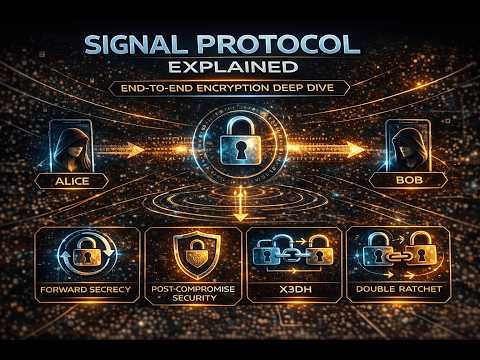
Signal Protocol Explained – End-to-End Encryption Deep Dive
Lexorithm
7m 2s1,260 words~7 min read
Auto-Generated
Watch on YouTube
Share
MORE TRANSCRIPTS


![Thumbnail for BUDIMPEŠTA TOUR [PART#1] by VucVlogs](/_next/image?url=https%3A%2F%2Fimg.youtube.com%2Fvi%2FT2U043Dtuxo%2Fhqdefault.jpg&w=3840&q=75)