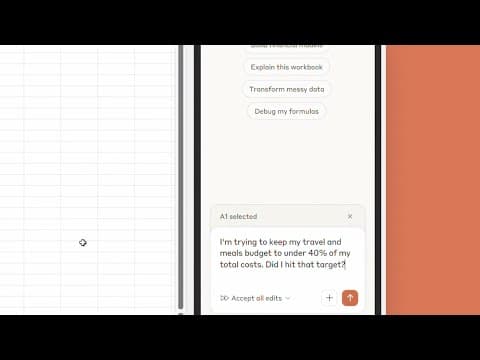
[0:03]Claude in Excel is a powerful AI agent right inside your spreadsheet. Everything you do manually, Claude can help with. Whether you're in finance, building valuation models, in accounting reconciling data, or in operations tracking performance, Claude can work the way that you do. You'll open it with control option C on Mac or control alt C on Windows. So let's try starting by asking questions about your workbook. Claude can look through the data and use it to answer questions that would otherwise require manual calculation. Here's an expense report with seven line items. I want to keep my travel and meal budget under 40% of my total spend. So, let's ask Claude, I'm trying to keep my travel and meals budget to under 40% of my total costs. Did I hit that target? Then, Claude calculates the total, adds up travel and meals, computes the percentage and tells me I'm just under budget. It shows the math so I can verify.
[1:09]Claude can also help you with errors. It knows what error messages mean and couples that with knowledge of your data set to provide more valuable debugging information. So, right here, we have a monthly sales sheet with an error in the average price column for May. To find out the problem, we can simply ask, why is there an error in May? Claude traces the error to its source. The formula in D6 divides revenue by units, but cell C6 is empty, so no units mean division by zero. Claude suggests a fix: fill in the missing data. So, Claude traced the error without me having to click into the cell, read the formula and check each reference manually. It just did it on its own. Formulas can be opaque, especially in spreadsheets that you didn't build. Claude can break them down for you. So, here's a grade book right here that uses VLOOKUP to convert numeric scores into letter grades. If you inherit this spreadsheet, the grading logic might not be obvious just from looking at it. I know it isn't to me. So, when we ask Claude how does the letter grade formula work, Claude breaks down the formula piece by piece. It gives us citation boxes so we can jump directly to the cells being referenced. It shows that the formula is in column C and that is VLOOKUP. Then explains the parameter, the lookup value, the table array, the column index, and that TRUE means approximate matching. So far, we've asked Claude single questions, but Claude can also work through multi-step tasks like cleaning messy data and building a model from scratch. This workbook right here has a raw sales sheet with monthly revenue data from the past three years. But before we can build anything useful, we need to clean this up. So, we can give Claude a clear prompt. Clean the Raw Sales data: standardize all dates to YYYY-MM-DD format, remove duplicate entries, sort by date, and create a summary of annual revenue in a new sheet called "Historical".
[3:18]Claude asks for permission before modifying the spreadsheet. Once I approve, it works through the data and reports what it did. It standardized all the date formats, it removed three duplicate entries and sorted 34 remaining records chronologically. It also created a historical sheet with annual revenue totals and transaction counts for each year. Claude even adds context: 2024 revenue shows a 16% increase over 2023 and 2025 is on track to finish strong with only 10 months of data recorded. Awesome. Now we have clean historical data. Let's build a forecast. Based on the historical revenue, build a 3-year forecast on the Forecast sheet and calculate the average annual growth rate and use it to project 2026, 2027 and 2028. Put the growth rate assumption on the Assumptions sheet so I can adjust it later. It fills in the Assumption sheet with this rate and builds out the Forecast sheet with projections through 2028. The model is fully dynamic. All forecast values are linked via formulas to the growth rate in the Assumption sheet. Claude also adds context noting that 2025 only includes 10 months of data, which affects the calculated growth rate. The same approach works for finance professionals needing more complex financial analysis. Here's a workbook with five years of historical financials. We can ask Claude to build a DCF model to value this company, use a 10% discount rate, 3% terminal growth, and project 5 years of cash flows based on historical trends. Show me the implied enterprise value. Claude analyzes the historical growth rates and margins, fills in the Assumption sheet and builds out a complete DCF model. It projects free cash flows, calculates the terminal value, discounts everything back to present value and shows the implied enterprise value. The model is fully dynamic. If I want to test different assumptions, I can ask Claude to adjust the discount rate or growth rate and the valuation updates automatically.
[5:18]Pivot tables are one of Excel's most powerful features and one of its hardest to master. Claude can build them for you. This workbook right here has a year of sales transactions, dates, regions, products, sales reps, and revenue. Create a pivot table showing total revenue by region and product. Claude builds the pivot table, organizing revenue by region in the rows and product in the same columns. It's the same pivot table you'd build manually, but Claude handles the setup. Now, create a chart from this pivot table showing revenue by region. Claude creates a chart from the pivot table. It chooses an appropriate chart type and adds labels. Claude can then edit any part of the chart: the type, the axes, the title or the colors. Change the chart to a stacked bar chart and add a title.
[6:10]Claude shows you every change it makes and explains its reasoning. Use this transparency. You can click the citation boxes in Claude's responses to jump directly to the cells being referenced. Your organization may have specific methodologies. Verify the outputs match your standards, especially for work that will be shared externally. And for sensitive or regulated data, always follow your organization's data handling policies. Whether you're in finance building valuation models, in accounting cleaning up GL data, in operations analyzing sales performance, or just someone who uses Excel extensively, Claude can help you move much faster. Claude compresses the mechanical work so you can focus on the decisions. What assumptions to use, what scenarios to test, and what story does the data tell? Open the sidebar with control option C on Mac or control alt C on Windows.


