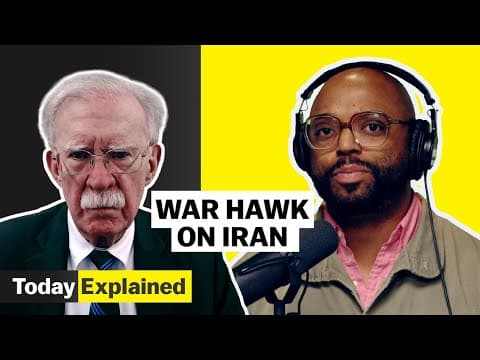
[0:00]So for 20 years, there's basically been one guy who was always known as the Iran War guy in Republican politics. For years, even decades, Ambassador John Bolton has argued that America needs to push for regime change in Iraq and take an active military role in making it happen. But now that Trump is doing just that, Ambassador Bolton says he's actually going about it all wrong and making a big mistake. So how did Trump lose the Republican Party's biggest Iran Warhawk? Let's find out.
[0:37]Ambassador Bolton, thank you so much for joining us. Well, thanks for having me, glad to be here. Ambassador, I would love for you to just run through your credentials, uh, for a second. We're going to be talking about obviously the growing war in Iran, but I wanted for you to, uh, give our audience just a sense of how closely you've been tied to this for a while. Well, I've had the privilege to serve in a number of uh senior US government officials, going back to the Reagan and first Bush administration, second Bush administration. I was under Secretary of State for arms control and international security. Then I was US ambassador to the UN, and, uh, I served in the first Trump term as National Security advisor for 17 months. I was his longest serving national security advisor. Yeah, and obviously that's the part that we really want to focus on. I think you've become known as one of the most prominent American advocates for military action in Iran over a set of decades. And this war is in a sense something that you've argued for long through your career. But in recent weeks, you've emerged as one of the sharpest critics of the Trump administration's actions and how it's conducting this war. I wanted you to walk me through your critiques. Where do you think they went wrong from the perspective of someone who wanted to see this happen? Well, what I support is a policy of regime change in Iran. Uh, and I've, uh, held that view for many years because I don't think there's any chance the current regime, uh, uh, will change its behavior on two critical fronts. It's not going to give up its pursuit of nuclear weapons, which threaten Israel, the United States, really the whole world. And it's not going to give up on its pursuit of terrorism, its support of terrorist groups like Hamas, Hezbollah, the Houthis, Shia militia in, uh, Iraq, and, and, uh, conducting terrorist operations around the world. And I think we've got decades of evidence that their behavior's not going to change. So when you're confronted with that kind of threat, danger, and behavior is going to change, the alternative is change the regime. I think the regime is in its weakest position, uh, since any time, uh, after it took power in 1979. Uh, the economy's a mess, the, uh, young people, uh, are, they can see they can have a different kind of life. Two-thirds of the population is under 30. The women are enormously dissatisfied since the death of Masa Amini, ethnic groups are dissatisfied. So to me, conditions are ripe for regime change as a policy to succeed. And the question is, what role can the United States play? And here, I think Trump is badly misplaced his hand, uh, from the beginning, unfortunately. Doesn't mean Tell me how. Trump initially did nothing to prepare the American public for the steps necessary to affect regime change. Normally, when a president, uh, uh, is going to take a a dramatic action like Trump has, you explain that to the American people, you make the case. Why it's in our national interest to seek regime change, to avoid the threat of nuclear weapons, to avoid the continuing threat of terrorism. Uh, you don't have to say anything about what your specific plan is, you don't have to talk about timing, but you have to be respectful of our citizens and make the case to them that this is in their interest. I think he could have done it. I think there's a very Yeah, that didn't happen. compelling case he didn't do it. A corollary to that is you need to prepare Congress. Certainly on the Republican side to get their support, but on the Democratic side, too. I think, uh, there are a number of important steps that Congress is going to have to take and instead of leaving them, uh, in the dark, it doesn't mean they would agree with you necessarily, but at least you've stated your case to them and it's part of making it to the American people. The, the other aspect, uh, one other aspect that Trump failed on was consulting with allies. You know, normally try and build an international coalition before the war starts, not after it is kind of a second idea. Uh, and he obviously didn't do that. I mean, we've got very close, uh, ties with Israel. I think our military planning and preparation has been seamless as far as I can tell. But they're plenty of others, not just the NATO allies, but the Gulf states in, uh, in the region, who are obviously affected by this, our allies in the Pacific, Japan, South Korea, and others, who get most of their oil from the Gulf. And this may be the most important of all, uh, as far as we can tell, he did, he did no preparation of, uh, the opposition actually inside Iran. Uh, no coordination, no effort to, to, uh, see what they would do, no, no effort to support them, to provide resources, uh, money, arms, if that's what they wanted, telecommunications. Just, just no coordination at all. And given that Trump's made it pretty clear he's not going to put, uh, boots on the ground in any major way, the opposition was always going to have to have a major role in overthrowing the regime. Uh, and, uh, they, they don't, they don't seem prepared for it. I, I hear that. I guess the question then becomes why is this happening now? I mean, my working theory is that Trump got a little trigger happy after Venezuela and has ignored the different context that has taken place here, or has simply, uh, under, under-represented, uh, uh, the differences from country to country. I guess my question is for you then, like, why do you think this is happening now, considering, um, he didn't take those steps of preparation. Honestly, I don't have the slightest idea why he changed his mind from the position he took in the first term. I and others, uh, tried to make the case to him then that regime change should be our policy, and he didn't accept it. Uh, there were plenty of dissenters and we had this debate and, and, uh, he wanted to go after the nuclear program and make sure it never got started, but, uh, he did that through economic pressure, what he called a maximum pressure campaign. And said publicly, in fact, he was opposed to regime change in Iran. So why this happened now, I, I just, I'm, I'm as, uh, at a loss for an explanation as anybody. I just I can't understand it frankly. I would love for you to slow that down for me. I mean, take me through those moments in the first Trump administration when you were arguing for things like regime change in Iran. Did where's the argument against it, some of the things we've seen now, the possibility of retaliation, the possibility that Iran would control the straight of Hormuz. Are we seeing the realities of what that debate was? Well, there those points were obviously mentioned, they're, they're sort of a first reaction by any, uh, regime like the Ayatollah in Tehran to try and use the straight of Hormuz as a pressure point. And to retaliate against its competitors and adversaries in the region, the Gulf Arab states, as well as, uh, as Israel. So Trump was aware of the possibility that this was a likely retaliatory action. Uh, absolutely. I mean, really, you can't miss it. It's if you know, if you look at geography, it's, it's obvious that that, that both attacking the, the Gulf Arab states and closing the straight of Hormuz are some of the first things Iran would consider. So, considering that, I guess I keep going back to, do we know why there wasn't a plan in place or the administration seems seemingly surprised by some of these actions? I mean, Trump said that nobody expected Iran to retaliate against neighboring countries. When you're saying, you briefed him or you were in discussions about that exact possibility. Yeah, I mean, it was something you had to consider and there were certainly people who didn't want to seek regime change, who, who made those points. I mean, I think the military side of, uh, the current campaign shows good planning and good preparation for, for some objective, whatever, whatever it is. Uh, I, my only surprise really is that they didn't act earlier, uh, against the possibility of the closure of the straight of Hormuz. That was a possibility from, from day one. And I would have fought, there would have been, uh, in addition in the early days to trying to take out retaliatory capabilities like Iran's ballistic missiles, that one retaliatory capability that needed neutralizing was their capacity to close the strait. And yet we were a couple weeks in before that really started. I guess the other possibility here is that the administration just doesn't share your goal of full regime change. that there's, they might be seeking some sort of off-ramp or having different sort of objective. Do we have any sense of what that other objective could be? Well, you know, in the course of events, since, uh, March the 1st, they've, they've given a half a dozen or more different alternative, uh, objectives. And I'm not sure which is which on a given day, but I do think it reflects the lack of strategic planning, uh, and, and failure to think through what would happen when you undertake a military operation this big. I mean, I think one danger now that they're not thinking about, uh, is what, what, what is the likely, uh, future if you leave a badly wounded regime in place in Tehran, but one that's determined to recover. Rebuild the nuclear program, re, re-finance and arm the terrorist groups, and now see palpably what the power to close the straight of form moves can do. I mean, that, that in a sense could make a, a more dangerous regime, uh, by re-building what's, what's left of it, uh, and, and, uh, and would have argued if they weren't prepared to see regime change through, they shouldn't have started this to begin with. Yeah, that's the question I was going to ask you, from a sense of someone who again, wanted to see some of this happen, but necessarily does not seem that the Trump administration may be shares your conviction to see this all the way through. There's a sense that they want to make this around four to six weeks, not necessarily the timeline that a full regime change could take. Is it your position that if they aren't willing to kind of see that all the way through, they shouldn't have started this in the first place? Right. I mean, four to six weeks might have been, uh, a good estimate of the Pentagon's initial campaign, but the, but the military action alone was never going to cause regime change, or at least it would have been a lucky event had it, had it done so. This has to come from inside Iran. It's the people, the opposition, the ethnic groups, the young people, the women that have to have to figure out how to actually accomplish it. And it's clear they were badly intimidated in January when the regime killed 30 or 40,000, uh, protesters, literally machine gun them in the streets of, uh, of Iran simply for protesting against the regime. That, that needed to be taken into account. That's why contact with the opposition, disorganized though it is, uh, but, but contact with figures inside Iran who could say, we, we know how to get things moving again at the right time. We know how to help cause dissent at the top of the regime. We know who to look for who might deflect, a regular army general, for example, not revolutionary guard, but, but others who could, uh, by, by increasing the tensions and disagreements within the regime, uh, cause it to fracture and, and, and thereby collapse. I'm going to ask you about a couple of recent developments. Trump announced that he, you know, over the weekend that he was going to pause strikes on Iranian power plants for five days, claiming that the US and Iran had had very productive conversations. Iran's foreign ministry immediately said that there had been no dialogue. Uh, I, I guess the obvious question here is, you know, who should we believe here, as the Trump administration making up dialogue that doesn't exist? Well, you know, it's a tough choice, uh, uh, credibility on either side of that discussion isn't very high. I mean, I think, uh, the best we can tell from what's become publicly available is that it was Trump that initiated some kind of contact through intermediaries, maybe Turkey, maybe Pakistan, perhaps others. Iran doesn't seem to have picked up on it. I mean, this is changing hour by hour, so it's hard to say, but I don't, I one thing I think is pretty clear is there's no, we're not close to an agreement here. Not saying we can't reach an agreement, it's Trump wants to, but I don't, I don't see that we're close at all at this point. And though some people have speculated that this could be some form of market manipulation by Trump. I mean, is the, the biggest factor about whether this war continues and ends, or continues or ends, the stock market? Well, that's what had occurred to me. He's done this sort of thing at other times and it, it's another piece of evidence how he didn't think things through. Uh, you know, when you go to war in the region that, uh, produces 20% of the war, world's oil and, uh, and and other commodities like fertilizer, uh, there, there's got to be an impact to it. And, and that has to be considered. That's one of the factors you have to take into account, uh, and it doesn't seem to me that they did that and they're, they're now, as, as is often the case with Trump, scrambling after the fact, on a day-by-day basis to figure out how to mitigate the problem. I've heard you say in other places that Trump is not a strategic thinker, a transactional thinker. That seems obvious from the public perspective, but from your perspective of someone who was in the White House, who was making kind of national security pitches or, or trying to strategize with the president. What was the impact of that lack of strategic thinking? Well, it makes it very hard to carry through to achieve a given objective. I mean, one thing that Trump has done in the second term is, uh, all but eliminate the National Security Council decision-making process, which I'll, I'll be the first to say is, is not perfect. But it's a way of getting all the different agency and department views together to try and get the facts assembled that would permit a president to make a responsible, well-informed decision, give the president options, giving the pros and cons of each. Obviously, it's ultimately the president's decision, uh, but if you go through that sort of process, you can think through contingencies and often offered by people who don't want to go forward with a particular suggestion. They'll say, well, here's this problem, here's that problem. And that, that serves a useful purpose because, uh, if you can't answer the problem that they're posing, then it means you may have a problem with the underlying strategy, with substance, with timing, with, with all kinds of things. Now, again, I'm not saying the NSC decision making is perfect or that it can't be abused as a source of delay, but if a president just sits around in what they used to call a bog set, a bunch of guys sitting around talking and makes decisions on the fly, then you risk, uh, making decisions that have ramifications that nobody thought through because there was never a process to do that. I'm saying, I'm hearing you that we should somewhat see the lack of planning that has manifested in this war as a result of the change in process or the collapse in process from the first Trump administration to the second. Yeah, I mean, making Marco Rubio both Secretary of State and National Security advisors is another piece of evidence there with all due respect to Marco.
[15:19]These are two completely separate jobs, uh, but, but what has happened. I don't, I don't blame that on anybody in the government other than Trump. He just didn't like, he thought he was being constrained by the NSC that somehow we were, we were trying to, I speak for all these other cabinet members, that we were trying to force him in one direction or another.
[15:40]Obviously, each member of the, of the NSC has his or her own views, but, but it's the clash of views that can benefit a president so he can see what the stronger case is, what aligns more with his preferences, uh, what the better plan is. All of these sorts of things, I, I think are generally enhanced by discussion. If you, if you don't have much discussion, or it's not well-informed discussion, you're, you're not getting the benefits. Fair. Um, in 2024, uh, in a new forward for your book, you call Donald Trump unfit to be president. You warned that his second term would be worse than the first, that it threatened NATO, Ukraine funding and would embolden China and Russia. It seems to go beyond ideology. I wondered when was your personal break with Trump that went from, uh, uh, view thinking that, you know, maybe this isn't a strategic thinker, it's a, hey, the actual second term, risk, uh, greater of the risks are greater than the first. one lesson Trump derived from his first term was that, uh, he didn't like a lot of people around him with ideas about which way to go. He wanted people who basically would say, yes, sir, when he came up with an idea, and, uh, I think in his search for, uh, decision makers, at least in the National Security space, he got what he wanted. I'm not saying there's not discussion and disagreement, uh, between people, but I think really one, one, Trump wanted discussion about the best ways to do what he wanted to do, not really what he should do. He, he thought he knew that. He thought he'd learned that in the first term, and I think that helps contribute to the chaotic nature of the decision making we see now. I did want to ask though, you know, considering how, uh, clear-eyed you've been about Trump's unfitness, you still also refuse to endorse Kamala Harris going into the 2024 presidential election. Considering the chaos that has, uh, ensued, considering the reality of some of the foreign policy decisions that have come from the second term of Trump, do you look back and wonder if that was a mistake? Well, I, I don't think, uh, she would have, uh, been a good president either. I wrote in Mike Pence, uh, because I thought he, he would, obviously there, there was no way he was going to win, or no, no way anybody other than Trump or Harris would have won. But I just didn't think that, uh, that, uh, either one of them, uh, met the standard I thought was appropriate. Do you look back and there could have been some benefit of maintaining the floor of even the process of national security, some of the things you're talking about Trump broke down feel unique to him? Yeah, well, I think that's probably true. I must say I didn't foresee that things would be so chaotic in the National Security space. I thought a lot would depend on who he nominated and and, uh, I think we know the answer to that now. Uh, but that's, you know, I, I live in Maryland, so my vote basically doesn't make any difference anyway. Um, has any of the last three weeks shaken any of your convictions? I mean, you have been someone who has, uh, uh, obviously advocated for regime change in Iran, but we have not seen the uprising from Iranian people that maybe some folks wanted or expected. uh, uh, what if regime change simply is impossible or is not kind of the desire of Iranians, is, is, is there any moment that could prove that to you? Well, I don't, I don't think, uh, people who know the situation inside Iran really thought that the people would go out in the streets for weeks, for a long time after the attacks began because they had been in the streets, uh, basically in an economic protest in December and January, and that had ended with people being machine gunned. And, uh, that has an intimidating effect as, as you can imagine. And I, I think, uh, it is the case that, uh, Trump and the chairman of the Joint Chiefs have all been saying to Iranians, stay indoors during this bombing campaign. What they should be doing is working on pulling the regime apart at the top, working on senior regime officials who maybe thinking, you know, this government is going down. I don't want to go down with the ship. Uh, and, and there, there's an appropriate time to come out in the streets. And what you're looking for is a time when much, if not all of the military, uh, isn't, isn't about to say, we're not going to fire on our fellow Iranians. We're just not going to do it, which is why I think the attacks on the Revolutionary Guard and the Basij militia inside Iran are so important. Uh, and I think just looking at targets over the past several days, it's pretty clear that, that, that the structures of the IRGC and the Basij really are still heavily targeted. And there are a lot of targets there, so there's more work to be done to weaken that, uh, capacity of the regime to harm its own citizens. You warned France 24 that Trump could be ready to stop the war at almost any moment. That sounds like him finding an off ramp declaring success. Do we know what that would look like? Well, uh, for Trump, it almost doesn't matter, he's capable of declaring victory, contrary to reality. I think he's got a real problem now, as does the rest of the world, with this closure of the straight of Hormuz. I think it is practically as a practical matter, impossible for him to declare victory, when it's so obvious that, uh, that, uh, that this threat to our economy and the global economy is still in place. I suspect that's one reason why these talks suddenly materialized, uh, and why he did make that announcement two hours before the market opened on Monday morning. I had heard some questions that maybe the US was going to focus its next offensive campaign on securing the straight of Hormuz to try to seize it independently. I mean, is that a possibility? Well, I've heard that idea before, that one thing you want to do is, is, is, uh, take the position isn't a very narrow straight as everybody knows, 21 miles at its narrowest and it's, it's surrounded by high ground on both sides. So, uh, if it were feasible and I, I don't, I don't know the answer to this, but if it were feasible to control the heights on much of the Iranian side, uh, to eliminate people firing shoulder held rockets and, and, uh, short-range missiles, then that would make sense. About a week or so ago, we bombed, uh, positions on the heights with, with one of our Bker Buster capabilities because we thought there were anti-ship missiles stored there. So that would be that would be the reason to go in, not to seize a lot of territory, but if it's defensible, just to make sure there's nobody close to the, to the strait itself who could, who could, uh, launch these missiles. I wanted to ask about Joe Kent, Trump's own national counter-terrorism director, who recently resigned saying that Iran posed no imminent threat to our nation. I know that you have argued that a strike did not require an imminent threat, and you have argued for that for a while. But I wanted to ask you about his assessment. Is he wrong that Iran did not pose an imminent threat to the country, as some administration officials have suggested? Well, I don't think, uh, there was an imminent threat from Iran itself. I've always said when asked the question how soon could Iran get nuclear weapons, about 72 hours by sending a wire transfer to the Central Bank in Pyongyang, North Korea and having North Korea deliver one of their warheads. Uh, there's no evidence that was in play now, and I do think that, uh, the 12-day war last summer did substantial damage to the Iranian nuclear program. We did not obliterate the program as Trump said, but there was substantial damage. Not enough to stop it, and there's clear evidence that Pickaxe Mountain and other sites, the Iranians have tried to start new efforts or repair the ones that were damaged. I did want to end on a kind of question about the public, at least 60% of American people opposed this war and the Trump administration, as you said, has really made no effort, uh, uh, to kind of curry public favor, explain to the public why this is happening, did not obviously make that case to Congress. You've criticized that failure yourself. But one question I have is like, is that not enough for that, for this war to kind of be unjustified in itself? How much does public opinion play a role when you're in those discussions about, uh, uh, what to do militarily, as you've been? Well, I think any, any president takes public opinion into account and, uh, that's one reason why it's just fundamental, sort of politics 101, that if you're going to undertake something that's difficult, risky, dangerous, uh, you need to go to the people and convince them. And, uh, I'm not saying you ought to look at polls and decide, well, if it's 51, 49, I'm not going to do it, but, but when you're commander-in-chief, uh, your hand is strengthened when you have more popular support, when you have more vigorous support even from your own party on Capitol Hill. So I don't, I don't think this is, uh, you know, rocket science here. It's just good politics, uh, to, to, to work to make sure that you go into a conflict in as strong a position domestically as you can, because, uh, until you achieve victory, you often go through some very difficult times, which I think Trump is now experiencing, and they don't have to be as hard for him, uh, as they're going to be because he didn't do his homework. I want to end on this question. You know, the administration would say that Iran is weak militarily, fundamentally, that their leadership has been, uh, uh, eliminated in a unique way. That they have sped up a succession crisis. Is that to you, uh, achieving the objective of regime change? No, not at all. Just this morning, there's a report that the regime has selected a new secretary of the Supreme National Security Council, held by, uh, Ali Larijani, who was killed a few days ago, and, and this guy is reported to be an old-time Revolutionary Guard hardliner. So, you know, if, uh, if he's the new National Security Council secretary, that's an indication that he's probably even more hardline than Larijani. To the extent the regime can rebuild, uh, and, and that's simply a matter of getting oil flows out, uh, through the straight of Hormuz. Uh, I have no doubt they'll be back to, to, uh, an assertive nuclear weapons and ballistic missile program, uh, and, uh, and lining up their terrorist surrogates again. It sounds like even though you've got, even though you kind of got what you wanted theoretically, it it may not end up, it doesn't necessarily leave us in a better place even under your own framework. Well, I think if you, if you are going to go after the goal of regime change, you have to know what you're getting into and be resolved to work your way through it, uh, in order to achieve it. And if you don't think you can achieve it, then don't start it, try something else, and it's clear Trump hasn't done many of those things, and that's, that's why he's in the conundrum that he is in himself in now. Ambassador Bolton, we really appreciate your time. Thank you so much for joining us. Well, thank you very much for having me.
[26:29]That was Ambassador John Bolton. Every Saturday, we'll be in your video and audio feeds with an interesting interview in politics or culture. And of course, you can catch Today Explained every day of the week, wherever you get your podcasts. I'm Sted Herndon, and we'll be back this Saturday and every Saturday. You can follow along at youtube.com/vox.


