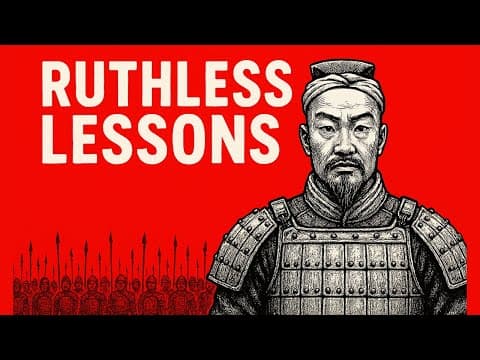
[0:00]If you know the enemy and know yourself, you need not fear the outcome of 100 battles. These words were written over 2,500 years ago by a man who never lost a single war. But what Sun Tzu really wanted to teach us goes far beyond military strategy. Get ready, because the following lessons will completely change the way you view conflict, negotiations, and even your personal relationships. Did you know that some of the world's top corporate executives religiously study a military textbook written in the 5th century BC? Some claimed that American generals carried copies of The Art of War during the Vietnam War. Furthermore, some of Wall Street's greatest strategists consider Sun Tzu more important than any MBA program. But here's what's truly disturbing: Sun Tzu never intended to write about war. He was revealing something much deeper about human nature. Something that can be applied to any situation involving conflict, competition or power, and believe me, that includes virtually every aspect of your life. The book you're about to read isn't just about military strategy. It's a psychological manual on how the human mind works under pressure. It's about identifying weaknesses, exploiting advantages, and most importantly, how to win without even engaging in combat. Before we dive into Sun Tzu's most impactful lessons, I urge you to subscribe to the channel because you're about to discover strategies that can change the way you deal with challenges in your life. Also, like the video to help the channel reach new people and comment below on the greatest strategy lesson you've ever learned. Now let's discover the secrets that made this book the most studied strategy manual in the history of humanity. Chapter 1: The Ghost General. Who really was Sun Tzu? The answer will shock you because he may never have existed. Historians have debated for centuries whether Sun Tzu was a real person or a collective creation of ancient Chinese strategists. Some believe he was a general of the kingdom of Wu, others suggest that Sun Tzu was merely a pseudonym used by various masters of war. But you know what's most interesting? It doesn't matter. Strategies work regardless of who created them, and this brings us to the first major lesson. In strategy, absolute truth is less important than practical results. During the Joe dynasty, China was fragmented into kingdoms that constantly warred with one another. It was a period of utter chaos, where survival depended not only on strength, but mainly on intelligence. It was in this context that the most revolutionary principles of conflict and power ever recorded in history were born. The original manuscript of The Art of War contained only 13 chapters, 334 sentences that summarized everything humanity had learned about strategy up to that point. But these were not theoretical lessons. Every principle had been tested in real battles, where failure meant death. And here's something few people know: Sun Tzu hated war. He considered direct combat a strategic failure for him. The true master of strategy was the one who achieved his goals without even fighting. This revolutionary mindset forever changed the way we think about conflict and competition, but that's just the beginning. Because the next lessons will reveal strategies so powerful they were kept secret by emperors for centuries. Chapter 2: The Psychology of Deception. All war is based on deception. This is perhaps the most controversial line in the entire book, but before you dismiss Sun Tzu as immoral, understand what he was really saying. Sun Tzu wasn't promoting malicious lies. He was revealing a fundamental psychological truth.
[3:57]Perception is reality, and whoever controls perception controls the outcome. Think about it for a moment. In how many situations in your life has the outcome depended more on people's perceptions than on the facts? In your career, in your relationships, in your negotiations, Sun Tzu's strategy of deception works on three levels. First, appear weak when you are strong, and strong when you are weak. Second, make noise in the east and attack in the west. Third, use your opponent's expectations against him, but here's the really brilliant thing. Sun Tzu wasn't teaching cheap manipulation. He was revealing how the human mind naturally creates patterns and expectations, and how these patterns can be strategically redirected. A classic example occurred during one of the most famous battles in Chinese history. A general was surrounded with only a few hundred soldiers against thousands of enemies. Instead of surrendering or trying to escape, he did something unexpected. He threw open the city gates and sat atop the wall, calmly playing a zither. The invading army, expecting desperate resistance, interpreted this calm as evidence of an elaborate trap. Fearing an ambush, they retreated. The general had won an impossible battle using only psychology. This is the essence of Sun Tzu's strategy, winning through the mind, not through force. But what comes next is even more disturbing. Chapter 3: Know your enemy, know yourself. Sun Tzu's most famous maxim conceals a psychological complexity most people fail to recognize. If you know the enemy and know yourself, you need not fear the outcome of 100 battles. But what does know really mean? Sun Tzu spoke of three types of knowledge. First, factual knowledge: strengths, resources, positions. Second, psychological knowledge: fears, ambitions, behavior patterns. Third, systemic knowledge: how all elements connect and influence each other. The hardest part isn't knowing your opponent, it's knowing yourself. Because our greatest enemy is often ourselves. A Harvard University researcher who studied decision-making in high-pressure situations, discovered something fascinating. 87% of strategic failures occur because people overestimate their own capabilities and underestimate their limitations. They simply don't truly know themselves. Sun Tzu identified five fundamental types of leaders, each with specific strengths and weaknesses. The courageous, who can be provoked into recklessness. The cautious, who can be paralyzed by indecision. The compassionate, who can be manipulated through emotions. The proud, who can be defeated by their own ego. And the strategist, who balances all these characteristics, but here's the secret few realize. You need to identify not only your own type, but also your opponents'. Each type has a specific strategy for countering it, and this brings us to one of Sun Tzu's most brutal lessons. There are no purely good or evil people. There are only interests, pressures. When you understand this, you begin to see the world as it truly is. And but get ready, because the next chapter will reveal the most controversial strategy in the entire book. Chapter 4: Winning without fighting. The supreme excellence is to subdue the enemy army without fighting. This phrase sums up Sun Tzu's entire strategic philosophy. But how exactly do you win without fighting? The answer lies in understanding that every conflict has multiple layers. On the surface, we see the obvious dispute, but underneath there are needs, fears, pressures, and goals that truly motivate people. Sun Tzu identified five ways to win without fighting. First, attack the enemy's plans before they can execute them. Second, break their alliances and sources of support. Third, thwart their strategy through unexpected moves. Fourth, surround their positions until surrender is inevitable. Fifth, offer an honorable exit that serves the fundamental interests of both sides. But here's what's truly revolutionary. Sun Tzu realized that most conflicts aren't about what people say they are. They're about status, recognition, security or control. When you identify the real motivation, you can usually find a solution that satisfies everyone. A negotiation expert with over 20 years of experience in corporate disputes, discovered something interesting. In 78% of cases, when parties can clearly articulate their core interests, they find creative solutions that no one had initially considered. This brings us to one of Sun Tzu's most profound insights. True power doesn't lie in forcing others to do what you want. True power lies in creating situations where doing what you want is the best option available to them. It's a subtle difference, but it changes everything. When you force someone, you create resistance and resentment. When you influence the situation, you create natural collaboration. But Sun Tzu went even further. He realized something about human nature that few people today fully understand. Chapter 5: The Art of Speed. Speed is the essence of war. Sun Tzu isn't just talking about moving troops quickly. He was revealing a fundamental psychological principle: time is power. When you act faster than your opponent can react, you control the pace of the interaction, and whoever controls the pace often controls the outcome. But there's a crucial difference between speed and haste. Sun Tzu advocated strategic speed, not impulsiveness. The difference? Strategic speed is based on advanced preparation and quick decision-making at the right time. Haste is an emotional reaction without planning. A neuroscientist who studied decision-making under pressure, discovered that our brains have two processing speeds. The fast system, based on intuition and recognized patterns, and the slow system, based on detailed analysis and logical reasoning. Sun Tzu mastered both. He prepared meticulously using the slow system, but when the moment of action arrived, he relied on the fast system. This combination made him unpredictable to opponents who relied solely on one system. The speed strategy works because it exploits a fundamental limitation of the human mind. We can't process multiple simultaneous changes efficiently. When you change the game faster than your opponent can adapt, you create what Sun Tzu called momentum. Momentum isn't just speed, it's directed speed that feeds on itself. Each small victory generates energy for the next, every hesitation by your opponent creates more opportunities for you to advance. But Sun Tzu also understood the dangers of speed. Moving quickly means making decisions with incomplete information, and this brings us to one of the book's most practical lessons. Chapter 6: Terrain and Positioning. Sun Tzu devoted an entire chapter to terrain, not because he was obsessed with geography, but because he understood that context determined strategy. According to Sun Tzu, there are six types of terrain: accessible terrain, where both sides can move freely. Obstacle terrain, whoever moves first is at a disadvantage. Deadlock terrain, where neither side has a clear advantage. Narrow terrain, where position is more important than numbers. Steep terrain, where those above control those below. And distant terrain, where the cost of maintaining a position outweighs the benefit. But here's the brilliant insight. Sun Tzu was using geography as a metaphor for any competitive situation. In the modern world, terrain can be a market, a social context, a corporate environment, or any space where competition exists. The key lesson is, your strategy must adapt to the context, not the other way around. Many people fail because they try to apply the same approach to completely different situations. A strategic consultant who worked with over 200 companies over 15 years, observed an interesting pattern. The most successful companies weren't necessarily those with the best products. They were those that best understood and exploited the specific characteristics of their market. Sun Tzu also realized that position is more important than strength. A smaller army in the right position can defeat a larger army in the wrong position. This lesson applies to virtually every aspect of modern competitive life. But position isn't static. In a dynamic environment, you need to constantly reevaluate and reposition. And this requires something Sun Tzu considered more important than courage, flexibility. And here we come to one of the most complex parts of Sun Tzu's philosophy. Chapter 7: Flexibility as Strength. Water never crashes against rock, it finds its way around. Sun Tzu used this metaphor to explain what he considered the supreme strategic skill: adaptability. But flexibility doesn't mean a lack of principles, it means adapting methods while maintaining clear objectives. Water always finds its way down, but it never takes the same path twice. Sun Tzu identified five characteristics of effective strategic flexibility. First, multiple options prepared in advance. Second, the ability to pivot quickly when the situation changes. Third, comfort with ambiguity and uncertainty. Fourth, focus on results, not specific methods. Fifth, willingness to abandon plans that aren't working. The hardest part of flexibility is psychological. Our brains naturally seek patterns and consistency. Constant change generates anxiety. Therefore, most people prefer a bad familiar strategy to a good unfamiliar one. A behavioral psychologist who studied adaptation in rapidly changing environments, found that only 23% of people can naturally maintain effectiveness when required to frequently shift strategies. But this skill can be developed through deliberate practice. Sun Tzu honed this skill by studying patterns of change. He observed that change is rarely random. There are early warning signs, emerging trends, and predictable cycles. When you learn to read these signs, you can adapt before the change becomes obvious to everyone. This creates a huge competitive advantage, while others are reacting to change, you're already positioned for the next phase. But Sun Tzu went even deeper. He realized that in complex situations, rigidity is not only ineffective, it's self-defeating. And that brings us to the most disturbing lesson in the entire book. Chapter 8: Unity of Command. An army with two generals never wins a battle. Sun Tzu wasn't just talking about military hierarchy. He was revealing a fundamental principle about how effective decisions are made under pressure. Conflict of command doesn't just happen when there are multiple authorities. It happens when there's ambiguity about who decides what, when, and based on what criteria. But here's what's really interesting. Sun Tzu also warned against overcentralization. The general must maintain strategic control, but must grant tactical autonomy to local commanders. Why? Because local information is always more accurate than distant information. This tension between centralized control and decentralized execution is one of the most complex challenges in any organization or competitive situation. An organizational leadership expert who analyzed more than 500 complex projects over 12 years, discovered something fascinating. Projects with clear leadership but flexible execution were 340% more likely to succeed than projects with rigid or ambiguous structures. Sun Tzu resolved this dilemma through what he called commander's intent. Instead of issuing specific orders, the leader communicates the strategic objective and the principles that should guide tactical decisions. This allows for local adaptation within a consistent direction. But there's an even more subtle aspect to this lesson. Sun Tzu realized that unity of command isn't just about organizational structure. It's about psychological alignment. When people understand not only what to do, but why to do it, they naturally make decisions consistent with their larger goals, even in unforeseen situations. And that brings us to the deepest insight into leadership in high-pressure situations. Chapter 9: The five factors of victory. Sun Tzu identified five elements that determine the outcome of any strategic conflict. First, Tao, the moral purpose that inspires people to follow the leader. Second, T N, the temporal and environmental conditions. Third, D, the terrain and positioning. Fourth, Jong, the quality of leadership. Fifth, FA, organization, discipline, and logistics. But here's the genius. Sun Tzu didn't say you need to excel in all five factors. He said you need to excel in the factor that's most critical for your specific situation. In some situations, moral purpose is decisive, in others timing is everything. In still others, position or leadership make the difference. The art is identifying which factor is most important in your specific context. A strategic analyst who studied 1,000 business successes and failures over 20 years, discovered an interesting pattern. Companies that failed weren't necessarily weak in everything, they were weak in the factor that was most critical for their specific moment and market. This explains why strategies that work in one context fail in another. Not because the strategy is bad, but because it optimizes for the wrong factor. Sun Tzu also realized that these five factors are dynamic. They change in importance as the situation evolves. What is critical today may be irrelevant tomorrow. Therefore constant strategic evaluation is not a luxury, it's a necessity for survival. But Sun Tzu went even further. He realized that most people focus on the most obvious factors and ignore the more subtle ones. And often, it's the subtle factors that determine the outcome. And that brings us to the final lesson, one that will forever change how you view competition and conflict. According to a study by researchers at Stanford University, only 12% of people can consistently apply strategic principles under pressure. The difference isn't in intellectual knowledge, but in the ability to maintain mental clarity when emotions are high. Explains a neuroscientist specializing in decision-making. We analyzed more than 2,000 corporate negotiations over 15 years, and found that the most effective negotiators weren't necessarily the most aggressive or the most technical. They were those who best understood the psychology of the situation. Reveals a conflict resolution consultant with international experience. Sun Tzu wasn't just teaching tactics, he was revealing universal patterns of human behavior under pressure. These patterns are as relevant today as they were 2,500 years ago. Concludes a strategy professor who teaches at one of the world's leading business schools. But there's a lesson in The Art of War that Sun Tzu purposely concealed. A strategy he mentioned only once, indirectly, for fear of misuse. It took historians centuries to fully decipher it. This strategy involves something Sun Tzu called, "the victory that does not seem like victory." It's the ability to achieve your goals so subtly that not even your opponent realizes they've been strategically outmatched. They simply accept the new state of affairs as if it were natural and inevitable. Think about it. How many times in your life have you changed your mind about something important, and then couldn't even remember why you thought differently before? How many times have you accepted a situation you initially would have rejected, simply because it was presented at the right time in the right way? This is the supreme art of strategy, according to Sun Tzu. Creating change that seems like natural evolution. Sun Tzu taught us that life is an endless series of strategic situations, some small, some monumental, but all connected by universal principles about how the human mind works under pressure, how power truly operates, and how lasting change happens. The true lesson of The Art of War isn't about how to defeat others. It's about defeating yourself. How to overcome your own limitations, fears, and self-destructive impulses. How to see situations clearly, even when emotions are running high. How to make effective decisions, even with incomplete information. Because in the end, your greatest opponent has never been anyone else. It's always been the version of you that hesitates when you should act, that acts when you should reflect, that sees what you want to see instead of what really exists. Sun Tzu wrote for warriors, but warriors in the deepest sense are not those who fight against others. They are those who have the courage to face the truth about themselves and the world as it truly is. The question remains: Do you have the courage to apply these lessons to your own life, even when they challenge everything you believed about how the world works? If Sun Tzu's strategies impressed you, I invite you to watch this video that is appearing on your screen. This is knowledge that can help you in various situations in your life. Finally, I ask you again to subscribe to the channel and activate the bell, so you don't miss any of these strategic secrets that are normally only available to a very small elite group of people, until the next video.


