[0:00]Two years ago, Judy Woodruff began traveling the country to examine the roots of division for her series, America at a Crossroads. Tonight, she returns with a conversation with someone who has spent his life considering such questions. fundamentally undermining the American constitutional order, changing us from being a democracy. Now 84 years old, Harvard Professor Emeritus Robert Putnam has spent decades studying how American society evolve from one that however flawed, was steadily moving towards greater connection. Equality, cooperation and cohesion. Ask not what your country can do for you, ask what you can do for your country. To one that in more recent decades has been defined by growing isolation, distrust, inequality and political discord. My recent election is a mandate to completely and totally reverse a horrible betrayal and all of these many betrayals that have taken place. To the point that Putnam now worries these forces threaten to upend the Constitution. they're talking about not obeying court orders. I mean, come on. That's, that's, the court system, better or worse, is currently the last bull work of our democracy. So we're awfully close to breaking the bounds that have kept us our democracy safe. How many in the in the room uh are on a bowling team, a bowling league? Paul Solomon first profile Robert Putnam on this program 30 years ago when Putnam published his essay bowling alone. Which would become his groundbreaking book, showing that since the high watermark of the 1960s, Americans had become steadily more isolated. And that this was weakening civic engagement and undermining our democracy. That is a primary cause of the Trump phenomenon. That's true, you can see it in the data, but you don't have to trust me, Steve Bannon has said publicly when you know, back in the day when they were trying to figure out how they could get Trump elected. They read this book by this crazy academic called Bowling Alone and that guided their, I'm not proud of this, but that that guided their strategy because they thought, just as I had been writing, that when people are socially isolated as we are increasingly, um, they become vulnerable to populist appeals. So that's the first point we are increasingly socially isolated and that makes our country vulnerable to to I was going to say fascism, that isn't quite true, but it's close to being true. The poor kids who live here now are living in a completely different universe than the rest of the kids in town. In 2015, Putnam chronicle another major concern with his book Our Kids, the growing gap between increasingly well-off college-educated Americans and everyone else. Now one of the greatest predictors of who supports Donald Trump. Well, until we fix the underlying problem, basically there's two pairs of underlying problems, increasing social isolation and especially in the non-college educated part of the population. We're constantly vulnerable to that same kind of pressure for the same reason that we were vulnerable when he came along. I met Putnam last week just off Washington Square Park in Manhattan at Judson Memorial Church. Founded in 1890 by American Baptist Minister Edward Judson with money donated by John D. Rockefeller. With a mission to provide aid and comfort to the poor immigrants living in the squalid tenements nearby. You come and have a place that is beautiful to look at away from what they were experiencing in the tenement houses. Today, Putnam sees strong parallels between that era, the post-Civil War period known as the Gilded Age, and our own. America was extremely polarized. Politics then was very tribal, just like it is now. Inequality was very high then, that was the last time the gap between rich and poor was anywhere near as as it is now. So, very polarized, very unequal, very socially disconnected, very socially isolated because then industrialization meant that millions of people had just moved from a village. A village in Sicily or a village in Iowa, to the big city. They left their family and friends and connections behind, so they were very disconnected, just like we're very disconnected and they were very self-centered if I can put it that way. Americans in that period were focused on I and not on the we. Putnam's most recent book, The Upswing, describes these many parallels in detail. And how out of those challenges came an explosion of new civic, religious and social groups. The boy scouts, the NACP, the Rotary Club, the General Federation of Women's Clubs, as well as the many reforms that came to be known as the Progressive Era. The federal income tax, women's suffrage, labor rights and more, changing the course of the following decades. All of a sudden we began to become more equal, less polarized, more connected, and a greater sense that we're all in this together. What did they do? Well, there are both positive and negative lessons, actually, I have to say. And I thought for sure, I knew what would change first. I thought it was the economic economics and I thought maybe the economics would change first. We begin to become have more equal economically and then our politics would improve and so on. The one thing that data show is that's not true. Economics was the last thing to change. So then what was the first thing to change? And to my shock, it was cultural change. It was a moral revival is the way I want to put it. People began to say, wait a minute, it's not all about us, we have obligations to other people. One example he points to was the Triangle Shirtwaist Factory fire, just a few blocks from where we were speaking. In 1911, a fire broke out there in a sweat shop, trapping garment workers locked inside, dozens jumped to their deaths. 146 women died in all, shocking the conscience of the city and beyond. Including a young woman named Francis Perkins, who was having tea with friends nearby. Up to that point, she had been thinking of herself as a debutante. And she said, that's evil. We have obligations to those people. Almost immediately she became a social reformer right here in New York City, and eventually she became FDR's Secretary of Labor, the first woman uh cabinet member in American history. And it was all because of that moral moment in which she realized she had obligations to other people and that's one example among what was happening a lot. I sort of think that it's going to be hard for us to turn things around in America. Until we begin to recognize we have obligations to other people that are at least as important as ours. This is a film about why you should join a club. And why the fate of America depends on it. Putnam's life story and work have been recently captured in the documentary Join or Die, encouraging people across the country, especially young people, to again seek out organizations and connection in their own communities. To find issues they're passionate about, and to affect change from the bottom up like the progressives did. But to also go beyond that movement to include Americans of all colors, backgrounds and beliefs. One of your points is that this is something that happened at the grassroots level. It didn't come out of Washington, it didn't come from the White House, handed down. or Harvard or whatever, yes. Do you believe that the ingredients are there for that to happen again? It is happening now. I mean not enough of it. We need to, well, your show this whole series is doing that. You and I both know from our own personal experience that this is happening and we a lot more of it is needed. But that's where it'll begin. I am not a determinist. I don't think any of these things are guaranteed to happen. I don't think it was guaranteed to happen last time. I don't think there was some, you know, big cycle in the skies or God or something that was saying, oh, there will be a progressive area here. I think it happened because a smallish number of young people around 19, between 1900 and 1910, decided, like, you know, Francis Perkins right here. She decided then she was going to help change America. It was not inevitable, it is not inevitable this time, but it could happen. That's why I'm saying the distinction between, will it happen? I don't know whether it will happen, but I know it could happen because it did happen. And that will be the focus of many of our stories this year. For the PBS NewsHour, I'm Judy Woodruff in New York.
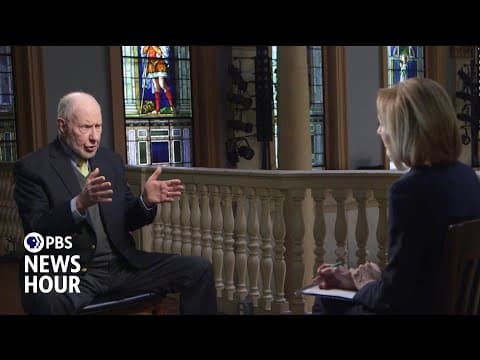
Robert Putnam reflects on how America became so polarized and what can unify the nation
PBS NewsHour
9m 27s1,468 words~8 min read
YouTube auto captions
Transcript source
YouTube auto captions
This transcript was extracted from YouTube's auto-generated caption track. The transcript below is server-rendered so it can be read, searched, cited, and shared without opening the original YouTube player.
Pull quotes
[0:00]Two years ago, Judy Woodruff began traveling the country to examine the roots of division for her series, America at a Crossroads.
[0:00]Tonight, she returns with a conversation with someone who has spent his life considering such questions.
[0:00]fundamentally undermining the American constitutional order, changing us from being a democracy.
[0:00]Now 84 years old, Harvard Professor Emeritus Robert Putnam has spent decades studying how American society evolve from one that however flawed, was steadily moving towards greater connection.
Use this transcript
Related transcript hubs
Watch on YouTube
Share
MORE TRANSCRIPTS


