[0:00]Whitney Houston's death has us talking about her fight with addiction for so many years. And we don't know if it played a role in her death, but we do know that for more than 23 million Americans fighting addiction, quitting, not it's just not a matter of willpower.
[0:15]New research actually reveals that substance abuse causes lasting changes in brain function. We're going in depth this morning with our host of Sanjay Gupta, MD.
[0:25]Sanjay Gupta, our resident doctor, our, you know, the list goes on.
[0:30]do everything basically. Um, all right, let's talk about your piece and and I guess why did you choose, I mean, this is your expertise, the function of the brain.
[0:40]what exactly the brain looks like in someone who who has addiction, who's going through this, is a pretty remarkable thing, and I think it gives us a lot of insight into how it should best be treated and also understand it.
[0:51]Uh, that that's what I'm trying to do here. And I want to explain a couple of things quickly.
[0:55]First of all, this idea that someone has uh, some sort of anticipation of taking a substance. Uh, that's sort of the first step, but then there are two important steps after that in the brain.
[1:03]Stick stick with me here. So, so imagine, for example, as you take a look at this animation I'm about to show you, that someone takes a a drug of some sort.
[1:12]What happens there and this is the middle of the brain is that there is a sense of euphoria.
[1:16]That's dopamine there, those small little particles, that makes you feel good.
[1:19]That that's Is it any kind of drug? We talking everything from cocaine to Xax.
[1:23]Yeah, that there are just just about any kind of drug and not even drugs necessarily.
[1:27]It can be other things too, certain food substances, sugar, for example, there can be a certain addiction quality, but I think what's important is the next step.
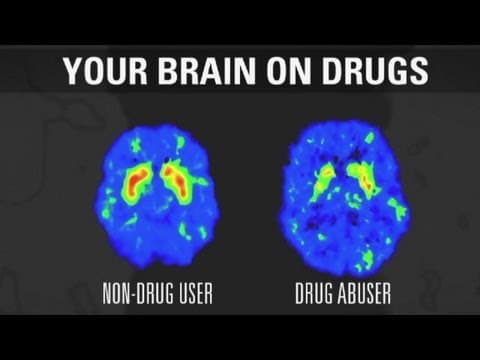
[1:33]So you have that euphoria, but in someone who's a true addict, take a look at this picture here.
[1:38]Uh on the left side of the brain is you see the bright areas, that's still feeling good, that's the euphoria.
[1:43]But on the right side is someone who has an addiction now, not as much of that bright spot, and that is relevant, why?
[1:50]Because they need more and more of the substance to try and get that euphoria back.
[1:55]Think about that for a second. You take the substance, you feel good, but in an addict, that that good feeling doesn't last.
[2:00]So what do you do? You take more more than ever before.
[2:03]And that's sort of the the basic, sort of simplistic, but basic form of addiction. Are those changes permanent?
[2:08]Well, they last a long time, and and exactly how long is a is a little bit of a subject of controversy.
[2:14]But people say you can eventually get to the point where your brain does feel natural pleasure again, but that can take some time.
[2:20]What doesn't go away is this idea of the memory of the addiction.
[2:24]So say you're a cigarette smoker, quit for 10 years, pick up another cigarette and start smoking again, and right away you can go back into addiction.
[2:31]Whereas if you've never smoked before, it would take you some time to build up that addiction again. It's like what they say, well, I mean,
[2:38]folks that we know that have gone through treatment, say once an addict, always an addict, there's truth to that, right?
[2:45]It's a you aren't just cured, it's a constant battle to stay away from the temptation or feel that euphoria, right?
[2:51]That's right. And people say that, but I wanted to show the pictures of the brain to really explain why that is. You see that that dark areas of the brain.
[2:57]You you need a lot of the substance to get that euphoria back, so that's why relapse occurs so quickly.
[3:03]They say three days of acute withdrawal, which is painful, three months where you're the most sort of subject to relapse again,
[3:10]and three years before you really start having natural sort of pleasure again from substances.


