[0:01]This UCSD TV program is a presentation of University of California Television for educational and non-commercial use only.
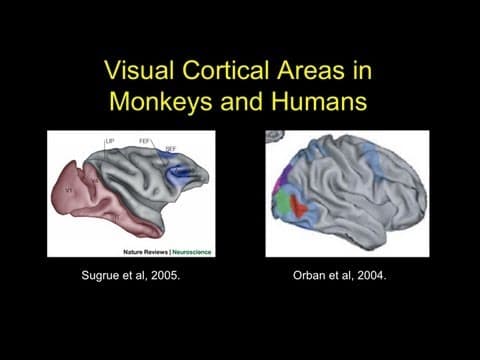
[0:52]Okay, well good afternoon everyone. Well, as you all probably know, there have been many attempts to teach human language to apes, but thus far, no ape has surpassed the level of language competence of about a three-year-old human child. And that, of course, suggests that there must be something fundamentally different about the human brain that allows us to keep, to keep going where apes stop. One obvious possibility for for explaining why humans have language is the fact that our brains are between three and four times larger than the brains of chimpanzees, for example. But the problem with this hypothesis is that there are actually some human beings with chimpanzee-sized brains, um, we call these people microcephalics. And the high-functioning among them have language abilities that exceed those of language-reared chimpanzees. And so that suggests that language isn't only about quantitative differences in the brain, but it's also about qualitative differences. There must also be some differences in the way the brain is organized. So what do we know about how the human brain processes language? Well, this is the classic model of of brain language processing that you're apt to see in textbooks today. It was proposed by uh Geshwin back in the 1970s, and according to this um model, there's an area back here in the posterior part of the left superior temporal gyrus, um, which is known as Wernicke's area, which is involved in speech comprehension. And there's another area up here in the left inferior frontal cortex known as Broca's area, and that's involved in speech production. And those two areas are connected by a very thick bundle of white matter fibers um called the arcuate fasciculus. So if we were going to look for special features of the human brain that could explain why we have language, it would make sense to look in these general areas. What you see here on the on the left-hand side is a surface reconstruction of a macaque brain, and on the right is a surface reconstruction of a human brain. And the macaque brain has obviously been uh enlarged to the size of the human brain. But what you see in color are those areas of the cerebral cortex that are involved in processing visual information in macques and in humans. And back in uh 1998, uh neuroscientist by the name of Leslie Ungerleider made an important observation, which was that, you know, it seemed that relative to the position of the visual cortical areas in macques, the human visual cortical areas had been displaced in a sort of posterior and ventral direction. And she said, you know, they look they look to be in a somewhat different position such that there's this very large expanse of cortex in the human brain that in macques would be devoted to vision, but in humans is not devoted to vision. It's involved in something else. And she speculated at that time that that sort of additional expansion of cortex was an evolutionary adaptation for language that evolved in in the human lineage. So what I'd like to do today is to um try to evaluate that hypothesis a little bit further with some additional evidence. And specifically, I'll try to answer two questions related to that hypothesis. Um, first, has there indeed been expansion of cortex on the lateral surface of the human temporal lobes? And secondly, do we know whether this cortex is, in fact, involved in language? And just to put you out of your suspense, um, the answer to both of those will be, yes. Okay, so I I'll try now to show you some evidence in support of those answers. Um, I'll talk about evidence from structural MRI scans, from a newer technique called diffusion tensor imaging and tractography. Um, I'll talk a little bit about um studies of stroke patients and and the lesions that they have, and then uh finally, a little bit about uh functional MRI studies. So first, has there, indeed, been expansion of this cortex? And it's an important point that to answer that question, we can't just compare humans and macaque monkeys, because macques are a quite distant evolutionary relative of ours. We really need to compare humans with chimpanzees because they're our closest living primate relative. It's only when we find uh a character of the brain that's present in human, but is not present in chimps or other primates that we can conclude that this is truly a human specialization. So the chimp data points are critical for these types of um studies. So, well, one obvious question is what is visual cortex look like in chimps? Do they look more human-like, or do they look more macaque-like? Well, unfortunately, the methods that were used to map visual cortex in macques are too invasive for us to use in chimpanzees. And the methods that were used in humans are really too impractical for us to use in chimps, it involves functional um MRI, which is difficult to do in chimps. So, we don't really know exactly where the visual cortical areas are in chimpanzees. But thankfully, it turns out that just using garden variety structural brain imaging, we can gain some insights into where the visual cortex is located in chimps. And so this is a um adult female chimpanzee being uh prepared for her MRI scan. She's anesthetized and um getting ready to go into the MRI scanner. The uh image that you see on your left is what we call a T1-weighted MRI image, and the image that you see on your right is a T2-weighted MRI scan, and um this is pretty much, looks like the negative of the T1 scan. We can put subjects in the MRI scanner, and we can acquire a T1-weighted scan of their brain. And then we can acquire a T2-weighted scan of their brain. And then what we can do is we can make a third image, which is the ratio of the T1-weighted signal to the T2-weighted signal. And that's what um my former student and now colleague Matthew Glasser has done, and I'm going to be showing a lot of the work that he's done recently. Um, this is, in fact, uh a T1-weighted to T2-weighted image, and what you're seeing is the the uh surface reconstruction of that image. And what he's done here is he's applied a color scale so that the regions that have the highest T1 to T2 ratio are in red and yellow, and the regions with the lowest T1 to T2 ratio, um, are in this sort of blue to to purple range, or or no color at all. Okay, the reason this is interesting is that it turns out that the ratio of T1 to T2 is very closely correlated with the distribution of myelin across the cerebral cortex. So, most of you probably know that myelin is the fatty substance that coats axons that are the connections in the brain. And the same regions that are very heavily myelinated also have a very high ratio of T1 to T2. It turns out that the most highly myelinated areas of the cortex are the primary cortical areas. So this is the primary motor cortex, this is the primary somatosensory cortex, this is the primary auditory cortex, and this is the primary visual cortex. These other areas are that are less highly myelinated are the heteromodal association cortex where information from different sensory modalities is integrated and some of the higher cognitive processing is going on. So this is a really exciting tool because it allows us to sort of parse the cortex up into areas that are involved in in perception, the the basic primary cortical areas and areas that may be involved in more conceptual processing, the association areas of the cortex. Okay, so then uh Matt went ahead and did the same analysis on the chimpanzee um cortex, and I think the first obvious thing that you notice is that there's a whole lot more color in the chimp um cortex, which implies that there's a much greater proportion of primary cortical areas in the chimp brain, or a much smaller proportion of those higher-order association cortices. If we put the human and chimp brain side-by-side, you can see it even more obviously, I think. So the the chimp brain here has been enlarged to the size of the human brain, and these brains are kind of inflated a little bit so you can see the sulci um better. But um you can see that that there's uh a lot more association cortex here in humans. I want to draw your attention though to the temporal lobe, because I'm talking about language today. And uh point out a couple of areas. So I mentioned that primary auditory cortex is is this region here in chimps, and in humans it's um right here. And then these areas back here are visual cortical areas, area MT and area MST in chimps, and you can see that they're very close to primary auditory cortex in the chimp brain. But in humans, um those areas are some distance away from primary auditory cortex, and in particular, there's been a lot of expansion in this uh association cortex down here involving the middle temporal gyrus, abbreviated MTG, and also the superior temporal sulcus, which is the sulcus just above it. So it really does look like there's been some important expansion of cortex, of association cortex on the lateral surface of the temporal lobe in humans. And so um my answer to the first question is, yes. Um, let's move on then to the second question. What is the evidence that this cortex is, in fact, involved in language? Well, I mentioned that this fiber pathway called the arcuate fasciculus, um is a known language pathway. So one question we might ask is, does the arcuate fasciculus project to this region of expanded lateral temporal cortex in humans, right? If a language pathway um connects with this area of cortex, it implies that that cortex may be involved with language. Um, so with uh this newer technique called diffusion tensor tractography, we're able to make reconstructions of fiber tracts um after imaging people or chimpanzees in vivo. And the technique is based simply on the diffusion of water. So you image the diffusion of water in the brain, and it turns out that water will uh preferentially diffuse parallel to the direction in which fibers are oriented, uh, rather than perpendicular to them. And so we can use the information about the direction of uh water diffusion in the brain to uh make these types of reconstructions of uh pathways. So this is the arcuate fasciculus and this is the, its termination in Wernicke's area, and Broca's area would be um up there. So, we reconstructed the um arcuate fasciculus pathway in humans, chimpanzees, and rhesus monkeys. And our results are shown over here on the left-hand side, but let me, uh, just sort of summarize for you schematically over on the right. So, we found that the arcuate fasciculus um, indeed, projected to classic Wernicke's area in the posterior part of the superior temporal gyrus, but that projection was dwarfed by a massive projection uh ventral to it that hits um both the superior temporal sulcus and especially the middle temporal gyrus. So, indeed, the very same regions that seem to have expanded in human evolution are the targets of the arcuate fasciculus language pathway. In chimps, um, we also found a projection into what we believe is the homolog of Wernicke's area in chimps, but there were very minimal projections ventral to that. And in uh rhesus monkeys, um, we also found a projection to what's thought to be the homolog of uh Wernicke's area in in rhesus monkeys. Here you can see what Matt has done for us here is shown us, um, the cortical surface terminations of the arcuate fasciculus. So this is the regions of the cortex that receive fibers of the arcuate fasciculus. So the fascicle is actually buried down in the white matter, um, underneath the surface of the brain, but this is where it comes up and hits the surface of the cortex. And what he's done here is just outlined roughly the posterior border of those arcuate fasciculus terminations on the cortex, and what you'll see is that coincides very well with the anterior border of the uh visual cortices that are back here, these heavily myelinated visual cortices. And so it looks for all the world like the um cortex that is receiving the arcuate fasciculus projections is language cortex is sort of pushing the visual cortex around in the human brain, which is what Leslie Ungerleider had hypothesized. Um, here's further evidence to suggest that this cortex in the middle temporal gyrus and the superior temporal sulcus is involved in language comes from studies of um stroke patients that uh develop uh aphasia's.
[16:07]Um, so this shows you the foci of of brain damage that results in impairment in auditory sentence comprehension. Um, and those are the exact areas that we've been talking about, STS and MTG. This is a review um by uh Dronkers et al. And um, finally, a final source of evidence comes from functional MRI studies where you put subjects in a MRI scanner and you image their brains function as they're performing um different verbal semantic tasks. And uh these are the areas in pink that are activated most often across lots and lots of different studies. And so once again, the the middle temporal gyrus is a prime candidate. You don't see the STS here, but there are other reviews that have argued that the superior temporal sulcus is involved in some components of syntax. So when we think about the special features of human language, we think of syntax, the the rules about how we put words together into sentences. And we also think about lexical semantics, how we understand the meaning of words. And I think this area of cortex is is a really key area for those two um functions. So, um, my answer to the second question is also, yes. And um, let me just uh, go ahead and summarize um, what I've said. Uh, first, that human brain evolution appears to have been characterized by expansion of this association cortex on the lateral surface of the left temporal lobe. Um, second, this expanded cortex is receiving projections from the arcuate fasciculus, which is a known language pathway. It also looks as though the arcuate fasciculus may have pushed this uh ILF pathway ventromedially in the human brain. And finally, uh, lesion and fMRI studies also implicate this region as being involved in language. Um, I'd like to thank, uh, especially, um, Matt Glasser, who did most of the analysis in this, uh, talk. Um, Todd Preuss has been instrumental in all of this work. This is a, um, project that is being led by him and and Jim Herden at the Yerkes Primate Center to acquire all of these MRI scans from chimpanzees. Um, I'd like to thank the imaging, the imaging people, and our imaging centers, and also, um, Dr. Tim Behrens at the University of Oxford. Thank you very much for your attention.
[19:39]Television unlike anything else.W.


