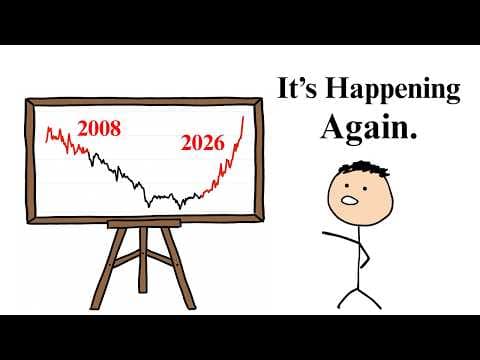
[0:00]The biggest risk to the United States economy was never the AI bubble, it was never China, and it was never the orange man in the Oval Office. It's something much more boring, and it's something you've likely never heard about, unless you've gone deep down the finance rabbit hole. And that's exactly why nobody's paying attention to it. Because if you've been wondering why mortgage rates refuse to fall, why stocks randomly freak out every few months, and why the Federal Reserve can talk about cutting rates but financial conditions still feel tight, the answer doesn't start in Washington. It starts in Tokyo, and more specifically, in the most boring asset on Earth, Japanese government bonds. Because the country best known for attracting American Weebs has also been the duct tape quietly holding the global financial system together for the past 30 years. And that duct tape is starting to peel. But to understand why Japan is so important, you first have to rewind to the early 1990s. Because 30 years ago in 1992, Japan's asset bubble burst. Real estate collapsed, equities collapsed, and Japan entered what became known as the lost decades. It was a three-decade-long period of being financially f***ed. There was no real growth, no inflation, and no wage expansion. It was like the economy hit pause, and nobody could find the remote. So the Bank of Japan did what central banks do when they're out of options. They cut rates to zero, and then they cut rates below zero. And then, when that wasn't enough, they introduced something called yield curve control, which sounds like a Marvel villain. But actually just means we're going to cap long-term bond yields, whether the market likes it or not. Basically, the Japanese government superglued interest rates to the floor, so for decades, Japanese government bonds yielded pretty much nothing. And that created massive problems for Japanese investors. Because imagine you're a Japanese life insurer, pension fund, or even a bank. You have a billion dollar investment portfolio and your domestic government bonds are paying you 0%. This pretty much leaves you with two choices. One, accept no return on your cash, or two, go shopping overseas. And they chose option two. So Japan entered a multi-decade-long global shopping spree that led them to become the largest foreign holder of US Treasuries, one of the largest buyers of US mortgage-backed securities, and the world's largest net creditor nation. Which is just the formal way of saying Japan became the world's ATM. And it's not because Japan just loves sending capital to America, but it's because the math made sense. And here's how it worked. Meet Bob. Bob wants to start making some money through investing. So Bob goes to the Japanese markets and borrows money in Yen at near zero interest rates. Then Bob converts that Yen into dollars and buys US treasuries that yield 4%. And after hedging costs and fees, he pockets the spread. And that's what became known as the Yen carry trade. Investors would borrow in Yen at near zero interest rates and then invest in foreign assets that yielded higher returns. And when investors borrowing costs are near zero, they don't just buy treasuries, they buy tech stocks, they buy real estate, and they buy into emerging markets. Basically, if it's got a pulse, and it yields more than 0%, they'll buy it. And that's why for years, this trade became one of the largest sources of global liquidity. At its peak, the Yen carry trade was estimated by some banks to be in the trillions. It was like the global markets were running on Japanese Wi-Fi. But the problem was that the entire trade relied on one assumption that held everything together, that Japanese yields would stay near zero forever. But in 2024, that assumption broke, when the Bank of Japan ended its yield curve control policy. And Japan raised interest rates for the first time in 17 years. And then they raised them again.
[3:37]And immediately following that second rate hike decision, the S&P 500 dropped 6%. And Japan's index, the Nikkei 225, plummeted over 12% in a single day, marking its worst drop since 1987. It was a clear signal that markets were officially spooked. Because when Japanese yields rise, two things happen. One, borrowing in Yen becomes more expensive. And two, hedging currency risk becomes more expensive too. And suddenly, the free money trade isn't so free anymore. And that 4% US Treasury Bob was looking at, doesn't look so good anymore. And this was the beginning of the end for the Yen carry trade. Because now the math had flipped, and the trade was no longer a no-brainer, and when the math flips, the capital flows flip too. And the money that flowed out of Japan for decades was starting to return home. And this is what's called repatriation, and it's one of the biggest threats in global markets today. Because investors are starting to realize the uncomfortable truth. The cheapest source of global liquidity for the past 30 years is no longer cheap. But here's why it actually matters. Because for decades, Japan wasn't just some random buyer of US debt. They were one of the most consistent, price-insensitive buyers of long-term treasuries. And the yields on those long-term treasuries, well, they aren't set by Jerome Powell. The Federal Reserve controls short-term rates. But the 10-year, 20-year, and 30-year, well, those yields are largely determined by supply and demand. And the problem is, everyone's staring at the wrong lever. And here's legendary investor and founder of the world's largest hedge fund, Ray Dalio, to explain it. Watch the bond market. The bond market is the basis. It's the backbone of all markets. It is the risk-free, meaning default-free, probably default-free, interest rate that determines what all asset returns are going to be. And when there is a breakdown of the supply demand picture for the bond market, you see a certain type of market action. You see long rates rising relative to short rates. You see the currency go down. You see gold go up because there's a movement out of that bond market because there's a supply and demand imbalance. When that happens, that raises interest rates, and it puts the Federal Reserve and other central banks in a bind. So while everyone is hyper-analyzing Jerome Powell's press conferences like it's a new GTA 6 trailer, they're looking at the wrong end of the yield curve. Because while the Fed has some indirect influence on long-term rates, what they really control is short-term rates, the overnight rate. But the long end of the yield curve is driven more by supply and demand. And when you add in the fact that the United States is running trillion dollar deficits annually, even a slight reduction in demand matters. Because the Treasury has to issue massive amounts of new debt every year just to keep the lights on in the economy. And as this debt issuance keeps growing, someone has to absorb it. And for the last few decades, Japan was a key part of that absorption machine. But before I explain why if Japan backs out, we are totally f***ed. A quick pause, because this video is sponsored by Gamma. I personally use Gamma because the hardest part about creating finance videos isn't the research. It's turning scattered ideas into a clear structure. Because when I'm breaking down complex topics like the cross-currency carry trade, the thinking is messy at first. It's notes everywhere, half-formed arguments, and connections that make sense in my head. And if the structuring isn't clear, the whole thing falls apart. And that's where Gamma comes in. Gamma isn't just a presentation tool, it's the bridge between your raw ideas and real polished output. Here's how I've been using it. First, I'll start inside Claude and upload whatever data, research reports, and any other scattered notes I have. From there, I go into Claude's settings and enable the new Gamma connector. Now, here's where the magic really happens. All I have to do here is ask Gamma to create me a presentation based on everything I've uploaded. And in seconds, it builds a clean structured deck that turns my scattered notes into a coherent presentation. And the best part, if I find new information or add new context in Claude, it'll simply update the Gamma deck as my thinking evolves without rebuilding it from scratch. Gamma allows you to go from brainstorming to a finished deck without losing any momentum. And it's not just limited to Claude. Gamma can connect to your GitHub, Notion, and even your Gmail. Gamma makes sure your ideas don't stay trapped as notes. If you're interested in checking out Gamma, you can head to gamma.app, or you can find it directly inside Claude Connectors. Thank you again to Gamma for sponsoring this video. Now, back to how Japan might f*** our economy. Because if one of the largest historical buyers of United States Treasury stops buying, then yields have to rise to attract new buyers. And that's how supply and demand shape long-term bond yields. But that's also how you can get a situation where the Fed cuts the federal funds rate, short-term yields fall, but long-term yields stay elevated. And that's how you get what's called a steepening yield curve. And if this happens and long-term rates stop cooperating, then it stops being just a bond market story and then becomes an everything story. Because when analysts build models to value stocks, they discount cash flows using long-term yields as a baseline. And when long-term yields remain elevated, the present value of future cash flows in these models decreases, which means valuations compress and stocks trade at lower multiples. So even if earnings are fine, the price investors are willing to pay for those earnings changes. And that's why markets can suddenly feel unstable, even when the headlines look calm. But it doesn't just stop at the stock market, because the 10-year treasury yield isn't just some nerdy number on Bloomberg. It sets the price of money and is the foundation of nearly every asset valuation. And mortgage rates are another example of this. Because, like stock valuations, mortgage rates are largely anchored to long-term treasury yields. So, if the 10-year yield doesn't meaningfully fall, mortgage rates don't magically drift back to 3%. So the Fed can cut the federal funds rate all they want, but if global demand for treasuries weakens, then the long end of the yield curve stays pinned. And when that happens, mortgage rates stay high, housing affordability stays strained, refinancing activity stays muted, and home transactions slow. But it's not just mortgage rates and equity valuations, because if you zoom out even further to corporate credit, it's the same story. If you remember back when capital was cheap in 2020 and 2021, when rates were suppressed, companies were issuing debt like it was Black Friday, and interest rates were 90% off. And when companies have access to cheap financing, we see increased deal flow, higher valuations, and more activity. And that's because credit is the bloodstream of the corporate world. But if borrowing costs stay elevated, we see the opposite. We see risk appetite fall, growth slow, and capital tighten. And this is the main point of the video, because for 30 years, the United States benefited substantially from being on the receiving end of the world's largest carry trade. And now that trade is unwinding. And as Ray Dalio said, the bond market is the backbone of all markets and the interest rate that determines what all asset returns are going to be. And what we are currently seeing is a tangible catalyst reshaping the foundation of the bond markets. And there's a reason why traditional financial media is ignoring this. It's because it's not clickable, and because it wouldn't trend on Twitter. Nobody wants to hear, let's discuss the cross-currency carry trade and how Japanese institutions are reallocating capital. Because that requires patience and nuance, and more brain cells than doom scrolling allows for. Instead, people want inflation, they want AI, and they want whatever Nvidia did last week. They want the topics that are visible, loud, and create headlines. So instead, the narratives become dramatically oversimplified to, if the Fed cuts rates, financial conditions will ease, and that's not necessarily true. And that's the lie we're being sold, that one rate cut fixes everything, that liquidity is automatic, and that someone, somewhere will always show up to buy our debt. But what if they don't? And what if the largest foreign holder of US Treasuries decides to take a step back? Well, then you see global liquidity tighten, and liquidity is the oxygen in markets. And when it tightens, well, that's the cost of money changing everywhere. And like I covered, it affects everything, from stock valuations to mortgage rates to corporate credit. And that's why I made this channel, because I want to shine a light on the issues that actually matter. The issues that traditional financial media won't touch because they don't get clicks. So if you're interested in knowing about what's actually happening in financial markets, hit subscribe and turn notifications on. Because I'll be covering the stuff that traditional financial media won't, because the real threats in markets aren't the loud ones. Those are usually priced in. The real threats are the ones hiding in plain sight.


