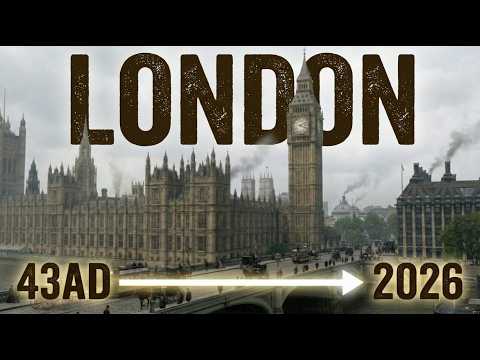
[0:00]Stand on any street corner in London today and you'll hear a dozen languages in as many minutes. Nearly 40% of Londoners were born outside the UK, making this one of the most diverse cities on Earth. But rewind 2,000 years and you'd find marshland along a tidal river, barely inhabited, strategically useless to anyone except the Romans. What happened in between? Invasion, fire, plague, revolution. A small trading post that became the heart of an empire. A city burnt to ash and rebuilt from stone. Through conquest and catastrophe, London kept growing, kept adapting, kept pulling people in from everywhere. For centuries, we've had to imagine what those earlier versions of London actually looked like. Artist sketches, faded engravings, descriptions in old journals. But now, using AI trained on historical imagery, we can take those original drawings and paintings and see them as they might have appeared in real life. The cobblestones, the crowds, the smoke rising from medieval chimneys. You're about to witness almost 2,000 years of history in one video. Sit back and relax as we journey through the incredible history of the capital of the United Kingdom, London. Let's go back to where it all began. The Romans. The year is 43 AD. Four Roman legions have just landed on the Kent coast and they're pushing inland. They need a place to cross the Thames. Somewhere they can build a bridge and establish supply lines back to the continent. They find it here at the river's lowest crossing point before it widens into an estuary. Within a decade, Londinium is bustling. Merchants from Gaul, soldiers from Syria, traders from North Africa. The Romans build their bridge exactly where London Bridge stands today. Around it, a port town springs up almost overnight. But 17 years after its founding, disaster strikes. Queen Boudicca of the Iceni tribe has had enough of Roman occupation. Her army marches on Londinium and burns it to the ground. Archaeological digs have found a layer of red ash beneath the modern city, evidence of that destruction. The Romans rebuild, bigger than before. They construct a massive wall around the city, parts of which still stand 2,000 years later. At its peak, Londinium is home to maybe 60,000 people, the largest city in Britannia. Amphitheaters, bathhouses, forums. This isn't some frontier outpost anymore. It's a proper Roman city. Then, by around 410 AD, Rome itself is crumbling. Barbarian tribes are hammering the Empire from all sides and Britain is too far away, too expensive to defend. Emperor Honorius sends word. "You're on your own." The legions pull out. Without Rome, Londinium's entire economy collapses. The trade networks that brought wine from Gaul and olive oil from Spain simply stop. Roman currency becomes worthless. The merchants leave, the officials leave, the skilled craftsmen leave. Within a generation, a city of perhaps 50,000 people dwindles to a few hundred squatters living in the ruins. For the next two centuries, the grand buildings slowly fall apart. Roofs cave in, walls crumble, weeds push through mosaic floors. But the Thames keeps flowing and rivers have a way of attracting new people with new ideas about what a city should be.
[4:10]The Saxons. The Saxons who settle in Britain after the Romans leave, don't particularly like cities. They're farmers, village people. They actually avoid the old Roman city, seeing it as haunted, cursed. One Saxon poet calls the ruins "the work of giants." They can't imagine how mere humans could have built such massive structures. Instead, around the 670s, they build a new settlement about a mile west of the Roman walls. They call it Lundenwic, "London trading town." This is where modern Covent Garden and the Strand are today. If you're watching a performance at the Royal Opera House, you're sitting directly above Saxon London. By the early 700s, goods are flowing in from all over. Amber from the Baltic, millstones and wine jars from the Rhineland. Pottery and metalwork from France and Germany. At its peak, Lundenwic might have 8,000 people living there. Not huge by Roman standards, but thriving. But then...
[5:25]The Vikings arrive. Starting in the late 8th century, Norse Raiders keep hitting the settlement. These aren't just raids anymore. They're coming up the Thames in force. In 842, they sack Lundenwic completely. In 851, they do it again. King Alfred the Great finally has enough. In 886, he retakes London from the Danes and does something clever. He abandons Lundenwic and moves everyone back inside the old Roman walled city, which is much easier to defend. He repairs the ancient walls, recuts the defensive ditches. The city is now called Lundenburh, "London fortress." Lundenwic is left empty, gradually earning a new name, Ealdwic, "the old settlement." That name survives today as Aldwych, the curved street in central London. Over the next century and a half, the city changes hands multiple times between Saxon and Danish rulers. In 1016, King Cnut, yes, the one from the legend about commanding the tide, makes London his capital. When Edward the Confessor becomes king in 1042, he builds Westminster Abbey just west of the city. That decision will shape London's geography forever. The city for commerce, Westminster for power. Edward the Confessor dies childless in January 1066 and England tears itself apart over who should rule next. Harold Godwinson is crowned king, but across the Channel, William, Duke of Normandy, claims Edward promised him the throne. In September, Harold has to march north to fight off a Norwegian invasion. He wins, but he's barely caught his breath when news arrives. William has landed on the South Coast with 7,000 Norman soldiers. Harold rushes his exhausted army south and meets William at Hastings on October 14th. By nightfall, Harold is dead and William has won England. On Christmas Day 1066, he's crowned King of England at Westminster Abbey. The Anglo-Saxon era is over. The Normans have arrived and they're going to rebuild England in their own image, starting with London. Medieval London. William doesn't entirely trust London's population. They supported Harold after all. So he builds not one, but three fortresses to keep them in line. The biggest becomes the Tower of London, which starts as a symbol of oppression and will remain a symbol of royal power for the next thousand years. The White Tower, its central keep, is a statement in stone. 90 feet high, walls 12 feet thick in places. It dominates the skyline, a constant reminder of who's in charge now. Medieval London is cramped, chaotic and increasingly wealthy. By 1100, maybe 15,000 people live here. The city's merchants form guilds that control trades. Goldsmiths, fishmongers, drapers, mercers. These guilds become so powerful that the king has to negotiate with them. In 1215, when the Barons force King John to sign the Magna Carta, London's support is crucial. The city extracts its own concessions: the right to elect its own mayor, freedom from arbitrary taxes. London Bridge, rebuilt in stone between 1176 and 1209, becomes a city unto itself. It takes 33 years to build. Shops and houses line both sides. The bridge has a chapel, a drawbridge, even heads of traitors displayed on spikes as a warning. For over 600 years, it's the only bridge across the Thames in London. Then, in 1348, ships arrive at London's docks carrying rats, and on those rats, fleas. And in those fleas, Yersinia pestis. The Black Death. Within two years, somewhere between a third and half of London's population is dead. The city that had grown to maybe 80,000 people is suddenly half empty. Entire streets are abandoned. Bodies pile up faster than they can be buried. Mass graves are dug in fields outside the city walls. The city recovers, slowly. By the late 14th century, London is growing again. But tensions are rising too. In 1381, peasants and workers march on London, demanding an end to serfdom and unfair taxes. Wat Tyler leads them. They storm the Tower, execute the Archbishop of Canterbury, burn the Palace of John of Gaunt. The teenage King Richard II meets with them, makes promises. The peasants' revolt is ultimately crushed. Tyler is killed, the leaders hunted down and executed. But it terrifies the ruling class. The common people of London have discovered their power and they won't forget it. Tudor and Stuart Era. By 1500, London's population has rebounded to about 50,000. Then something remarkable happens. It explodes. By 1600, it's 200,000. By 1650, it's nearly 400,000. London becomes the largest city in Europe. Henry VIII's break with Rome in the 1530s transforms the city's landscape. Henry wanted to divorce his first wife, but the Pope refused. So Henry broke away from the Catholic Church, made himself head of the new Church of England, and shut down all the monasteries. In London, monasteries owned massive amounts of land. Once Henry seized it, that property became available. Aristocrats and wealthy merchants bought it up and built grand houses. Suddenly, London had room to expand. Under Queen Elizabeth I, London becomes the cultural capital of Europe. The Globe Theatre opens on the South Bank in 1599. Shakespeare is staging Hamlet, Othello, King Lear. Meanwhile, merchants are getting wealthy from trade with the New World and Asia. The East India Company is founded in 1600, setting the stage for Empire. But London has always been vulnerable to two things: disease and fire. The city is built almost entirely of timber with thatched roofs: dried straw and reeds. Houses are packed close together, upper floors overhanging narrow streets, nearly touching across the gaps. Open fires in every building for cooking and heating. Candles everywhere. No fire departments. It's a tinderbox. Both disaster and disease strike in the 1660s with devastating effect. In 1665, the plague returns. Not the Black Death exactly, but close enough. At its peak, 7,000 Londoners are dying every week. The wealthy flee to the countryside, the poor are trapped. By the time it burns out, maybe 100,000 people are dead: a quarter of the city's population. The following year, on September 2nd, 1666, a fire starts in a bakery on Pudding Lane. It's been a hot, dry summer. Strong winds are blowing. The fire spreads faster than anyone thought possible. For four days, London burns. 85% of the city within the walls is destroyed. 13,000 houses gone. 87 churches, including the old St. Paul's Cathedral. Remarkably, only about six people die in the fire itself, but 100,000 are left homeless. Christopher Wren sees an opportunity. He proposes a completely new city plan. Wide boulevards, classical architecture, open squares. It's an enlightened vision and it's almost completely rejected. Property rights are too complicated. Rebuilding too urgent. Most streets follow their medieval patterns. But the city is rebuilt differently. New building regulations require brick and stone instead of timber and thatch, far more resistant to fire. And Wren does get to rebuild St. Paul's Cathedral. The new one with the iconic dome takes 35 years to complete. It's still there, dominating the skyline, one of the few buildings to survive the Blitz centuries later. Georgian & Victorian London. 18th century London is the center of the Enlightenment. Coffee houses become the internet of their day, places where ideas and news spread rapidly. Lloyd's Coffee House becomes Lloyd's of London, the insurance market. Jonathan's Coffee House becomes the London Stock Exchange. London is also becoming the capital of an empire. In 1735, Robert Walpole becomes the first Prime Minister to live at 10 Downing Street, which will remain the official residence for centuries. George III buys Buckingham House in 1761 as a private residence for his family. It will eventually become Buckingham Palace. The city is expanding physically too. Westminster Bridge opens in 1750, finally giving London a second crossing after six centuries with only London Bridge. Blackfriars Bridge follows in 1769. After the defeat of Napoleon in 1815, Britain is the dominant world power. And London is where the money flows. Banks, trading houses, shipping companies. Wealth is pouring in from India, the Caribbean, Africa. Then comes the Industrial Revolution and London transforms yet again. Factories, railways, mass production. In 1801, London has just over a million people. By 1851, it's 2 and a half million. By 1901, 6 and a half million. It's the largest city in the world. The Victorians build on a scale that's hard to comprehend. Trafalgar Square is laid out in the 1840s, commemorating Nelson's victory. The Houses of Parliament and Big Ben rise in the 1850s, after the old Palace burns down. That iconic Gothic Revival architecture, defining the city's identity. In 1851, the Great Exhibition opens in Hyde Park. The Crystal Palace, a massive structure of iron and glass, showcases Britain's industrial dominance to the world. 6 million people visit. It's a moment of supreme confidence, Britain at the peak of its power. The sewage system, still in use today, built by Joseph Bazalgette after the Great Stink of 1858, when the Thames became so polluted, Parliament had to shut down. Bazalgette's sewers finally fix the problem, channeling waste away from the river. The Underground, the world's first subway system, opening in 1863. The Tower Bridge, an engineering marvel, completed in 1894. But Victorian London is also a city of brutal inequality. The rich live in Mayfair and Belgravia in extraordinary comfort. The poor are crammed into East End slums. Cholera outbreaks killed tens of thousands in the 1830s and 1840s. Entire neighborhoods wiped out by contaminated water. It takes a doctor named John Snow, proving in 1854 that cholera spreads through water, not air, before anyone fixes the problem. Crime is rampant. In 1829, Robert Peel establishes the Metropolitan Police, the first professional police force, nicknamed "Bobbies" after him. But the city's dark side persists. In 1888, Jack the Ripper terrorizes Whitechapel, murdering at least five women. He's never caught. The case becomes infamous, a symbol of Victorian London's dangerous underbelly. Charles Dickens writes about it all: the workhouses, the slums, the children working in factories. The contrast between the world's wealthiest empire and its desperate poor, all compressed into the same city.
[19:19]20th Century. The 20th century brings London back down to Earth. The First World War kills hundreds of thousands of young British men. However, London's main infrastructure survived. But the Second World War brings the war directly to the city: the Blitz. Between September 1940 and May 1941, German bombers hit London almost every night. Entire neighborhoods are leveled. St. Paul's Cathedral miraculously survives. Photographs showing it standing defiant amid the smoke and flames. By the end of the war, a million buildings are damaged or destroyed and almost half a million souls from the UK are lost. We will remember them.
[20:13]Post-war London is broke, bombed out, exhausted. The Empire is collapsing. India gains independence in 1947. Rationing continues into the 1950s. Fog and coal smoke are so thick that in 1952, the Great Smog kills 12,000 people in just five days. But London rebuilds, again. The 1951 Festival of Britain, held on the South Bank, signals a new beginning. Brutalist towers rise from the rubble. The welfare state expands. And crucially, people start arriving from former colonies. The Windrush generation from the Caribbean in 1948. Followed by waves of immigration from India, Pakistan, Bangladesh, later from Africa, Eastern Europe, everywhere. The 1960s bring a cultural explosion. Swinging London. The Beatles, the Rolling Stones, Carnaby Street, Mary Quant. For a moment, London feels young again. The next few decades are rockier. Economic decline, strikes, terrorism from the IRA. By the 1980s, the Docklands are abandoned, the East End is neglected. Then comes massive redevelopment. Canary Wharf rises from the old docks. The financial sector booms. London reinvents itself as a global financial center.
[21:54]21st Century. The 21st century starts with the Millennium Dome, an expensive flop that later becomes the O2 Arena. But London keeps growing. The 2012 Olympics transforms East London, bringing investment and infrastructure. The city passes 9 million people, the most since before World War II. Modern London is defined by its diversity. Over 300 languages are spoken here. Entire neighborhoods have their roots in different parts of the world. Brixton's Caribbean culture, Southall's South Asian community, Chinatown, Turkish Dalston, Polish Hammersmith. You can eat food from any country, hear music from any tradition, find a community from anywhere. The skyline keeps changing. The Shard, the Gherkin, the Walkie-Talkie building. Traditional architecture sits alongside glass and steel towers. It's controversial, constantly debated, but it's happening. London has survived Roman withdrawal, Viking raids, the Black Death, the Great Fire, the Blitz. Each time it rebuilds, each time it adapts, each time it pulls in new people with new ideas. That's what makes London, London. It's messy, crowded, expensive, complicated. And it's been that way for 2,000 years. Thanks for watching. Creating videos like this takes an enormous amount of research and time. It's mainly a passion project for me, piecing together thousands of years of history into one story. If you enjoyed this journey through London's evolution from Roman Marshland to Global Metropolis, I'd really appreciate it if you'd hit the like button and subscribe for more deep dives into history. And let me know in the comments: What city would you like to see next? As always, we'll see you in the past.


