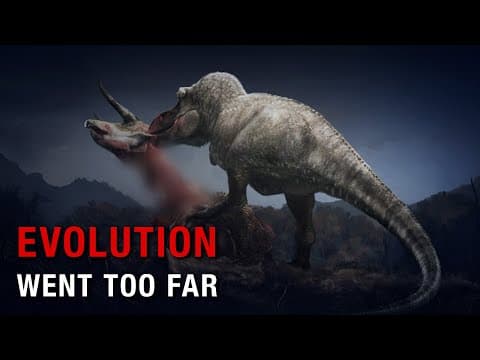
[0:03]Near the end of the dinosaur age, long after most giants had already come and gone, the world produced something unusual. Earth had been experimenting with size, shape, and survival for more than 160 million years. Entire dynasties of dinosaurs had risen, ruled, and quietly disappeared. And in this late, fragile chapter of Earth's long history, a final predator emerged. Not as a beginning, not as a symbol of growth, but as something that shouldn't have been possible. An animal built wrong. A design that broke the rules. A predator that evolution never intended to create. It was not shaped by a stable planet. It was forged by a world nearing its end. Only then do we give it a name. Tyrannosaurus Rex.
[1:10]This episode is supported by Planet Wild. We'll return to them later in the story.
[1:20]Before we can meet Tyrannosaurus Rex, we have to answer a more basic question. How do we even know dinosaurs existed at all? Because no living human has ever seen one breathe, walk, or hunt. See, everything we know begins with stone. When the first dinosaur fossils were uncovered in the early 19th century, they were fragments. Teeth, bits of bone, shapes without context. Early scientists did their best to imagine the animals that once carried them. The results were strange. Dinosaurs were drawn like oversized lizards, dragging their tail, sprawled low to the ground, slow, and dim-witted. They were monsters, not animals. And obviously, those early images weren't foolish. They were honest. They reflected the limits of the evidence at the time. As decades passed, fossils accumulated. Skeletons became more complete. Trackways revealed movement, bone structure hinted at posture, muscle, speed, even metabolism. Each new discovery forced us to redraw these animals, not once, but again and again. Today, paleontology is one of the most data-rich historical sciences we have. More than 10,000 dinosaur fossils have been discovered. Over 900 distinct species have been identified so far, and the story is still growing. Between 2003 and 2022, scientists identified on average about 45 new dinosaur species every single year. That's not because dinosaurs are suddenly appearing. It's because the earth is still giving up its secrets, slowly, reluctantly, layer by layer. With every new fossil, our picture of the dinosaur world becomes sharper, and more surprising. You might think why we are discussing these. To truly understand T-Rex, we have to travel far deeper than its bones. We have to go back to the beginning.
[3:31]Long before the continents looked the way they do today, the Earth was united into a single, vast landmass. Pangea.
[3:46]A world without oceans between continents. A world of extremes. Vast deserts inland, seasonal monsoons near the coasts. And violent volcanic activity reshaping the planet from within. The oldest dinosaur fossils appear toward the end of the Triassic period, around 230 million years ago. These were not giants. They were small, lightly built, often overshadowed by other reptiles that ruled the land at the time. The Triassic Earth was hot, dry, and unstable. Mass extinctions had recently cleared ecological space, and evolution was experimenting rapidly. Early dinosaurs were just one of many contenders trying to survive in a dangerous world. Then, around 201 million years ago, the Earth changed again.
[4:59]Volcanic eruptions tore through what is now the Atlantic region. The climate shifted. Many dominant reptiles disappeared, and dinosaurs, almost by accident, found themselves inheriting the planet. This marked the beginning of the Jurassic Period. The Jurassic world was greener, wetter, and warmer. Vast forests spread across the continents. Dinosaurs grew larger, more specialized, more confident. Some evolved into colossal plant eaters. Others into formidable predators. Thanks largely to cinema, this is the era most people think of when they hear the word dinosaur. The Jurassic Period became famous not through fossils alone, but through film. Jurassic Park etched it into popular imagination so deeply that it now feels like the definitive dinosaur age.
[6:14]But here's the truth. The Jurassic was impressive. It was not the peak. That came later. The real explosion, the age when dinosaurs truly flourished in diversity, size, and ecological dominance, was the Cretaceous Period. Beginning around 145 million years ago, the Cretaceous was the longest chapter in dinosaur history. The supercontinents Laurasia and Gondwanaland began to fragment, slowly drifting toward the arrangement we recognize today. New coastlines formed, shallow seas flooded inland regions, the planet grew warmer. Sea levels rose, and life responded. Flowering plants appeared and spread, transforming ecosystems from the ground up. Insects diversified alongside them. Herbivorous dinosaurs adapted to new food sources, and predators followed. Almost every type of dinosaur you can imagine lived during the Cretaceous. Swift, intelligent raptors, heavily armored giants, long-necked titans that shook the ground with every step. Some of the largest land animals to ever exist. Argentinosaurus weighing as much as 77 tons, Titanosaurs stretching longer than a blue whale laid end to end. And among them, near the very end of this long, crowded era, appeared something extraordinary. Tyrannosaurus Rex.
[8:07]Despite its fame, T-Rex was a late arrival. It lived only during the final stretch of the Cretaceous, roughly 68 to 65 million years ago. Its reign was brief, geologically speaking, but intense. Most scientists agree that T-Rex did not exist during the Jurassic period at all. Which makes one detail quietly ironic. The animal chosen as the logo of Jurassic Park didn't live in the Jurassic. This isn't a small mistake. It reflects a much deeper problem. Every dinosaur film we've ever seen collapses time, not by thousands of years, but by tens of millions. Species separated by vast stretches of deep time are shown living together, hunting together, dying together. Entire evolutionary eras are blended into a single moment. Once we see it that way, it's almost impossible to unsee. The dinosaur world wasn't one golden age. It was many, rising, falling, transforming over 165 million years. And Tyrannosaurus Rex stood at the very edge of it all. Not at the beginning of the story, but just before the end.
[9:29]So where exactly did T-Rex live? Well, not across the whole planet, not roaming every continent. Its world was surprisingly small. Around 66 million years ago, Western North America wasn't connected to the rest of the continent. A shallow sea ran straight down the middle, from the Arctic to the Gulf of Mexico, cutting the landmass in two. The Western side was an island continent. Scientists call it Laramidia. This is where T-Rex lived, and as far as we know, nowhere else. Most of the fossils we've found come from a stretch of rock called the Hell Creek Formation. It runs through Montana, North Dakota, South Dakota, and parts of Wyoming. When paleontologists dig there, they're not just finding T-Rex. They're finding an entire world preserved in stone. And that world looked nothing like ours. Picture a subtropical floodplain. Rivers braiding through dense forests, swamps thick with humidity. The air is warm, heavy, and wet. Average temperatures sat around 11 to 12 degrees Celsius, higher than today, and rainfall was abundant. No grasslands. Grass hadn't really taken over yet. Instead, the ground was covered with ferns, and the forests were a mix of conifers and flowering trees. Palms grew alongside sycamores and magnolias. It was lush, it was humid, and it was crowded. This place was packed with life. Triceratops was everywhere. Those three-horned giants made up nearly 40% of the large animals in some fossil beds. Everywhere T-Rex looked, there were herds of them grazing and moving through the forests. Then there were the Hadrosaurs. Edmontosaurus, the duck-billed dinosaur, traveled in groups so large, they probably shook the ground when they moved. Easy prey if you could catch one. Ankylosaurus was there too, low to the ground, armored like a tank with a club on its tail that could shatter bone. Not an easy meal for anyone. Smaller dinosaurs darted through the underbrush. Pachycephalosaurus with its domed skull. Thecelosaurus, a modest plant eater that kept to itself. Raptors, Oviraptorids, a whole community of creatures we rarely see in films because they weren't big enough to sell tickets. And beneath all of them, mammals. Tiny, furry, mostly nocturnal, scurrying through the leaf litter, staying out of sight. Their time would come, but not yet. In the rivers, crocodilians drifted. Turtles, fish, even sharks patrolled the waterways that connected to the inland sea. This was the Hell Creek ecosystem. Dense, diverse, fully functioning. And at the top of it all, stood T-Rex. Not a rare sight either. Fossil surveys suggest Tyrannosaurus made up nearly a quarter of large predator specimens in these deposits. That's a remarkable number. It tells us T-Rex wasn't some freak of nature glimpsed once in a generation. It was an established part of this world. Of all the T-Rex skeletons ever found, one stands above the rest. Her name is Sue. Discovered in South Dakota in 1990, Sue is approximately 90% complete, the most perfect T-Rex skeleton ever recovered. She now resides at the Field Museum in Chicago, where millions have stood beneath her reconstructed frame. But Sue's bones tell a harder story. Her skeleton shows evidence of healed injuries. Bite wounds on her skull, broken ribs that mended, tail vertebrae that fused after trauma. She survived attacks, infections, and possibly gout. She lived a violent life, and her body kept score. When we look at Sue, we're not just seeing a skeleton. We're seeing the accumulated damage of a life spent at the top of the food chain. When we imagine T-Rex, we often picture it alone, cinematic, framed against an empty horizon. But that's not how it lived. It lived here. In this wet, green, noisy world, surrounded by prey, surrounded by competition, surrounded by life that had been evolving alongside it for millions of years. This was the kingdom it inherited, and it wouldn't last much longer. You know, 66 million years later, we're still losing ecosystems. Not to asteroids this time, but to ourselves. Throughout the world we have these wetlands. But they're mostly concentrated across Europe. And here's what most people don't realize. These aren't just empty swamps. They're some of the richest ecosystems on the planet. Full of life we never even think about. Birds, insects, plants that exist nowhere else. And on top of that, they store more carbon than all the world's forests combined. Think of them like giant sponges, wet, ancient, and holding the planet steady. And over the last century, we drained more than 80% of them. But our partner on this video, Planet Wild, is actually doing something about it. And I'm proud to be part of this mission. They partnered with local conservation groups, brought their own members out into the field, and together, they started restoring the land. And now, they'll keep watching over the land for the next five years. And it's working. The water's coming back, the carbon stays in the ground, beavers are building dams again, cranes are nesting. 7 hectares that used to be farmland, it's a wetland sanctuary now. You can almost feel it breathing again. And that's just one mission. They're stopping plastic from reaching the ocean in Mumbai, rescuing orphan seal pups in Poland. Real work, real results. See, Planet Wild isn't one of those charities where you donate and never hear what happened. It's a community. You help pick the missions, you see exactly where your money goes. You're not just watching nature's comeback story, you're part of it. So if you want to do more than just worry about this stuff, click the link, scan the code. Join Planet Wild. If you feel connected to this, I genuinely recommend joining. Give whatever feels right. Every contribution matters. You can cancel at any time. And because I believe in Planet Wild's work, I'll personally cover the first month for the first 100 people who join, using my code Mr. Science 1. Let's make hope something real. Now, back to our predator.
[16:51]We've seen their world. Now let's look at the animal. And we should start with the obvious, T-Rex was enormous. Fully grown adults stretched around 12 meters from snout to tail, which is around 40 feet. Roughly the length of a city bus. Weight estimates vary, but most land somewhere between 6 and 7 tons. Some individuals may have pushed beyond that. But size alone doesn't explain what made this animal so effective. Lots of dinosaurs were big. What set T-Rex apart was how everything worked together. Start with the skull. The head of a T-Rex was massive. Over 1 and a half meters long in the largest specimens. But it wasn't just big. It was built for one purpose, generating force. The jaw joints were reinforced. The bones around the skull were thick, riddled with ridges and struts that distributed stress. The teeth weren't blades like some predators, they were thick, conical, almost like spikes, designed not just to cut, but to punch through. Computer models estimate T-Rex could bite with a force of 35,000 to 57,000 newtons. For comparison, a saltwater crocodile, which has one of the strongest bites alive today, tops out around 16,000. T-Rex was in a different category entirely. It didn't just kill prey, it crushed bone. We've found fossils with T-Rex tooth marks punched clean through solid bone. And we've found T-Rex coprolites, fossilized dung, containing fragments of digested bone. This animal ate everything, including the skeleton. I remember one scene in Jurassic Park has shaped public understanding of T-Rex more than a century of paleontology. The moment a character freezes hoping the Tyrannosaurus vision is based on movement. It's completely wrong. CT scans of T-Rex skulls reveal a brain with huge olfactory bulbs. The part dedicated to smell was enormous. This animal could probably track prey from a considerable distance, long before it ever saw them. And the eyes, they faced forward. Not to the sides like most reptiles. Forward, like a predator that judges distance. The overlap between left and right visual fields gave T-Rex binocular vision, depth perception. The kind of eyesight you need when you're chasing something and timing a strike. Studies suggest T-Rex had visual acuity rivaling that of eagles. If you could travel back to the Cretaceous and stand motionless before a T-Rex, it wouldn't just see you. It would see you clearly. Its hearing was sharp too. Inner ear anatomy suggests sensitivity to low frequency sounds. Vibrations, footsteps, the deep rumble of a herd moving through the forest. Its brain was twice as large as those of other giant carnivores. Not because it was doing calculus, but because processing sensory information at this level requires neural real estate. This wasn't a mindless brute stumbling through the fog. This was an animal built to find you. And that iconic roar? Well, it's fictional. T-Rex didn't have a larynx. Its closest relatives, birds and crocodiles, bellow and boom. Low frequencies that travel through air sacks. If T-Rex made any sound, you wouldn't hear it first. You'd feel it in your chest, from hundreds of meters away. Then there are the arms. Yes, they were short. Absurdly short relative to the body. But the anatomy tells a different story. The bones show attachment points for remarkably powerful muscles. The biceps and forearm flexors were substantial. Each arm could likely curl over 200 kilograms. The claws were thick and curved, not vestigial decorations, but functional implements. Could T-Rex reach its own mouth? No, but during close combat with struggling prey, those arms could grip, slash, and hold. More importantly, they became small because they didn't need to be large. As the skull expanded into a bone-crushing weapon, the arms were freed from their previous functions. One more thing worth clearing up, the skin. Early Tyrannosaurs, the smaller ancestors, had feathers. We have fossil evidence of that. But by the time T-Rex came along, skin impressions from close relatives show something different. Scales, pebbly, reptilian skin. Adults at least weren't fluffy, they were armored.
[21:54]So here's something most people don't think about. When you walk into a museum and stand beneath a T-Rex skeleton. You know that moment where you're just looking up trying to take it all in. You're not actually looking at a complete animal. See, what you're seeing is a reconstruction. Most of what's up there, it's man-made. When paleontologists uncover dinosaur bones, they usually only find part of the animal. A skull, some vertebrae, a rib cage, a prehistoric puzzle full of missing pieces. The first T-Rex mounted for display was uncovered in Montana in 1902. They found the skull, most of the tail, a rib cage, pelvis, and most of the vertebrae. But the rest, those had to be invented. There was a time when scientists stuck the wrong skull on an Apatosaurus body and called it Brontosaurus. The error stood for decades before it was corrected. Today, the process is different. Scientists can combine information from multiple individuals to build a composite picture. They use CT scans to mirror bones. If they have a left leg, they can digitally flip it to create the right. The work is precise, methodical. Modern dinosaur exhibits are 99 to 100% accurate. But they're still reconstructions, still fragments assembled into holes. But here's the deeper question. Why do we even piece together skeletons at all? Why not just display what's actually found? Well, the answer has nothing to do with science. It has to do with who we are. Humans are storytelling animals. We don't experience the world as disconnected facts, we experience it as narrative, beginning, middle, end, characters moving through time. We see a creature that walked this planet millions of years before we exist, breathing the same air, feeling the same sun. That the story of life is so much bigger than ourselves. That's not a scientific insight. That's a human one. When you make an exhibit, you're not just displaying discoveries, you're telling a story. We don't just want to know what T-Rex was and how humans found some fossils in 1908. We want to meet it. But here's something uncomfortable. As of now, there are approximately 61 scientifically significant T-Rex specimens in public museums. But 71 are in private hands. The commercial fossil trade changed in 1997. When Sue sold at auction for 8.36 million dollars. The Field Museum acquired her. She became a symbol, but she also became a price tag. In 2020, Stan, one of the most complete specimens ever found, sold for 31.8 million dollars. No museum could match that bid. For over a year, no one knew where he was. One of the most scientifically valuable fossils on Earth simply disappeared. The average price for a T-Rex now hovers around 10.8 million dollars, which most museums simply can't compete. See, every skeleton contains information that can't be replicated. Bone microstructure, isotopic signatures, pathologies that reveal disease and behavior. When a fossil enters a private collection, that data becomes inaccessible. Science depends on shared access to evidence. A T-Rex in a billionaire's foyer might as well be back in the ground. The loss is particularly painful for juveniles. 20% of privately held specimens. The part of the life cycle we understand least is the part most aggressively harvested by the market. Commercial collectors argue they're rescuing fossils from erosion. There's a grain of truth in this. But of the 80 specimens collected by commercial operations since 1992, only nine have ended up in public trusts. The rest remain in stock rooms, private collections, or in shopping malls. Once they leave, they rarely come back. We recognize that human heritage belongs to everyone. But dinosaur heritage, that's still up for auction. See, you've been here since the beginning of this video. Not for the numbers, not for the Latin names, not for the dates. You stayed for the story. A story I've tried to stitch together from the work of paleontologists and research teams around the world. They spend lifetimes in the dust. They uncovered the fragments, they asked the questions. I just tried to make the bones breathe again. And the story of T-Rex, the last emperor of a fallen world, is one of the greatest we've ever found. When a child stands before a mounted T-Rex skeleton, craning their neck, mouth slightly open, trying to comprehend the scale of the thing. Something happens that can't be measured. A connection is made. Between that child and an animal that died 66 million years ago. Between the present and the unimaginably deep past.


