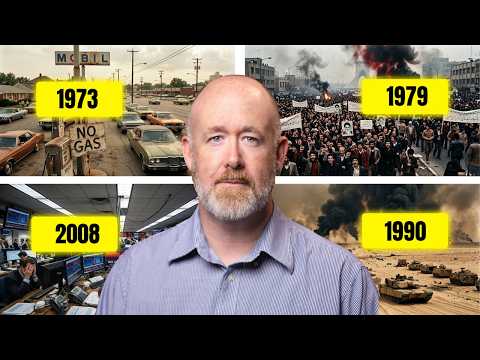
[0:00]I think that we all know that gas is up almost a full dollar a gallon in a single week. The Dow dropped 700 points and right now, most investors are going to make the same exact mistake that they made in 2022, in 2008, in 1990, and again in 1979. Where they're all chasing the spike and history says like that's the wrong move. Every single time. Because the real opportunity happens to be somewhere else. So here's what we're going to do in this video. I'm going to show you the data. Not opinions, not predictions, the actual historical data on what happens to the markets after every major oil crisis going back 50 years, and that it all comes down to this one chart. Then I'm going to explain why this crisis looks a lot scarier on the surface, but is actually less dangerous to the economy than most people think. And look, I need to say this up front that this is not financial advice. I do this for educational purposes, and if you're new to the channel, I'm not super fluffy and I dig up as many facts as I can. And I think that the data here is going to speak for itself. So, if you get any value from my research, my spreadsheets, please consider pressing the like button so my channel can continue to grow. Oil hit $119 a barrel intra day last week. That's one of the largest weekly spikes in crude oil futures in decades. The straight of formuz handles 20% of the world's supply flowing through passage only 21 miles wide. Traffic through that straight has dropped to nearly zero. And there are about 200 tankers that are just sitting outside anchored and waiting. And CNBC is calling this the biggest oil supply disruption in history, three times the scale of the 1973 embargo. And I get it, that sounds terrifying. And everyone on Wall Street right now is reacting exactly how you would expect. Money right now is flooding out into energy, gold and defense stocks, and it's flooding out of tech airlines and consumer names, where a lot of all those big name companies and those sectors are drastically down in the past week. But the S&P energy segment is up 24% year to date. That's the consensus trade. You're going to buy oil and just sell everything else. But here's the thing. This has happened before, not once, not twice, but five times in the past 50 years, and the oil spike reversed, every time without exception. In 1973, the OPEC embargo sent oil from $3 to $12. And it reversed. In 1979, the Iranian revolution pushed oil from $13 to nearly $40. Once again, it reversed. Crash down 40% by the mid-80s. And then in 1990, when I was alive, Saddam invaded Kuwait. Oil instantly doubled. And then in 2008, oil hit $147 simply on speculation. Five months later, it collapsed a full 80%. And in 2022 when Russia invaded Ukraine, Brent hit $130. And then four months later, it fell 30%. Every single one of those energy stocks that looked invincible at the top of those spikes, got completely hammered on the way down. And once again, the reactionary trade during an oil spike, it's by energy and sell tech, which has been the wrong long-term trade five out of five times. Now, I want to be completely fair. I have covered enough of these cycles to know that dismissing a crisis because it always works out, that's just lazy thinking. This isn't the same as a brief missile exchange. This is a physical supply disruption. And the closest comparison, it's not 2022. It's actually 1979. And the last time that Iran was at the center of an oil crisis, it was the same country and it was the same type of disruption. Iranian production dropped 4.8 million barrels a day. That was 7% of the world supply, which was enormous at the time. Today, it's 20% of the world's supply that's being held up. So the scale of this disruption is significantly larger. And there are a couple of things that make the current situation a little bit uncomfortable. The strategic petroleum reserve, America's emergency oil stock pile, is sitting at 415 million barrels. And I get it, that sounds like a lot until you realize that the capacity is 714 million, which means we're sitting at 58% full. And the administration has already said they are not going to tap that. And then there's OPEC's spare capacity.
[6:36]OPEC says that they have 5 million barrels a day that's just spare capacity. And that's kind of ridiculous because almost all of that spare capacity sits in Saudi Arabia and the UAE. And where does their oil go? Through the straight of Hormuz. So that spare capacity, yeah, it exists, but it's on worthless paper. So at this point, you might be thinking, this sounds a heck of a lot worse than I thought. If that spare capacity is locked and the US reserves will never be tapped, maybe this drags on. And you're right to think that. The critical variable here is duration. If hormuz reopens in weeks, like the 1990 Gulf War, this is a short spike and a fast recovery. But if it stays closed for months, yeah, it starts looking a lot more like 1979 and the recession risk goes way up. But here's what changes the math completely for today. In 1979, oil was 1.5% of America's GDP. Today, it's only 0.4%. Our economy has become 70% less dependent on oil over the last 45 years. Cars are more efficient. We heat with natural gas instead of oil. renewables are growing, and remote work means less commuting. So $100 oil today doesn't really hit the economy quite the same way that oil spikes did in 1979. Now for the counterpoint, and I want to be real about this. Diesel is still the backbone of shipping. Diesel is up 89 cents a gallon in a single week. And diesel is what moves everything that you buy. Your groceries, your Amazon packages, and trust me, having spent years in supply chain at Amazon, I can tell you that fuel surcharges ripple through everything. So I I genuinely hope that you're asking yourself, if the oil spike is the wrong move, then what exactly is the right one? Well, I've been through this before. 2022 cost me a little bit of sleep, but it also taught me the playbook, and the playbook is relatively simple. When Russia invaded Ukraine in 2022, oil spiked to $130. The Nasdaq dropped 33%. Everyone was selling tech and buying energy, and here's what happened next. Oil was back below $100 within four months. If you'd bought QQQ, the Nasdaq 100 ETF at the very bottom when it was negative 33%, then you were lucky enough hopefully to write it up when it was up an extra 54%. That's an 87% swing from trough to peak. And once again, energy faded, and tech created a lot of wealth. And the historical data backs this up across every geopolitical crisis. The average S&P 500 drawdown during major geopolitical shock is a negative 4.7%. And the average time to bottom, 19 days. And the average recovery, well, that's about 42 days. And the S&P 500 is higher 12 months after the onset of a conflict, roughly 70% of the time.
[11:30]The key insight from all of this data, it's not the event's severity, it's whether or not it causes a recession. And with the economy 70% less oil dependent than in 1979, the odds of an oil driven recession are quite a bit lower today. Now, here's what I'm personally looking at. There are AI and tech stocks trading at what I'd call bargain bin prices. Most all of us look at something called the PEG ratio. It's the price to earnings ratio divided by the earnings growth rate. And here's why that matters. A peg that's under a one means that you're paying less than the company's growth rate would normally justify. Anything that's under a one in simple terms is a deal, and right now there are several high quality names well below that line. AMD and Qualcomm are both sitting at a peg of 0.57. Dell's at 0.61, Micron at 0.64 and Broadcom at 0.75. And the best part is these are not speculative penny stocks. These are companies with real revenue, real earnings and real cash flow. This isn't 2000 where tech companies had no business model. The dip isn't because AI stopped working. It's because oil scared everyone into selling. And another kicker is that there's 7.8 trillion sitting in money market funds right now. All-time high, and that's not invested in energy. That's parked on the sidelines just waiting for clarity. When that money starts moving back into the stock market and it will, it's going to flow into quality growth at a discount, not energy, which's already sitting at the top. Of course, I want to be very clear that there is still a lot of risk here. If the straight of Hormuz stays closed for months and oil stays well above $100, that really changes our entire calculus. I am not pretending that this is a guaranteed outcome, but the historical pattern is really hard to ignore. And the value in these beaten down tech names is real, and it's easy to cling on to. So here's my take, and I'm pretty confident about this. Five oil spikes in 50 years, and it resulted in five reversals. In every case, there was the reactionary trade. Buy energy and sell tech, and it's been wrong over the long-term, every single time. And here's another data point, as of this week, Trump signaled that the war with Iran could be ending soon. And what exactly happened? Yeah, oil dropped hard and the stocks began to bounce back up. So we may already be watching that sixth reversal play out in real time. The window between peak fear and recovery is where the biggest returns get made. So looking back at 2022, that window gave investors an 87% swing. That window is open right now, but I can guarantee you, it's not going to be open for long. Look, if you want to stay on top of this as it unfolds, my free newsletter goes out almost on a weekly basis with market updates and my portfolio, which the link is down below. I hope that you were able to get some value from this one, and as always, thank you so much for watching and I'll see you next time.


