[0:00]In the reference of landfills, okay, maybe you don't have to pay for it now, but in 20 years when they're full, you're still going to end up paying for it. So why push that responsibility onto someone else? But don't you think the citizens have a right to decide if they want to go along with this? I don't think that citizens have the right to be wasteful more than someone else.
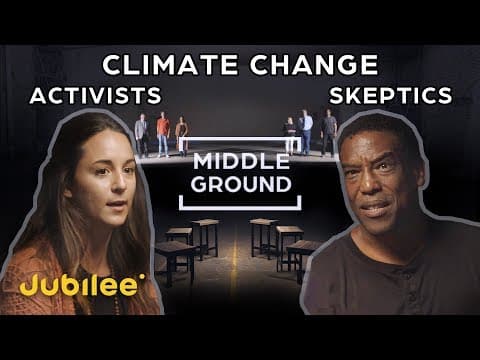
[0:30]My name is Don. I am a professor of geology and a professional climate scientist and have published in the field for many years. My name is Andrew. I studied Environmental Science Policy and Management. I'm a consultant that specializes in sustainable tourism. My name is Natalie. I'm a local government consultant and I believe that anthropogenic climate change is real. My name is Michael. I'm the vice president of a nonprofit that concerns itself with the threats to Western civilization. My name is Dr. James Enstrom. I'm a physicist and epidemiologist and I'm passionate about scientific integrity. My name is Keith Hardeen. I'm a constitutional rights activist and uh I'm concerned about the uh future of the next generations. May I please have my activists to the left and my skeptics to the right.
[1:25]I believe global warming should be our number one concern.
[1:35]There's obviously a lot of issues that our politicians deal with and that as a society we can care about. But if our earth is moving in a direction to where our species cannot survive, then homelessness, then all of the other issues that are out there, are going to be irrelevant because we won't have a place to live. I agree that there are many issues that are important at the local level and we are not doing a great job with a lot of things. But things like extreme droughts, extreme heat waves and devastating hurricanes and tornadoes are going to make life harder on us no matter where we come from and no matter what our economic background. Really, if you want to look at it as an issue of health, I don't see why everyone wouldn't be concerned and everyone wouldn't be participating in ways to reduce the impact of climate change or reverse global warming.
[2:24]No matter what the United States does, it's not going to make an impact on the worldwide greenhouse gas emissions. As long as China and other parts of the world are increasing the greenhouse emissions. It puts the United States at an economic disadvantage when uh we try to transform our lives and the other countries just simply ignore these efforts. The United States seems to be the most held responsible for the global warming, for for doing something about it. And that's what bothers me. You know, we have a constitution and nobody ever considers that constitution uh the importance of protecting the natural rights of the individual. And I think global warming is a an infringement on those rights. Uh when I say global warming at least the uh the agenda of the political aspect of it. I think it's time to change how we live. I I really do, which we have seen how changing our habits, changing the the resources that we use and what we pump into the air and how we reversed that hole in the ozone. We've seen how it can change and we can change it, but we're going to have to make changes. Well, I don't believe that climate change is our biggest problem because I don't believe that man has anything to do with it. Climate has changed since before man existed on the planet and will continue when man is gone. As a professional climate scientist, who's done this for 50 years, I'm afraid you're not correct. Um, the climate evidence is very, very clear. And probably the clearest evidence of all comes from ancient records where we can actually see what the planet was like before humans were involved. This is why climate scientists, 99% on almost every study of climate scientists shows that we're unanimous as scientific community ever gets. And that this evidence is real and that it's happening and it's happening on every scale from the ice caps to the ocean, everywhere we look, we get the same answer. No, I'm not a climate scientist, but I know a lot of them and I've heard um exactly the opposite argument made. Thousands of scientists just in the United States signed a letter saying man has little if any effect on climate. Well, are they all climate scientists? Oh, yes, yes, they are. Not actually doing climate research and publishing it. Yes, they are. I don't believe it.
[4:40]I know people who have been affected by environmental regulations. Yes.
[4:50]Wow, everybody agrees on this one. I have a very good friend, uh he is a trucker, he was able to be successful and maintain a career for 40 years. He was stopped in that career because of claims that his diesel truck was killing people through the exhaust. There was a program in Los Angeles called a clean truck program that basically put him out of work because he couldn't afford to buy a new truck. So this is the kind of uh environmental regulation that hurts real people, especially here in Southern California. I'll say also that uh many of the people who own homes, they're not allowed to water their lawns. Why? Because of environmental regulation laws, which are suppressing, again, suppressing the natural right to use water. It seems like an underlying issue with you guys is money, power, choice. And I grew up on a farm where there was a lot of regulation. Agriculture is very regulated. And then eventually, there was this regulatory thing that came in called the Conservation Reserve Program where we had to convert a part of our land to prairie. At the time, my dad was very angry because we lost money from that. But that conservation area also created um a buffer between the farm fields and the water to capture eroding soils that it didn't go into the water and decrease the water quality. So I think there's certain regulations that we need to look at more long-term, look at the bigger picture and although we may be losing money now, we could be earning it greater in the future. We need to look at it a bigger picture. I really like your point about the water and the regulation of water because I can remember that from a few years ago. And the reason they put that regulation in was because the snow pack wasn't there for that year. It's not like it was a random year where the government just said, start charging people for water. It's because the effect of climate change, one of the aspects of it is that we are not seeing consistent seasons. And I I completely agree with a regulation that, you know, limits the amount of water, amount of precious resource that we have to consumers. A regulation a lot of us didn't like when the cost of gas went up here in California, and we all had had catalytic converters. But we've all agreed in this group that we're grateful that the air is clean like it wasn't when I was a kid and we don't want those laws reversed because we'd be back to the smog we had when I was a kid. So those regulations may not have been great at the time, they may not have made people happy, but we've all learned to live with it and now we're grateful. I'd like to bring up my concern about China again. On some days, the pollution levels in China can be 10 to 50 times what they are here in Southern California. They simply assign their citizens to wear gas masks. And then they take the jobs, the manufacturing jobs that used to be in this area, have now gone to China. I might be missing it, but are you saying that you would rather have that manufacturing be in California and that we all wear gas masks all the time? Because that regulation that we have here that makes it expensive to have manufacturing here is what keeps us safe. That is what makes it expensive. No, I think you're misunderstanding me. You could bring manufacturing back, just like President Trump has done in various parts of the United States, by just making the economics work. So we can still keep the clean air, but we don't need to keep beating down. Not some of the regulations now are more severe than they were 50 years ago. And what you need to do is talk to some of these businessmen that are faced with this on a day-to-day basis. An eco-friendly lifestyle is expensive.
[8:28]We all know we're paying twice as much for gas as the rest of the country. I pay an enormous amount for energy in my little tiny one bedroom um condo. Wind and solar have been subsidized, so I mean, we've already paid a fortune for it all. You know, why not put some of these regulations to a vote instead of uh the EPA and all the rest of these uh administrative arms, placing these regulations on us, taking more and redistributing more of our wealth or more of our money to pay for something that we're not even going to use or benefit from.
[9:04]An eco-conscious lifestyle does not need to be expensive. There are incentives that are built into our policy that encourage people to live a more eco-conscious lifestyle. Because you have control over that. A lot of things we don't have control over, but you have control over how much you're buying at a grocery store and how much you're deciding to throw away. And minimize that, scale it back, in all regard, in how far you're driving, in the water, in the electricity, in all the different sectors that impact climate change. You have the decision to make of how much you're going to use and there are direct cost savings with not being so wasteful. I I'm also an example of that. Um, I drive an electric car and it's not that hard in Los Angeles to get it charged. And in the future, it's going to be much easier for more and more people with electric cars, especially as the cost of internal combustion engines keeps adding up. Uh, I spend a tremendous amount of time recycling plastic, recycling aluminum, and about every six months, I go to the recycle yard myself and it pays off very handsomely. Aluminum is extremely valuable. There's a lot of small choices and a lot of larger choices and you can make those choices quite easily. I mean, my entire yard is now all drought resistant plants. That's that is your that is your choice. But what you were talking about is making choices for me. No, you can choose to keep using water, but you're going to pay for it. You can choose to still have your green lawn. No one is coming around and saying you cannot do that, but you are going to pay for it. Look at, we can have a middle ground on this. There's a lot of uh a lot of people that believe in these things that are totally separate from the role of climate change. And a lot of these recycling and energy efficiency policies are very good and I think most people would agree with them and most of people are trying to adhere to them. What I think what we're talking about again is the imposition, uh whether you force people to have drought resistant lawns, or you force people to have solar panels on their roof. I don't see any reason why people can't make choices like that on their own. When it comes down to it, like those choices we make, what we buy, what whatever um we vote on, um, is is is it doesn't have to be expensive. But what we're trying to do is prevent these costs from getting bigger long term. I mean, I think we just simply need to change some of our choices and be a little altruistic. I worry about our future.
[11:28]Yes, I definitely worry about our future. Uh it's something I think about a lot. Uh because I watch and because I work with the data from climate science all over the country and all over the world. Uh and I especially worry because I have three young sons, one of whom just has his birthday today and I'm very worried that the planet they're going to inherit is already going to be much, much more difficult to live on than the one I inherited or the one my parents gave to me. The Constitution preamble, uh last part of it says, uh to secure the blessings of liberty to ourselves and our posterity. I'm concerned about them having liberty, having the freedom. Some people think that we don't have the right to choose, you know, how we should live. I mean, because you want to force your way of life on others. Um, I have four grandsons that I love more than life. I fear for their future that they that they are going to be living in a socialist country because this is what this leads to. I don't have a voice in this state at all. I have no voice. I worry about the future because I have four nieces and nephews. And I'd like to have a family of my own someday and have kids. And so I think about the future and how degraded the environment could be or how the amount of CO2 we're putting into the air and greenhouse gases increases. But I'm hopeful because I've found that there are people living in way worse conditions that I am and they're full of hope because they understand that they have choices, that they can work hard to make a better life for themselves. I don't know about you guys, but at least for me, I'm going to make choices that improve the environment, improve public health and leave this place better for for the future generations. Hi Natalie. Hi everyone. Natalie, where are you? I just I'm not I'm not in fear. I have made the choice to not have children and I honor that decision and we all have that choice and I don't operate from a place of fear. A big question that I don't know if we've addressed today or if we ever will address is who takes responsibility for the impact that we're having because we know that we have an impact. So I just believe in using our purchasing power, our political power through our vote, through supporting policies that are going to create healthier communities and basically doing the best that we can so that we can continue to enjoy our environment now and for future generations. Hey everybody, you make me too. Professor, interesting to hear your point. Nice meeting you. Thank you. Nice meeting you. Mother Nature, All right, Nice meeting you. Hey everybody, thank you for watching another episode of Middle Ground. My name is Aaron and this is Dan and we are both Jubilee directors. I think um, you know, we obviously have our own beliefs that we carry through our own lives. Um, and then when you are directing an episode of Middle Ground, what's interesting is when you start reaching out to cast members to be in the episode. You start talking from people who you actually disagree with. I wouldn't say it makes you agree with them, always, but you do empathize and listen a lot more. You can't just dismiss it completely. You have to see the human being coming with that opinion. Well, if you guys have any thoughts on what you've learned from Middle Ground, please comment below. Be sure to follow us on Instagram. That's where you're going to find out a lot more of what's coming up next in our videos as well as behind the scenes stuff with us and uh we'd love to get to know you there. So, see you then.


