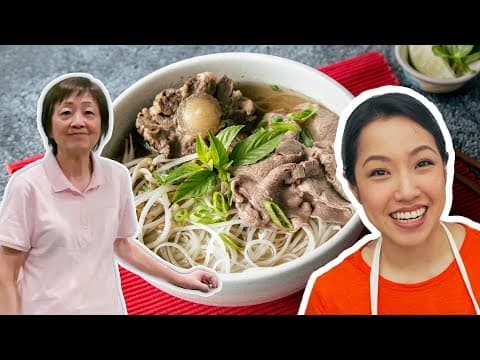
[0:05]Sawasdee ka, welcome to Hot Thai Kitchen. So, I have had many bowls of pho in my life and then I had the one that blew everything out of the water.
[0:15]It was made by Auntie Jacqueline, who is my mother-in-law's childhood friend and they grew up together in Vietnam. Now, this pho was so special, it was so rich and flavorful,
[0:25]that afterwards, I had to call her up and ask her for the recipe because not only do I want to eat it again, this is her signature dish that needs to be preserved and right now, she's the only one who knows how to make it.
[0:38]So, I asked if she would let me share this recipe with you on my channel and she was delighted. She was so excited that I wanted to share this recipe with the world and I was excited that she didn't want to like keep it a secret or something.
[0:51]So, with her blessing, I share with you Auntie Jacqueline's legendary Oxtail Pho.
[0:57]The quality of pho is basically the quality of your broth and the flavor and richness of the broth comes mainly from our beef supply. So, let's take a look at them.
[1:08]First, you need some beef bones. Now, this is the heart of your broth. Joint bones and marrow bones are great because cartilage and marrow makes for a really rich, full-bodied broth.
[1:19]What I've got here is knee cap bones and I get it from a Korean supermarket, which usually has really great beef supplies.
[1:25]For the meat, you'll first need some stewing beef. So, this is brisket but chuck will also work and this will get stewed together with the broth.
[1:33]You'll also need thinly sliced beef that you're going to put on top of your noodles raw and then you're going to pour hot broth over it and it'll cook right into your bowl and all the beef juices will add to the flavor of your pho.
[1:46]I recommend buying this pre-sliced because otherwise you'll need some real knife skills to get it super thin and you can buy this at the hot pot section at any Asian grocery store.
[1:55]There are many cuts available, just choose one that fits your budget.
[1:59]Finally, Auntie Jacqueline makes luxury pho, so she likes to add oxtail. Now, oxtail makes a difference because all of this connective tissue and the bone marrow, like this makes for a really rich broth.
[2:12]Also, the meat on the oxtail when braced, I mean it is just tender and juicy and luscious, there is nothing quite like it. Now, it is pricey, so you can skip it but then you will need to add more bones and more beef to sort of make up for the richness.
[2:28]All right, let's get cooking.
[2:34]Hello, this is Jacqueline. I'm delighted to share with you this pho recipe that my mom cooked for us for many years on family gathering. Enjoy.
[2:47]First, I'm going to wash all of the bones, the oxtail and the brisket.
[2:52]And then once that's all washed, I'm going to put them in a pot which needs to be at least seven quart in volume. This one is 7.5 and it just fits.
[3:00]Cover with 4 L of water and then bring to a simmer.
[3:06]While that's going, let's prepare our aromatics. I'm going to put some onion and ginger under the broiler and broil them for about 10 minutes until the onions are charred. The ginger is not going to look all that different but everything will be quite fragrant.
[3:19]While that is going, we can be toasting our spices. I've got a cinnamon stick, some star anise, black cardamom and green cardamom and I'm going to toast them in a dry skillet over high heat just for a few minutes until the green cardamom starts to brown slightly and everything should be very aromatic.
[3:36]Take them out. Then I'm going to toast my coriander seeds and I want to do them separately because they're so small and because the pot is already so hot, it's going to take like less than a minute before they start browning and become really aromatic.
[3:48]Then I'm going to crush my cardamom pods slightly so they are broken open and then put everything into a soup bag, which you can find at Asian grocery stores.
[4:00]You can also wrap these in a cheesecloth as well. And by the time you're done all that, the water is probably almost simmering. Time for us to add our seasoning.
[4:06]I'm going to add some salt, some rock sugar. This is traditional, but if you're using granulated sugar, it will not make a difference.
[4:14]Finally, we're going to add a little bit of beef stock powder and this is the Korean brand that Auntie Jacqueline swears by. She's been using it for 10 years.
[4:22]If you are anti-MSG, you can leave it out, but just know that it's not going to be quite the same. Now, that is going to simmer for 1 hour.
[4:32]Now, by this point, many of you experienced pho maker might be yelling at the screen at me, "Wait a minute, you didn't blanch your bones!"
[4:42]No, and here's why. So, for those of you who don't know what I'm talking about, traditionally, the beef and the bones are first boiled in water for a few minutes.
[4:50]You throw away that water. You're supposed to scrub the pot sparkly clean and then you start the whole thing again with fresh water and that whole process is supposed to remove impurities and make the broth more clear.
[5:05]Now, when I spoke to Auntie Jacqueline, she said, this is what she said to me. "I used to do that but it was a hassle. So, I tried not blanching and it made no difference."
[5:16]So I tried not doing it. I just washed the bones under hot tap water, and then it turned out just fine. I couldn't tell the difference and she hasn't been doing that for years.
[5:27]And I love that. I love that she questioned tradition and just tried things out for herself.
[5:33]So, you see all of this scum that is floated to the top, this is the impurities that the blanching step is supposed to remove, but you'll still have some scum floating to the top that you have to skim, it's not going to get rid of everything.
[5:46]So it's not really saving you any steps and you just have to wonder how much flavor is being thrown away with that first boiling water, right? Now, if you do blanch, your broth might indeed be clearer.
[6:00]But I really don't care about the clarity of the broth personally. I care most about the flavor of the broth. So, you can see what my broth looks like at the end.
[6:09]And if you really want your broth to be more clear, then by all means, go ahead and blanch.
[6:14]So, I am going to now skim this scum and using a fine mesh strainer is really important because it'll get rid of everything without losing any broth and also, it'll pick up a lot of fat too.
[6:27]And by the way, none of the impurities are toxic or anything. It's all completely edible, it just doesn't look good. After an hour of simmering, I'm going to do a final skim and then add my aromatics, the onions,
[6:40]the ginger, which I've sliced, the spice bag, and also some daikon which is going to be delicious and it'll make the broth super sweet. Let this simmer gently for two more hours at least or until your biggest piece of oxtail is fork tender.
[6:56]You can also remove the oxtail and the beef and then keep the bones going for a richer broth.
[7:03]Here's one that I made earlier. I did top up with just a little bit of water to keep everything submerged, but no more than that. Now we're going to remove all of the stuff that we're not going to eat from the broth.
[7:12]That includes the bones, the ginger, the spice bag and the onion. Well, the onion you could technically eat if you want. Now, before you discard the bones,
[7:23]check to see if there's any delicious meat or tendon stuck to it. You don't want to waste any of that. Pick it all out. Here is my final broth.
[7:32]And by the way, if you want to see sort of how clear it is, I will show you. Not bad, right? I mean, like, why would you want it any more clear than this?
[7:42]Now, there are bits floating around, that's just coagulated beef juices. If you're bothered by that, you can run this through a, like, just the broth, run it through a fine mesh strainer and it'll still be less of a hassle than doing the whole bone blanching thing.
[7:57]So, you can strain the little bits out at this stage. Okay, now we're going to do final seasoning, but instead of adding fish sauce a little bit at a time until it's salty enough,
[8:06]what I'm going to do is I'm going to add a fixed amount of fish sauce, and then I'm going to taste and add water until it is no longer too salty.
[8:20]And the reason I do this is this, at this point, I have no idea how much liquid has evaporated.
[8:24]But I know that this is the amount of fish sauce that I need for the number of servings that I want out of this pot.
[8:31]So, this way I ensure that I don't end up with not enough broth to go around. It is a terrible thing to have a pho party and then you don't have enough broth to go around.
[8:42]It has happened to me once before, it was awful. This is why I'm doing it this way, okay? So, now we're going to give this a taste.
[8:50]Okay. It doesn't need a lot, just a little bit.
[9:04]Yeah, perfect. And by the way, if you get to this point and you feel like it actually needs more fish sauce, that's fine. Go ahead and add more fish sauce or salt.
[9:12]Now for the rest of our stuff, you're going to need some dry rice noodles. Size small is my preference and you want to soak these in room temperature or lukewarm water for about 20 to 30 minutes until they are fully pliable.
[9:26]Once they are drained, you can actually keep these in the fridge and then it'll last for a few days. I'm also going to slice up my brisket.
[9:35]Cut my daikon into manageable size and have my raw sliced beef ready to go. For the toppings, you're going to need some bean sprouts, lime wedges,
[9:47]thinly sliced onions, which I soaked in water to mellow it out a bit and make them a little crunchier, some Thai basil and green onions and or cilantro.
[9:58]Okay, it is go time. I have yet another pot full of boiling water that we're going to use to blanch the noodles and the bean sprouts.
[10:06]And yes, for the filming of this video, I have gone through every single large pot that I own. I never said it was quick and easy. Okay. So, I'm going to blanch the bean sprouts for literally 5 seconds, just to wilt them.
[10:18]1, 2, 3, 4, 5 and then fish them out.
[10:25]And some people like it raw, but I like them a little bit wilted and this way it warms them up also.
[10:31]And then I'll just put the bean sprouts out on this plate and people can just serve themselves. I just think it's easier that way. Okay.
[10:40]Next, we're going to blanch the noodles. I am using this noodle strainer right here and I'm going to blanch one portion of noodles at a time because it is way easier to separate raw noodles into portions.
[10:55]Then if you cook the whole bunch of noodles, now you got hot steaming clump of noodles trying to separate those into portions is a nightmare.
[11:00]So if you're serving several people, measure out all the noodles and have them in their own serving bowls. Okay, if the noodles are properly soaked, they will take 5 seconds in boiling water.
[11:12]1, 2, 3, 4, 5 and this is a trick right here.
[11:20]You let the hot water drain into the bowl and this will warm up the bowl and then you pour it out. I learned this trick from Helen's recipes.
[11:30]So, a shout out to Helen. And then your noodles go in. Okay, we're going to do a pot switcheroo.
[11:37]Okay, we are so close to eating, I promise. I've got my noodles here.
[11:43]And then we're going to put the raw beef on top of the noodles.
[11:47]And make sure it's spread out so that it will cook properly. If they're kind of folded together on top of each other, then it's harder for them to cook.
[11:58]And you can put as much as you want of everything. There is no, there are no rules. Okay, the important part, the soup should be boiling because otherwise it won't be hot enough to cook all this beef.
[12:11]Voilà! There we go. Woo, look at that. Nice.
[12:20]And look at the clarity of this broth, right? Once it hits the beef, it'll be a little bit cloudy because the beef juices is going to come out, so that's totally normal.
[12:30]Okay, this can stop now. Thank you. Some white onions, some bean sprouts, some green onions and or cilantro. If you like cilantro you can do that too.
[12:43]Sautéed coriander is a great choice, Thai basil, I guess. I mean, to be honest, I don't like my pho with Thai basil. Don't tell anyone, but for the sake of the show, I'm going to just put a couple of pieces on just for.
[12:53]And that's it. Look at this beautiful bowl of pho. Oh my god, the oxtail, ah, the thing I've been advocating this whole time. Bam, oxtail. It just went up from $15 to $22 a bowl right there.
[13:10]Okay, let's eat. You have no idea how much I've been looking forward to this bowl of pho all day. Okay. I didn't even get the daikon.
[13:18]The daikon, by the way, is going to be one of my favorite things in this bowl. And I also need the brisket.
[13:28]But my personal favorite is the oxtail and the raw meats. So I can, the brisket I can take it or leave it. Oh, oh, no. I like lime.
[13:35]I feel like this lime is optional, but I always feel like it needs it because that little bit of acidity makes a big difference, I think.
[13:44]Needs more soup. I'll be right back. It's been a long day. That's more like it.
[13:51]Oh, it's so good. It's so satisfying. And this oxtail should be so tender that it should just come off the bone super easily just like that. See? Oh my god.
[14:15]Oh man. That was worth, that was worth every, every minute. Although, normally, I would spread out the work a little bit.
[14:24]I'll talk about how to spread out the work in the blog post to do it all in one day for filming. It's not recommended.
[14:33]The daikon is so tender and sweet and flavorful and this don't skip it, this makes the broth so, so good.
[14:43]I cannot tell you how happy it makes me to be able to put this recipe in video form.
[14:51]I have always loved preserving memorable, valuable, sentimental recipes from my own family and now also my husband's family and I hope you try this at home and experience the greatness of this bowl of pho.
[15:07]Or if, hey, if you have a pho recipe that's like been in your family for generations, share with us how it's different what I've done here. You know, we'd all love to know different things.
[15:15]The recipe as always will be on hotthaikitchen.com and a special thanks to all of our Patreon members who help support the show.
[15:24]And if you want to know what that's all about, how to get direct access to me and watch my videos ad free, the link will be in the description below.
[15:30]Thank you as always for watching and I will see you next time. Sawasdee ka.


