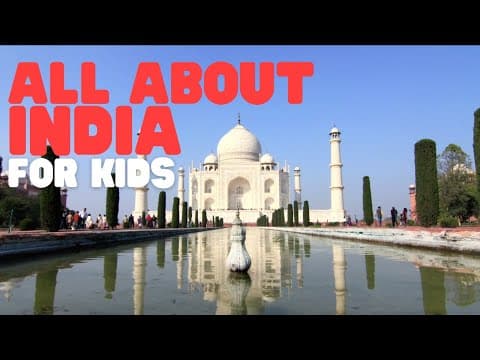
[0:06]All about India. For kids. The flag of India is one of the most unique designs in the world. The first strip is saffron colored. Saffron is an expensive spice grown in India and Asia. The saffron stripe represents courage and strength. The white band with the blue spoke symbol represents peace and truth in harmony with the Dharma Chakra. A religious symbol meaning the wheel of the law. The green stripe represents the land, agriculture, and the deep ties to the productivity of the land. The flag of India describes the values of India's people, culture, religious traditions, and contributions to civilization. Found on the continent of Asia, India is nearly 1.3 million square miles in area. About one-third the size of the United States. Yet, with a population of around 1.39 billion people, India is home to more than one billion more people than the United States. Whoa! India shares a border with Pakistan, China, Nepal, Bangladesh, Bhutan, and Myanmar. Most of the country forms a peninsula, which means it is surrounded by water on three sides. The terrain of the country varies from the world's highest mountain range, the Himalayas in the north. The Thar Desert in the west, and various jungles in the northeast. The Ganges Plain is a very fertile area of land that covers much of Northern India that was created from soil deposited by rivers running down the Himalayas. Remember how we mentioned that India has over one billion people living there? The two largest cities by population include its capital, New Delhi, and the city of Mumbai. Hindu is the main language spoken in the country, though many Indians also speak English. Hinduism is the main religion followed by Islam. India's history goes all the way back to around 6,500 BC. When India's earliest known civilization existed. Evidence suggests that the earliest domestication of animals, including horses and cattle, the evolution of agriculture, and the development of arts and crafts all happened during this time. Have you ever heard of a language called Sanskrit? Here is an interesting fact! Sanskrit is one of the oldest languages in the world. Beginning in the 4th century A.D. the Gupta Empire began. Arts, crafts, science, and math all thrived during this time. An Indian astronomer and mathematician named Aryabhata determined that the Earth rotated around its axis daily. And also scientifically explained solar and lunar eclipses. His work would help scientists and mathematicians hundreds and hundreds of years later. Here is another interesting fact! The decimal numeral system was invented in India in 500 A.D. Yep, that's right. Turns out that decimals are super old. India went through a huge period of change, where a new religion, Islam, was introduced, and invaders from outside of the country sought to rule over the land. By the 1500s, the Mughal Empire began its reign, led by a man named Babur. The Mughal Empire built roads, religious mosques, gardens, and tombs, including the Taj Mahal. It was also a golden age of art, literature, and architecture. By the year 1600, the British East India Company was granted a charter, or contract, by Queen Elizabeth I to have exclusive rights to trade with India. In this way, the British Empire began to slowly take control of India. Eventually, incorporating the country into its empire in 1858. In 1877, Queen Victoria declared herself empress of India. British rule lasted for several decades until 1920, when a civil rights leader named Mahatma Gandhi led a campaign of non-violence against the British government. In order to seek independence, this movement eventually led to the end of British rule, and in 1947, the British Indian Empire was divided into two independent dominions: India and Pakistan. Today, India is a bustling country with dense urban areas and rural villages, and everything in between. Life is pretty different in the villages than it is in the cities or towns. In fact, there are some areas where girls do not attend school. Tourists travel from around the world to see sites such as the Taj Mahal, which is one of the seven wonders of the world. The Ganges River is also a special place. At over 1,500 miles long, the Ganges River is named after the Hindu goddess, Ganga. And people travel from all over to bathe in its waters. The Ajanta and Ellora Caves are also another wonder. Dating back to the 2nd and 6th centuries, these man-made caves were carved into the hillside by hand, using a chisel and hammer. One of the most important celebrations in India is the Hindu festival, Diwali, which is also known as the Festival of Lights. Diwali takes place in October and signals the start of the New Year in the Indian calendar. Everyone lights lamps in their homes to celebrate. India is also home to many different kinds of animals. Remember when we mentioned how cows are special in India? It is literally illegal to harm a cow, so there are cows wandering everywhere. Even on the streets with cars. Other animals include elephants, pythons, river dolphins, lions, tigers, rhinos, and many more. Here is an interesting fact! In the Sundarbans forest, tigers swim in the same rivers as dolphins, sea turtles, sharks, and crocodiles. How's that for wild? Now that we have gotten to know more about India, let's take a little quiz! True or False: India is three times the size of the United States. False! India is only 1/3 the size of the United States, but it is home to one billion more people! True or False: Diwali is a special Hindu festival that is celebrated every October.
[8:47]True. Fill in the blank. The most famous building in India is called the _______ Mahal. Taj Mahal. Great job, everyone! As with all civilizations with a long history, India has endured conflicts, periods of peace, and everything in between. And today, India has emerged as one of the most unique, most populous countries in the world. Hope you had fun learning with us. Visit us at learnbright.org. For thousands of free resources and turnkey solutions for teachers and homeschoolers.


