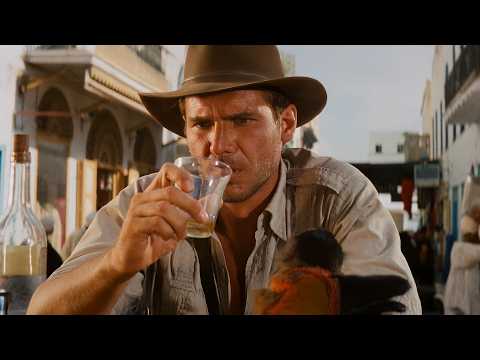
[0:02]In the early 80s when Hollywood was flying high or going intergalactic, a couple of filmmakers dared to ask if they could make a film just as thrilling without ever leaving the ground. And this is for you. The films of today look like they've been sand blasted until every rough edge is gone. Dizzily painted until the image is sterile and plastic. We must pray. Then you look at the stunning grit of Raiders of the Lost Arc, and you wonder why this feels more genuine. In this video, I'm going to break down the sheer, reckless, analog craft that makes Raiders of the Lost Ark look like a billion bucks. Forget nostalgia for a moment. This film's look is an aesthetic choice, a photographic style born from a negotiation between director Steven Spielberg and his cinematographer Douglas Slocombe. Spielberg initially wanted the film to be dark, moody and stylized. Think of classic black and white film noir. But Slocombe had his own instincts and when Spielberg saw the dailies, he noticed that Slocombe's lighting was achieving something different. I am a shadowy reflection of you. Spielberg learned that Slocombe's natural tendencies were better for the kind of zany, globetrotting adventure they were making. The film found its look because the director let his director of photography teach him something new. It's important to understand the format Slocombe used. This was anamorphic cinematography with a 2.39:1 aspect ratio, but with an incredible depth of field. Depth of field is how much of the image from foreground to background is in sharp focus. He was using a smaller aperture opening. This reduces the amount of light hitting the film and to compensate, Slocombe relied heavily on two things: hard lights, and the hardest light you know, the sun itself. through here and made a beam that came down on the floor here. The use of the sun, even artificially, is what gives Raiders its iconic look. Back lighting silhouettes the actors, giving them a heroic quality. It makes the lighting filtering through the dust and heat of the desert air visceral. This is a classical, almost painterly lighting applied to a pop adventure film. When most directors can't look away from their monitors and cinematographers panic without one, Douglas Slocombe calmly shot Raiders without even a light meter. He relied on years of experience and instinct. He mapped sunlight with a compass and watched how it moved through the day. Every shot was planned around what nature gave him. That is why the light never looks staged. This specific combination of hard lighting and depth of field is a sense of epic scale that modern films often miss. The film feels massive because you see everything all the time, always in focus. Spielberg had a reputation for going over budget. Lucas challenged him to shoot this film in 85 days, so this time Spielberg came more prepared than ever before. He shot Raiders of the Lost Ark in a blistering 73 days. How do you make a $20 million movie look like a $40 million movie? You shoot fast. Spielberg demanded about 35 set ups a day when shooting outside in places like Tunisia. Think about that for a second. The energy you feel, that breakneck pace. It's not just in the editing, it's in the very way the camera was put down, framed and picked up again 20 or 30 times a day. This rapid fire pace was only possible because Slocombe and his crew were a well-oiled machine. Slocombe was in his 60s, but moved with the speed of a younger man. Spielberg worked with extensive storyboards that plotted out almost every single shot. Large set pieces and complex action could be executed quickly because the crew knew exactly what the director needed. The film is edited by Michael Kahn, to feel like a train that's lost its brakes. This relentless, focused efficiency is baked into the DNA of Raiders. Every scene tells a story in the fewest possible shots.
[3:43]The film wasn't designed to launch a cinematic universe or reverse engineer from toy sales. It was a movie made by two friends who were just excited about the idea. They didn't feel the need to iron out the character's flaws or explained every plot point. Lucas and Spielberg were adamant that the picture be made practically. Take the stunts. The famous truck chase sequence is one of the greatest pieces of action choreography ever put on film, period. In the original storyboards, Indiana was supposed to grab the tailpipe with his whip, and then climb back onto the truck. Stunt coordinator Glenn Randall came up with a more desperate idea. Let Indy crawl underneath while it poured ahead. It's a genuine show stopper because you know it's happening. Watch the boulder chase again. No slow motion. The boulder is real, 22 feet wide, built from fiberglass and wood, rolling on a real mat. Harrison Ford ran for his life about 12 times. The Wells of Souls set really had over 7000 real snakes. For the wider shots, they ran out of snakes, so they cut garden hoses to different lengths and threw them in. Look for them. Even the set pieces that seem technically impossible are combinations of physical props and traditional visual effects. They did not build a functioning flyable plane, they built a plane not to fly, but to generate danger with its deadly propellable blades. The film also used matte paintings, a traditional technique where an artist paints an extension of a set onto glass and the painting is photographed alongside the live action, making the Nepal mountains look impossibly grand. The film's climax, the opening of the ark, was also all physical. The storm and the lightning flashes were achieved using cloud tank photography, where miniature clouds were created by injecting white paint into a water tank and filming the flowing results. So how do you end a crazy film? Make it even crazier. The melting face finale was an ingenious rig designed by Chris Wallace. They took casts of the actor's faces, the same substance dentists use, and built gelatin and wax skins over stone skulls. Then they simply applied heat to slowly melt the faces over about 10 minutes. It's not perfect, but it will get a reaction out of you. A computer could do it faster, more perfectly and it would not move you. What moves you is Harrison Ford. It's impossible to imagine another actor as Indiana Jones and make it just as fun. In the script, the Cairo swordsman scene was a long, complex, whip versus sword fight that they had rehearsed for weeks. But on the day of the shoot it was 120 degrees and Harrison Ford had dysentery. He asked Spielberg if he could just shoot the guy and Spielberg loved the idea. The film's greatest magic trick is convincing you Jones might not survive any of his adventures. He gets beaten, shot, dragged and exhausted. He's grumpy and constantly improvising. And that's why when he does win anything, it feels earned, and we cheer for him like he's a running back. We also cheer for the music. John Williams' iconic score gives the perfect adrenaline blast for Indy. Sound designer Ben Burtt, who worked with George Lucas and Star Wars, was a genius in mixing simple real world sounds with weird props. He gave the film its signature Foley from the crack of the whip to the terrifying hiss of the snakes and the Ark's supernatural crafted sound. I also can't think of Raiders without Karen Allen's incredible screen presence. She's not written as a damsel or a prop. She fights and drinks. Her eyes never flinch. I don't know about you, but the warmest glow in Raiders still comes from her. The sequels just aren't the same without her. When Spielberg finished shooting, he learned a critical lesson. The only way to tackle a massive production like this was to move quickly and lean on the established craft of his crew. That's the formula he continues to use to this day. He said that if he had more money or time, the film would have been pretentious. The look and feel of Raiders of the Lost Ark endures because its appearance is not dependent on nostalgia. It was born old and stayed young. It still looks priceless because it was built from the oldest trick in the book, real everything, and let the camera tell the truth. The more you learn about how it was made, the better it looks. Come, look, look here, look. Sit down. Come, sit down. This film proves that devotion to the real is the most powerful special effect in the world. The films we remember aren't the loudest or the most polished. They're the ones that dare to look life straight in the eye and keep rolling. If you want to support this channel, watch my film links in the description. And if you enjoyed this video, whip that like button, dig up your thoughts in the comments and subscribe.


