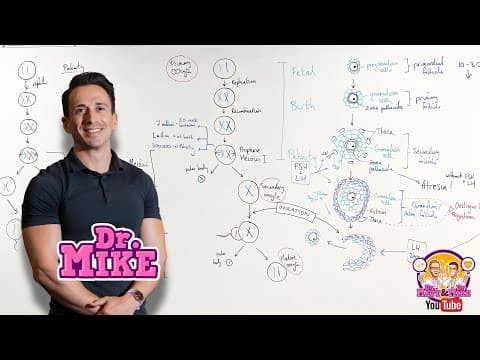
[0:00]Hi everyone, Dr. Mike here, in this video we're taking a look at a process termed oogenesis and folliculogenesis, and hopefully make sense of these two important processes associated with the female reproductive system.
[0:20]Now to begin, you need to understand that oogenesis simply refers to the oocyte, also known as the ovum, also known as the egg. So this is an important gamete or sex cell associated with the female reproductive system. Now its job is to make sure that it has the right genetic material so that when it gets fertilized by a sperm, it can produce viable offspring. Now the process of folliculogenesis is referring to the development of follicles that are these different cell types that can surround the ovum or egg and help nourish it, protect it, but also produce certain hormones that can facilitate this process of not just fertilization, but also implantation of the fertilized oocyte. So I want to begin not with oogenesis, not with folliculogenesis, but with spermatogenesis and you might be thinking this isn't why I turn this video on, not to talk about sperm, but to talk about the female reproductive cycle. Talking about spermatogenesis first is a great launching off point. It makes so much more sense. I'll tell you why, because the process of spermatogenesis, which is to create viable sperm, which is the equivalent of the viable egg, is a much simpler process. And so I can draw it out nice and easily and then you can compare oogenesis to it and see how it's different, where and how. So to begin with spermatogenesis, we need to produce viable sperm, and we do this because uh we do this by starting with a stem cell called a uh spermatogonia, right? And if we have a look at this cell, what we know about this cell is just like every other cell in our body, it contains our genetic material. Specifically, it contains 23 pairs of chromosomes, so remember, I were to pluck a cell out of my body and have a look, there's 23 pairs of chromosomes. A pair of chromosome one, a pair of chromosome two, a pair of chromosome three and so forth. Now, it's a pair because I got one chromosome one from mum, one chromosome one from dad. One chromosome two from mum, one chromosome two from dad. Hopefully that makes sense because it's very important because when it comes to sex cells like sperm, like the ovum, right, or the egg, we don't want two copies. We only want one from here and one from here, because when they combine, that's how we got the pair, the one from mum, the one from dad, right? So, let's begin. We've got our 23 pairs of chromosomes in this spermatogonia, in this stem cell. So, let's just say, let's just look at chromosome one. So I've got one chromosome one here, that's the one I got from mum, for example, and one chromosome one here, this is the one I got from dad. So we're just using that as an example. Now, the very first thing that needs to happen in this process, now this process begins at puberty. This is important when it comes to spermatogenesis. This begins at puberty. Now, this, what happens to this spermatogonia is, first thing it needs to do is it needs to replicate. So it needs to increase the amount of genetic material it has, so it can undergo mitosis and it can replicate. Now, when it replicates, what we have now is not just two copies of every chromosome, right, 23 pairs, but we've got 23 pairs of chromosomes doubled up. So I'm going to have that doubled up, and I'm going to have this doubled up because we've replicated the DNA. Now what we need to do is we need to undergo a process called recombination. So recombination is swapping some genetic material. So chromosome one and chromosome one should be nearly identical. There's going to be some differences, but they're virtually identical, and one arm from chromosome one and the other arm of chromosome one, they can recombine, they can swap alleles, swap genes, right? That's recombination. So if we were to draw this recombination up, we can draw it up like this. These arms are crossing over for example, and that's going to combine.
[4:39]Now, the next thing that happens in this process is we need to undergo meiosis. So we've undergone mitosis, which is simply uh doubling up the genetic material, so we can split it apart into equal daughter cells. We've undergone replication to double up that DNA, we need to undergo meiosis where we actually halve the genetic material into two cells. So we take this, and what this needs to do is it needs to undergo like I said meiosis, and it does this because there's certain cytoskeletal structures which can help pull these chromosomes apart. And so they start to hold on to these chromosomes, and they start to pull them apart. And so what you get is the splitting off, right? So you're going to have one daughter cell here and one daughter cell here. Now, this one is going to have, remember, it recombined, right? So, this one's like this and this one is going to be like this.
[5:49]Okay. We just underwent the process of meiosis. How's that for rhyme. We just underwent the process of meiosis. So I'll draw it across like this. So we just underwent what's called meiosis one. But the thing is we need to undergo two types of meiosis or two stages of meiosis, because remember we only want one chromosome one because I want to mix it with one chromosome one from mum, right? So, here we've got doubled up chromosome, we've replicated chromosome one, we've replicated chromosome one, we don't want that. So, we need to undergo meiosis again. So we undergo meiosis again, and what we're left with now is, if we draw up these four cells, we're going to have that one, we're going to have this one, we're going to have this one, and this one. Now what can you see here that's really important? These four daughter cells, which originally came from this, have different chromosome one. That chromosome one is different to that one, which is different to that one, which is different to that one, right? We call these, because it's spermatogenesis, spermatids, they're immature sperm cell, but what they develop over time in the testes or testes is that little tail. And now what we've ultimately developed is sperm, ultimately. Now, this is that second process of meiosis, process of meiosis again. So this is meiosis two. All right. Perfect. As you can see, we hit the end point that we wanted, a single chromosome, because this one can mix with the equivalent chromosome from mum. This is what's happening. Now, remember this begins at puberty, and this will continue all the way to old age, basically, to the end of life for a male, right? Puberty all the way to end of life. Now I want to compare this with oogenesis, which is a similar process, but there's some important differences. First thing I want to highlight here is we have that stem cell that begins. It's not a spermatogonium, right? It's an oogonium, and this is an early egg, and again, it's going to contain just like that chromosome one, chromosome one, right? And it's the pairs, 23 pairs of chromosomes, and it does the same thing, it replicates, right? So it replicates, and we double it up, and just like we had for the male reproductive system, it's all pretty much the same so far, including the recombination. So we even undergo this process of recombination. Let's write this up. Recombination. So that genetic material starts to swap over, great.
[9:02]And then what happens is it wants to start the process of meiosis. So those important cytoskeletal structures come out to bind and try and start pulling it apart, but here's an important point here that's different for the female reproductive system compared to the male is that it freezes at this point. It stops. Now, I said that for the male reproductive system, this began at puberty, right? So what, 10, 11, 12 years of age and goes to end of life. For females, this begins at pre-birth, fetal life, gestation. So when a female is in utero, within their own mother's uterus, this process begins. And this process goes from fetal life, this occurs, it also, from birth and puberty, and in actual fact, while this may begin at fetal life, it doesn't go any further until puberty. Until puberty. So it's frozen at this point. Now this point is meiosis one, right? We've drawn it up here. This is actually the beginning of meiosis one, which is called prophase one. So here we're in prophase of meiosis one, and we're stuck at that point until puberty. All right, important thing to highlight here. This is the egg, right? The egg contains the genetic material. It needs to be viable so that when fertilization occurs from one of these viable sperm, the genetic material can mix and you can undergo the whole process, not just of fertilization, but of the development of the embryo. We need to understand folliculogenesis because in the ovary where this is occurring, this cell, or I should say this oocyte needs to be nurtured, protected, fed, nourished, and so forth, and this is what folliculogenesis is. So inside of the ovary, you have this oocyte, right? Now, if I were to draw the oocyte up like this, let's just say that this thing here is that thing here. What we've got here is something that we call a primary oocyte. So this is a primary oocyte. And what you're going to find again, during fetal development, during fetal development, is it surrounded by these relatively flat looking cells, which are called pregranulosa cells. Pregranulosa cells. And what we call this, with the oocyte and the pregranulosa cells, is a primordial follicle. So this is called a primordial follicle. Now, the thing is that this primordial follicle doesn't stay as a primordial follicle. It undergoes multiple processes of maturation and development. This primordial follicle will turn into what we call a primary follicle. So there's the oocyte again. Now the primary follicle, these pregranulosa cells will turn into more cuboidal looking cells that we don't term pregranulosa cells now, we just term granulosa cells. Granulosa cells. But surrounding the oocyte, we also have another structure called the zona pellucida. Here we've got the zona pellucida. Now, I haven't told you anything about the granulosa cells or the zona pellucida. Simply put, right now, the granulosa cells help nourish that oocyte, keep it alive, make sure everything's okay. The zona pellucida is a structure that surrounds the oocyte and is important when during ovulation, when one of these sperm cells want to get into the oocyte and it penetrates the zona pellucida, it acts like a security system. Once one sperm cell has entered the zona pellucida, it sets down a cascading series of events, which close that oocyte off so no more sperm can enter. So this is not a primordial follicle anymore. This is what we call a primary follicle. Now a primary follicle will also mature into a secondary follicle, and the difference here is the oocyte gets slightly bigger, the zona pellucida is still there. The granulosa cells start to get a few more layers associated with them, so you start to get around about two layers of granulosa cells now, but in addition to that, you start to develop another cell type. And this cell type are called theca cells. So you now start to get these theca cells on the outside. So we've got theca cells, we've got the zona pellucida, and we've got the granulosa cells. Now what we've got here is not a primary follicle, probably know what it's called now, it's called a secondary follicle. Now, let's just compare folliculogenesis with oogenesis, right? Inside the primordial follicle, the primary follicle, the secondary follicle, we've got this primary oocyte. This primary oocyte goes all the way here.
[15:18]I told you, this process here to prophase uh one of meiosis happens during fetal development. During fetal development and it stays like that throughout birth, it stays like that up until puberty. However, from fetal development through to birth, through to puberty, this process going from primordial follicle to primary follicle to secondary follicle, continually occurs. So we keep taking this cell, and in here, it undergoes this process from fetal development up until puberty.
[16:04]And they will all undergo atresia up until puberty, which means that if we have a look at this particular oocyte, this primary oocyte, if we were to have a look at that, during around about 20 weeks gestation, now what does that mean?
[16:47]You're halfway through pregnancy basically. So you're a developing fetus halfway through, right? How many of these do you have in your ovaries? You've got around about seven million. But remember, these get taken and undergo this process and continually die, every single month. 10 to 30. And what we end up getting, in actual fact, it happens more than every month, but we'll get to that point. What happens is at, by birth, we've gone from seven million to one million at birth. And then by the time we hit puberty, we've got 300,000. Now your question might be, it makes no sense, I don't understand why we would take this prophase one cell that we've gone all the way to this point and just continually kill them off. We don't know why this happens, but it does happen until puberty occurs. Now, what happens at puberty, that's the important question. Generally speaking, what happens at puberty is that this prophase one or meiosis one will complete. Now, when it completes, remember, have a look. We need to undergo this splitting stage, right? So puberty hits, we need to complete this process. So what happens is just like with spermatogenesis, it splits in two, but what you get is this. You get a small cell and a big cell. This small cell will contain half of the chromosomes that are replicated. So this one's going to contain, for example, and we call this a polar body. Throwing pens as usual, this is called a polar body. Now that polar body can undergo the second stage of meiosis, or not, it depends. Sometimes it does, sometimes it doesn't. But this bigger one here, which now contains this right here, this is the main ovum, or oocyte that we're referring to.
[19:07]This oocyte is no longer a primary oocyte now, it's a secondary oocyte. All right, now another important point to understand here. Primary oocyte, secondary oocyte, and then we have primordial follicle, primary follicle, secondary follicle. Don't mix the follicle stages up with the oocyte stages up, because the primary oocyte to here is present to here. That's important, all right? So we've got this secondary oocyte now, because we've undergone, we've now completed the first stage of meiosis. So meiosis has finally happened when puberty sets in. So meiosis one is now finally complete. Compare that to the male reproductive system. The whole thing started at puberty and goes all the way through, continues. Here, puberty, puberty hits, meiosis one completes. All right, that's important. We've now got this secondary oocyte. What now happens with the secondary oocyte? Okay. Firstly, what is it about puberty that stimulates this process? Well, when puberty hits, certain hormones are released. So what you need to remember is that you've got your brain, so here's the brain, and at the base of the brain, you've got your hypothalamus, and you've got your pituitary gland like that. Now, I know that mainly looks probably like a chicken more than anything else. But here we've got our hypothalamus, and underneath, you've got the pituitary gland.
[20:47]Now, the pituitary gland has two, see, I knew I shouldn't have pituitary. My gosh, not great today. There's an anterior and posterior, it's the anterior that we're after here, the anterior aspect of the pituitary gland, because the hypothalamus, once puberty hits, the hypothalamus will release a hormone called gonadotropin-releasing hormone. And it travels down the blood supply to the anterior pituitary gland, and the anterior pituitary gland will release two more hormones. It will release, and I'll put them in red and black, it will release what we call the gonadotropins. Now, what are these gonadotropins? These gonadotropins, there's two types. There's what we call luteinizing hormone and there's what we call follicle-stimulating hormone. Now once puberty hits, this process happens. Gonadotropin-releasing hormone is released, travels down this blood vessel that goes from the hypothalamus to the anterior pituitary, stimulates the release of the two gonadotropins, luteinizing hormone, follicle-stimulating hormone, and in actual fact, they get released in a pulsatile fashion every 90 minutes throughout all of reproductive life. So from around about 11 years of age, all the way up until around about late 40s, you get this pulsatile release, and not only is it pulsatile every 90 minutes, but it changes over 28 days, which we call the menstrual cycle, the uterine cycle, the ovarian cycle. So, hit puberty, these hormones are now released. What happens is something important. The luteinizing hormone, follicle-stimulating hormone that gets released, they combine to receptors on these cells. Now, some of these cells, not every single one will undergo atresia, some will mature a little bit more, right? Some will turn what's uh turn into what's called um preovulatory follicles, or preantral follicles, but in actual fact what they are is like this, right? You've still got the oocyte, you've still got the zona pellucida, you've still got the granulosa cells that are present. So let's draw these granulosa cells. I'll draw it really rough here, right? They're usually relatively cuboidal in shape, you have a whole bunch, right? And then you have these theca cells as well that surround, and there's usually two layers of theca cells by this point, an internal and an external, and you end up getting this space that's present. So, see this space here, this starts to get filled with fluid, and this is called the antrum, right? So this starts to develop. Now what I'm saying is that once puberty hits, there are receptors, right? So you're going to have from, now this is called, let's call this a preantral follicle, or pregraffian follicle, right? There are receptors for luteinizing hormone and follicle-stimulating hormone. Now, the theca cells have receptors for luteinizing hormone. And the granulosa cells have receptors for follicle-stimulating hormone. Now I want you to think about this. Throughout this process, right? We hit puberty. Every month the menstrual cycle occurs, what you're going to find is that there's going to be follicles at different stages. So you're not just, if I were to take, let's just say day seven of the menstrual cycle, and had a look in the ovary, I'm not just going to see 10 to 30 secondary follicles, right? I'm going to see 10 to 30 follicles, some are primordial, some are primary, some are secondary, some of these pre-antral follicles, right? But then once we hit a particular point, in which, in this cycle, follicle-stimulating hormone, luteinizing hormone starts to rise up, right? So it's starting to rise up day five, day six, it's starting to rise, right? They're going to bind to receptors. Now these receptors are located on all the different types of uh the primordial follicles of granulosa cells and theca cells. And so that includes here, right? So let's just say on the secondary, and let's compare it now to this one. So they're going to bind to luteinizing hormone and follicle-stimulating hormone. All right. When they bind, they stimulate both, because I haven't really told you what they do, the granulosa cells and the theca cells, together they produce estrogens. Now, specifically, the estrogens that they produce are estradiol, estradiol. So they produce together estradiol. So, let's do an arrow here and write, let's just write estrogen, and because I'm in Australia, let's spell it properly, estrogen. So together they do this. Now, they actually do this because they need, they rely on each other, right? So theca cells can help produce androgens, like testosterone, and then hands those androgens off to the granulosa cells that can turn the androgens into estrogens, like estradiol. So, the estrogens now released. Now, what this estrogen does is it travels to the uterus. Remember, the whole point of this whole process is we want to ovulate an oocyte that can be fertilized and then embed in the uterus, specifically the endometrium. So the release of estrogen during this phase stimulates the uterus to thicken and become more vascular, right, preparing for implantation. But because of negative feedback, that estrogen will travel back to the brain and specifically tell the gonadotropins to stop releasing and the anterior pituitary gland to uh the gonadotropin-releasing hormone to stop being released and the gonadotropins to stop being released. That's negative feedback, which means luteinizing hormone stops getting released, follicle-stimulating hormone stops getting released. Okay, this is weird. What's going on? All right, when puberty hit and those hormones were released and bound to those cells, specifically FSH stopped some cells from undergoing atresia. Remember, 10 to 30 pre-puberty went through this process and just died off, right? It just went through this process and died, 10 to 30 every single time. But puberty hit, these hormones are released. The binding of these two, specifically follicle-stimulating hormone, it's all in the name, right, would stimulate or save some follicles from atresia to move on to the next stage, right, a subset of this 10 to 30. And as they continued to grow and divide, they start to release estrogen. Of the surviving ones start to release estrogen. This estrogen inhibited the release of more FSH and LH. That's important because then it stops any more follicles from moving forward, and of the follicles that have moved forward, you're going to have one out of all of them that's going to be the most mature. This one, like this one here, because it has more granulosa cells and more theca cells, that it starts to produce huge amounts of estrogen, right?
[29:13]Huge amounts of estrogen. So the estrogen levels really go up. Now, I said that here when these cells produce, you know, a little bit of estrogen, it results in negative feedback. So little bits, little amounts of estrogen, results in negative feedback, but if you pump that estrogen really high, it actually, and we don't know why, it results in positive feedback. So now it goes back to the gonadotropin-releasing hormone and says pump some more out, which then goes to the gonadotropins and says pump more out, and now we pump out a bunch of luteinizing hormone and follicle-stimulating hormone. In this case now, it's the luteinizing hormone that we're after, and what happens is the luteinizing hormone tells these theca cells, for example, to start releasing enzymes that start breaking down the walls here. And what ends up happening is you, from the release of LH, right, luteinizing hormone now, what it does is it results in ovulation. Here are the theca cells. Here are the granulosa cells, and the egg, the oocyte ovulates. And it's going to be surrounded by just a couple of granulosa cells. So what we have here, because of that luteinizing hormone, we have ovulation. Now, this happens at day 14 of the menstrual cycle. Now, let's just compare this oocyte, where is it? What's happening? All right, let's think about this. So this secondary oocyte, the one here, this is actually the one that gets ovulated. This oocyte is that oocyte. It's the one that gets, so that's a secondary oocyte now, right? It was a primary oocyte up until around about this point. Now it's a secondary oocyte, which means it's turned up to this phase. Now once ovulation has occurred, right, so this is the one that gets ovulated, it is in the uterine tube, and the sperm can come along and fertilize it. And then it undergoes the second meiosis, or completion of second meiosis. And now we've got the mature oocyte that contains the complement of paired chromosomes, one from mum, one from dad. It's this that can develop in utero, implant and develop into an embryo. And so hopefully, this is a simple-ish overview of oogenesis and folliculogenesis.