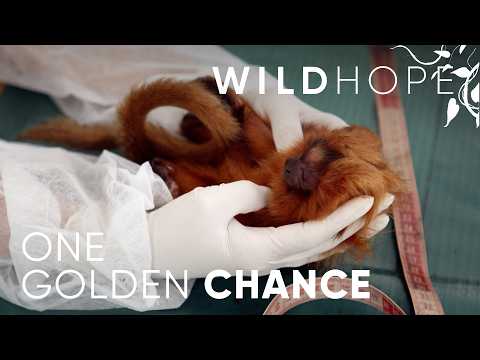
[0:00]The monkey fell asleep everybody. Where should I take this now? Exams
[0:15]The last yellow fever epidemic that hit the state of Rio, was a surprise. The golden lion tamarin is extremely susceptible to the virus that circulated in Brazil. This was a wake-up call for us. I never imagined that one day I would have to work on a vaccine to save these animals.
[1:01]The golden lion tamarin lives in the interior of the state of Rio de Janeiro.
[1:10]It's the only place in the world where the species exists in the wild.
[1:16]But this forest in Southeastern Brazil has not been a safe haven. By the 1970s, habitat loss and poaching had decimated the wild tamarin population, reducing it to fewer than 200 individuals. And that is very little. This is practically very close to extinction. The crisis prompted 150 zoos to launch a worldwide breeding program to rescue the species. Biologists selectively bred the small primates to maintain their genetic diversity, and zoo-goers fell in love. The program was so successful that by 1984, zoos began releasing captive-born tamarins back into the wild. The program is now run by the Brazilian nonprofit AMLD, with local conservationists playing a pivotal role in monitoring the monkeys. In 1989, I started to coordinate the reintroduction team. Under Andrea's watch, 146 tamarins were brought in from zoos, doubling the wild population. Because it's an animal that exists in the city where I was born, I think it's our duty to protect them. But protection would require more than just breeding. The tamarin's habitat was also in need of drastic restoration. Centuries ago, the Atlantic Forest covered over 500,000 square miles, nearly twice the area of France. Since then, at least 75% of the region has been clear-cut. We are talking about a small population in a very small territory. It has already been greatly affected by human development for agriculture, livestock, city, and infrastructure. Today this habitat is quite fragmented into islands of vegetation, which is very bad for a species that lives in trees and needs to move around in the landscape. Tamarins need large territories to establish new troops and prevent inbreeding. And they won't cross open ground to get from one patch of forest to another. So Luis and his team have replanted more than 800,000 native trees. and connected forest fragments with canopy bridges, tunnels, and a highway overpass. They have expanded the forest by about 1,000 acres.
[4:12]These efforts have more than paid off.
[4:17]We celebrated the birth of the 1000th golden lion tamarin in 2001.
[4:29]By 2005, tamarin numbers had increased to 1600. And by 2014, the population had more than doubled again to around 3700. It was an astonishing comeback.
[4:48]But then, in late 2016, a killer began stalking the Atlantic Forest. An outbreak of yellow fever that spread South from the Amazon. Humans and tamarins can both contract the virus from mosquitoes that carry it, though they don't pass it to each other. The monkeys are especially vulnerable to the virus, which can rupture blood vessels in vital organs. In 2 years, the population was reduced by about 32%. The numbers plummeted from a high of 3700 down to 2500, more than 1,000 tamarins lost.
[5:39]It is sad because you get to know all the animals since they were born and they recognize us. Then, suddenly you see that everything starts to die. What are we going to do to reverse the situation?
[6:00]This time, it was a virologist who came to the rescue. Marcos Freire developed the vaccine and also came to teach us how to use it.
[6:17]My doctoral thesis was to develop a new vaccine for yellow fever. A vaccine for humans. But faced with a dire challenge, Marcos proposed a radical solution: adapt the human vaccine for the monkeys. We did experiments with different doses, different vaccine formulations, different vaccine approaches, and we observed that the most effective was the human vaccine.
[6:50]In 2021, clinical trials confirmed the vaccine was safe, and the team set out to immunize the wild population. Vaccinating wild animals to prevent the spread of disease into humans is not a new practice. But using a human vaccine to protect wild animals for their own good is more novel and experimental. It's not yet possible to assess how much of this vaccination has objectively affected the numbers of the species, but it was an emergency action and we had to do something fast. Even without an official assessment, the results are encouraging. The epidemic has died down, and the team is now vaccinating to try and prevent future outbreaks. And the tamarin numbers are rebounding. In 2022, we carried out a new survey. Now, the population has increased to 4,800 animals in the wild. That marks the largest population ever recorded, and the fruits of 50 years of breeding programs, reforestation projects, and vaccine interventions. We are now in a better situation, but we still don't have as much forest as we need that's protected and connected. The team believes the tamarin population will be self-sustaining when at least 2,000 monkeys live across 25,000 connected hectares of forest. Currently, the largest continuous stretch of habitat covers about two thirds of that. So there's still a way to go, but they hope to reach their goal in the next two years. We want to show that restoring the habitat is possible, to make the species more resilient to any new diseases that may occur in the future.
[9:12]Thanks for watching this episode. If you'd like to dive deeper into this story or learn how you can help protect biodiversity near you, visit wildhope.tv. And come back on Mondays for more Wild Hope right here at PBS Nature on YouTube.