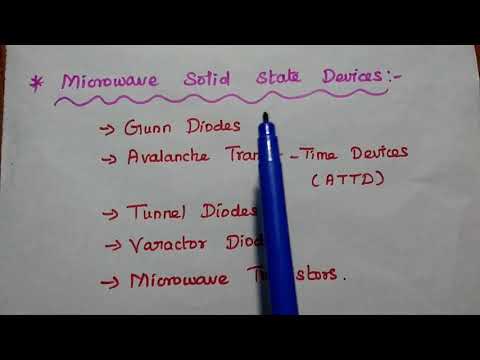
[0:00]Dear students, now we are going to discuss about the microwave components and matched terminator. So microwave components are very high frequency components which are made up of the sections of coaxial lines, waveguides, strip lines and micro strip lines. So especially maximum microwave components are made up of waveguides. So here the waveguide is nothing but a hollow metallic tube. Simply a hollow metallic tube which is used to guide the microwaves from one place to another place. Okay? So here this microwave components are used in both laboratory and in microwave communication and radar systems. So these all are the places we are using this microwave components. So like a normal component, an electronics components, the microwave components is also having two parts, one is passive components, another one is active component. Passive components, examples we can say the matched terminator, attenuator, phase shifter, directional coupler, T- Junctions, power dividers, isolator and circulator and so many passive components are available. Passive, passive means that these components are used as a part of a system. It cannot generate or it cannot do any operation on its own. It needs some input or power supply to activate itself. So that is what passive components. So next one is active components. Here active components there are two types, microwave vacuum tube devices, another one is microwave solid state devices. This microwave vacuum tube devices we are having again two categories, one is amplifier, another one is oscillator. So here this microwave amplifiers, there are two major categories or examples we can consider, one is two cavity klystron amplifier, another one is traveling wave tube amplifier. Two cavity klystron amplifier is mainly used to amplify the signal in the low frequency range. Especially in laboratory purpose, traveling wave tube amplifier, that is high frequency range can be obtained by using TWTA. Okay? So especially in satellite communication, so there and all we are using traveling wave tube amplifier. So microwave oscillators, there are different types of oscillators available. So the best examples we can consider here are reflex klystron. So this is the oscillator, which can generate a low frequency microwave signal. Another one is magnetron. So it can generate a very high frequency microwave signal. This magnetron is widely used in microwave oven. Okay? So reflex klystron is specially designed for laboratory experimental purpose. So next one is microwave solid state devices. Microwave solid state devices are nothing but diodes and transistors. There are several microwave diodes available. Few examples are Gunn diodes, avalanche transit-time devices, that is simply represented as ATTD, tunnel diodes, varactor diodes, pin diode. So N number of diodes are available. These are the widely used diodes in microwave systems. So likewise, there are some microwave transistors are also available. So we are going to discuss about all these microwave components in further lecture videos in detail. So microwave waveguide components are looking like this. It is simply a metallic devices. So the next topic is matched terminator. So matched terminator is a two-port microwave passive component used to absorb all the incident power without any reflection and radiation. So terminator as you all know that terminator means that is the end. There is no further transmission after this termination. And it is the matched terminator. Matched terminator means whichever waves coming towards this matched terminator device, all the incident signals can be absorbed without any reflection and radiation. So here we have to mention this term particularly that is single-port. It is very important. So physically we can say, the matched terminator is having two port. It is having two sides. But one of the side is terminated. That's why it is represented as a single-port because we are going to give the signal only to the towards one direction. There is no further transmission. Okay? So here this is the matched terminator diagrammatic representation. So in this one, this part, okay, at the terminating part is filled up with lossy dielectric material. Since it is a lossy, it is going to absorb the power of the incident wave. Okay? That's why we are going to fill up one side of this terminator with lossy dielectric material. Okay? So then, a tapered lossy dielectric is placed at the end of a shorted line to form a matched termination. So here we are going to use this lossy dielectric in a tapered. Tapered means we can use this landing likewise the slanting or we can use, we can place this dielectric lossy dielectric material like this. This is called tapered. Okay? It is a short end. Okay? So why do we use like this instead of having, so we can have that lossy dielectric like this, straight away we can fill it up. What will happen means, if the incident wave is coming towards it, okay? So the initial part of this lossy dielectric can absorb the signal. Okay? And the last part of this lossy dielectric material cannot receive the incident signal. So it can stop at some point. So that's why we are going to make use of the full lossy dielectric material to absorb the incoming signal, we have to design this as a tapered manner. So if the incoming signal is coming means, it starts to flow through all the areas of this lossy dielectric. So this lossy dielectric can absorb all the incident signal. So for better utilization, we can say that better utilization of this lossy dielectric material to absorb the incoming signal, we can use tapered structure. Okay? And then the length of the tapered section is kept 1 to 2 times the guided wavelength for effective absorption of power from this incident one. Okay? So we have to ensure that the length. Okay, the length of this tapered section should be kept like this, 1 to 2 times that guided wavelength. And next very important one is to increase the power dissipation, we have to use aquada coated sand material. So this lossy dielectric if I'm going to use this aquada coated sand, it can absorb the maximum incident energy. And then the parameters, important parameters for this matched terminators are input impedance, output impedance, both should be equal. It should be approximately equal to 50 ohm or 75 ohm. So VSWL, voltage standing wave ratio, the range should be 1.02 to 1.05. That is it is equal to 1. Okay? So there is no reflection. No reflection means del is equal to S11 is equal to 0. So the matched terminated load is located at the center of the Smith chart as the reference point.
Microwave Components : Matched Terminator
Padmasri Naban
9m 12s1,107 words~6 min read
YouTube auto captions
Transcript source
YouTube auto captions
This transcript was extracted from YouTube's auto-generated caption track. The transcript below is server-rendered so it can be read, searched, cited, and shared without opening the original YouTube player.
Pull quotes
[0:00]Dear students, now we are going to discuss about the microwave components and matched terminator.
[0:00]So microwave components are very high frequency components which are made up of the sections of coaxial lines, waveguides, strip lines and micro strip lines.
[0:00]Simply a hollow metallic tube which is used to guide the microwaves from one place to another place.
[0:00]So here this microwave components are used in both laboratory and in microwave communication and radar systems.
Use this transcript
Related transcript hubs
Watch on YouTube
Share
MORE TRANSCRIPTS


