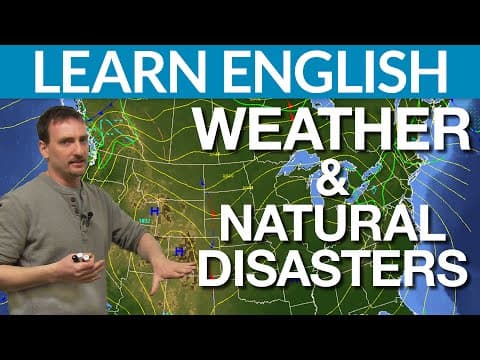
[0:01]Hi, welcome again to engvid.com. I'm Adam. Today's lesson comes from a few requests from the engvid.com comments section.
[0:11]Some people wanted to know about natural disasters. So, what I have here is a bit of a combination of climate vocabulary and natural events.
[0:23]I don't call them disasters because realistically, they're only disasters to humans. To nature, they are just events.
[0:30]Okay. Before we begin, I want to make sure we understand the difference between climate and weather.
[0:37]Weather is the occurrence of nature every day. Today is sunny, tomorrow's raining, today's a little bit chilly, tomorrow's going to be nice and warm.
[0:47]Every day's situation is the weather. Climate is the pattern over, usually we talk about a year.
[0:54]So if I if a country or a place has four seasons, spring, summer, fall, winter, each season has its own climate, rainy, hot, humid,
[1:07]whatever the case may be. So we're going to look at climate and natural events that usually go together.
[1:13]Now, this last year, or the past two or three years, have seen some very crazy weather, or, sorry, climate events.
[1:21]So I'm going to give you some words to be able to discuss these amongst yourselves. First, we're going to start with flood and drought.
[1:30]Okay? The H, the GH, not pronounced, drought. Flood, like going up.
[1:37]So, flood is when there's too much water. Very heavy rain, sometimes it's because snow melts too quickly in hills or mountains.
[1:47]All the water comes into a low place or a flat place. The earth doesn't absorb it quickly enough or the sewage can't take all of it, the pipes, etcetera.
[1:57]So all the water rises up above the ground. Goes into your houses, into the subway stations, everywhere.
[2:04]That's a flood. A flood. Drought is the complete opposite. The drought is what it is what happens when a region or a place doesn't get water, doesn't get any rain for a very long period of time.
[2:17]Everything dries out. All the crops, all the wheat and rice and everything dies.
[2:22]Sometimes this leads to a famine, okay? A famine is when there's a lot of people starving.
[2:32]So this is a natural disaster because human beings and animals are starving because everything died in the drought. There's nothing to eat.
[2:40]Okay. Next, we have earthquake. Quake basically means shake.
[2:47]An earthquake is when the earth shakes. Okay? Now, what often happens is when there's an earthquake in the sea or near the sea, there's often a tsunami.
[2:57]Now, this is actually a Japanese word, actually, it's two Japanese words, but they are used so commonly that we just take them as an English word now.
[3:07]Tsunami means harbor wave.
[3:10]Not so important for you guys right now, but it's basically a big wave or a big series of waves that after the earthquake, all the water in the seas or the oceans starts moving around.
[3:22]Sometimes it moves onto the land and just destroys everything.
[3:26]I think everybody probably remembers the tsunami from 2006 or so, in Indonesia and that area, very destructive, in Japan a couple of years ago.
[3:37]Huge tsunamis. Next, and this is what we're experiencing lately with climate change, global warming, whatever you want to call it.
[3:45]Heat waves and cold fronts. Now, if you watch the news, the weather channel, for example, sometimes you'll see it something like this.
[3:55]You'll see lines with semicircles moving. Other times you'll see red lines with triangles moving.
[4:06]The blue lines, these are cold fronts. Means a very cold mass of air, a cold amount of air is moving. The red one, same thing, but heat.
[4:16]A lot of heat. Heat waves are very dangerous because they come very suddenly, it gets very, very hot.
[4:23]A lot of people suffer from it, a lot of people die from it. Same with a cold front.
[4:28]Suddenly the temperature really, really drops, minus 20, minus 30, minus 40. And again, very, very dangerous.
[4:36]You don't want to be outside when that happens. Next, we'll talk a little bit about snow.
[4:40]Now, the Inuit, that's the natives of Canada in the far north, they have I think maybe 50 different words for snow.
[4:48]You, I'm only going to give you a couple other than snow. A blizzard is a very heavy snowstorm.
[4:54]Okay? Lots of lots and lots and lots and lots of snow. Very white.
[4:59]If you live in a hot country, you don't know what this is, but it's actually very beautiful, but very dangerous.
[5:07]Not fun to drive in, not fun to walk in, just fun, nice to look at, that's it.
[5:11]A squall is like a blizzard, except that it's very sudden, very short and very intense.
[5:20]So sometimes a squall will come in, you have like sunshine, pretty day, it's cold, but, you know, it's winter, but sunny.
[5:27]Then suddenly, you can't see anything. Everything's white. Just snow, snow, snow.
[5:33]Like you can't see past two feet in front of you. And then 10 minutes later, half an hour later, it's gone and it's sunny again.
[5:42]We call this a snow squall. Okay. I know all of you know this word, storm, but do you know the different types of storms that you can experience?
[5:50]You can have an ice storm. An ice storm is when it seems to be raining, except that it's not raindrops.
[5:58]It's little little tiny ice particles. They fall on a tree and become ice.
[6:04]They fall everywhere and become ice. So in Toronto, that's where we are today, in Toronto this winter we had an ice storm.
[6:11]Overnight, all the ice fell. In the morning, trees started falling down. Why? Because all the branches were covered in ice and became so heavy that it boom, crashed.
[6:23]On top of cars, on top of people, on top of everything. Power was out for a long time. Not much fun.
[6:29]In desert places, like in the Sahara Desert, you have a sand storm, where suddenly a big wind carries all the sand and you can't see anything and it gets in your eyes and not much fun.
[6:39]Thunderstorm, lots of thunder. Lightning storm, lots of lightning. Hail, hail are little pieces of ice about this big and they drop and they hit you on the head and they're a little painful.
[6:51]Rainstorm, dust storm, all kinds of storms. Always one word, ice storm, one word, sandstorm, one word, not two separate words.
[7:02]Now, students often ask me, what is the difference between a hurricane, a typhoon, and a cyclone, sometimes tornado and monsoon.
[7:09]Hurricane, typhoon and cyclone, same idea. It's a big circling storm that comes over land and destroys everything.
[7:17]A hurricane happens in in the Atlantic Ocean and sometimes in the northeast Pacific. Mostly it's in the Atlantic and that's why it hits the states and Mexico all the time.
[7:29]Typhoon is in the northwest Pacific Ocean. It's Japan, Philippines, all those countries there.
[7:37]A cyclone happens in the South Pacific and Indian Oceans, hitting India and countries in that area.
[7:45]A tornado. A tornado is like a like a tiny little hurricane, except it's very localized, very small area, happens on land.
[7:54]These all happen, these all begin in the ocean. This happens on land. Like a little wind spins really, really fast and just destroys everything on its way.
[8:05]Mostly it happens in the US in the middle of the United States. And a monsoon.
[8:10]A monsoon is like a very, very heavy wind and rainstorm. Usually hits India and Southeast Asia, those areas there.
[8:20]Then sometimes these are natural events. They're not necessarily connected to climate, but the climate does help.
[8:28]A mudslide. Sometimes you see like there's too much rain or too much deforestation, too many trees have been cut down from a mountain.
[8:36]These trees, the roots of these trees hold the earth together. Not enough trees or too much water and half the mountain just slides off the mountain.
[8:47]It's mud, you know, mud, like sand and water, becomes mud. Just slides off and buries everything underneath it.
[8:53]An avalanche is like a mudslide, except that it's snow. In the mountains, you have lots of snow, lots of snow, eventually it gets too thick and heavy and just starts falling down and burying everything underneath it.
[9:05]And then you have a volcanic eruption. A volcano is like a little mountain, but very hot inside with magma.
[9:14]Or lava is another way to say it, and then it just blows. In Iceland a few years ago, a volcano exploded, all the ash covered the air.
[9:27]And you couldn't see anything and flights couldn't take off from Northern Europe, very bad situation.
[9:34]So, this is what happens. This is the earth we live on. We deal with it, but we also like to talk about it now and again, and now hopefully you have some vocabulary to use in that discussion.
[9:44]Of course, you can test yourself at engvid.com. There's a quiz. Come by and try it out and we'll see you again soon.


