[0:00]Designers don't want to just accept the world the way it is. We actually want to change the world. We realize that we don't have all the answers as designers, that we're going to hit push back.
[0:11]Everybody keeps talking about China as the country to watch. But I keep telling people, I think India over the long term is going to be the country to watch, not China. A lot of design activity is focused on the needs of the middle class.
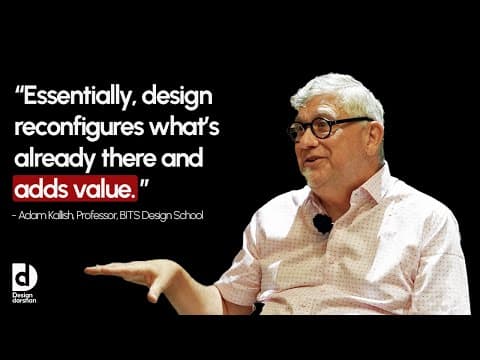
[0:26]And the signal of the village has gone way down. So essentially, design reconfigures what's already there to actually create better value. We're not really thinking about the value of design.
[0:43]Hello and welcome to Design Darshan. Today we are joined by our very own Professor Adam Kallish. Adam, would you like to introduce yourself to our audience? Sure. My name is Adam and I'm from Chicago, Illinois in the center of the United States. I'm a human being and I want to make a difference in the world and I think design is a great platform to do it. I'm an accidental designer. I didn't plan to be a designer. It wasn't something that was a burning desire when I was young. I fell into it, like many designers, because I didn't want to do science. And I, by accident, wanted to do cartography, because cartography was an extension of geology. I was a geology major, and they didn't have a mapmaking program at my university. And so somebody said, well, go on over to the design program and see if you'd be interested in going to design. And I went over there and they had a great conversation and I went into a traditional foundation program and I never looked back. And that's where I am today. So, geology seems so, so much different from design. Like, are there any things that were in geology that you were able to transfer to design? Yeah, that's an interesting question. Geology is really about systems that dynamically change over time. Very slowly, we're talking millions and millions of years. And it's a lot about observation because in geology, you're observing natural landscapes that have tectonic forces underneath the ground. And so you're trying to understand how these tectonic forces shaped what you're actually looking at. And a lot of it is inferential. So you're looking at things and it's inferring natural processes underneath the ground that you can't see. So I had to actually learn how to really observe and ask very critical questions about what I observed and then do research to actually find the answers. And so I see a lot of parallels between the hard sciences, which is looking for structure, and is thinking in terms of systems, and what designers do with human beings in terms of the natural, sorry, the natural environments and the man-made environments that they actually create, which is what Don Norman talks about. I mean, Don Norman says that everything that we consider normal is artificial, everything. But yet, how do we get ourselves out of the acclimation of the familiar and actually realize that all these things are manmade. Everything that you see in this room, that we wear, that we interact with, are all artificial. And when you start to think that way, you're going to realize that there's nothing intuitive or natural about our world, because we created all this stuff. It wasn't naturally created. So there are similarities to geology in terms of systems and trying to understand how things change over time. But there are things that are very different because in geology, you're dealing with inanimate objects, you're dealing with ground forces, tectonic plates, where in design, you're dealing with people and people systems. So that would be the difference from geology. So as someone, you know, was born and brought up in Chicago and who is now in India, what have you observed about India in terms of systems and people? And what do you think India has to offer that any other country doesn't? It's difficult to describe India. It's probably difficult to describe the United States too. The United States is familiar to me. I would say I grew up in it, just like you grew up in India. Yeah, when I came to India in 1990, India was a very different country. It was centrally planned. There was a lot of scarcity. The middle class only made up, I think, probably about one or two percent of the whole population. There was a lot of poverty in India. India has a very unique history. It's much older, obviously, than the United States. You have many different types of cultures here in the United States. It was pretty much conquered by the English or the French.
[5:11]There are only a few occupying powers, where India has had many, many occupying powers over the centuries. You have many languages here. In the United States, we're monolingual, even though we do have different regional variations. So India to me was an interesting case study of how does all this diversity work together as one country? And I think even though India is an old country, really your independence in 1947, after many centuries of being occupied, really made it a young country in many ways. In 35 years, since I first came to India to now, I've seen a huge market change in India. India used to be very insecure about itself in terms of its image of itself. I think it was controlled for so long that India wasn't sure what it was. 35 years later, I think India is finally realizing we're proud to be Indian. We don't have to apologize to be Indian. We can compete on a world stage like any other country. The middle class has grown, it's exploded to like 30% of the population. There's what I call the desire economy, where consumption is everywhere. There's money sloshing everywhere in India. Everywhere I go, there's money. And that's very different than in 1990 where there was no money. Now I'm seeing consumerism, mass consumption, which brings up a lot of issues, obviously. But I think India now, everybody keeps talking about China, as the country to watch. But I keep telling people, I think India over the long term is gonna be the country to watch, not China. Now you're seeing more and more investment in India by multinational corporations. And I think, because India is a democracy, I think it's a much more dynamic economy than you're finding in China. And I think it's going to have a higher growth rate in terms of economic growth than China. China's slowing down. I think India is going to have a much more sustained growth rate, which will have huge impacts on the practice of design in this country. Can you elaborate on what those impacts in design would be? Like, how do all these factors that you just mentioned about India? How does that change the way you design for an Indian context versus an American context? Yeah, well, when Charles Eames came here in the 1950s, he was brought over to actually visit India by the Sarabhai family, which is an old textile family in Ahmedabad. He traveled India just like I did when I came here, and he wrote a report. It was called the Eames Report, and in the Eames Report he identified two key things. One, he identified the Lota, which is just a vessel, as probably the most Indian thing he could identify that was from India.
[8:26]Nobody knows who the designer was of the Lota. It was designed by many people over many centuries. But he held that up, that simple form, as probably the epitome of Indian design. So that was the first thing he did. The second thing he did was he said, that India needed a Institute of design to be created to actually train designers. Very early on, there was this connection between the social dimension of design and helping people at the village level improve their agency and improve their lives. And that set in motion at NID. When I was there, many decades of focusing on improving rural village life, access to water, access to contraception, access to electricity, to utilities, things of that nature. And I think that that really shaped what design was, probably for 50 years. But I think because of the rise of the middle class in India, design very much as a middle class activity. Design was originally created in the 1850s when it was defined in a modern way to actually help improve the products the middle class consume. And so I think what's happening now in India is that a lot of design activity is focused on the needs of the middle class and the signal of the village has gone way down. I don't really hear a lot about design at the village level anymore. I hear about design at the multinational, which are corporations. And I hear about products and services are geared to the middle class, like Swiggy, or Blink-It, or other services, digital services for example, that the middle class want to consume that defines middle class lifestyle. So I think that's a huge change, is that I think design is really focusing on what I call the desire economy. And guess where the money is? That's where the resources are. And I'm not seeing as much of design for the need economy, which is really the people who are not served at all, or the underserved, which is what I talk about, which is the want economy. These are the people that are earning a little bit more money, but they're not middle-class yet. They have middle-class aspirations. So something that I find really interesting is the difference between American consumers, and the Indian middle class consumers. American consumers, they have different needs, right? And so do Indian consumers. And as an Indian consumer myself, I always look for the cheapest and the most convenient option. Whereas, I guess the American consumer looks more for like the luxurious option or something that is much elevated than a usual service. So how do we as designers sort of decide what aspect of the consumer to serve?
[11:35]Hmm. Yeah, it's interesting. Um, yes, it's true that American consumerism is older than Indian consumerism, but not very much. You know, India, America didn't really have consumerism until after World War II because there was this thing called the Great Depression, which obviously affected the whole world. There was no money, there was no work. It was a horrible time for about 20 years. But after World War II, when the Nazis got defeated, it opened up a whole explosion in terms of economic development that went from the war effort to the post-construction effort around the world. And the United States consumers were sort of created. It was all this pent-up demand for cars and washing machines and all sorts of stuff. But I would say that American consumers aren't more sophisticated than Indian consumers, actually, because they both have a lot of things in common, which is they want to have enough capital, they have enough resource to fulfill their desires. Their wants are taken care of. All their wants are taken care of. Once your wants are taken care of, you move to your desires. I want to get a car. I want to get a washer. I want to go on vacation. I want nice clothes. I want, these are things that aren't core to your life from a needs perspective. They're your wants. They're the things that give you identity. And I think that design, whether it's in the United States or design in India, goes back to what I talked about in terms of the desire economy. Is that I think that we're playing to people's desires or things that they don't think that they want or need but actually are being advertised as something that they want or need because it's an aspiration. So we're actually creating aspirations for people to have a fulfilled life, but there's an edge to that, which is the more we consume, the less we feel fulfilled. So a lot of people actually feel emptier the more they consume, rather than the more fulfilled they feel. So this is something that design has to grapple with, which is, we want to help people live better lives, whatever that means, whether you're the desired economy, the wants economy, or the need economy. But we also have to be very careful about the effects of our activities in terms of the human psyche, in terms of fulfillment or human agency. So going back to your question is, I don't think that American consumers are actually that much more sophisticated or are looking only for luxury. There's a lot of people in the United States that are middle class, lower middle class, and they're searching for value, just like the Indian consumer would search for value. They don't want to spend a ton of money, but they want to get more in return for what they spent. So as you were just saying, how designers promote the consumer's mindset, do you think designers are ethical for doing that? Because, you know, they are creating more aspirations, and while they might improve quality of life, like you just said, that's also taking away from a lot of their life too. Yeah, it's an interesting question, design ethics. It's like saying, is there business ethics? Technically there is, but actually if you look at capitalism, capitalism is supposed to be amoral.
[15:06]Because if we include all the moral dimensions of things, a lot of capitalism wouldn't work. Like inequality, for example, that isn't fair. But capitalism depends on inequity. It depends on people who have more and people who have less. Designers are very much part of that, like you said, we are there to support the capitalist system. We're there to support the needs and wants of corporations who sell products and services to people like yourself. I would say that design is an applied art, which means it has the utility value versus a fine art. And I would say that most designers probably don't think too much about the ethical dimension of what they do. But I would say that there are more and more designers that are asking questions about the impact of their activity on a lot of things you're talking about. Is it good that we have 50 different brands of toothpaste or 20 different brands of cars? Is that really necessary? So I think we are starting to ask ourselves some of the questions and saying, Does design need to create a whole new thing? Like Don Norman talks about, do we really need another app? Right, he talks about that. So I think design should start to ask these higher order questions because we do impact society, but I think we see it as like an externality. Like that's somebody else's problem to deal with, or somebody else will deal with that. We just have to fulfill the short term request, which is to create something that people want. So I think it's starting to happen. I don't think it's happening enough, but I think given all the problems that we're seeing in the world in terms of global warming, in terms of inequity all over the world, I think design is starting to finally realize, hey, we are part of the problem, how can we become part of the solution? But there's no easy answer to that at all, there isn't. You said something really interesting, that is there a need for another app? And this brings me back to something that I had a conversation with about someone else, is that, you know, a lot of the times when you're working in a big corporate, you're working on top of someone else's work and you're improving that work. And then when we're not creating new things, we're improving things. So how do we as designers go about such a situation? Hmm. Yeah, it's funny, design is always associated with the new. But actually, most of the design is improving what's already there. That's really what the bulk of design does. And there's nothing wrong with that. So essentially, design reconfigures what's already there to actually create better value. So for example, how do we make things more understandable? We're not creating new understanding. We're just taking things that are already there that are complicated to understand, and we're reconfiguring them in a simplified way for people to actually be able to consume that product or service in a much better way to get more value. So I think a lot of design is just reconfiguring what's already there. There's nothing wrong with that. I think a lot of things just need a simple tweak in order to make it better. And I don't think designers should feel, oh, that's too constrained, for example. Then there's innovation. And innovation isn't necessarily about the new, but it's about shifting the value in a more dramatic way to actually create more value than just tweaking around the edges. And I think that's the interesting space for design to be in, is to actually push in a more aggressive way, to actually get greater value by not just reconfiguring things, but actually adding new capabilities to things that already exist. And you guys have done this within just your short amount of time here at BITSDES, where you actually work on real problems that real people were having. Some of your things were reconfiguring what was already there, but there were things like we're bringing these things in that didn't even exist to actually create even more value. And then the highest order is invention, where you're actually inventing something that didn't exist before, and that happens very rarely in design. This design is going to be that transformational. That's saying it hasn't happened. Like even the iPhone, for example, which everybody says, oh, that was such an innovative or cutting edge or inventive product. It actually was just a reconfiguration of many technologies that had already existed. It just reconfigured it and put it into a new form factor. The form factor had never existed before. So that was the invention, but all the technologies that were in that form factor had been around for years. It just was reconfigured. So I think design should concern itself less with, is this a simple reconfiguration? Is this an innovation, or is this an invention? And just try to solve the problem, but do it in a way that provides the best value for people. So you're into service design, right? And this is something that isn't really offered as a course in many universities, at least in India. And you know, we have product design, we have industrial design, communication design, but service design isn't something that's really taught. Why do you, why do you think that is, A, and B, how do you think that it can be promoted more and taught in a better way? Yeah, I think what you hear a lot all over the world is experience design, or how to create experiences. What is an experience? An experience is something consumed over time. It's a very process-driven. That's why we have experiences. Service design was defined in the 1980s by a woman, Lynn Shostack, and she wrote an article in Harvard Business Review called, I think, Designing Services That Matter.
[21:14]I think that's what her, and she was not a designer at all. And so she actually was very interested in how does the service get delivered and there's a lot of back-end processes that people don't see that are impacting what is seen. So her big innovation was trying to link the unseen processes with actually what people actually experience and actually putting them together and saying this is a whole system that has to be thought of as a system in order to be delivered seamlessly to people who don't care about what's behind the curtain, but what's behind the curtain is impacting the things that is in front of the curtain. Okay? So service design started to take off in the 90s, but it's funny, it was more adopted in Europe than in the United States. So even though it was invented in the United States, as actually European design schools and European universities that actually took service design, formalized it, and one of the biggest users of service design in Europe were governments, was how to improve government services. So actually, they actually created design capabilities within governments to actually rethink the way, for example, how people got healthcare or how social services were delivered in a more efficient way, in a more human-centered way. So instead of it being seen as a handout, right, government services, or something that's just sort of given to people, that who really cares, because it's free through our taxes, why don't we actually create services that actually help people's agency and actually helps improve the way they actually get the service? So the reason you really don't care about service design is that it's become regionalized in Europe. Uh, I think though you are starting to see service design get more visible internationally through the Service Design Network, the SDN, as the professional organization for service design. And I think the service design model, which is using the Cooper model, the Cooper model is the front of the stage, the back of the stage, is a very simple and understandable way to structure an experience. So a lot of people who say, oh, I'm an experienced design, the first thing I ask them, what is experience design? And they look at me like a deer with headlights. They don't know how to answer. They're like, well, you know, an experience. I'm like, well, you can't use the name and the answer. So what goes into an experience? And I say, well, you know, how you feel and what you see. And I'm like, well, you're getting closer, but I still understand what an experience is. So I think the nice thing about service design, service design focuses on how all of our senses work together in order to have some sort of value that's delivered to us through our actions, through our interactions with systems. Systems can be people, can be communications, can be objects, and how all of these things are coordinated in a seamless way for us to get the value. Because in the end, we don't really care about the mechanics of the service, we just want the value. But we do value when we get good service. We remember good service, but we also remember bad service. Yeah, and that's just true in general. We remember the bad more than we remember the good. So I think service design, you'll start to see it become more visible, but it's regionalized, unfortunately. So in like India, do you think since again, we don't have like a career called service design, like who do you think are the people doing service design? Because services certainly exist in India. Absolutely. And there has to be people doing like designing these services, but they're not called service designers. So who do you think is doing them right now? Well, the short answer is I don't know. Just the short answer. I would say that the designers that I talk to that are creating services, because they do use the word service, but I don't hear the word service design, are addressing the front of the stage and the back of the stage, but they don't call it those things. So they understand the concept of service design, but they don't understand the concepts behind service design. And I think that's the disconnect. So I think that they immediately talk about look and feel. They immediately talk about what the brand is, for example. But they don't really go in deeper into that. They look at the surface issues rather than the underlying motivations that people have or should have when they the consumer product or service. For example, Zomato, the food app, they actually had a video that somebody put together about Zomato, but they used the service design model to deconstruct Zomato, for example. So they were looking, they sort of retrofit service design, trying to rationalize all the decisions that Zomato made in terms of their platform. And so I would say that... I would hope that more service designers from different countries actually come to India and actually talk more about it. I do know that the Service Design Network probably has many Indian practitioners who are actually learning what service design is and then talking to other people in India about service design. So I think it's a great opportunity, but I don't really see the signal yet. So to me, service design seems very technical, logical, methodical. Whereas the perception of design in India is that it's a commercialized art. So how do, how does creativity play a role in service design? Yeah, service design is meant to be systematized. So you're actually correct. If it is based upon the logical progression, of how people act with information and objects and systems and data over time to complete some sort of transaction in order to get value for the person to get value. I would say in not just in India, internationally, design is not associated with that. That is design is associated with creativity and imagination and the object. They're all just rule sets. And so we're already seeing it. And so a lot of designers are like, well, if Midjourney or DALL-E or whoever can essentially make these things with no human intervention or just through prompts, then what are designers are supposed to do? We can't compete against a machine system. So I think design is we're starting to realize we can collaborate with AI, but that means that design is going to have to push itself upstream. It's going to have to, because if we don't push ourselves upstream to things that can't be systematized through an algorithm. And this is also happening in engineering. So one of the biggest questions I got in these college nights when I would go is that parents say, tell me that my child isn't going to be out of the job in five years because of AI. I got that question the most. And I said, how do I answer that? So I turned it up and I said, what do you do? Well, I'm an engineer. So I said, oh, engineering can be systematized. So your job, can be just as automated as design. In fact, it can be even automated easier than design because design is idiosyncratic, where engineering is about logic and about gravity and about algorithms and rule sets and whatever. So actually, I said to them, I said, your job is probably going to be much more at risk than a designer because of the logic of your discipline. We're going to see it in medicine, we're going to see it in law. We're going to see essentially, the algorithmization of those professions. And they're going to have to move themselves upstream too. Law and medicine. So I am pessimistic, but because I'm a designer, I'm an optimist. And so it's like I'm perpetually frustrated, or what my friend calls a pissed-off optimist. That's how I sort of, I sort of liked that when I heard it. I said, yeah, I'm a pissed-off optimist. I have anger, but I have this incredible sense that we can make tomorrow better than today. And that's what I hope for all of you.
[30:23]That's the eight ball. Just to close out now, that's a nice note to end on. Thank you, Adam, for joining us. We learned so much from you and I think our audience definitely learned so much, too. And once again, thanks a lot for coming. And thank you very much for the opportunity. I learned a lot today myself.