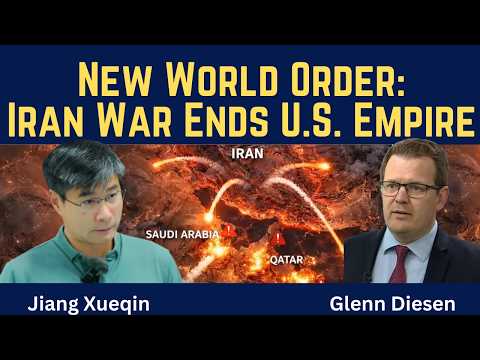
[0:00]Welcome back. We are joined today by Professor Jang, who uses historical patterns and game theory to predict the direction of geopolitics. And uh, Professor Jang's famous for many things. Among some predicting the return of Trump, and also the war against Iran. Now, a second word that is, uh, so thank you for coming back on the program. Thanks, Glenn. Um, how, how do you make sense of this war though? Uh, against Iran? I mean, how, how do you measure how this war is developing in terms of where the successes or failures are? Right. Um, so first of all, Trump has failed to articulate a purpose and a strategy for this war. Um, at first, it was about nuclear enrichment in Iran, uh, and a fear that Iran would develop a nuclear weapon. In fact, uh, in Trump's State of the, of the Union addressed, um, he said that he would never allow Iran to develop a nuclear weapon. And, uh, both chairmen of Congress, that both the Democrats and the Republicans rose to cheer and applaud. It was really the first time that Congress demonstrated any unity during that speech. It was a extremely, uh, political, uh, speech. Um, but the problem with that is that, um, the Omani Foreign Minister, a few hours before the Americans and Israelis struck Tehran, told, um, us that the Iranians had already agreed to zero uranium enrichment, even for civilian purposes. Um, so the idea that, um, Trump needs to prevent a nuclear weapon, um, that doesn't hold. It is a pretext. And they tried different many different excuses, and then finally Rubio said this. Rubio basically said, look, we had to attack because Israel was going to attack first. And then the Iranians would retaliate against both the Israelis and us. So to defend ourselves, we had to preempt Israel and attack first. Okay? So, they're struggling for a narrative. They're struggling to explain to the American people, um, why this is happening. They're also struggling to contain the fallout because, um, after the Americans and Israelis struck the Iranians, the Iranians started to bombard US bases in, uh, the GCC, and they closed off the Strait of Hormuz. And this is doing tremendous damage to the global economy. So, oil right now, it's, uh, approaching $120 a barrel, $110 a barrel, I'm not quite sure, okay? But this is double from a week ago. And remember that the Strait of Hormuz delivers most of its oil to the Asian economies of Pakistan, India, uh, China, South Korea, and Japan. Japan relies on 75% of its oil from the Strait of Hormuz. So, in about seven, eight months, Prime Minister Takechi has informed her cabinet that Japan will be out of oil. Um, and Japan is, you know, a, a manufacturing powerhouse. So, um, this war has been a disaster. And even today, Trump has failed to articulate why the Americans are doing this, what the purpose is, and what the, um, off-ramp is. And what we're seeing day by day is pretty rapid escalation. In fact, I think the second day, or the third day into this war, there are rumors of ground troops. Uh, yesterday, there's rumors that the 82nd Airborne Division, uh, of the American Army, was, uh, given deployment orders. Meaning that, meaning it is possible Americans will choose to air drop, uh, these soldiers into the middle of Iran. For what purpose? We don't know. There's talk of the Americans seizing Kharg Island, which is the oil depot of, of Iran, uh, and which accounts for 90% of Iranian, uh, oil exports. Um, there's talk of the Americans, uh, funding proxies. Um, there's talk of using tactical nuclear weapons. There's talk of a national draft to find 500,000 soldiers for a ground invasion of Iran. So, this war is completely out of control. And it is completely unclear what the Americans hope to accomplish with this war. Yeah, the narrative, I think, was very poorly planned, even worse than the war has been planned. Because it began, as you said, with nuclear weapons, then it moved over to ballistic missiles, then apparently they want to help protesters, then it was about the oil that they should be taken out of the hands of Iranians, then Trump mentioned Iran might take over the Middle East unless, um, you know, so they had to go in. And as you said, the Israel thing was interesting because if the argument is that Israel will attack Iran, then Iran will retaliate against Israel, I guess Israel and the United States, so they had to go in first and then they're essentially admitting that they're fighting Israel's war, but they can't say that either. So, so the, uh, yeah, the, uh, the ability to find a narrative is, uh, was quite poor compared to other wars. Other usually have one narrative, all the media they, they, they organize around it and everyone obediently repeats the same talking points. It hasn't been done well. But this is a war of attrition though, to a large extent, that is both sides seeking, well, not both, there's many all sides seeking to exhaust each other. But this isn't terms of weapons, ammunition, but it's also spilling into energy and, yeah, water, if you will, or just general economics. How, how do you see who, who would, uh, exhaust whom first? Right. So I think Iran is trying to find a war of attrition where it is putting pressure, um, on the global economy, on the GCC nations, because Iran believes that, uh, the GCC nations, especially Saudi Arabia, uh, Qatar, and UAE, can apply pressure on Trump to end this war as quickly as possible. Uh, by closing off the Strait of Hormuz, uh, Iran is trying to pressure the South East Asian economies of China, Japan, and South Korea to pressure, apply pressure on Trump to end this war as soon as possible. So, uh, the Iranians are funding a war of attrition. Unfortunately, the Americans are fighting a war of destruction. So, even though they haven't stated the purpose, it is clear from what is happening on the ground that the Americans and Israelis are intent on complete and utter destruction of the governments, of the Iranian government's capacity to deliver basic services to its people. When I mean by that is that, uh, they yesterday struck a desalination plant in Iran. Um, it, and, you know, so you're denying fresh water to the civilian population. That is a war crime. Um, then the Americans struck, uh, oil facilities in Tehran. Uh, these are, these are civilian oil facilities so that, uh, uh, citizens in Tehran can drive their cars. And if you look at footage from Tehran, it is the apocalypse. It, there's acid rain. Uh, the entire, uh, the entire sky is black. And these people have to breathe that air. So they're, they will develop cancer. They'll have, uh, uh, birth defects. Uh, it's almost like chemical warfare. Um, so, if you are just saying this is a war of attrition, um, that makes no sense. A war of attrition means you embargo Iran economically. Why are you targeting civilians? You know, in the first of the war, a Tomahawk missile hit a school in Southern, uh, Iran and killed about 170 schoolgirls. These are, this is an elementary school. 170 schoolgirls were killed in that. Um, and, uh, and, uh, um, this war, the way it's been constructed, the way it's being fought, seems to me that the Americans are first and foremost focused on the destruction of Iran as opposed to, uh, regime change. Yeah, well, I guess that's a good description. The Iranians are fighting a war of attrition, so time won't be on their side, while the US is, well, seeking to destroy the country with its, yeah, 90 million people inside. So, uh, this is, uh, quite problematic. But the Iranians, of course, it's a limited what they can do to, to the United States. They can, of course, hit their bases and, uh, uh, but, uh, but it seems that Iran is obviously prioritizing, uh, going after the Gulf States. Because that's a good way of, uh, creating some pain for the US-led alliance. Uh, how, how vulnerable do you see them being here though? Yeah, so the Gulf states are the great vulnerability of the American Empire because Israel, um, it has an eschatology. Uh, unfortunately, religiously zealous have taken over the state of Israel. So, they're perfectly okay to die for what they believe in. And, um, they can live in bomb shelters for years and years. That's how strong their faith is. Um, and Israel was designed as an extremely resilient, extremely creative society. So, uh, Israel will emerge from this war intact and probably stronger. The, but the Gulf States are different. The Gulf States are basically mirages. Um, these, 50 years ago, these were just deserts, right? The, um, and for most of human history, the Arab, the Arabian Peninsula was not that inhabited because it didn't have access to fresh water. It didn't have much agricultural, um, output, and so it cannot sustain, um, a large population. And most of were desert nomads engaged in trade. But Pax Americana, uh, changed all that because Pax Americana could, could, uh, needed oil to fund its empire, and it could offer protection to the Gulf States. So, they, um, they developed really rapidly. So cities where maybe tens of thousands people before, now are in the millions. And one striking example is Dubai. Uh, you know, if you go to Dubai, it's just skyscraper after skyscraper. It is a very glitzy city. And it, it's trying to be the financial capital of, um, the Middle East. And there are thousands of extremely wealthy individuals who've transferred their savings to Dubai because they believe that, uh, it's safe, it's comfortable, lots of good Michelin restaurants, lots of good five-star hotels, and no tax. Um, but this image of Dubai as a financial hub is now shattered by this war, and they'll never recover from this. In fact, uh, we're already hearing rumors of, of, of millionaires just fleeing with, with their wealth. Now they're going to Singapore, now they're going to, um, uh, Southeast Asia. A bigger problem is this. A bigger problem is that because the Strait of Hormuz is closed, their oil economies have collapsed. They can no longer sell their oil, and they've shut down their, their oil production facilities. What people don't recognize is that, uh, the Strait of Hormuz takes GCC oil to, to Asia, but then it brings back food. Uh, GCC, um, imports 80, 80 to 90% of its food supply. So, Dubai, the rumor is Dubai will run out of food in about a week's time. Um, then there's the issue of fresh water, where the great vulnerability is actually desalination plants. So, the GCC nations, um, desalination plants provide about 60% of all their water needs. And, so, if these desalination plants are destroyed, then they run out of water in one or two weeks. And this means the entire destruction of the, uh, GCC. Now, now, I mean, the destruction, the, the, desalination plants will be the nuclear option for Iran, and so I don't think they would use it very lightly.
[17:28]Um, but, um, there's really no coming back from what's happening. I mean, for the longest time, the GCC had a reputation for being safe, uh, for being extremely wealthy,


