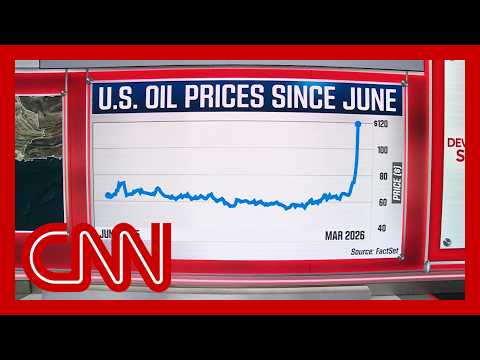
[0:00]Oil prices soaring. West Texas crude now hovering around $100 a barrel. You can see this chart over time, the last time it was this high was when Russia invaded Ukraine. Uh in that height was a June of 2022, but I want you to look at the very end of this chart, an almost vertical increase over the last two weeks. An incredibly quick rise over a very short period of time. It could get even higher experts say by the end of March, maybe even $150 a barrel. If travel through the straight of hormones does not start flowing again. That flow of oil through that critical waterway has effectively ground to a halt. It's only a 20-mile stretch of sea between Iran and Oman and actually only a 2-mile wide sea lane. The president shrugged off the rise in oil prices calling it a very small price to pay for USA and world safety and peace. CNN's Matt Egan is with us now. And and these prices we've seen overnight, the sharp, sharp increase, more than 10% in one day, Matt. That's pretty staggering. Yeah, it is absolutely staggering. Look, oil prices are going through the roof and you know, oil is a notoriously boom to bust market. But even by those standards, this is just a historic spike. Look at this. Oil prices nine, nine months ago all the way in the left side of your screen. That was the last time there were tensions with Iran and a conflict and that looks like just a tiny, tiny increase compared to what's going on now. Before the war started, US oil prices were trading at about $67 a barrel. At one point overnight, they got to $119 a barrel. Now let's look at live look at oil prices, you can see they have pulled back from that peak just over $100 now. However, a 11% increase, a $10 increase of dollar amounts at one point this morning, US oil prices were on track for their biggest one-day dollar increase in history. Now, as you mentioned, the problem is the fact that this war has disrupted the supply of oil out of the Middle East. And it's not just that the straight of Hormuz effective closure is delaying the shipment of oil out of the region. It's the fact that oil producers there, they have nowhere to put the oil. They're running out of literally running out of room to store it all, so they have to slash production. And you look at gas prices, 298 before the war started, 348 a gallon right now. That's the highest level since August of 2024, quite the move in just the span of a little over a week. And you know, this is another look at gas prices as well, zooming out, you can see how it's just going significantly higher. Now, it's not just gas, though, John, uh jet fuel, right? Jet fuel prices have skyrocketed. United Airlines CEO warning that that could raise the cost of airfare. And diesel as well, diesel prices, they're actually up by even more than gasoline on a percentage basis, 24% increase. This is a three-year high and look, this is bad news for farmers, for railroads, for trucks, and ultimately, John, for consumers because everyone is indirectly paying the cost of diesel when they're buying stuff. So, this is a significant situation and and look, the White House is arguing and the president has said that this is uh hopefully just a short-term glitch and that prices will eventually crash. Hopefully, he's right. I think the bottom line here is how long is this last, right? The duration. Because if this is just a few days of $100 also oil, this could end up just being a blip economically. But if this is something that lasts in terms of weeks or even longer, then you're going to start to hear some people really concerned about a potential recession caused by higher energy prices. And looking at US stock futures, uh they're down, but not dramatically lower given the scale of the spike in oil prices. Again, when I woke up overnight and prices were around $120 a barrel, there was, I don't want to use this word loosely, but there was borderline panic at this steep increase in just a few hours. Absolutely, there's no other way to look at it. People were on their edge of their seats for a few hours. Matt Egan, thank you very much for that. That was an overnight drone attack on the residential area of Sitra, which is near Key energy infrastructure in Bahrain. Now, that drone attack injured 32 people, including four children, one 2-month-old, two young boys and a 17-year-old girl. The latest we've heard from Bahrain is that its national oil company Bako has actually just issued a force majeure. That essentially means that it won't be able to meet its contractual requirements to deliver certain amounts of oil due to an unforeseen circumstance. That unforeseen circumstance being this ongoing conflict. Video geolocated by CNN shows an industrial area that houses one of the Bako refineries on fire recently with large amounts of black smoke billow from it. Whether that is linked to this force measure or not, we don't know. We've reached out to Bako for comment and we can let you know when we find out more. But I think what this really points to is that this weekend Iran has consistently targeted Bahrain's civilian infrastructure. Yesterday a desalination plant was hit. It wasn't damaged to the point of no longer functioning, but it was hit. This morning we see this drone strike in Sitra near energy infrastructure that's injured all these people and now the latest is that in this other area of Bahrain, that one of these Bako refineries is on fire. So, this really points to a clear target from Iran on these sorts of infrastructure. G7 Finance Ministers meeting today to discuss whether to release oil from their strategic reserves. CNN's business editor at large Rich Quest is live in London. Good to have you, Richard. We are looking at these prices as attacks continue to unfold on infrastructure across the region where I am. Question is, how bad could this get at this point? According to one trader, the sky's the limit. Uh for one simple reason that look, we got we came back from 120 down to these levels because of that G7 meeting, which is taking place. But there are real the factor that's really moving this market. Firstly, that there is very little oil moving through the straight of Hormuz, virtually none at all. So the supply is almost uh non-existent or the increasing supply is non-existent. And the second factor, the damage that is being done to infrastructure, both in Iran and elsewhere. Uh when you see, for example, as you saw in Bahrain with the depots being blown up. So you take those two factors and you end up with a market that is extremely worried about what comes next. We went into this war, by the way, with a glut of oil, which is why we had a price of around $60 a barrel. That has evaporated and now the concern is not only the supply, but frankly, just will they even be able to handle the stuff if they can get it out of the ground.
[7:44]Yeah, I mean it's not the fact that they've the world doesn't have oil. Um it's just moving that oil around and getting it to the places that matter most and that includes, of course, two refineries where, you know, we're not just talking about oil here, but we're talking about refined products, aren't we? And those products around the world are massively important to the global economy. The G7 ministers are weighing releasing strategic reserves. What does that look like? What might that look like, Richard? Okay, so if you start releasing the reserves, uh of which all major governments have a certain large number and the US has, I mean, gazillions based, it's in the, it's in the poorest rock and in the mountains in the, in the ground in the United States. That does bring the price down. No question about it, but it is a short-term measure. Essentially, you are making it available to the market, but you're not able to replenish it. You can in the US because of, you've got, of course, local supply, but elsewhere you won't be able to replenish it. So the moment you release your supplies, your stores, if you will, that is a one-hit wonder. Um you'd better hope that you, you know, the, the the overall situation improves. If you have a scenario where the President of the United States says he and the Israelis will decide when this ends. And you've got the Iranians saying no surrender. It's difficult to see this ends soon, and in that scenario, why would the price come down other than through artificial means such as release of supplies?


