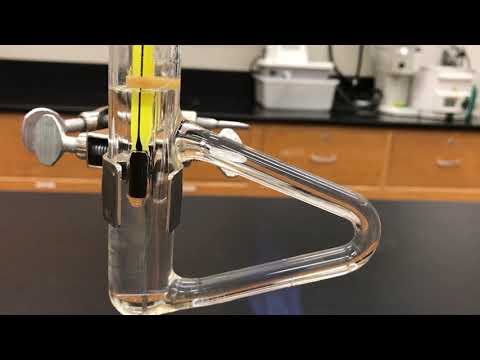
[0:00]Hi everyone. My name is Lisa Nicholls and today I'm going to show you how to determine the boiling point of a liquid using one of these, a Theal tube. First, you want to clamp the Theal tube to a ring stand, and I tend to clamp it right at the triangle. You also want to make sure that there's enough oil in the tube. It should completely cover that triangular area. There should be no gaps. Next, you'll get your thermometer set up, and if you use a rubber stopper that has a hole in it with a slit, the thermometer can slip in there really nicely. And next, I tend to try to position the thermometer almost correctly. Um, you want to position it so that the bottom of the thermometer bulb is roughly halfway, maybe a little higher, but that it will sit into the oil. And next, I'm going to put a small tube onto the thermometer, this is called a Durham tube. And you want to make sure there's no liquid in there yet, cuz otherwise it's just awkward. But you take your empty tube and you can connect it with a little small rubber band. And just slip that on and try to position it rather high onto the tube. When you stick it into the oil, you want to make sure that that rubber band isn't actually submerged in the oil, or it might pop. And next, you want to take the liquid that you want to analyze its boiling point of and add that to the Durham tube. Fill it up roughly between a half and two-thirds full. And then you're going to take a capillary tube, which is open on one end and sealed on the other end, and put it into the tube with the open end down. The sealed end should be on the top.
[2:02]And then that whole setup is going to go into the oil. Likely, you're going to have to adjust the height again to get it exactly right. You want to make sure that that rubber band is not actually submerged in the oil, but you want it to get as as low as possible. Um, your sample should definitely be submerged in in the oil or surrounded by the oil is more more accurate. Um, if you notice the thermometer touching the glass, you want to try to adjust it so that doesn't happen as well. Off to the side, you then want to light a Bunsen burner. Bring that in and start heating the arm of the Theal tube. This is a way to indirectly heat the sample because you'll end up creating a current within the oil. The hot oil will rise, the cooler oil will sink, and you'll create a um a current, uh that eventually moves energy around and heats your sample. So keep on gently waving the Bunsen burner on the arm of the Theal tube and eventually you're going to heat your your sample up. Um, at some point you, you might notice bubbles within the oil. Um, I don't think it happens too much on on the example that that I have, but um sometimes if you do notice bubbles in the oil, what that is is just from um past students where the rubber band has broken and the sample has spilled out into the oil and so you're really just boiling that uh material, that organic material inside the oil. In the interest of time, I'm going to speed it up a little, and let's zoom in on the tube and see what's happening there. So eventually as you heat it, you're going to start getting bubbles coming out of the capillary tube. And what you want to do is keep on heating it gently until you get a vigorous stream of bubbles. So vigorous that it's hard to distinguish between each individual bubble. So this would definitely be good enough. What you then do is you want to take off the heat. So you turn off your Bunsen burner, and then you just let the whole system cool down. At this point you're actually a higher temperature than the boiling point. You've overshot it. But you want to let the whole, uh, the oil cool down and the sample cool down, um, and what we're trying what we're looking for is you want to get to the point where those bubbles eventually slow and completely stop and you just get that moment where the first little bit of liquid pulls into that capillary tube. We'll see it here in in a while. Sometimes what will happen is that you'll have actually heated it too rapidly and uh you'll get all of the liquid to evaporate completely. Uh you don't want that. Uh if that happens then you just have to repeat the whole thing and try to go a little more slowly the the second time around. So this is actually a sped up video. It's probably about three times the speed. It does take quite a while for the bubbles to stop. But eventually they will slow and notice also our liquid level has uh been reduced as well because a lot has evaporated away or boiled away. Um, and eventually though, you should have some liquid left and you should start seeing, you know, bubbles becoming less frequent. They get much more slow, one every couple seconds or so, and what we're looking for is that first moment where the bubbles are done and the liquid draws into the capillary tube. We'll see it here in in a while. Sometimes what will happen is that you'll have actually heated it too rapidly and uh you'll get all of the liquid to evaporate completely. Uh you don't want that. Uh if that happens then you just have to repeat the whole thing and try to go a little more slowly the the second time around. So this is actually a sped up video. It's probably about three times the speed. It does take quite a while for the bubbles to stop. But eventually they will slow and notice also our liquid level has uh been reduced as well because a lot has evaporated away or boiled away. Um, and eventually though, you should have some liquid left and you should start seeing, you know, bubbles becoming less frequent. They get much more slow. One every couple seconds or so. And what we're looking for is that first moment where the bubbles are done and the liquid draws into the capillary tube. We'll see it here in in a while. Sometimes what will happen is that you'll have actually heated it too rapidly and uh you'll get all of the liquid to evaporate completely. Uh you don't want that. Uh if that happens then you just have to repeat the whole thing and try to go a little more slowly the the second time around. So this is actually a sped up video. It's probably about three times the speed. It does take quite a while for the bubbles to stop. But eventually they will slow and notice also our liquid level has uh been reduced as well because a lot has evaporated away or boiled away. Um, and eventually though, you should have some liquid left and you should start seeing, you know, bubbles becoming less frequent. They get much more slow. One every couple seconds or so. And what we're looking for is that first moment where the bubbles are done and the liquid draws into the capillary tube. We'll see it here in in a while. Sometimes what will happen is that you'll have actually heated it too rapidly and uh you'll get all of the liquid to evaporate completely. Uh you don't want that. Uh if that happens then you just have to repeat the whole thing and try to go a little more slowly the the second time around. So this is actually a sped up video. It's probably about three times the speed. It does take quite a while for the bubbles to stop. But eventually they will slow and notice also our liquid level has uh been reduced as well because a lot has evaporated away or boiled away. Um, and eventually though, you should have some liquid left and you should start seeing, you know, bubbles becoming less frequent. They get much more slow. One every couple seconds or so. And what we're looking for is that first moment where the bubbles are done and the liquid draws into the capillary tube. We'll see it here in in a while. Sometimes what will happen is that you'll have actually heated it too rapidly and uh you'll get all of the liquid to evaporate completely. Uh you don't want that. Uh if that happens then you just have to repeat the whole thing and try to go a little more slowly the the second time around. So this is actually a sped up video. It's probably about three times the speed. It does take quite a while for the bubbles to stop. But eventually they will slow and notice also our liquid level has uh been reduced as well because a lot has evaporated away or boiled away. Um, and eventually though, you should have some liquid left and you should start seeing, you know, bubbles becoming less frequent. They get much more slow. One every couple seconds or so. And what we're looking for is that first moment where the bubbles are done and the liquid draws into the capillary tube. We'll see it here in in a while. Sometimes what will happen is that you'll have actually heated it too rapidly and uh you'll get all of the liquid to evaporate completely. Uh you don't want that. Uh if that happens then you just have to repeat the whole thing and try to go a little more slowly the the second time around. So this is actually a sped up video. It's probably about three times the speed. It does take quite a while for the bubbles to stop. But eventually they will slow and notice also our liquid level has uh been reduced as well because a lot has evaporated away or boiled away. Um, and eventually though, you should have some liquid left and you should start seeing, you know, bubbles becoming less frequent. They get much more slow. One every couple seconds or so. And what we're looking for is that first moment where the bubbles are done and the liquid draws into the capillary tube. We'll see it here in in a while. Sometimes what will happen is that you'll have actually heated it too rapidly and uh you'll get all of the liquid to evaporate completely. Uh you don't want that. Uh if that happens then you just have to repeat the whole thing and try to go a little more slowly the the second time around. So this is actually a sped up video. It's probably about three times the speed. It does take quite a while for the bubbles to stop. But eventually they will slow and notice also our liquid level has uh been reduced as well because a lot has evaporated away or boiled away. Um, and eventually though, you should have some liquid left and you should start seeing, you know, bubbles becoming less frequent. They get much more slow. One every couple seconds or so. And what we're looking for is that first moment where the bubbles are done and the liquid draws into the capillary tube. We'll see it here in in a while. Sometimes what will happen is that you'll have actually heated it too rapidly and uh you'll get all of the liquid to evaporate completely. Uh you don't want that. Uh if that happens then you just have to repeat the whole thing and try to go a little more slowly the the second time around. So this is actually a sped up video. It's probably about three times the speed. It does take quite a while for the bubbles to stop. But eventually they will slow and notice also our liquid level has uh been reduced as well because a lot has evaporated away or boiled away. Um, and eventually though, you should have some liquid left and you should start seeing, you know, bubbles becoming less frequent. They get much more slow. One every couple seconds or so. And what we're looking for is that first moment where the bubbles are done and the liquid draws into the capillary tube. We'll see it here in in a while. Sometimes what will happen is that you'll have actually heated it too rapidly and uh you'll get all of the liquid to evaporate completely. Uh you don't want that. Uh if that happens then you just have to repeat the whole thing and try to go a little more slowly the the second time around. So this is actually a sped up video. It's probably about three times the speed. It does take quite a while for the bubbles to stop. But eventually they will slow and notice also our liquid level has uh been reduced as well because a lot has evaporated away or boiled away. Um, and eventually though, you should have some liquid left and you should start seeing, you know, bubbles becoming less frequent. They get much more slow. One every couple seconds or so. And what we're looking for is that first moment where the bubbles are done and the liquid draws into the capillary tube. We'll see it here in in a while. Sometimes what will happen is that you'll have actually heated it too rapidly and uh you'll get all of the liquid to evaporate completely. Uh you don't want that. Uh if that happens then you just have to repeat the whole thing and try to go a little more slowly the the second time around. So this is actually a sped up video. It's probably about three times the speed. It does take quite a while for the bubbles to stop. But eventually they will slow and notice also our liquid level has uh been reduced as well because a lot has evaporated away or boiled away. Um, and eventually though, you should have some liquid left and you should start seeing, you know, bubbles becoming less frequent. They get much more slow. One every couple seconds or so. And what we're looking for is that first moment where the bubbles are done and the liquid draws into the capillary tube. We'll see it here in in a while. Sometimes what will happen is that you'll have actually heated it too rapidly and uh you'll get all of the liquid to evaporate completely. Uh you don't want that. Uh if that happens then you just have to repeat the whole thing and try to go a little more slowly the the second time around. So this is actually a sped up video. It's probably about three times the speed. It does take quite a while for the bubbles to stop. But eventually they will slow and notice also our liquid level has uh been reduced as well because a lot has evaporated away or boiled away. Um, and eventually though, you should have some liquid left and you should start seeing, you know, bubbles becoming less frequent. They get much more slow. One every couple seconds or so. And what we're looking for is that first moment where the bubbles are done and the liquid draws into the capillary tube. We'll see it here in in a while. Sometimes what will happen is that you'll have actually heated it too rapidly and uh you'll get all of the liquid to evaporate completely. Uh you don't want that. Uh if that happens then you just have to repeat the whole thing and try to go a little more slowly the the second time around. So this is actually a sped up video. It's probably about three times the speed. It does take quite a while for the bubbles to stop. But eventually they will slow and notice also our liquid level has uh been reduced as well because a lot has evaporated away or boiled away. Um, and eventually though, you should have some liquid left and you should start seeing, you know, bubbles becoming less frequent. They get much more slow. One every couple seconds or so. And what we're looking for is that first moment where the bubbles are done and the liquid draws into the capillary tube. We'll see it here in in a while. Sometimes what will happen is that you'll have actually heated it too rapidly and uh you'll get all of the liquid to evaporate completely. Uh you don't want that. Uh if that happens then you just have to repeat the whole thing and try to go a little more slowly the the second time around. So this is actually a sped up video. It's probably about three times the speed. It does take quite a while for the bubbles to stop. But eventually they will slow and notice also our liquid level has uh been reduced as well because a lot has evaporated away or boiled away. Um, and eventually though, you should have some liquid left and you should start seeing, you know, bubbles becoming less frequent. They get much more slow. One every couple seconds or so. And what we're looking for is that first moment where the bubbles are done and the liquid draws into the capillary tube. We'll see it here in in a while. Sometimes what will happen is that you'll have actually heated it too rapidly and uh you'll get all of the liquid to evaporate completely. Uh you don't want that. Uh if that happens then you just have to repeat the whole thing and try to go a little more slowly the the second time around. So this is actually a sped up video. It's probably about three times the speed. It does take quite a while for the bubbles to stop. But eventually they will slow and notice also our liquid level has uh been reduced as well because a lot has evaporated away or boiled away. Um, and eventually though, you should have some liquid left and you should start seeing, you know, bubbles becoming less frequent. They get much more slow. One every couple seconds or so. And what we're looking for is that first moment where the bubbles are done and the liquid draws into the capillary tube. We'll see it here in in a while. Sometimes what will happen is that you'll have actually heated it too rapidly and uh you'll get all of the liquid to evaporate completely. Uh you don't want that. Uh if that happens then you just have to repeat the whole thing and try to go a little more slowly the the second time around. So this is actually a sped up video. It's probably about three times the speed. It does take quite a while for the bubbles to stop. But eventually they will slow and notice also our liquid level has uh been reduced as well because a lot has evaporated away or boiled away. Um, and eventually though, you should have some liquid left and you should start seeing, you know, bubbles becoming less frequent. They get much more slow. One every couple seconds or so. And what we're looking for is that first moment where the bubbles are done and the liquid draws into the capillary tube. We'll see it here in in a while. Sometimes what will happen is that you'll have actually heated it too rapidly and uh you'll get all of the liquid to evaporate completely. Uh you don't want that. Uh if that happens then you just have to repeat the whole thing and try to go a little more slowly the the second time around. So this is actually a sped up video. It's probably about three times the speed. It does take quite a while for the bubbles to stop. But eventually they will slow and notice also our liquid level has uh been reduced as well because a lot has evaporated away or boiled away. Um, and eventually though, you should have some liquid left and you should start seeing, you know, bubbles becoming less frequent. They get much more slow. One every couple seconds or so. And what we're looking for is that first moment where the bubbles are done and the liquid draws into the capillary tube. We'll see it here in in a while. Sometimes what will happen is that you'll have actually heated it too rapidly and uh you'll get all of the liquid to evaporate completely. Uh you don't want that. Uh if that happens then you just have to repeat the whole thing and try to go a little more slowly the the second time around. So this is actually a sped up video. It's probably about three times the speed. It does take quite a while for the bubbles to stop. But eventually they will slow and notice also our liquid level has uh been reduced as well because a lot has evaporated away or boiled away. Um, and eventually though, you should have some liquid left and you should start seeing, you know, bubbles becoming less frequent. They get much more slow. One every couple seconds or so. And what we're looking for is that first moment where the bubbles are done and the liquid draws into the capillary tube. We'll see it here in in a while. Sometimes what will happen is that you'll have actually heated it too rapidly and uh you'll get all of the liquid to evaporate completely. Uh you don't want that. Uh if that happens then you just have to repeat the whole thing and try to go a little more slowly the the second time around. So this is actually a sped up video. It's probably about three times the speed. It does take quite a while for the bubbles to stop. But eventually they will slow and notice also our liquid level has uh been reduced as well because a lot has evaporated away or boiled away. Um, and eventually though, you should have some liquid left and you should start seeing, you know, bubbles becoming less frequent. They get much more slow. One every couple seconds or so. And what we're looking for is that first moment where the bubbles are done and the liquid draws into the capillary tube.
[27:48]Now it's a little bit past, but do you see how the liquid draws into the capillary tube? Uh-huh, so it keeps on traveling. Um, but we want, we want to have written the, um, the temperature down on the thermometer a little while ago.
[28:10]And that's the way that you can measure the boiling point using a Theal tube.


