[0:00]Welcome to PTOIC Watch, the weekday podcast from the Wall Street Journal editorial page from the opinion pages of the Wall Street Journal. This is PTOIC Watch. I'm Kate Odell and I'm your host today. Uh, a big question of the week has been President Trump uh in Iran. Is he willing to finish the job? The Mullins are dug in and not moving off their demands. The open files include nuclear enrichment, Iran's existing stockpile, the ballistic missile program, the straight of hormuse, terrorist proxies all over the region. We're going to talk a little bit about Iran today and give you an update there. But we're also going to take an interlude from the hurly burly of the daily headlines and talk about a larger issue that lurks behind the war in Iran and lurks behind many of America's actions in the world. And that is the US competition with China and the Chinese Communist Party. We have a great guest today to help us think about Iran, China, and the volatile world we live in. That's our contributor, Matt Pottinger. Matt served as deputy national security adviser during the first Trump administration. He also served as a US Marine and deployed as an intelligence officer to both Afghanistan and Iraq. Uh, as impressive as that is, Matt's most prestigious credential, of course, is that he is a former reporter for the Wall Street Journal. Matt, thanks so much for joining us today. Kate, it's great to be with you. >> Yes. Okay. So, let's start by asking Matt, uh, I think a lot of a question on our listeners minds is is what comes next in Iran? And one way you could help us think about that is how does the president see Iran fundamentally differently from the rest of the world? He has shown that he is willing to take military action against Iran. He's willing to hold red lines such as zero enrichment. But in recent weeks, we've seen him um recede to uh his uh position that his personal style and his diplomacy can bridge massive differences in worldview. And so how how is the president thinking about Iran right now? And what do you think comes next uh in these negotiations? >> Well, yeah, look, I think I think you said it right, which is, you know, your question implies that he might view Iran differently from the way he views other US adversaries. And I think that's correct. I I I accompanied President Trump to meet with the North Korean dictator more than once, right, uh, in during the first administration, Kim Jong-un. And I I think that I I think that President Trump came away from those interactions believing that uh Kim uh for for all of the uh strangeness and even for the nukes and all and all the rest that that at some fundamental level Kim was not suicidal, that Kim could be deterred. And um President Trump tried to test that proposition with the Iranians in the first term. He offered uh to meet with Iranian leaders. They came close to brokering in fact Emanuel Mcronone attempted to broker a call between the then uh Iranian president and President Trump when President Trump was up in New York for the UN General Assembly and that the Iranian leader got cold feet and backed out. Uh they were unwilling to talk to him. They sent assassins to try to kill the president. People forget that during the 2024 campaign, um you can you can look up the DOJ case about uh Iranian proxies who were hired to try to put together a plot to kill u uh candidate uh Donald Trump in 2024. So I I I I think that just his experience um having tested the proposition of maybe there's there's some room uh I I think he came away more or less persuaded that they are uh cannot be deterred or or more more precisely if they had nuclear weapons they would not be deterable. they would be able to conduct even more aggressive terrorist activities, more aggressive uh overseas uh proxy wars uh knowing that they're they have a shield. You know, they've got a nuclear shield. Nuclear powers don't tend to fight one another, right? With with the with the minor sort of exception of India, Pakistan, no other two nuclear powers have ever really taken shots at each other. So um I think that he is right to identify this regime as being uh qualitatively uh more problematic ideologically uh even than than North Korea when it comes to uh this idea of aggression and deterrence. So um uh so here we are. We now now we he has a war. I think he wants to dismount but he but he doesn't want to do it without uh uh some kind of a pathway to uh preventing further enrichment. And and and I think he he's quite serious about wanting to take possession or at least move out of Iran the the already uh uh enriched uranium that resides in Iran. Uh but the you know right now what what we're looking at is uh dueling blockades of hormuz. President Trump was right to to to impose his own blockade of Iran when Iran was uh asserting control and only letting its own oil get through. But but this might be the new normal. I think we might be in this position for quite a while. I the president has talked about yeah we might we might be very close very close. I thought it was very telling that he mentioned in an interview just the other night maybe Labor Day. Okay, that's September, right? So, I I wouldn't be surprised if the summer is a summer of relatively little oil coming out of uh the straight to Hormuz, >> right? And I think, you know, the US Navy's ability to keep up that blockade is better than the Iranian government's ability to go without uh the oil revenues. And it it seems like has Trump has maybe been a little impatient with that blockade, but the longer it goes on, the more leverage he gets. And to me, um, an indefinite blockade, even if, uh, you know, it feels like an unsatisfying outcome, that's better than a bad deal. Uh, do you So, it sounds like you think the president, uh, sees it that way. And we'll >> Okay. Yeah. >> Look, I I I think I think that's where he's at. I think I think this is one of the areas where President Trump has been pretty consistent for for as long as I've known him, a decade or I mean going back to when he first ran in 2026 um or rather in 2016. This you know denuclearizing Iran, ensuring that they don't obtain this is a hard fundamental uh legacy uh uh sort of issue for the president and that's why you see him making comments. He's been criticized, but I think sometimes for these comments, but I think it's I think it's helpful when he does uh make clear that that there is a red line that he's not willing to go below. He said, "Look, I this isn't about the midterm elections, right?" He said, "I don't care about the midterms in the context of keeping uh uh nukes out of the hands of this insane regime that kills tens of thousands of its own kids on the streets earlier this year. Right. They're today's the today's the anniversary of the Tanman massacre, 1989. I remember very well where I was as a high school student when that happened. Iran killed an order of magnitude more uh street demonstrators this January. Um they they have no legitimacy. This is a regime without legitimacy, but it's a regime that has armaments and still has the desire to develop nuclear weapons. >> And stepping back a little bit, I mean the discussion, there's been a big debate in Washington about how China is reading the war in Iran. And I think on on one side of that, you've had uh the United States expended a lot of uh exquisite munitions, a lot of air defense weapons, and it's left itself more vulnerable in um the near-term if there were to be a Pacific crisis. On the other hand, I think you have a compelling case that the United States also showed uh that it is still willing to engage uh militarily and also um Iran's Russian and Chinese supply chain military equipment did not perform very well. So to me, I think the the action in Iran really muddies the water at best. But I how do you think the Chinese Communist Party is looking at uh the Iran war in the United States uh in the Middle East? >> Yeah. Well, you know, they're as Leninists, they're they're going to uh hedge. They're going to be prepared to make the most of a difficult situation while also uh probably hoping to see oil flow again uh through through the strait. Uh but in the meantime, as long, you know, China is pretty cleareyed about the Iranian regime, even though Iran is part of China's axis. They're sort of the they and the North Koreans are the are the two most problematic members of of that access. Uh I I have a pretty good information that Chinese diplomats showed a certain amount of contempt for um for Iran's just the rigidity of their of their approach. like the fact that they they they go to war instead of manipulating. You know, China China for China, the high gold standard is manipulate your way, influence your way. Um uh you know, use leverage to get your way without having to actually uh pull the trigger and go to war. Iran is just always ready to bring a war upon itself, you know, and and uh and and here they are. How's that worked out for them? Not great. Not great. Um but uh but in the meantime, Beijing is going to keep providing support for that Axis power, right? They they they want to test new weapon systems out on the battlefield. They want to they they're learning uh about American TAD uh missile interceptors and Patriot interceptors and American stealth fighters and technology. They're they want to test their radars on the battlefield let letting letting the you know they'll they want to fight the Americans to the last Iranian and to improve their own capabilities in the process. So we should be pretty cleareyed about the fact that uh China's on the other side of this thing even even though I do think they would be uh probably relieved at some level to see oil flowing again. >> Yeah. And Ukraine of course has been another testing ground for the same kind of adversary military equipment. I think you're right to connect for listeners that um this really is an access food chain here and they're not necessarily independent events in the Middle East and and in Europe. Um yeah, I I wanted to ask a you know so the president just came back from from China a couple weeks ago. Uh and it's not really a a novel observation here to say that his his posture towards China seems different from how it was in the in the first term. I think the president uh actually uh came to office with a lot of credibilities credibility with voters because he was more hawkish on China and identified China as a a threat to the United States. But the theme of this summit was uh friendship with uh market opportunities in China. Um can you try to describe to us what's what's changed um in Trump? Is it Trump's thinking? Is it the advisers around him? Um, is it his own kind of comfort in power? Uh, how is Trump Trump thinking about China now? And is it is it different from his first term and to what extent? >> Yeah. Yeah. Look, I I I think he uh in all honesty, I think he was a bit freaked out uh by China's uh exercise of its leverage over the global rare earths supply chain, right? All of these value added goods, magnets, and industrial products that contain uh rare earths. And China has a virtual monopoly on uh on many of those things. I once Beijing showed that it was willing to exert that leverage during the uh the sort of the trade battle in 2025. Uh I I think that was a um I think it came as a shock to the administration and President Trump said okay look I I the president have uh several other goals in mind as well uh besides uh you know out competing China even though that remains a goal. uh Venezuela, uh Cuba, now of course, as we've just discussed, Iran. There there's a there's a logic to wanting to sequence, not take on the world all at once. And and I think that that's part of what's driving this uh this what I what I would call a day. I I don't think the president uses that term. The the term that you are seeing used that I think is a is a substitute for day is um a a a relationship of constructive strategic stability. That's the watch word. Beijing is now has adopted that phrase. Except the thing that we need to be careful of is that Beijing defines that differently than the way we define it, right? We define it what the words suggest. You know, let's not confront each other right now. Let's have let's allow for a little bit of stability and predictability. Uh the way that Beijing views it is the same way the Soviets viewed day in the 1970s when President Nixon followed by Ford followed by Carter pursued this day tant strategy. Uh and and and what the Soviets said was, "Oh, this is the Americans getting a little bit timid. Uh we we're going to use the opportunity to become more aggressive." And I think you're going to see evidence of that. I think not not necessarily something uh you know, not necessarily war, but what I'm what I'm talking about is putting continuing to put pressure on the United States on rare earths. That was not solved during this latest uh summit. and and for and and China if you look at what their ministry of state security is writing and it's important to look at what they're writing because they are the most powerful uh component of of uh China's apparatus right now more important than statements from the foreign ministry in China they they are writing about how China has just achieved what they call a strategic stalemate with the United States and the way that you get through a stalemate is to compete even harder. So while we think that we might be able to sort of take our foot off the gas, divert our attention to other parts of the world, Beijing is saying while the Americans are distracted or or want things to remain copathetic, let's push harder. And one of the areas where they're going to push especially hard is on US allies. Uh they're you know, you can see them uh roughing up the Europeans on trade. Europe is really facing a moment of truth uh for itself. They have to just man up and decide whether they want to have any industry in Europe. Uh because they're on the road to having zero industry. That is China's express goal is to make everything that Europe buys. So um are they going to erect tariff walls? Are they going to actually push back? The only only Europe can decide for self whether it actually wants to manufacture anything. U they will not be a very relevant continent um uh or power uh if they don't. And u look at what they're doing to Japan. they're putting pressure on on Japan, more explicit pressure on rare earths elements and things of that nature. So, uh, so that so we're we're in we we got need to be careful. I think that we're moving into a dynamic that that's going to remind us of some of the downsides of >> Dayton in the 1970s. >> We've been writing that one of the big flash points to your point about pressure on on US friends is this pending arm sale to Taiwan. Uh the the president uh appears to have kept an arms package for Taiwan in his pocket to kind of set the mood for uh this summit in Beijing. And I I thought, you know, one of the big takeaways of the summit was that the president wants to talk about economic engagement. He wants to talk about getting along. And Xi Jinping wants to talk about Taiwan. I mean, he issued a very stark uh warning uh to the uh to the president about that that's the issue that could uh derail USChina relations. he made this you know very complimentary to China and its own um view of itself metaphor about the thudic disease trap. Um and so my question to you is really uh first we try to articulate here why why Taiwan matters and why the Americans should want us to sell arms to Taiwan. Um but also what do you expect um the the president to do now that that summit is over? Is he going to um clear that package um now that uh that that's passed or is he going to continue to try to pursue this data and and keep it on ice? >> Yeah, Kate, I think I think you frame the dynamic very well. So, I mean, what's what's going to happen with this arms package? The US has this this sort of unfortunate tradition, Republican and Democratic presidents going back uh you know all the way to the early 90s uh of of not wanting to offend Beijing with arm sales, but knowing that we have to do the arm sales. Taiwan has no other vendor uh to that it can turn to to deter Beijing. And so what what we used to do would would would be that we would kind of Taiwan would make requests for arms and we'd let these requests accumulate and then just as a president was about to leave office, I'm thinking of George HW Bush uh uh you know doing a deal to sell F-16s to Taiwan in you know the in the early 1990s. Um you know then they then they sell this huge package and we finally graduated from that. broke that cycle uh during the first Trump administration when we said our policy now is that if Taiwan asks for arms and we think that these are arms that it makes sense for them to have, we're just we're going to sell them the arms. You know, it takes time to to manufacture those things, there's a backlog, but we approve the arms sale and we inform Congress on the spot. We don't we don't accumulate these things to try to, you know, uh uh, you know, accommodate uh Beijing's feelings about this. So, I think I think what we're seeing right now is a little little bit of backsliding on that. Um, which is unfortunate. I I still think President Trump's going to going ultimately he's going to approve those arms. It's still going to take time to make the arms, which is really the the bigger thing that we, you know, the Trump administration is trying to address, which is, you know, we never should have gotten into this game of of minimal runs for making crucial weapons. uh we we should always be ready to fight two major wars uh at the same time. That means that we need to we need more munitions and uh that means we need a budget um uh to do that. In addition to the sort of things that uh the dis the disruptive the good disruptions that the uh Department of Defense is trying to usher in uh to to let u you know more uh commercial vendors into the space to try to compete and and more efficiently make um uh armaments and asymmetric weapons like drones and counter drones and the rest. I mean, that represents, I think, uh, the best of the president's China policy is his push for a larger defense budget and trying to fix the acquisition system so that the United States can pro procure um, a better mix of weapons and and be able to defend its interest in the in the Pacific. Even though um, sometimes his remarks are mixed, I think that that sends a pretty unmistakable signal if he follows through with it. But I do want to ask one more question on on Taiwan because it's at times hard to tell whether the president wants a different policy on um on Taiwan. I mean, the president came back from um from his Beijing summit uh saying we we don't want a war 9,000 miles away from the United States, which is absolutely true. He said that some of the diplomatic penumbra that governs our relationship with Taiwan, like the quote six assurances from 1982, which were a list of things we told Taiwan, don't worry, we're not doing this. The president said, uh, you know, um, those are those are old. Um, we why would I keep let that keep me from from talking to China about Taiwan? Um, but he also said he was going to call the president of Taiwan. Um, which is something that typically would outrage China. So, this is a hard a hard mixed bag to read. Uh, does he does he want um to make does he want to just hold things steady so that there's no crisis in the Taiwan Strait on his watch? Um does he does he realize that um Congress would probably box him in if he tried to change um how the how America thought about Taiwan? What's he what's he going for? >> Yeah. Yeah. I mean, look, the the policy that he pursued in the first term and what I think he's pursued so far in the second term is still consistent with what US policy towards Taiwan has been going all the way back to, you know, Reagan, right, which is uh uh what some people like to term strategic ambiguity, but it's pro it's continuing to provide armaments um because the only way we're going to avoid a serious crisis for the United States uh will will be to deter a war. Even if the US uh even if it wasn't a war, it was just a coercive annexation that happened quickly of Taiwan. We are in a world of hurt. President Trump's uh major uh goals with respect to the US economy, with respect to winning the AI race, with respect to uh re-industrializing the United States, kiss all of that goodbye if Taiwan is subsumed uh coercively by mainland China. And that's because we're not going to have access to computing power anymore. We China will have taken over the global uh center for computing power. Uh and even though we're doing the right thing by building and requiring companies to build more uh chip fabs in the United States, it's still it it's great. It it's it it needs to keep accumulating. It's going to take a long time for the United States to build anything close to what uh what is made available by Taiwan. that is our entire economy. That's the entire tech, you know, foundation for the United States. So, if if uh the US doesn't deter this war and help Taiwan and and Japan and others to to create an an environment of deterrence, um you know, we're Yeah, it's uh we are we are in serious trouble. I mean, it's it's going to make the whole COVID shock uh look like uh the good old days, >> right? And I think you're right to underscore there that it's America's relationship with Taiwan is is economic. It is um strategic from its location in the first island chain. And it's it's >> there there's this tendency to think that hey, we've already taken care of this re reshoring of of uh of chips. There's good stuff happening. Don't get me wrong. Taiwan Semiconductor Manufacturing Corp. has built this you should go look at this thing if you haven't been there in Arizona. This this like growing behemoth fab. And yet if you compare if you compare that to spending an hour on the highway uh you know between Taipei City and Shinju it's one of those every four minutes you know that you drive past you know you drive past another Arizona you know uh you know every few minutes. So we we've got a long way to go before we are not dependent uh on Taiwan on that front. And then there are a lot of other reasons why we should not want Taiwan to be, you know, coerced into uh becoming a communist, you know, protectorate. You know, this is uh this is really key terrain. This is the this is one of the freest countries in the world. It's one of the most prosperous countries in the world. It's one of the cleanest in the in the sense by which I mean no corruption. It it's an amazing place and that is an example uh for China. It's an example for the whole region and it's also really strategic terrain where they are uh right between Japan and the Philippines. >> Well, I was hoping you could make that uh case. I believe it was you who wrote somewhere that Taiwan is um the the East Berlin of the West Berlin of a new cold war. And so I it's it's kind of declass now to argue that America is in a larger ideological competition and that that what we're talking about here are the values of of the free world and what kind of world we're going to live in. I mean, people hate the phrase rules-based liberal um rules-based international order, and I understand that, and I think Trump has been right to move away from that and to acknowledge that hard power and military power are essential in world affairs. But I also think now there is almost in neither party there is not much of a case being made that um what uh what China wants to do is overtake the United States as the premier power in the world. and that if if the US doesn't want that to happen, we are going to have to compete to stop it. And so, um, describe for our listeners just kind of how you think about our contests with China in in ideological terms, in the terms of, >> you know, it would be a luxury if, uh, you know, if if governments globally were legitimate that had consent of the of of their people to, you know, uh, to constitute a government, uh, government by the people. You know the it's the fact is and then and then we wouldn't have to really talk as much about about ideology. The problem is that the ideology is interested in us you know whether we like it or not. Number one, if you spend time reading what Xiinping is telling his own system, you know, it it'll it'll uh you know that those are some smelling salts that that'll wake you up pretty quickly as to what the scope of his ambitions, the role of ideology in his vision for this uh single party socialist uh empire that spans the globe and and uh and beyond. So uh so so that's number one. the the the it's an ide ideological competition on on the axis side. Don't make no mistake about it. The second thing is even though uh you know we we we don't want to uh be preachy uh and we've got our own problems at home, the fact is we are a free society. We are we are the longest running liberal uh democracy, democratic republic, representative democracy with with all of these rights endowed and and on on on our in our best days wellprotected rights um that uh keep us prosperous, keep us safe, make life work worth living. and and we we underplay that to our detriment because it's one of the most potent uh narratives that we have to tell. It's it's it's not a fake narrative. It's not, you know, all all this disinformation that that is pouring in from the Axis powers. All we have to do is tell the truth about, you know, our system and and the conversations that are h happening in it and and all the problems of it, but how we we still deal with those problems in the context of a constitutional uh uh democracy. You know, we should not be holstering that gun. We should be we should be using it. We should be making sure that people can can hear those conversations in places like Venezuela uh you know which has now graduated from you know a dictatorship to a uh you know a slightly more liberal autocracy. Now we now we need to we need to bring that up to uh you know a full democracy. That's what the people want. That's what they've already voted for just a couple summers ago. So uh same thing with Cuba. Same thing with Iran where my gosh, you know, 40,000 kids getting gunned down in the streets. The Iranians hate that system. We should be we should be giving them um hope uh and uh and do it in a way that's truthful. >> Yeah. Um and I think there's there's an audience for that. you look at public opinion polling of kind of who um Americans perceive as the greatest threat to the United States, even on open-ended polls, China is uh something that commands a China is gets 50% plus of Americans saying I I think China is a a long-term big threat to the United States. So, it seems like there there is also um an audience for that. But to to drive home your point about the the difference in systems and what that means, I think it'd be helpful helpful if you could give us your best theory on the purges going on right now in Xiinping's uh military command. I mean, some of these uh some of these purges include uh some some of his childhood friends um people who have been around him for a long time. I guess my my kind of best guess involves that he's trying to consolidate his hold on power, that he is um unsatisfied with some of the progress that his military forces are making in their ability to conduct joint operations. Um but what is just so wild is how opaque it is and how little we know about those purges. So what do you hear? What's your best guess? So my friend Steven Cotkin the the biographer of of Stalin uh says that Hitler killed his enemies and Stalin killed his friends. Right? Cinping is in the Stalinist mold. He he is purging the closer the most dangerous thing in China is is to be a trusted uh you know uh close lieutenant of Cinping. Whether you're in uniform in the military or you're just another party apparatic who's made it up to the pilot bureau. These people are are uh one after another being disposed of. Some most of them are not being shot in the head the way that that uh you know Stalin liked to do it. Most of them are just being sent into jail or or or h house arrest or or or what have you. Although there have been a lot of um a lot of people who've fallen out of windows as well. A lot of generals who've committed suicide. the the the fact that he has put so much emphasis on on the military purge is really quite interesting. Right? We're now up to 90% of the Chinese generals uh generals and admirals who were serving on the central committee of the Chinese Communist Party. Remember the Chinese military does not swear an oath to China. It swears an oath to the Chinese Communist Party. It is not a national military. it is the armed wing of a uh single party dictatorship. And so 90% of the generals have been purged uh ju in in in just the last few years. Some of them with with uh wrap sheets and they've been publicly humiliated. Others we just don't know where they are. They don't show up anymore, you know, at these uh central party gatherings. Um I think that it is part of it is a feature of the system and Ciinping is influenced by Stalin as interpreted by Mao Dong. Mao was a huge he he he he he he sometimes resented being treated like Stalin's little brother Mao. But he also loved what he learned from Stalin, which was first and foremost, your first job as dictator is to purge uh uh the system constantly to keep it on on its toes, to keep yourself in power. And you also purge first and foremost anyone in the guise of reform. Anyone who presents themselves as a reformer, they catch the first bullets in that worldview. And Cinping is a student of that worldview and he is now the greatest practitioner of that world view. So that's why he's eliminating his military leadership. He wants people who will uh ideally have some level of competency. But much more important than that, they're going to salute and say, uh, you tell me to jump, I I'll ask you how high you want me to jump. I will do anything that you tell me to do, and I will go to war even if I think it's a bad idea. That's what he's looking for is a loyalist um uh militant uh officer corps and so we should be aware of that. So even though that probably means he needs a little time to rebuild that, think about what he's building. Okay, this is he is building a command uh militant officer corps uh to be ready to wage war. >> Matt, this is a fascinating conversation. we have to wrap up and so I do want to close with one quick fun question which I'd love to know what was the best story you ever covered for the Wall Street Journal. Uh and uh you you traveled around Asia I think pretty extensively for the journal. Yeah. >> Uh what was >> Well, I'll tell you too the the the uh the the saddest one was the Asian tsunami in 2004 uh that that hit you know the Indian Ocean countries all around it killed a quarter of a million people. I got scrambled down to cover that and it was a very heartbreaking um life-changing experience. I met a bunch of US Marines uh who were responding to that crisis and that that set me on the path to becoming a US Marine myself. So that was the most contest which is impressive. Yes, >> I I was 32 but I in those days I I uh I could pass for a recent college graduate and so uh I was able to keep up with the flow. >> Well, thanks Matt. Thanks so much for joining us. Uh we'll be back on Monday with more PTOIC Watch.
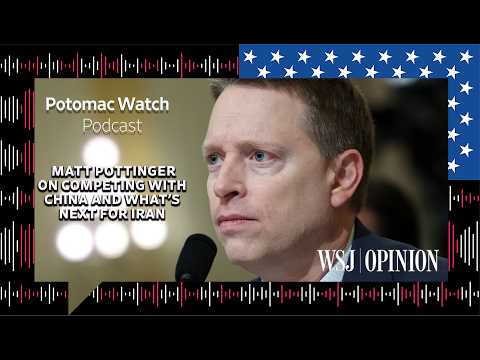
Matt Pottinger on Competing with China and What's Next in Iran
Wall Street Journal Opinion
32m 50s6,033 words~31 min read
YouTube auto captions
Transcript source
YouTube auto captions
This transcript was extracted from YouTube's auto-generated caption track. The transcript below is server-rendered so it can be read, searched, cited, and shared without opening the original YouTube player.
Pull quotes
[0:00]Welcome to PTOIC Watch, the weekday podcast from the Wall Street Journal editorial page from the opinion pages of the Wall Street Journal.
[0:00]The open files include nuclear enrichment, Iran's existing stockpile, the ballistic missile program, the straight of hormuse, terrorist proxies all over the region.
[0:00]But we're also going to take an interlude from the hurly burly of the daily headlines and talk about a larger issue that lurks behind the war in Iran and lurks behind many of America's actions in the world.
[0:00]We have a great guest today to help us think about Iran, China, and the volatile world we live in.
Use this transcript
Related transcript hubs
Watch on YouTube
Share
MORE TRANSCRIPTS


