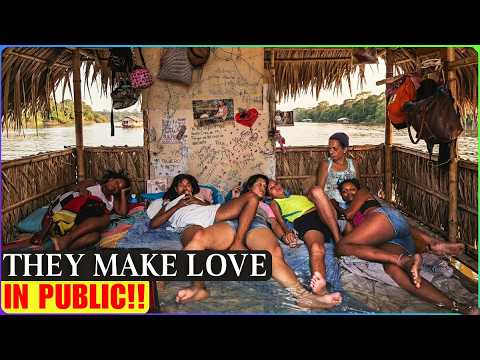
[0:03]Deep in Brazil's Amazon rainforest, a surreal urban landscape defies every rule of traditional architecture. A society can function without a single inch of solid ground. You move through the narrow canals of the Blackwater River to discover a life of remarkable vitality, floating between desperation and ingenuity. The floating city of Manaus is a growing community where foundations are made of logs, and the streets are dark river waters. Locals and curious visitors often call this place the Venice of Brazil.
[0:48]Thousands of families have built an entire world on the surface of the river. And instead of cars, the sound you hear is the low hum of the Rebita, a long, narrow wooden canoe with a small outboard motor attached to the back. If you need to get somewhere, you get in a boat, and it works. Not in a broken, barely holding together kind of way. It actually works. Children in uniforms sit at desks in floating classrooms with teachers writing on blackboards. Catholic churches ring their bells on Sunday mornings, and the sound drifts across the water, while evangelical congregations sing hymns that echo through the jungle at night. Neighborhood shops sell rice, soap, cooking oil, candy and fresh fish. Some of them even have working freezers and limited Wi-Fi. There is a floating beauty salon that fills up before community festivals. There are bars and restaurants where you can sit over dark water and eat a steaming bowl of fish stew while birds call from the trees above you. So how does anyone make a living here? Before continuing, comment where you're watching so I can say hello.
[2:07]At the foundation of the floating economy is fishing. Families go out before sunrise in small wooden boats, casting nets and lines into the dark water. They are hunting for Tucunaré Tambaqui, Pirarucu Surubim. Some catch just enough to feed their own households. Others sell their catch boat to boat at floating markets or to middlemen who carry the fish into the formal city of Manaus. It is hard, physical, uncertain work but it is consistent and it belongs entirely to the people doing it. The surrounding forest adds another layer. Acai berries are harvested by hand. Brazil nuts, bananas, Papuna and Cupuacu are collected from the jungle and either sold fresh or transformed into juices, jams and sweets. Families produce cassava flour, tapioca, artisanal soaps, and homemade candies using recipes that have been passed down through generations. These are not just food products, they are cultural artifacts. They are proof that knowledge survives, even when everything else is taken away. And then there are the women. In the floating city, women are the engine of the local economy. They manage small businesses from their porches. They prepare meals for neighbors. They offer haircuts. They trade handmade crafts. They cook, clean, raise children and simultaneously run operations that keep entire families alive. They are not background figures in this story. They are the story. Many residents also commute. Every morning, boats carry workers from the floating city to the docks of Manaus, where they disappear into the formal city to work in construction, domestic service and small commerce. Every evening, they return across the water to their floating homes. Two worlds separated by a short boat ride and an enormous social distance. Be honest, did this lifestyle feel easier or harder than you expected? Let us know in the comments. We read every single one.
[4:31]Have you ever turned on a tap and thought about where that water came from? Have you ever flipped a light switch and considered what it would mean if nothing happened? Most of us have not because for most of us, these things simply work. They are invisible. They are assumed. In the floating city, nothing is assumed. There is no sewage system. Waste from toilets flows directly into the river, untreated and unfiltered. The same river that provides food, transportation, and daily water for bathing and cooking is also the city's open sewer. People know this. They live with this knowledge every single day. They have no alternative. Drinking water is a daily crisis. Some families collect rainwater during storms, storing it in makeshift tanks on their roofs. Others filter river water through cloth or boil it when they have the fuel to do so. Many drink directly from the river, knowing it may contain bacteria, heavy metals and fuel residue from the boats that pass through constantly. When it is all you have, you drink it. Buying bottled water is the safer option, but it costs money that many families do not have. So they spend hours collecting every drop of rain that falls from their corrugated metal roofs, treating it like the precious resource it is. And then there is electricity. Or rather the terrifying substitute for it. There is no formal electrical grid in the floating city. What exists instead is a web of illegal connections, known locally as gatos, which means cats. These are makeshift wires, often uninsulated, stretched from the mainland across the water to the floating porches. They hang over the river in tangled, precarious clusters. In a neighborhood built entirely of wood, floating on water, these wires represent a constant, ever present threat of fire and electrocution. Some families use generators. Others use kerosene lamps. Some use nothing at all when night falls in those homes. It falls completely. After hearing this, will you think differently the next time you turn on a tap or a light? I want you to imagine something specific. It is 2 in the morning. Someone in your family collapses. Their breathing is wrong. Their colour is wrong. Every second matters. You pick up your phone and call for an ambulance. You hear the siren in the distance. Help is coming. Now remove the phone. Remove the ambulance. Remove the road. Replace all of it with dark water, a wooden boat, and a neighbor who may or may not be awake. That is the medical reality of the floating city. There is no clinic on the water. There is no emergency response system. If someone suffers a heart attack, a severe injury, a difficult childbirth, their survival depends on how fast a neighbor can start a boat engine and navigate the dark, narrow channels to reach the docks. And then how quickly they can find transportation to a hospital on the other side of the city. There are stories here that do not have happy endings. Stories of people who did not make it because the river was too low or the engine would not start or the channels were too crowded at night. They are neighbors, they are children. They are the cost of being invisible to the systems that are supposed to protect everyone. Volunteer doctors visit occasionally, brought by NGOs or religious organizations. Some residents have learned to administer basic first aid, to give injections, to manage wounds. It is not a healthcare system, but it saves lives when real help is too far away.
[8:29]In a place where the government has largely abandoned its responsibilities, where infrastructure does not exist, where every basic service that most people consider a right is either absent or improvised, something extraordinary has taken its place. Community. When a house starts to sink, neighbors do not wait to be asked. They arrive with logs and barrels and lift it back up. When a boat motor breaks down in the middle of a channel, someone appears with tools or a spare part. When extreme floods come, and they do come, residents reinforce the floating platforms together, adjust the moorings together, add extra floaters under the houses together. No announcement is needed. Everyone simply acts. When trash accumulates between the houses, families organize mutires, community cleanup days. Some have built shared sheds to collect recyclables, which they sell for a small income. Others teach neighbors how to compost or safely manage waste. These are not government programs, they are people solving problems because no one else will. The schools stay open because teachers travel long distances by boat to get there. Students paddle through flooded channels every morning, rain or shine, because they understand that education is the one thing that cannot be taken away once it is inside you. This community does not just float physically, it floats socially, held up by the weight of mutual obligation and the simple, powerful understanding that in a place like this, you help today because tomorrow it could be you who needs it. But why here? Why would anyone choose to build their life on water?
[10:17]Go back to the early 20th century. Manaus, the capital of the Brazilian state of Amazonas, was one of the wealthiest cities in South America. The rubber boom had turned this jungle outpost into a place of extraordinary opulence. The famous Teatro Amazonas Opera House with its gilded dome and Italian marble was built in the middle of the rainforest as a monument to that wealth. Rubber barons lived in mansions. The city glittered. And then it ended, almost overnight, when synthetic rubber was developed and the Brazilian rubber monopoly collapsed. The wealth evaporated, but the people did not leave. Thousands of migrants, river dwellers, rural workers and the desperately poor had already flooded into Manaus, chasing the promise of a better life. Now they were stranded. Land in the city was expensive and controlled by the elite. Formal housing was not for people like them. The government had no plan for them. The city had no room for them. So they looked at the only thing that was free, the water. The Igarapes, those dark, narrow channels running through and around the city, belonged to no one. Or at least, no one was enforcing ownership over them. And so the first floating houses appeared. Not as a romantic experiment in alternative living, as a survival tactic, as the last option available to people who had been pushed to the very edge of the city and refused to fall off. What you see today, those weathered walls and sun bleached wood and tangled wires over dark water is not just a neighborhood. It is the architectural footprint of a century of poverty, migration and the relentless human refusal to give up.
[12:10]Now I wanna tell you something, that the floating city of the Amazon is one of the most genuinely extraordinary places a human being can visit on this planet. And almost no one knows it exists. There is no road that takes you there. That is the first thing you need to understand. The only way in is by water. You board a small wooden boat or a boadira, a fast motor canoe from the center of Manaus, and you enter a different world. The transition is not gradual. It is sudden. The noise of the city, the motorcycles, the horns, the construction, it fades behind you as the boat enters the narrow channels. And then there is only the sound of the motor, the water and the jungle. If you are lucky, and in the Amazon luck often means simply being quiet and patient, you will have company on the journey. Pink river dolphins, the boto, are not a myth or a tourist attraction here. They are neighbors. They surface alongside boats with a casual familiarity that suggests they have been doing this for centuries. Because they have. Their pink skin catches the light in a way that seems almost impossible, almost too beautiful to be real. Above you, birds move through the canopy. Herons, kingfishers, parrots, and occasionally the shadow of a harpy eagle crossing the sky. The sounds layer on top of each other in a way that no recording has ever fully captured. It is something you feel as much as hear. And then the floating city appears. Houses on logs and barrels, painted in faded blues and yellows and greens, rising and falling gently with the movement of the water. Laundry hanging between windows, children sitting on porches with their feet dangling over the river.
[14:05]A woman selling Acai from a small boat, paddling slowly between the houses, calling out her price. During the flood season, the experience becomes something close to surreal. You can take a boat directly into the flooded forest, the Igapo, and navigate between the trunks of trees that are standing in several meters of water. Fish swim beneath you through the roots. Monkeys watch from the branches above. The boundary between river and forest dissolves completely, and you find yourself moving through a world that exists nowhere else on earth. During the dry season, you walk on sandbanks that were underwater three months ago. You find river shells and smooth stones that have traveled thousands of kilometers from the Andes. You watch caimans sunbathe on the muddy banks with the unhurried confidence of animals that have no natural predators. And through all of it, the floating city continues its quiet, extraordinary life around you. The people here are not living this way for your benefit or your camera. They are living this way because it is their life, their inheritance, their home. And that authenticity, that absolute realness is what makes it unlike anything else you will ever experience as a traveler. Before the end of the journey, I want to ground you in the geography of this story, because understanding where this place sits on the map makes everything we have talked about even more extraordinary. The floating city is not hidden in some unreachable corner of the deep jungle. It is not days away from civilization by canoe. It exists right alongside one of the largest urban centers in the entire Brazilian Amazon, Manaus. A city of over 2 million people with shopping malls, universities, international airports, and a famous opera house that once symbolized the peak of colonial wealth. Manaus sits at one of the most dramatic geographical intersections on the planet. It is the point where two massive rivers meet: the Rio Negro, whose waters are so dark they look like black tea, and the Solimoes, a muddy, sediment-heavy river the color of cafe au lait. When these two rivers collide, they do not immediately mix. For several kilometers, they flow side by side in two distinct colors, dark and light, without merging. Locals call it the meeting of the waters, and it is one of the most visually stunning natural phenomena in the world. The floating city grew from the smaller channels that branch off from these great rivers. The Igarapes. These narrow waterways wind through the landscape like a hidden circulatory system, connecting the jungle to the city, the past to the present. The main floating districts, Educandos, Sao Raimundo and Cachoeirinha, emerged from these channels over decades, built by people who had no other option and no other place to go. And here is something that most people do not realize about the Rio Negro specifically. Its dark color comes from decaying organic matter released by the surrounding forest. Tannins and humic acids stain the water a deep, almost opaque brown-black. But this chemistry has an unexpected benefit. The acidic, low nutrient water of the Rio Negro is far less hospitable to mosquitoes than other Amazonian rivers. The larva cannot thrive in it, which means that in a region of the world famous for malaria and dengue fever, the floating city built on the black river actually has a natural biological defense that the surrounding jungle does not. The river that looks like it should be dangerous is, in one very specific way, safer than the alternatives. During the rainy season, the rivers rise dramatically. The water level of the Rio Negro can fluctuate by up to 14 meters between the dry and wet seasons. 14 meters, that is the height of a four-story building. When the floods come, the Iguarapes expand, the forest becomes submerged. The floating houses rise with the water, adjusting naturally to the new level, because that is exactly what they were designed to do. During the dry season, the transformation is equally dramatic, but in reverse. Sandbanks emerge from the water like temporary islands. Muddy trails appear where boats once traveled. The channels narrow. The city contracts, and the people adapt, as they always have, as they always will. We have traveled a long way together in this video. From the dark water channels of the Igarapes, to the collapsed rubber economy that created them. From the floating schools and churches, to the illegal wires hanging over the river. From the pink dolphins to the Pirarucu. From the women selling Acai from their porches, to the families who have never once had clean water come out of a tap. And I want to leave you with a question. Not a comfortable one. We live in a world that measures progress by GDP, by infrastructure, by the number of highways built and hospitals opened, and megawatts of electricity generated. We have entire systems of measurement designed to tell us how civilized a society is, how developed, how modern. But what do those measurements say about a community that has built schools without government funding, maintained healthcare without clinics, sustained an economy without banks, and preserved culture without institutions, for over 100 years? What word do we use for people who have been failed by every system designed to protect them, and responded not with collapse, but with creation? The floating city of the Amazon does not appear in most conversations about human achievement. It does not win awards. It does not make headlines unless there is a flood dramatic enough to photograph. The people who live there are not celebrated for what they have built. They are more often pitied for what they lack, because what they have built in the absence of everything we consider essential is something that most modern cities with all their infrastructure and all their institutions have quietly lost. They have built a place where people actually need each other, where the survival of one depends on the willingness of another, where community is not a word on a government poster, but a daily, living, breathing practice that keeps the houses from sinking and the children in school and the sick from dying alone in the dark. Maybe the question is not what they are missing. Maybe the question is what we have forgotten. If this story moved something in you, if it made you see the world a little differently, share it with someone who needs to see it too. And tell me in the comments, what part of this surprised you the most? Because I read every single one, and I wanna know what landed. And don't forget to hit subscribe, turn on notifications bell so we can see you again in our next video. Thanks so much for hanging out with us today. I hope you enjoyed it. Your support truly means the world. Wishing you the best of luck.


