[0:00]The following content is provided under a Creative Commons license. Your support will help MIT OpenCourseWare continue to offer high-quality educational resources for free. To make a donation or to view additional materials from hundreds of MIT courses, visit MIT OpenCourseWare at ocw.mit.edu. So, again, welcome to 1801. We're getting started today with what we're calling Unit 1, highly imaginative topic, a highly imaginative title, and it's differentiation. So let me first tell you briefly what's in store in the next couple of weeks. The main topic today is what is a derivative? And we're going to look at this from several different points of view, and the first one is a the geometric interpretation. And that's what we'll spend most of today on. And then we'll also talk about a physical interpretation of what a derivative is. And then there is going to be something else which I guess is maybe the reason why calculus is so fundamental and why we always start with it, uh at, and in most science and engineering schools, which is the importance of derivatives of of this to all measurements. So that means pretty much every place, that means in science and engineering in uh political science, etc., uh polling, uh, lots of commercial applications. Just, just about everything. Now, so that's what we'll be getting started with. And then there's another thing that we're going to do in this unit, which is we're going to explain how to differentiate anything you know. And that's kind of a tall order, but let me just give you an example.
[3:06]If you want to take the derivative this, we'll see today is the notation for the derivative of something of some messy function like e to the x arc tan of x. We'll work this out by the end of this unit. All right? So anything you can think of, anything you can write down, we can differentiate it. All right, so that's what we're going to do, and today, as I said, we're going to spend most of our time on this geometric interpretation. So let's, let's begin with that. So here we go with the geometric interpretation of uh derivatives. And what we're going to do is just ask the geometric problem of finding the tangent line to some graph of some function at some point which is say x0 y0. So that's the problem that we're addressing here.
[4:38]Um, I guess I should probably turn this off. All right. So here's our problem, and now let me show you the solution. So, well, let's graph the function.
[4:59]So let's say here's its graph. And here's some point. All right. Maybe I should draw it just a bit lower so that I don't All right, so here's a point P, maybe it's above the point X0. X0, by the way, this was supposed to be an X0, that was the some fixed place on the X axis. And now in order to perform this, this mighty feat, I will, um, use another color of chalk. How about red? Okay. So, so here it is. There's the tangent line. Well, not quite straight, close enough. All right, I did it. All right, that's the end. That's the geometric problem. I achieved what I wanted to do. And uh it's kind of an interesting question which unfortunately I can't solve for you in this class, which is how did I do that, that is, how physically did I manage to know what to do to draw this tangent line, but that's what geometric problems are like. Um, we visualize it, we can figure it out somewhere in our brains, it happens. And the task that we have now is to figure out how to do it analytically to do it in a way that uh a machine could do just as well as I did in drawing this tangent line.
[6:36]So, So what do we learn in high school about what a tangent line is? Well, a tangent line has an equation any line through a point has the equation Y minus Y0 is equal to M the slope times X minus X0. So, so here's the the equation for that line. And now there are two pieces of information that we're going to need to work out uh what the line is. The first one is the point that's that point P there. And to specify P given, given X, we need to know the uh the the level of Y which is of course just F of X0. Now that's that's not a calculus problem but anyway that's a very important part of the process. So that's the first thing we need to know. And the second thing we need to know is the slope. And that's this number M. And in calculus, we have another name for it, we call it F prime of X0, namely the derivative of F. So that's the calculus part, that's the tricky part, and that's the part that we have to discuss now. So just to make that uh explicit here, I'm going to make a definition, which is that F prime of X0, which is known as the derivative of F at X0, is the slope of the tangent line to Y equals F of X at P.
[8:48]All right. So, so that's what it is, but still I haven't made any progress in figuring out any better how I drew that line.
[10:17]So I have to somehow grasp this and I first do it in language.
[10:25]And it it's the following idea. It's that if you take this orange line, which is uh called a secant line, and you think of the Q, the point Q is getting closer and closer to P, then the slope of that line will get closer and closer to the slope of the red line. And if we draw it close enough, then that's going to be the correct line. So that's really what I did sort of in my brain when I drew that first line. And so that's the way I'm going to articulate it first now. So the tangent line is equal to the limit of secant lines PQ as Q tends to P, and here we're thinking of P is being fixed.
[11:32]All right, so so that's the again, this is still the geometric discussion, but now uh we're going to be able to put symbols and formulas to this computation and we'll be able to, um, to work out uh formulas in any example. So first of all, I'm going to write out these points P and Q again.
[12:05]So maybe we'll put P here and Q here, and I'm thinking of this line through them. I guess it was orange, so we'll leave it as orange. All right. And now I want to compute its slope. And so this is gradually, we'll do this in two steps and these steps will introduce us to the basic notations which are used throughout calculus, including multivariable calculus, across the board. So the first notation that's used is you imagine here's the x-axis underneath and here's the X0, the location directly below the point P. And we're traveling here a horizontal distance, which is denoted by delta X. So that's delta X, so called, and we could also call it the change in X. All right, so that's one thing we want to measure in order to get the slope of this line PQ, and the other thing is this height. So that's this distance here which we denote delta F, which is the change in F. And then the slope is just the ratio delta F over delta X. So this is the slope of the secant PQ. And the process I just described over here with this limit applies not just to the whole line itself, but also in particular to its slope. And the way we write that is the limit as delta X goes to zero. And that's going to be our slope. So this is the slope of the tangent.
[14:17]And now this is still a little a little general. And I'm going to I want to work out a more usable form here. I want to work out a better formula for this. And in order to do that, I'm going to write delta F, the numerator, more explicitly here. The change in F. So remember that the point P is the point X0, F of X0.
[14:50]All right, that's what we got from our formula for the point. And in order to compute these distances, and in particular the vertical distance here, I'm going to have to get a formula for Q as well. So if this horizontal distance is delta X, then this location is X0 plus delta X. And so the point above that point has a formula, which is X0 plus delta X, and F of, and this is a mouthful, X0 plus delta X.
[15:32]All right, so there's the formula for the point Q, here's the formula for the point P. And now I can write a different formula for the derivative,
[15:49]which is the following. So this F prime of X0, which is the same as M is going to be the limit as delta X goes to zero of the change in F. Well, the change in F is the value of F at the upper point here, which is X0 plus delta X. and minus its value at the lower point P, which is F of X0, divided by delta X. All right, so this is the formula I'm going to put this in a little box because this is by far the most important formula today, which we use to derive pretty much everything else. And this is the way that we're going to be able to compute these numbers.
[16:48]So let's, let's do an example.
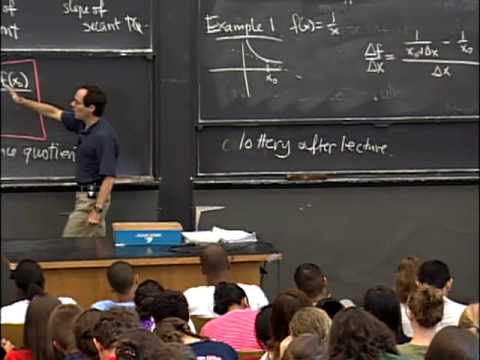
[17:07]This example, so we'll call this example 1, uh, we'll take the function F of X which is 1 over X. That's sufficiently complicated to have an interesting answer. And uh sufficiently straightforward that we can compute the derivative fairly quickly.
[17:33]So, so what is it that we're going to do here? All we're going to do is we're going to plug in this, this formula here for for that function. That's, that's all we're going to do.
[17:48]And visually, what we're accomplishing is somehow to take the hyperbola and take a point on the hyperbola and figure out some tangent line. All right, that's what we're accomplishing when we do that. So we're accomplishing this geometrically, but we'll be doing it algebraically. So first, we consider this difference delta F over delta X, and write out its formula. So I have to have a place, so I'm going to make it again above this point X0, which is a general point, we'll make the general calculation. So the value of F at the top when we move to the right by F of X, I just read off from this read off from here, the uh, the first thing I get here is 1 over X0 plus delta X, that's the left-hand term, minus 1 over X0, that's the right-hand term. And then I have to divide that by delta X. Okay, so here's our expression. And by the way, this has a name. This thing is called a difference quotient. It's pretty complicated because there's always a difference in the numerator and in disguise the denominator is a difference because it's the difference between the value on the right side and the value on the left side here.
[19:26]Okay, so now we're going to simplify it by some algebra. So let's just take a look. So this is equal to, let's continue on the next level here. This is equal to 1 over delta X times Now all I'm going to do is put it over a common denominator. So the common denominator is X0 plus delta X times X0. And so in the numerator for the first expression, I have X0, and for the second expression, I have X0 plus delta X.
[20:06]So this is the same thing as I had in the numerator before, factoring out this denominator. And here I put that numerator into a this more amenable form. And now there are two basic cancellations. The first one is that X0 and X0 cancel. So we have this. And the second step is that these two expressions cancel, right? The numerator and the denominator. Now we have um a cancellation that we can make use of.
[20:46]So we'll write that under here. And this is uh equals minus 1 over X0 plus delta X times X0. And then the very last step is to take the limit as delta X tends to zero.
[21:10]And now we can do it. Before we couldn't do it. Why? Because the numerator and the denominator gave us zero over zero. But now that I've made this cancellation, I can pass to the limit, and all that happens is I set this delta X equal to zero, and I get minus 1 over X0 squared. All right, so that's the answer. All right, so in other words, what I've shown, let me put it up here, is that F prime of X0 is minus 1 over X0 squared.
[21:54]Now, uh, let's, let's look at the graph just a little bit to check this for plausibility. All right. Uh, what's happening here is first of all, it's negative. Right, it's less than zero, which is a good thing. You see that slope there is negative.
[22:23]And the second thing that I would just like to point out is that as X goes to infinity, that is if we go farther to the right, it gets less and less steep. So that's also consistent here is when X0 is very large, this is a smaller and smaller number in in magnitude.
[22:54]Although it's always negative. It's always sloping down.
[23:00]All right. So, I claim that on the whole, calculus is uh gets a bad rap, that it's um actually easier than than most things.
[25:49]Um, but it has a there's a perception that it's that it's harder. And so I really have a duty to to give you the calculus made harder uh story here. So we we have to make things harder because that's that's our job. And this is actually what most people do in calculus and it's the reason why calculus has a bad reputation. So the the the secret is that when people ask problems in calculus, they generally ask them in context. And there are many, many other things going on. And so the little piece of the problem which is calculus is actually fairly routine and has to be isolated and gotten through, but all the rest of it relies on everything else you learned in mathematics up to this stage from grade school to through high school. So that's the complication. So now we're going to do a little bit of calculus made hard. By, uh, uh talking about a word problem. Now we, we only have one sort of word problem that we can pose because all we've talked about is this geometry, uh, uh, point of view. So, so far, those are the only kinds of word problems we can pose. So what we're going to do is just pose such a problem. So find the areas of triangles enclosed by the axes and tangent to, um, Y equals 1 over X. Okay.
[27:42]So that's a geometry problem, and let me draw a picture of it.
[27:50]It's practically the, the same as the picture for example 1, of course. So here's, we're only considering the first quadrant. Here's our shape. All right, it's the hyperbola. And here's maybe one of our tangent lines, which is coming in like this. And then we're trying to find this area here. All right, so there's our problem. So why does it have to do with calculus? It has to do with calculus because there's a tangent line in it. And so we're going to need to do some calculus to to answer this question. But as you'll see, the calculus is the easy part. So let's, let's get started with this problem. First of all, I'm going to label a few things. And one important thing to remember, of course, is that the curve is Y equals 1 over X. That's perfectly reasonable to do. And also we're going to calculate the areas of the triangles. And you could ask yourself in terms of what? Well, we're going to have to pick a point and give it a name. And since we need a number, we're going to have to do more than geometry. We're going to have to do some of this analysis, just as we've done before. So I'm going to pick a point and consistent with the labeling we've done before, I'm going to call it X0 Y0. So that's almost half the battle. Having notations X and Y for the variables and X0 and Y0 for the for the specific point. Now, once you see that you have these labeling's, uh I hope it's reasonable, uh, to do the following. So first of all, this is the point X0 and over here is the point Y0. That's something that we're used to in graphs. And in order to figure out the area of this triangle, it's pretty clear that we should find the base, which is that we should find this location here, and we should find the height, so we need to find that, uh, value there. All right, so let's, let's go ahead and and do it. So how are we going to, how are we going to do this?
[30:17]Well, I claim that there's only one calculus step. And I'm going to put a star here for for this tangent line. I have to understand what the tangent line is. And once I figured out what the tangent line is, the rest of the problem is no longer calculus. It's just that slope that we need. So what's the formula for the tangent line? Put that over here. It's going to be Y minus Y0 is equal to, and here's the magic number. We already calculated it, it's in the box over there. It's minus 1 over X0 squared X minus X0. So this is the only bit of calculus in this problem.
[31:14]But now we're not done, we have to finish it. We have to figure out all the rest of these quantities so we can figure out the area.
[31:26]So this simplifies a bit. Uh, let's put, let's see. This is minus X over X0 squared, and this is plus 1 over X0, because the X0 and X0 squared cancel somewhat. And so if I put this on the other side, I get X divided by X0 squared is equal to 2 over X0. And if I then multiply through, so that's what this implies.
[32:27]And if I multiply through by uh X0 squared, I get X is equal to 2X0. Okay. So I claim that this point we've just calculated, it's 2X0.
[34:50]Now, um, I'm almost done. I need to get the other one. I need to get this one up here. Now, I'm going to use a very big shortcut to do that. So the shortcut to the Y intercept is to use symmetry.
[35:07]All right. I claim I can stare at this, and I can look at that and I know the formula for the Y intercept. It's equal to 2Y0.
[35:43]All right, that's what that one is. So this one is 2Y0. And the reason I know this is the following. So here's the symmetry of the situation, which is not completely direct. It's a kind of mirror symmetry around the diagonal. It involves the exchange of X, Y with Y, X. So trading the roles of X and Y. So the symmetry that I'm using is that any formula that I get that involves X's and Y's, if I trade all the X's and replace them by Y's and trade all the Y's and replace them by X's, then I'll have it a correct formula on the other way. So everywhere I see a Y, I make it an X, and everywhere I see an X, I make it a Y. This switch will take place. So why is that? That's because the that's just an accident of this equation. That's because
[39:41]if I take d by dx of X to the nth power, that is equal to nx to the n minus 1. So what I've shown you is that d by dx of X to the n is equal to nx to the n minus 1. So now this is going to be super important to you right on your problem set, in every possible way.
[49:57]And I want to tell you one thing, one way in which it's very important, and one way that extends it immediately. So this thing extends to polynomials. We get quite a lot out of this one calculation. Namely, if I take d by dx of something like x cubed plus 5x to the 10th power, that's going to be equal to 3x squared, that's applying this rule to x cubed. And then here, I'll get 5 times 10, so 50 X to the 9th. So this is the type of thing that we get out of it. And we're going to make more hay with that next time.


