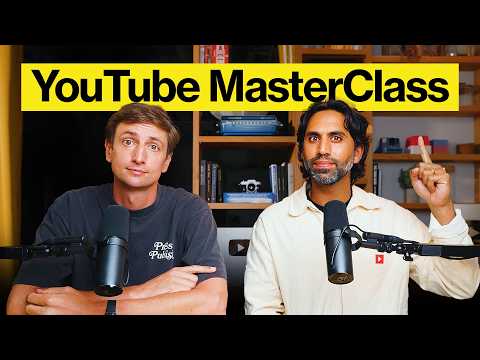
[0:00]54% of adults said that they would quit their job to become a creator. So if we were starting a YouTube channel today, how would we do it? We've been building YouTube channels together for over 13 years and we've interviewed hundreds of top creators. At the end of the day, if they don't click, they don't watch. Actually, I don't think I've ever told the story. We had an actual playbook for how to launch a YouTube channel. We're going to get really into the weeds in this episode, everything from filming style, which data you should track, short form video versus long form video. Everything we know about YouTube put into a seven-step framework you can follow. So, 13 years ago, when we first started on our YouTube journey, we filmed everything with a MacBook. Like literally the webcam from our MacBook, and we edited the videos and uploaded them all using one device. It is the ultimate creator tool. So, we decided, we want to give one of you a brand new MacBook Air. This is a 13-inch MacBook Air with the Apple M3 chip. It has 16 gigs of memory and 512 gigs of storage. I feel like I should bid like it's the price. Come on down. All you have to do to win it is click the link in our description and subscribe to our newsletter, The Publish Press. In our newsletter, you'll get creator news faster than you would hear it on our YouTube channel, and you'll get it delivered to your inbox three times per week. We're going to be announcing the winner of this giveaway a week from now in the newsletter. And if you're watching after the giveaway is already over, we do these giveaways from time to time, so make sure you're subscribed. We are also going to be giving away a first of its kind Press Publish hat. We have never done this colorway before. That's going to be included in the giveaway. That's literally the only one we have. The only one. All right. Let's get into it.
[1:41]I will say Samir, in our over 13 years of experience, there are so many years that we did not study YouTube. And had we studied YouTube, had we watched a video like this, we would have been so much further along than we are now. I think literally we would have cut our time in half. This is a moment where I absolutely don't want to make videos anymore. Absolutely don't want to make absolutely don't want to make videos anymore. Yeah. Truly. Sorry, I was like living in the past. There were some hard times. 13 years is a long time and it and it and it took us a while to get everything off the ground. I also think the the landscape of YouTube is very different today. There's this interesting stat from Nielsen that 10% of watch time on connected TVs is occupied by YouTube. And compare that to Netflix, which is 8.4% of watch time on connected TVs. So, basically, YouTube is leading in watch time hours on TVs. YouTube is not cat videos, which is what it kind of started as. It is not vlogs, which is an era it went into. It is becoming the thing that generations of people are watching on TV. choosing to watch with other people, it is like prime time. So when you're thinking about starting a channel, it's actually a pretty serious thing to do and and you do need to take it seriously. Step one of our framework for starting a new YouTube channel, implement the Super Mario effect. Now what is the Super Mario effect? This is something we learned when we sat down for the first time with Mark Rober. The Super Mario effect is basically like, I mean, when you're playing Super Mario Brothers or some video game for the first time, you fall into a pit and you're just like, oh my gosh, I fell into a pit. I failed. How embarrassing. I never want to play this game again. You're like, no, okay, crap. There's a pit right there. Okay. Next time I'm going to come a little bit faster. I'm going to jump a little earlier. You immediately learn from the failure and you're like stoked to try again. And so that's very much my philosophy. If you can gamify your challenges and think of them like a video game, you can learn so much more, you can have more success and have fun while doing it. So what Mark is saying there is that you want to be going throughout your YouTube journey, similar to a video game, which means that if you fail, you don't actually die, you get to start again. How do I interpret that? Get a job. That is literally the first thing I would do is like, get a job, or make sure that my finances are taken care of. Yeah. Truly. Like if I was to start from scratch, I would go, all right, let me get my finances taken care of so that I can experiment on YouTube without the pressure of making it the job. Yeah, and and experimentation or not, I think anyone who comes to me and asks me about starting a YouTube channel, I think the the three things that I ask them about is number one, how much time do you have, which means like how much financial runway do you have? Can you commit the next three years to this and be okay that it takes three years or five years for it to take off? Two, your relationship with failure and your ability to learn from it, because it's going to happen a lot. And three, your relationship with making videos. Because all of that goes into becoming a creator. It's going to take a very long time for it to get off the ground. You're going to fail a lot. You're going to have ups and downs. And you're going to just have to keep making videos. Like you're just and so if you don't like making videos, that's already a problem. But this concept of like gamifying it and looking at it as like playing a video game where you can die and you have more lives, actually think is a really cool way to think about it. Like, how do you ensure that if you die, you just restart the game? Okay, step two of our framework, identify what you're optimizing for. So make sure you understand going into your new YouTube channel, what does success mean? Are you looking for money? Are you looking for more time? Are you looking for experiences? For me, if I was to start from scratch, I would want my new YouTube channel to align with one of my life goals right now, which is like to get outside more often, to have new experiences. That would be one of the first things I would look at. I think for me, this this can get a little intangible for people, I think, listening to this, and one of the most important things to do is to make it extremely tangible. And so what that looks like for me is writing out start to finish, what a dream day in your life looks like. Then doing that for a week and a year, and saying, what is this look like if it works? Like what does success mean tangibly in terms of what am I doing with my time? What are some of the doors that this has unlocked? Is there a certain amount of money that I need? I want this to unlock. I think one of the mistakes that people make when starting a YouTube channel is, YouTube channels and the internet are this ever-expanding space where anything is possible. And if you don't put frameworks around what you want out of it, it's one of the fastest paths to like burnout, confusion, um, and a really weird relationship with making YouTube videos. Yeah, you've said this before, but like success is just the opportunity to do more of what you're already doing. So, if your YouTube channel does become successful, make sure that you like what it is, what it's about, what the journey is, because you will be spending a lot of time in that community and in that work. All right, number three, this one starts to get way more into the weeds, and it's actually from a conversation that we had with MatPat and Stephanie. We have like the most up-tight process for launching a new YouTube channel that I've ever heard of. We research every vertical that we go into. We watch everything in that vertical. We understand how the hosts talk to the audiences. We understand the colors they use, how long they episodes are, how often they post, what their opening lines are, whether they have a theme song or not, what their titles include, do their titles include punctuation? Do their thumbnails involve a white stroke on the outside of everyone's head? Whatever it is, we know everything about the vertical before we even decide to go into it. And then from there, it's like, okay, what would we actually say, and we come up with literally a year's worth of content titles and loglines. If you don't have, if you don't have, and I mean, maybe more than that. It was like a hundred. It's like a hundred. Like a hundred titles and loglines. And if you don't have a hundred titles and loglines, you don't have enough content to like think about launching this channel. Do you match thumbnails to those or like a couple thumbnail mocks, or like how do you do? Totally. You get, you have, I mean, you have to think about the audience that you want and what they're already watching. So, step three is what you would do really going into any business. It's essentially you're performing a market analysis, um, or a niche analysis, whatever you are, whatever community you're entering into on YouTube.
[8:52]I think one of the most important things is that as you go into making a YouTube channel, your product, first product is attention. Attention is the currency in which the audience will pay you. And that is something that is not created in a vacuum.
[9:06]Something that Stephanie said there is the audience that you want and what are they already watching. The reason for that is because of how YouTube works in terms of discovery. There's there's a few ways audiences discover videos, but the most common ways are browse and suggested. Browse means when someone goes onto YouTube, they log onto youtube.com, they open their mobile app, they open their TV app, and there's seven or nine videos that are sitting there.
[9:34]That's browse. They're browsing YouTube and they find a video that they want. Suggested is the second way. Suggested means they just watched one of our videos, and now on the right side, there's a ton of other videos that are similar. So, when you think about how to start a YouTube channel, this piece is by far the most important. Studying your community. You will not gain audience in a vacuum. You will gain audience within a pre-existing community. So, understanding the visual language of that community. Understanding the time stamps. Understanding the, uh, tone of that community. Everything, all of it, most likely, your first videos will be viewed through suggested content. Yes. So, number three, perform a niche analysis. It doesn't mean you should copy what's there. It's actually the inverse, which is number four. Choose your value prop. It's about studying your niche to understand how you can be slightly different, how you can stand out, and the value that you provide to that community is singular. is a little bit different. So, the way that I would approach this and and what I wrote out was I think you should essentially create the equivalent of like a Pinterest board, right? So, take to Google Slides. I love making Pinterest boards. Yeah, but but it's really, it's a really important thing, like, I I really do. What do you make Pinterest boards about, just to quick a side? Fashion, tattoos I may get, vintage cars I want to own. Okay, so another part of working with you for 13 years, is you have not stopped talking about getting a tattoo, and you do not have one. Yeah, but I do have a Pinterest board. It's the first step. Okay, fine, whatever. The the concept that I'm saying here is like the tangible action that I would suggest you take is you make a Google Slide deck or, you know, whatever, Keynote Slide deck, and you go thumbnails, and you screenshot a ton of thumbnails.
[11:34]And you put those on a page. Then, I think you go into comments, and you read comments from the community. You screenshot a ton of comments, positive comments, negative comments. What do people like about the videos? What do they not like about the videos? Most commented on comments, like which comments are at the top that are developing the most conversation, that's super important. I would then go and look at first 30-second scripts. So, meaning, look at in your niche, whether it's so let's let's call it cooking. How do people open videos in the cooking niche? What is the common way and maybe different ways that people are opening the first seven seconds and then the first 30 seconds? What do those feel like? And I wouldn't be afraid to start this process extremely niche. I'll give you an example. I I put myself through this process of starting a new YouTube channel, and you know, with number two, right? Like understand your goals, what success means. For me, it was getting outside and doing activities. And I thought, okay, in my actual life, I would love to take more weekend car trips from LA and do activities. I started right there. I was like, that's what I want more in my life, like going to interesting beaches, interesting homes, Airbnbs, and doing activities. I thought, could I make a channel all about day trips or weekend trips from LA? And I started searching. I found out that's extremely niche. And there is not that much viewership. Um, there's actually not even that much of a community. So, I started watching those videos, and it led me to Ryan Trahan's Airbnb videos. Yeah, which have like 20 million views. Right, of him experiencing an interesting or unique Airbnb. And then I thought, what if I made a channel just for Airbnbs that will give you an outdoor experience? Like interesting Airbnbs that have cool things about them, like maybe they're next to a national park, or maybe they have a pickleball court that's incredible. Like what if I just highlighted in every episode an incredible Airbnb that has an activity with it? Right? So you get a tour of the house, and then you get to see me go through the activity. That's where I landed. So, interesting, though, it's good comp because going back to early stages, right? The early stages are all lifestyle considerations, stage one and two, that we talk about. And I think it is really important. Everything I know about doing YouTube for 13 years, it is a thing that consumes your life. So, the format you select, the topic you select is going to have a lot to do with how you spend your time and how you spend your life. And so, in that one, like the the interesting thing to think about is like, again, back to step two, what are you optimizing for? I'm optimizing to get outside. Yep, that's okay. That's a completely reasonable way to start a YouTube channel. But if if you're optimizing for money, I would say the other slide that I would put in this deck is take a screenshot of every brand partner, every brand deal in these videos. So, if it's outdoor stuff like that, who's sponsoring those videos? Are there common sponsors? If it is, um, cooking, who's sponsoring it? Right? And I started watching a ton of cooking videos because I was interested in this subject matter. I noticed Made In. It's a, uh, a brand that makes like, uh, uh, cookware. Never heard of them, but they sponsor a ton of cooking videos on YouTube. So, if I'm to enter the niche, if I'm to enter this industry, that's going to be a probably a common partner that comes up. So, I I like the tangible advice here is to build a slide deck that has images across your niche or your market. And I would also look at similarities. Are there formats that come up a ton? You know, are there like this versus that? Is it cooking challenges? What what is coming up a lot in this niche? That is an extremely common format, and I would do this across devices. So, I would do this for mobile phone, I would do this for connected TV, and I would do this for desktop. I like that a lot. I will add that as you're doing this niche analysis, the one thing you should understand about storytelling in general is that it all involves conflict and contrast. Up all the way to the biggest Mr. Beast videos, to a cooking tutorial, it's all about conflict and contrast, and that should exist in your thumbnail as well. So, as you're looking at titles, as you're looking at thumbnails, start to think about like you were even saying like the cheapest version versus the most expensive, or whatever it is, it's conflict and contrast. So, when it comes to step four, and choosing your value prop and and how you stick out, I think well, one thing that we take all of our students through in our, um, Cohort Creator startup, is an exercise called identities, emotions and actions. And split up a page. So, take out a sheet of paper. Split it up into identities, emotions and actions, and write down the different identity groups of people who are in your audience. So, again, back to to cooking, uh, the casual chef, uh, the person who's like trying to to figure out how to cook stuff at home, the college student, the person who's trying to do it on a budget, you know, like basically write down all these different identities. And then write down the emotions you want them to feel. And it's totally fine if you want them to feel, um, entertained, or less alone, like they can flip something on the TV and feel like you're you're you're part of their living room. Uh, educated. There there's all these different emotions. And then think about the action you want them to take. Do you want them to, what would prompt them to comment? What would prompt them to go out and cook a meal themselves? Is it a cook along with me type thing? So, if you split that up and you start writing that, you will start to find where you sit from a value proposition perspective. Who are these people, and why do they watch is a question that I think a lot of people forget to ask. So, as an example, if you wanted to make a casual cook feel safe and confident in the kitchen, a potential idea would be like 10 cooking mistakes to avoid, or something like that, right? Like 10 ways to handle a knife, right, to avoid, I don't know, you know what I mean? Like there are ways that you can think about ideas and titles based off of the identity and the emotion. Speaking of titles, Yeah. Step five in our framework is write 100 titles. This is actually something, I believe we both learned from Ryan Trahan. Yeah. He's definitely just mentioned it. Ryan, as far as I know, when when we were hanging out with him, he makes 10 ideas. He writes 10 new ideas, video titles, every single day. And I did that for 10 days, and they're not all the ideas aren't great, but at the end, I have a hundred new ideas. Right? And ideas are the engine for a YouTube channel. If you don't have ideas, and you don't have a huge surplus of them, it's going to be a lot harder to make a video and keep it consistent. So, develop something called an Idea Bank. This is, this can be Google Sheets. It can be in a notebook. Some people do this in a Notion. And I I actually interestingly enough, as I was doing this, uh, I I really struggled to come up with like net new ideas. Um, I could come up with like five. I could come up with six some days, but 10 was actually really hard for me. So, I turned to, uh, uh, AI to support me. Uh, Spotter has a tool called Title Exploder that really helped, you know, kind of like put in a title, and then see a bunch of different variations, and I would get tipped off with some word, and I'd be like, oh, that's interesting. I know some creators use chat GPT for this, where essentially you're you can say like, write me 10 YouTube titles based on cooking. And you can at least start to get in the practice of what a title looks like. I write all of mine in a notebook, and I actually intentionally don't use AI because I want to put ideas down even if they're bad. Sure. I think it's okay to put ideas down that are bad, uh, because they will often reveal to you what's good. And that's also what AI does. Like AI, if you ask for 10 titles, you're actually looking for what's not good to reveal what is good. And I think like, of course, you want to start this on 10 days, but if it's, if it's cleaner for you to do five ideas a day, and you can do that for 30 days, like, my suggestion here is actually that to start a YouTube channel from scratch, first, you definitely need a hundred ideas to pick from. Like I I definitely think you need a hundred ideas to pick from. Um, but as you continue going, if you're committed to becoming a professional creator, this is going to be a huge piece of what you do. So, get uncomfortable with something that you can commit to every single day, like brushing your teeth, I think is really important. And I think you can also at the top of the page, write out formats that you really like, um, titling conventions and formats. So, again, versus is a is a common one. Um, $100 thing versus $1,000 thing, right? Like that is that is extremely common format that works across a lot of niches. So you can start going, that's something I can come back to. All right, I'll write three ideas like that in a in a day. Um, and so this this is more about developing a practice. But in the subject matter of starting from scratch, you need a hundred to choose from. I would suggest when you when you look at those a hundred, you whittle those down to 30. And ideally, every day you elevate like your favorite two. Right? Two to three. You're like, oh, these are actually good. Seven of them can be bad. But three of them, you should be like, oh, I could probably develop that. All right. So now put yourself in the shoes of someone who has never done YouTube before, but they're sitting in there looking at 30 ideas. Yeah, they're continuing to whittle them down. How do you choose, and how do you stress test which ideas you should actually try and make into a video? And that is step six, which is find a testing ground. Now, this means you should find really low-lift ways to put your idea out into the world to the community you're trying to reach and see if it actually resonates. So, a perfect example of this. Again, I don't like when I have to bring up your LinkedIn. It hurts, it kind of pains me because of how much you promote it. And now it seems like I'm the biggest promoter of your LinkedIn, but you did post on your LinkedIn about, uh, what, what eventually became our Hot Ones episode. Yeah. So you posted a take on LinkedIn about the show Hot Ones, could it survive without Sean Evans? And could it be the end of the show, who should buy it, why isn't it selling? That took off on LinkedIn. There was a lot of conversation, and that proved to us that this would be a good topic to make a YouTube video about. Now, uh, uh, if you're building from scratch, I think the assumption is you have, let's just assume you have no audience anywhere. Sure. So you you might not even get that feedback somewhere, right? So, finding a testing ground could also mean in your social circle. It could also mean sharing the ideas with friends and Mark Rober talked about this with us, which was really cool that he gets a lot of his ideas in conversation where he's talking to people and he's like, well, what about this? And and seeing people's reaction. Hassan Minhaj called it the power of the PDF, saying like the idea on paper when you tell it to someone, when they read it, does it stack up? Does it resonate? Does it drive conversation? Yeah. I think this also, if it's not conversation, it could be starting with short form video. Because we've done that as well, where it's like, you know what, we don't want to make a 35-minute YouTube video, but we can commit to a 60-second short. We did this about Squid Game, about the impact of Squid Game after it came out on Netflix. We made a 60-second short. It absolutely exploded, became one of our most viewed shorts, and then we turned it into a long form video, and that also did well. Another way to look at this and like explore it is go on off-platform community hubs. So that could be a subreddit, or a Discord community. And look at what people care about, and if they care about the subject matter. So, if it's like cheap versus expensive, um, cookware again, Maybe you're looking at a a cooking subreddit, and everyone's confused about this really expensive pan. Right? So now you're like, oh, actually, maybe is it, is it worth it? I mean, specific example for us, this week, it was shared around in our Slack, uh, a post from R/cooking, uh, what happened to YouTube cooking channels? Yeah. Saying that like they're not doing as well as they used to. They're not as impactful, and it was a conversation we started to have, and we came up with a video idea around that topic. They call out certain cooking channels and we thought, oh, could we interview these cooking channels and ask them about what's happened with the cooking niche? Do they feel like something has happened? And that's why people maybe aren't watching, or just what's the health of that, right? Uh, and that's a place where it's like, oh, people are already talking about it because they're talking about it on Reddit. It's proven people like this, and they want to talk about it. Yeah. Can we go from there? So, these first six steps are very much about like, the the first phase is like understanding yourself, what do you want out of this, the lifestyle consideration of doing this.
[24:39]Then, deeply understand the community. How do they discover your work? How do they engage with each other? What do they care about? What ideas resonate in this space? All of that deeply matters.
[24:52]Okay, so now in your new YouTube channel journey, you're at the point where you have actually not even uploaded a single video. But you have a ton of ideas. You've identified some that have already started some conversation. You choose one that you want to turn into a video, and you're ready for step seven. Which is Film. Edit. Upload. Repeat. Now, this is very all-encompassing, and we're going to get into the weeds of of what we mean by this, and certain decisions we would make with videos and with a YouTube channel if we were to start from scratch. So, the first thing is making the video in a document before you film. Time and time again, every creator we talk to, if you do the pre-production, everything gets easier. So, what does pre-production mean? It's literally opening a Google Doc, putting the title in big bold letters, uh, putting your thumbnail that you've designed or similar thumbnails that you want to emulate up top. And then, Ali Abdaal said this to us. He said, most YouTube videos are just title thumbnail list. So, thinking about a list format of like, it doesn't necessarily have to be like three things about, you know, X. It could just be beginning, middle, end. Hook is extremely important. Uh, the beginning part of the video, the middle part of the video, the end. Now, in this, the time that we spend the absolute most time on is the first seven seconds and the first 30 seconds of the video. So, as you're developing these script documents, I would identify from your list of a hundred ideas. Let's whittle that down to like 20 ideas that could be short form ideas, 10 ideas that could be long form ideas. Now, in both of those documents, the hooks are going to be your most important pieces. So, meaning, what are the first few words that are said in each video? And that'll come up later when we talk about data that we're tracking. Yeah, what matters in that hook is whether it's a short or a long, does the hook identify and meet the expectations of the viewer? Mhm. And does it then give something new they actually weren't expecting? Because that's what's going to keep them watching. Yeah. Right? So, specifically when it is like a title and a thumbnail for one of our episodes, like Hot Ones, we try and make sure that when you click, yes, we are going to touch on, is this the end of Hot Ones? But you're also going to get something new. Can the show survive without its host? So, a lot of storytelling and specifically on the internet is about unanswered questions. Constantly, storytelling is always about unanswered questions. So, basically, in your first few lines, you want to make sure that you validate the video, like you said, and then you open up a new unanswered question. And throughout your script document, as you're writing out, always look at it, in your beginning, your middle and your end, is there an unanswered question? And then at the end, when that question is answered, or the final question is answered, the video is over. Yeah. So, write it out. It doesn't have to be word for word, but you're making your video first on paper, then on camera. Next, if I were to start from scratch, I would make sure that I have a really lean filming style. I don't want to overcomplicate and add friction to the process. And if you look at, you know, whether it's Marquez with his autofocus channel again, or you look at Ryan Trahan with his videos, they're primarily shot with an iPhone. Right? If if what you wrote is good, and the script is good, you should be able to execute that idea with an iPhone. Yeah. You can always go up from there, but I think you should always be able to come back to the lowest common denominator and keep the process as frictionless as possible. You also want to think of everything on a 52-week window, not a one-week window. So, you look at it in the context of, if I'm to start this YouTube channel today, can I make a video every week for the next 52 weeks? Yeah. Right? Or 104 weeks. Um, so you want to have a lean production style. If you love making stuff with your DSLR and you're like, your lifestyle is you travel everywhere with your DSLR and no matter if you're on vacation, or wherever you are, you can make that video, sure. But go back to when everyone started from scratch. Look at Marquez's first video. Mhm. Again, look at our first video, we shot on a MacBook. Like everyone starts with the lean production style, and that's because you're going to have to make 100 videos before you truly develop your style. You know, you just are. Now, to get to 100 videos quicker, YouTube has changed in 2024. You can start with short-form content. Yeah. And I would say there's a couple things here about starting with shorts. Number one, it is a good testing ground to see if your ideas resonate. It's a great way, if you add a call to action within your script to subscribe to the channel, to drive audience and subscribers before you commit to long form. And what we've seen is that when we eventually upload a long-form video, if we also upload a short that is about the same topic, the long-form video does well. Does better, actually. Yeah, than if we don't. So, your shorts are obviously going to be 60 seconds or less, right? Now, when you're starting with shorts, I I would say you don't want to go too far without making long-form videos. I think you should identify, you know, five shorts you want to make, and think about making two to three shorts per every long-form video in the beginning. And when you look at your shorts, um, you know, again, when you look at that Idea Bank, you're going to naturally start to see which ideas go towards short form content and which ones go towards long form. And the way to make this decision is actually when you look at video length, right now, on YouTube, longer watch times are extremely common. They're rewarded, right? The the base premise of YouTube is, did the audience click, did they watch, and were they satisfied? The first two are very quantifiable by data that Google gives you and YouTube gives you. The third is less, you know, explicit, of are they satisfied? But all of that is going to dictate how much your content surfaces and how much it gets, uh, put up in the algorithm. I think one of the biggest mistakes we made was making videos where we were clearly afraid people were going to leave. Yeah. But if you have a good title and thumbnail that attracts the audience you want, trust that once they click on that title and thumbnail, you've already gotten them in the door. Mhm. Trust that they are open to 20 to 30 minutes worth of this topic. Yeah. And this goes back to your niche analysis, because if most of your content, when you're starting from scratch, is going to show up in suggested, that means that whatever the general viewing habits are of that community, are probably going to be consistent. So, for us, what we notice, when we have a two-hour long episode with Emma Chamberlain, that's going to be a lot harder to drive, um, audience in browse than it is suggested. Because someone who is regularly watching podcasts is probably going to be interested in that. Now, are they going to in one sitting go from a two-hour podcast to a two-hour podcast? Probably not. But we are going to get fed into a world of people who are like, I regularly watch two-hour YouTube videos. Most likely, you know, for us, right? This is a podcast, some people are just going to be listening at this point, but in those first 30 seconds, most likely we have their eyes. So, we try and make it incredibly visual, and make sure there are new questions that need to be answered, you know, from a script perspective, but also from a visual perspective.
[32:46]Yeah. So, it it can get, it's not that we can't have successful videos that are at 78% or 75% in the first 30 seconds, but this data that we're telling you that we track should also inform you what matters in your scripting process. Click-through rate, first 30 seconds viewership, and then the next thing is going to be the average view duration. So, average view percentage and average view duration. So, how much of the video are people watching? If they're only watching those first 30 seconds, and then they leave, that's that's not interesting. That means you made a video. First 30 seconds were great, but then it wasn't what people expected. Yeah. And audience satisfaction is a major thing that you're optimizing for. So, you want to be looking at this and going, if it's a very long video, let's say it's in the multiple hours, like a lot of our shows, eventually it'll be in the like, you know, 50% 40% range. But if you're making a 20-minute video, I think you want people watching more than 50% of that video. Yeah, that's your goal. So, the those three, I think are your first pieces of data to track. You can make a little Excel sheet and go this video. When I launched it, what was the click-through rate? What was the first 30 seconds? And what was the average view duration?
[34:32]How long were people watching? Now, that's video to video. Taking a more macro zoom-out perspective of the channel. Some of the things that we look at are average views per video. Is it staying somewhat consistent? Is it and is it continuing to rise, uh, the more that time goes on? I think this is actually really important in terms of growing a business, right? Which is sort of a whole other conversation, but making sure that you are like a trustworthy space with a consistent amount of audience that continues to come back over time is important. How do you know if you're growing? We look at new versus returning viewers. So, if one of our videos really pops, most likely, we will look at new versus returning, and we're going to see that there are a lot of new viewers in that video. In that instance, it's super important to make sure that we have a call to action to subscribe, because it does make a huge difference. If we have a video that pops, and we don't tell people to subscribe, they don't really subscribe. Yeah. But if we do, it is drastic. And then there are some videos that we make that don't get as much viral viewership, but they hit more of our average, and you'll find that's a lot of our returning viewers. And I think it's okay to have a mix of videos that have different purposes. Right? It's okay sometimes to have, you know, uh, that big swing, that potentially viral pop that could reach really big scale, and reach new audiences. And then it's okay to have ones that are for more of your core community, and to set the expectation that there's going to be more returning viewers here. Yeah. As you continue and you have like a bigger catalog of of content, the the two other things that I look at quite a bit are browse versus suggested traffic to each video. And then device average view duration. So, like, based on the devices that people are watching on, how long are they watching for? So, for us, like, for example, our like TV makes up 46% of our watch hours, and the average view duration is 33 minutes. So, starting to deeply understand how your audience is consuming. They're turning it on on a TV, and leaving it on for 30 plus minutes. So, that helps you inform like where your content moves in the future, right? What's your video length? What type of subject matter are you covering? All of that is going to inform where you're going in the future. Look, if you've made it to this point in the episode, you are in the deep end. You have made it very far. Hopefully, you have learned a lot about either starting a YouTube channel, or your current YouTube channel. I imagine there's a lot of people watching and listening who are already deep into YouTube. But I hope that helped. The part at the end here, data analytics, there's so much that we could go into here, and a lot of channels do that. I think we gave a pretty decent like high level of what matters to us. Especially when you're starting from scratch. Yes. Um, I do want to read this quote that I thought was was interesting and relevant here, because I'm sure at this point you might be thinking about monetization or collaboration or how do I get into the YouTuber community? Right, the broader economy, the Creator Economy, all this. Um, Naval has this great quote where he says networking is overrated. Go do something great and your network will instantly emerge. I really like that quote because I think in the beginning, when you're starting from scratch, you just have to put your head down and make great videos. You got to get to the point where you're doing something within a community that is different. That was unexpected. So that you are what people are gravitating towards. Yeah, and the people you want to reach are reaching out to you. Exactly. Allow people to reach out to you. That's how it happened with us. We had creators reach out to us. We had brands reach out to us. We had, um, we we kept our head down and focused on making videos for six years. And that network value compounded greatly. Like, you know, the impact of that network over time has been immense and a huge part of us, you know, being established and feeling safe in this career, feeling like we've had some success. So, patience. Patience is incredibly important when you're starting from scratch. All right, don't but don't forget Pinterest boards. I think don't overlook Pinterest boards, everybody. Now, if you've gone through all these steps, if you're in the process of being a professional creator, and you want a little bit more on how to monetize your channel, how to turn your YouTube channel in a business. We do have a 30-day cohort called Creator Startup, and that's linked in the description if you want to find out more about that. And again, we are giving away this MacBook Air. This is a 13-inch MacBook Air with an Apple M3 chip. All you have to do is subscribe to our newsletter, The Publish Press. And if we've already given this away, we'll probably give away another one, so make sure you're subscribed. The MacBook Air. Potentially, the only tool you need to start a YouTube channel. That was our seven-step framework. If you guys have other notes on how you would approach starting a YouTube channel, or if you have questions that you want us to answer, put them in the comments here on YouTube. Make sure to subscribe to the channel, and we will see you next week.


