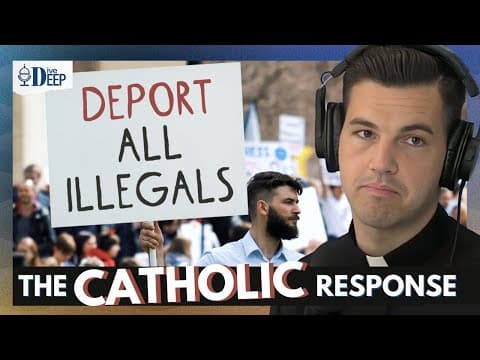
[0:00]An authentic Catholic response to the immigration and deportation debate. This is Dive Deep.
[0:11]From the Diocese of Springfield in Illinois, this is Dive Deep. We dive deep into our Catholic faith. I am Andrew Hansen, and of course, it is all over the news across America now, and frankly for the past several months, this whole immigration and deportation debate. So much of the political infighting, so many of your friends and family have been saying things and you're getting in fights with people about this whole debate going across the country. But what is our response as Catholics? How should we be viewing this debate? What side should we take? Is there a side to take? Let's get into it with Father Christopher Trummer. He is here to speak all about it. Father Christopher, good to see you. How are you? Doing great, Andrew. Thank you so much for having me. You're welcome. We thought we'd bring you on because you are a you have a license in sacred theology in moral theology from the Pontifical University of the Holy Cross in Rome, Italy. You're a parochial Vicar at St. Boniface Parish in Edwardsville. You're also served the Spanish-speaking community, and you also wrote a column. I should, before I say, a reflection, breaking all this down in Catholic Times, the magazine of the Diocese of Springfield, Illinois. It was excellent. It even got national attention. The National Catholic Register picked it up, so we really thought we'd dive deep into this issue because this is an issue you can't just pick a sound bite. You can't just pick a little sliver because it is very extensive. So, I want to first talk broadly on this issue. Um, because there are certain Catholic teachings that are very black and white. We think of abortion, that's a very black and white where we're where the church stands, and it's quite clear. But this debate, it doesn't, it's not as clear, and that's why you see so many people getting in arguments over, even within the, you know, the Catholic community, which we're really going to try to, you know, show the way here. So, let's just start broadly speaking, where does the church stand on these issues? Yeah, I think you set it up really well. So, like you said, there's not some clear-cut principle where any current immigration policies are just obviously totally violating that principle. Uh, what we're talking about is several different principles that are at stake, several church teachings about community life, about social life that are at stake, and then how different policies to different degrees, uh, uphold or fail to uphold those. And really, what we're talking about here is a category of prudential judgment. So, with other issues, like you mentioned, abortion or euthanasia, there's a, there is a black and white because we're talking about that, those things are, the church calls them intrinsic evils. So, when we look at the immigration debate and different policies, we have to ask, like, okay, what's, what principles are at stake, and that's what I tried to laid out, lay out in the article. So, a few of them that are at stake are human dignity. So, we're not talking about human dignity being utterly destroyed, obviously, as if someone's life is being taken, but human dignity can be threatened by certain policies. It is possible for us to offend human dignity in different ways. Also, uh, solidarity is at stake. So, solidarity is like the, the bonds, the responsibilities that we have to other human beings. That extends in a special way to our family, to our community, uh, even to our country, but we do have solidarity. We have a connection with, with every human person on the planet, right? Uh, there's also concerns of like law and order, like the church really believes in the importance of law and order, and to adjust society and order society. So, it is, it's not as, um, fun sounding or as flashy to dive in all these nuance principles, but that's really what we have to do if we want to think with the church. I think often times, we kind of, we go with our gut, maybe even if we're formed well, we kind of pick a side and then we maybe try to justify how the political party we're supporting or the political platform we support, try to justify how where that fits in church teaching. And I'm trying to do is to get us to kind of go back to the drawing board and like, okay, what really is at stake here? And so we can start from the issue itself, thinking with the church, thinking with scripture, and then we can see, okay, how can some of these different policies yes, further those principles or uphold those principles or fail to do so to different degrees. Hmm, yeah, the big question, uh, welcoming the stranger versus upholding the law. That's really kind of the question. Now, Father Christopher, I know most people can agree, if you're in the country illegally, and you have done or are doing bad things, you should be, you should be kicked out. Right? The big question, I think, that we're having right now is if someone is here illegally, but they have been here for years, they may have a family here, they're, they contribute to society, they've done no wrong. Their only wrong is coming here illegally. Um, is it morally okay to to deport them, and, you know, a good family, too.
[5:21]Yeah, great question. So, first, I would just say to talk about deportation itself, just to note, as I did in the article, that deportation itself, understood as relocating some, someone back to their country of origin, and removing them from the country in which they are illegally residing, that in itself is not evil. It's not intrinsically wrong. The church is not always opposed to it. I would mention, someone actually gave me some feedback on the article, and they said, well, St. John Paul II in Veritas Splendor, one of his encyclicals, in paragraph number 80, he is, he's quoting the Second Vatican Council, and it actually lists deportation among things that, uh, offend human dignity. So, I kind of looked into that, and really, um, I sort of understood this from other context, but what, what was the council was talking about there was deportation in the sense of, kind of what was happening with the Soviets and with like the Nazis where you're having mass deportations of people, like kind of ethnic cleansing, or wrongful deportations of whole groups of people, just because of race or something. So, we're obviously talking about a different context. We're not talking about, uh, ridding a country of, of a certain ethnicity based on race. We're talking about, does somebody have legal standing? So, back to your, uh, original question, I would say the short answer is in principle, morally, it is legitimate for someone to be deported if they enter the country illegally. So, the question is going to be, uh, by a matter of degree, what kind of, what kind of enforcement do we want of that policy? So, we think about justice, and upholding the law, upholding the common good of the country, justice is not reducible to just always filling out the law to the letter, right? I think we often recognize, whether you think about, you know, a teenager convicted of a crime or involved in some gang thing or whatever, there's many instances where the law justly applies to somebody, but part of the common good does include mercy, right? So, uh, we can, we can discern as a community, as a nation, and through our elections, through our politics, we can decide that we want a more or less strict enforcement of the law. Uh, if we have a very, very strict and harsh enforcement of the law, it creates a lot of resentment. It creates a lot of political tension, and it creates a kind of desperation and an exasperation from people, and it creates, it, it can kind of raise the temperature. On the other hand, uh, if there's impunity and people are just constantly disobeying the law, and there's no consequence consequences, that creates contempt for the law. So, this is really, I know it can kind of seem like I'm making it more complicated. Short answer is, yes, somebody can be legitimately deported. There are circumstances where I think the state should look into that and, and, and there should be trials for people on a case-by-case basis and just say like, and the state can set a criteria to say, okay, if someone's been here for more than a year, more than two years, uh, if they have family here, if they have family members that were born here, that's when it gets more messy and complicated, and we can say, okay, maybe they can have some other punishment, they can have some other consequence. There do need to be consequences if people enter the country illegally, and if they make no effort to pursue legal citizenship, there need to be consequences, but deportation is not the only consequence, and I think in some cases, it would be disproportionate. I think, when we look at the landscape of illegal immigration today in our country, I think there are a lot of people that have recently entered the country illegally in violation of the law, and they can make a claim, you know, they can make, they can apply for asylum, and unfortunately, a lot of them, the immigrants that are coming into the country, in recent years, are what are called economic migrants. So, people seeking to better their life, seeking opportunities, but some of them are, most of them don't meet the criteria that we currently have for asylum. So, I think it's only about 10 to 15% of people who apply for asylum get approved. So, we can respect and acknowledge the fact that people want to improve their life, they want to improve their, their opportunities for their family, but the country needs to have a clear policy. They need to, we need to have clear criteria for how we're going to address, you know, the wrongdoing of entering the country illegally, and it, it, that's where I think is, that's the messiest part of this debate is people who've already entered. And part of that, even think about, you know, now we have the Trump administration. Part of that is dealing with consequences of, of previous policies and previous administrations where, uh, you know, we, I think we need to look into that and say, well, if there was a completely different kind of policy effectively, based on the non-enforcement of the law, uh, it, it does raise other questions about like, what can people be expected to do if they were allowed to enter with impunity? Maybe they showed up to a court and really nothing was done to them, so they've kind of been, um, encouraged. Some people have been encouraged, basically, to enter illegally in the past and to remain illegally. So, I know it's very messy, but those are some of the factors that are involved. No, but I, your answer was, I, the comprehensiveness of your answer though, is what we need to hear because this is not an issue that you can put down into a sentence or two because it isn't black and white. But I want to talk a little bit more, uh, dive deep into your Catholic Times article, because you wrote that Catholics can disagree on policy, uh, which I think is really important for our people to understand. Again, unlike black and white issues like abortion and euthanasia where the church has a clear teaching and Catholics are called to defend human life, in this regard, we can actually disagree on policy and still be faithful Catholics.
[11:15]But what are the non-negotiables as Catholics on this immigration and deportation debate? Where must we agree, where must we disagree?
[11:47]Yeah, fundamental, the most important one that we have to agree on is human dignity and the right to life of of everybody involved in the situation.
[12:10]So, if there were a brutally harsh deportation policy that was very indiscriminate, that was removing people with no even semblance of due process, just sort of anybody who was associated with somebody and just sort of shipping people out, um, in huge numbers without any semblance of due process,
[12:35]I think that would be, that would be an offense against the dignity of those people and it would fail to, uh, kind of understand the circumstances of, of their entering the country. Especially, I mean, if people were who had legal, a legal claim to enter were were being sent out. So, human dignity, um, you know, even if deportation is justified, for example, if somebody were being sent to an area that they have no connection with, or, you know, almost being like exiled to like some other country,
[13:21]uh, that would be, that would be problematic. On the other side of it, on the nation side of it, I think we have to uphold the nation's law and order in the sense that recognize that the nation has a right to have borders, and has a right to enforce its laws. So, this is not, uh, John Lennon, Imagine, you know, Imagine there's no countries. It isn't hard to do. One, that would be very hard to do. Uh, two, yeah, as I kind of hinted at in the article, the church doesn't see obliterating borders as somehow the ideal. And, oh, if only we could get rid of these pesky borders and these nations, and it's dividing people and it's, it's bad. Like, no, the church doesn't see borders as bad. Nations are very important. It creates, uh, space. I mean, a geographical space, but also creates a population with within which there are strong ties, there's accountability, there's responsibility for, for each other, an added layer of responsibility, and there's representation, right? I mean, if we have, the church doesn't want like one world government, you know, that's ruling over 9 billion people or something like that. So, I would say those are the two biggest non-negotiables, human dignity in the carrying out of, of justice especially, and discerning who can come and then national sovereignty, which includes the right to have borders and to enforce those borders.
[15:10]So, when it comes to how Catholics should view this, are you saying I can be a Catholic in good standing, and be in favor of deportation? I can be a Catholic in good standing and say, let's keep them here.
[15:51]Yeah, I think, yeah, I think you can be. I think, um,
[16:04]in terms of policy when you say, okay, I can be in favor of deportation. I would say, yes, you absolutely can be as a Catholic in good standing with the conditions of that deportation being carried out rightly. And right, and, and this is important because if somebody, so say, I support this policy in general, that doesn't mean I have to defend or explain every instance of how it was carried out. You know, well, I heard a story about how, I heard a story about how ICE did this thing in the city, or, you know, the immigration enforcement, they mistreated this person, or they, there was one case where they sent somebody out who shouldn't have been sent out. Okay, you can condemn every instance where it was carried out poorly or unjustly and wrongly, and also just be in favor of the policy in general. On the other side, uh, in terms of, no, I say, let everybody stay here. Um, I think you can support amnesty programs, and, and to say like, okay, what's create a, let's create a pathway toward citizenship, or a pathway toward legal standing for these people. But I don't think that can go to such an extreme. Again, one to say just like, obliterate the border, open the border back up, or let everybody in. It also can't just be, just total impunity and no consequences.
[17:42]I mean, the state needs to for all the people who are here illegally, like, there's, um, estimated between like, I think, 13 and 16 million people here currently in the country illegally, around that number. You know, there needs to be accountability for who are these people and where they from, and there, you know, there just needs to be investigation, and we need to know their whereabouts, um, their status, their family, and there, you know, even if we're going to help them, even, to integrate, we need to know who they are, and, and all that. So, I think you can have a much more restrictive view as a Catholic, that, you know, that insists. I would, for example, I think, you can insist that there should not be a single illegal border crossing, just to be totally clear. Like, I, you don't have to just accept that, well, you know, there's going to be some hundred thousands or a million people a year that enter illegally. No, I, I think it's totally consonant with a Catholic worldview to say there shouldn't be anybody entering the country illegally. The big question is, right, the people who are already here, and then also, we do have to have a serious conversation. This is more of like a existential conversation about our nation, our responsibilities and things, going forward. But we have to have a conversation about how many people can we responsibly integrate into our country? So, this is a just a matter of degree. There's not a black and white policy, but like, I think the church teaches that wealthier nations have an obligation, within reason, to, to welcome people to their country. So, we clearly are very well the nation. We have a responsibility to welcome some people, but the citizenry, the, the people, through their elected representatives, have to discern how many people can we absorb? Uh, I think we can clearly absorb more than 100,000 people or something a year, but, you know, what if 80 million people want to come here in the next year? I, I don't think that's possible. I don't think it's possible, and it wouldn't be for the good of anyone involved. It wouldn't be for the good of the people who come because the opportunities would quickly dissolve in this country if we just, you know, increased our population by 20 or 30% every year. We would not have anything really to offer them. And then, on the other side, uh, it wouldn't be good for those, it wouldn't be good for the people who already live here. Because, right, they've, they've built a life here, and then they would be quickly complete, we'd exhaust all of our resources just trying to assimilate people. So, it's clearly a matter of degree, right? Like, we need to welcome, we can't welcome zero people with all the blessings, and all the wealth, and resources we have. But we also can't welcome 100 million people a year. Well, I think what, what I hear in, in all your answers, which is what I really appreciate is, as a Catholic, amongst all the news cycles, and yet, to your point, you, you hear a story of ICE doing something horrible, and then you hear stories of people doing horrible things to ICE. And you're like, gosh, where am I supposed to fall on this issue? Um, and, and the fact that there's leeway, and, in a, in a Catholic worldview of this issue, uh, where you can be a good practicing Catholic and have, be within the goalposts of, you know, of, of almost different sides of the issue, but still within the framework, you, you mentioned. Um, what should policy look like do you think? And I know you're not running for office here, but, uh, because you kind of touched on it in your article. What's a long range immigration policy look like that that could be viewed from the Catholic lens that says, this is good. This is what we should do.
[22:15]Yeah, this one is, is, is more complicated. I think, again, I, I already kind of weighed out what are what's the, I think, what I think is the playing field, what's a legitimate Catholic view. What, do I think would be a great policy? I think a lot of it actually gets into, this is why it's complicated, I think it gets into international politics.
[22:38]So, in Catholic social teaching we talk about the common good, which is usually like the good of a community of people, but there's also this idea of the global common good. And we have solidarity, as I mentioned, not just with Americans. We don't just, we're not just responsible to other American citizens. There is a special layer of responsibility there, a special solidarity. We also have solidarity with everybody throughout the world. For you and I, practically speaking, how do I express my solidarity to people around the world? Well, there's different ways. Uh, charities, the church fosters the missions. There's a lot that the Catholic church does in particular to foster solidarity around the world. But for immigration policy to the US, this is, it's hard because it's a huge, a high level question. How does our attempt to be really generous and to welcome a ton of people into our country, that can actually create a negative incentive structure for other countries to sort out their problems. So, we can become a kind of buffer zone where we absorb, basically, the economic issues and economic problems of other countries, especially like in Central and South America. So, we don't want to make the US, and I don't say this to be offensive to anybody, but like, a kind of dumping ground where, where everybody who has, who's disenfranchised, or whatever, is coming to the US to, to kind of take advantage of the US's wealth. And all that, we clearly can and should welcome a pretty good number of people. We have the ability to do that and they have the ability to be integrated, but we don't want to, we, I think there needs to be, the policies should apply pressure on other countries to create opportunities in, in their own country. We don't want to give, you know, there are dictators and very aggressive, um, regimes in other countries, and people are fleeing those situations. And so, on the, on the short term, it's clearly better for those people to leave. But if you're trying to, we, we need to think about sustainability and the long-term flourishing of people. Not just in our country, not just for the people who flee, but what about the other people who have to remain in that country? So, I know it's a very complicated question, but I think the policy should, it also involves foreign policy. And how with trade, sanctions on trade, different things like that, pressure needs to be applied to insist that these countries that are creating, I mean, creating so much poverty and violent, and all these things in the impunity, and the cartel, you know, all this, all these problems in other countries, they're creating the situation where people have to flee and come to our country. So, it's kind of a short-sighted solution just to say, well, we'll just accept as many people as possible. We should accept some people, but like, what, how are they, how is the problem in the, in the home country going to be addressed? And, yeah, I think we shouldn't be totally on the US to absorb the fallout of of problems of social problems in other countries. On the other hand, we do have a lot of influence around the globe. And we've used it for good in many other areas in the world, uh, even recently. I think we should use it for good also in in these countries, particularly in Central and South America. One thing you also touched on in your in your article was about scripture passage. And that, and how some people can pick one or two sides and say, hey, our, you know, two things in the Bible. Hey, look, see, the Bible says this. I told you, and then the Bible says this. See, I told you. So, how do we decipher when scripture is being used faithfully versus when it's just kind of being used as political slogans? Because it, it seems challenging, because you see one scripture passage, like, yeah, that makes sense. I should be welcoming everyone. Then you see other scripture passages, like, oh, no, we should be closing our borders.
[27:47]Yeah, yeah. Uh, a big thing is obviously, this is just applies to scripture interpretation in general, but is discerning what was the context of the passage? So, the social context, what like the people of Israel, for example, in the Old Testament, this very small, vulnerable people, and how they, you know, handled their borders, or how they handled interacted with other nations. So, that's a very different context. You think about even the Jewish people in the New Testament are under, the oppression of the Roman Empire. So, how the Jews understood themselves and how Jesus was was was speaking his message. Um, so, in attention to the context, uh, recognizing that scripture, the teaching of the word of God, and even Jesus himself is giving us absolute essential moral principles for how to live our life. A lot of them are about how we live as an individual. Sometimes, when we go from, we try to extrapolate out from an individual principle of how do I interact with people, how do I love people, how do I treat people. If you try to extrapolate out from that to a social policy, it's a lot more complicated. Jesus says, sell all you have and give it to the poor and come and follow me to people who he's calling to a, a particular kind of discipleship. But Jesus also says, give to God what is God's and give to Caesar what is Caesar's. Jesus's call to give to the poor is that is an obligation that each of us has. And we have to be honest, are we doing that? Are we serving the poor? Pope Leo just came out with this Apostolic Exhortation on the poor, and God has a preferential love for the poor. How are we living that out? There's a danger of abdicating our personal responsibility to live the demands of the Gospel and giving that to the state. So, from the, oh, we're called to love the poor, as you did it for the least of my brothers, you did it for me, the good Samaritan. All these powerful images, and powerful teachings, sometimes it's easier to say, well, just take a little more off my taxes, and I'll advocate for some government policy. Uh, the government can do a lot of good, the state can do a lot of good, but we don't want to, on the one, the one extreme would be neglect, ignoring our responsibility, and just not engaging with the demands of the Gospel. That's clearly a big problem for all of us. I think we all need to be challenged by Jesus. The other extreme is, or the other, I mean, it's not the exact opposite of that, but is to kind of similarly ignore our personal responsibility to live the Gospel by outsourcing that to the state. So, the state will take care of people, we have programs for that, or we have, you know, whatever, these kind of institutions or organizations. They will play a role, but we really need to to wrestle with, I think, how do I live it out? So, I would say back to your original question, just to be more clear, scripture is giving us absolute essential moral principles, but prudence, which is the most important virtue for the moral life, involves discerning how do these universal moral principles, these laws, these commands of God, how do they apply to the particular circumstances that I'm in now? The circumstances today in 2025 in the US, whatever in your city, are not the same as what they were in Israel, and 700 BC, or in 30 AD when Jesus was was doing his public ministry. Uh, you can't just write it off as like, oh, it's a totally different context. But it is different, and so, in the way states work, the way policies work, um, government programs, welfare, um, the incentive structures are very different. Societies are more complicated. All the basic elements are still there, and they've been there, but, yeah, the way society works, the way taxes work, all these things, they are undoubtedly more complicated. Yeah. All right, we'll get you out on this one. What's your message to Catholics when it comes to the immigration and deportation debate, as we all try to wrap our minds around these issues, and be a faithful Catholic and not trying to get caught up in one side or the other and then get angry and be antagonistic toward each other. Yeah, my message would be to really seek to think with the church. So, this is very hard in the American context. We have a very intense, very polarized, uh, very contentious political climate, and I think we, all of us, I include myself, you know, as Christians, as Catholics, when it comes to any of these politicized issues, we tend to think of ourselves first as a Republican or first as a Democrat, or first, you know, as a supporter of this group or that group, and then secondly as a Catholic. And my invitation in the article, and my invitation now is, uh, for us to recognize that the issues are pretty much always more complicated than, for our convenience, and for purposes of, you know, marketing and ads and, and campaigns. It's very common to just simplify issues, to try to boil them down to a slogan or a soundbite, as you said. I think with every issue we need to to be more sober-minded, to be willing to do some deeper reflection, to recognize, like, okay, what's actually think about what's at stake here. Let's actually try to understand maybe what people who disagree with us, what, what points do, do they have? They, everybody is, most people are sincere, you know, they might be even if they're wrong, or they're wrong on certain points. They're sincere. Let's try to, let's be models of charity and dialogue. Let's be models of how to disagree well. And again, I guess the, the bottom line would be, let's try to think with the mind of the church. Not just the, you know, a recent comment of a pope or or a recent interview or something like that, but with the mind of the church, which is a, a worldview, and of view of, of the human person, of human society that's been developed over centuries. Let's try to seek that deeper formation so that we can bring like real deeper solutions and not just kind of side, immediately side with, or reflexively side with, the people who we generally support. Even if you generally support a particular political party, you have to maintain the ability to to criticize your own side, you know, and there's nothing wrong with supporting a political party, um, but let's not be just reflect, reflexively defensive of of that party and it shows, actually, I think it makes you more credible when you show a willingness to criticize your own side whenever they get something wrong. At least part of something wrong. So, that would be my invitation. Awesome. Father Christopher Trummer, thanks for breaking this all down. Really appreciate it. Thanks, Andrew. You got it. This has been Dive Deep. For more podcasts, head to our YouTube page, youtube.com/diospringfield.
[36:18]Until next time, we'll see you right here on Dive Deep.


