[0:00]Now, next question is, how do we recognize an unstable obstructed airway? If you hear a voice, the child is verbalizing, talking, presume the airway is stable. In the unconscious child, if you hear no voice, presume that the airway is unstable. If you hear a noise, consider that the airway is obstructed.
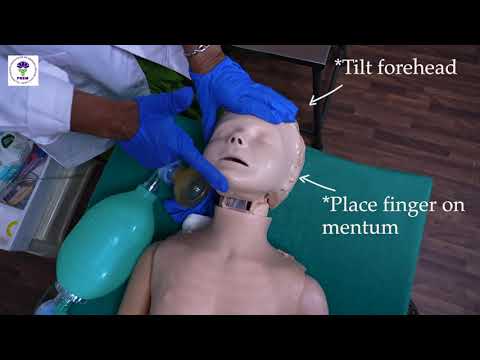
[0:45]The mother brings the child who is unresponsive, and you hear no voice, you presume that the airway is unstable. You need to now do the first intervention in resuscitation, which is open the airway of unresponsive child. So how do you do it? You need to organize yourself. So first, request the mother to place her child on the resuscitation trolley with the child's head at the head end. This is the head end of the resuscitation trolley. You yourself will have to run, seat yourself at the on the airway stool at the head end of the resuscitation trolley. Wear gloves. Because you will be handling a lot of secretions and you need to protect yourself. And proceed to do the first maneuver which is opening the airway using the head tilt chin lift maneuver. The head tilt chin lift maneuver is a bi-manual maneuver. I use my hand to tilt the forehead and lift the chin by placing a finger on mentum. But since I have to do this maneuver while being seated at the airway end of the resuscitation trolley, I use my thear eminence to do the head tilt chin lift maneuver and use my index finger, place it on the mentum and do the chin lift maneuver. Now, there are some precautions which I take during the head tilt chin lift maneuver. Avoid placing the finger in this area which is the soft tissue and where the airway of the baby is present. Avoid touching this area below the mentum. Always place your finger on the mentum and mentum only. Number two, avoid overextension because this can flatten the airway or the airway tube of the small infant. Number three, this position, this head til chin lift maneuver has to be performed throughout resuscitation. Ensure that somebody at the airway end is always holding this position during all procedures. So the second procedure to clear the airway is oralal suction. For this we employ the suction cathetors. There are two available. One is a flexible suction tip, the other the Vancouver suction tip. The young cover suction tip is preferred for its three main advantages. Number one, it's a firm tip. The large bore can help you rapidly remove particulate secretions. Number two, you can see it's curved. This helps you to have tip control and thereby you don't touch the posterior fringal wall during the oralal suctioning process. If you happen to touch the posterior fringal wall, you will induce vagal induced bradicardia. Number three, it has an aperture here which helps you to control the suction process. When you've completed the suction process, if you remove your thumb, this suction will stop. If you occlude it, you can continue suctioning. This is called thumb control. So to recap, broad tip, tip control and thumb control. While maintaining the head tilt chin lift maneuver, I use the Yanko suction tip to remove the visible secretions in the oral firings. Then I tilt the head to one side and place the tip in the lateral gutter of mouth where the secretions would have accumulated. This maneuver prevents the tip from touching the posterior frangel wall and causing vagal induced bradicardia. I then turn it and continue to maintain the open airway. The third maneuver for the airway is the nasogastric decompression. In this we rapidly decompress stomach contents and ensure that the stomach is empty. For this process, we need several items. Number one, the nasogastric tube. In children, the nasogastric tube size varies with age. So you need to check a chart which is usually displayed near the crash cart where the consumables are kept. And you need to identify which diameter you need for which age group. Because there are several sizes available, 5, 8F, 7F, 10F, etcetera. Once you identify the right size, you also need a syringe. You need a trouser-cut plaster adhesive. See, trouser cut. A stethoscope and a colleague who can confirm the position of the nasogastric tube placement. Once you've got your stuff together, you need to measure. Step number two is measuring the length needed to introduce. For this, the tip of the nasogastric tube is placed at the nostril from the tragus to the epigastric region. Pinch the end which is at the epigastric region. Then using the natural curvature of the nasogastric tube, while still maintaining the head tilt chin lift maneuver, introduce the nasogastric tube via the nostril. Once this enters the stomach, there will be a gush of stomach contents in the tube confirming its position. If the child has vomited or the tube has gone into the trachea, we need to confirm the position inside. For this, we use the syringe, we aspirate some air and we push the plunger so that it enters the tube. A colleague who is auscultating the epigastric region should confirm that she or he has heard the sound of the air in the stomach. Once your colleague confirms the position, then using this trouser-cut plaster, invert it and place the base on the filterum. Then using either end of the the the limbs of the plaster, encircle the NG tube and fix the nasogastric tube. It is important that you fix it because if you, if the child moves, this tube can get displaced. All the time, ensure that the head tilt chin lift maneuver is maintained throughout this process.


