[0:00]The average person now spends seven hours a day staring at their screens. But that level of consumption doesn't just steal your time and your life, it actually rewires your brain, shortening your attention span and making you reach for your phone the millisecond that you start to feel bored. 20 years ago, if you asked someone what their hobbies were, they could probably tell you all sorts of things. Dance classes, maybe they're into gardening or crochet, or they really enjoy volunteering at their local community center. But these days, I've noticed that when I ask people what their hobbies are, they don't really know how to respond. Social media has trained our brains to crave quick dopamine hits and anything slower will almost certainly feel really dull at first. But hobbies can actually retrain your brain to be able to focus and enjoy the real world. If you're new here, I'm Izzy, a mum, tech founder and Cambridge trained doctor. And on this channel, we explore these strategies and mindsets to help you create your dream life. So in this video, I'll be walking you through exactly why hobbies are more important than ever in this day and age. The neuroscience behind how hobbies can actually heal your brain rot from social media, and then some frameworks around how to choose hobbies that really nourish you and bring joy to your life. And finally I'll go over the four categories of hobbies, and I'll give you a whole bunch of ideas in each of these categories so that you can maybe choose a few to experiment with. As a companion to this video, I've made a completely free list of all the hobbies that I'm talking about, along with some journaling prompts and questions to guide you along the way. So if you'd like a copy, feel free to check out the link in my description. So how exactly are hobbies going to change our lives? In 2023, scientists did a meta-analysis on 93,000 people across different countries around the world. And what they found consistently across all populations was that hobbies make people feel better in terms of their mood, they feel happier, they're less depressed, they're actually physically healthier, and they also feel more satisfaction with their life. And they even noticed that some specific types of hobbies, such as creating art or learning a musical instrument, can literally increase the volume of your brain and improve your memory, potentially even reducing your risk of developing dementia down the line. And so here's how hobbies can literally help to heal your brain rot, fix your attention span, and also help you to enjoy real life again. We sometimes joke about social media shortening our attention span, so how people in Gen Z or like even Gen Alpha have the attention span of a goldfish now. But beyond all the jokes, actually the science is showing that this is actually true, because when we consume lots of rapid fragmented content on platforms like TikTok or Snapchat, our brains initially get overwhelmed and hyperstimulated, but then they start to rewire. And studies done exploring this relationship between social media usage and cognitive function have found that it reduces our memory, we lose cognitive control, and it literally erodes our ability to stay focused on something. And beyond social media just rotting our attention spans, it's also rotting our ability to enjoy life. You've probably heard of social media addiction and dependence, but have you heard of digital anhedonia? Digital anhedonia can be defined as the reduced ability to find enjoyment in real-world experiences after prolonged digital saturation and stimulation. And this is literally because social media is rewiring their brains reward system. But the amazing thing about our neurobiology and really everything in the human body is that it's governed by something called homeostasis. This is the process through which our body regulates and balances all the systems using feedback loops. So in our brain, we have dopamine receptors, which receive the signals from dopamine being released on our brain. And so in the case of social media, if there's a huge flood of dopamine, suddenly there's a huge amount of stimulation on those receptors. But what the brain does to restore this yin yang balance is that then it starts to downregulate the receptors and becomes less sensitive to that dopamine. That means that even if there is the same stimulus, there isn't quite the same feeling of reward anymore. The problem happens when you switch off social media, because your brain has literally recalibrated its set point for what it's expecting in terms of dopamine in order to feel a sense of enjoyment or reward. And then when you get back to something like taking a peaceful walk in the park or reading a book, those don't produce such a massive surge of dopamine. And so they don't feel rewarding, they feel boring. There's an interesting comparison with let's say quitting smoking. So when I was training and then working as a doctor, one of the things that we would really focus on is how to help support patients to develop health forming habits in their life. And so one example is quitting smoking. For people who are addicted to cigarettes, often they also feel this sense of a void, where when they've removed this unhealthy habit, suddenly they're like, okay, they get this feeling or this trigger where they want to reach for a cigarette, they're like, wait, but I'm I'm quitting smoking now, I'm no longer a smoker now. So what do I do? And they face this void. And so then as physicians, one of the things that we can suggest to them is to think of some replacement for the cigarette. So it's like, okay, like next time if you're feeling like having a cigarette, where can you divert that energy? So instead of trying to block that energy completely, you're just redirecting it. A common suggestion actually was for them to get some little lollipops, like sugar-free, xylitol lollipops, which they could reach for instead of reaching for a cigarette. And what this did was a couple of things. Firstly, it gave them something to do in that time. Secondly, it also semi-mimicked a little bit of the reason why they wanted to smoke a cigarette. And yes, it's not going to be as stimulating as a cigarette itself, but it almost gives them something to fill the void. And so I've discovered that hobbies can be the same thing but for social media dependence. Where if it's like, okay, it's like the evening, I'm kind of bored, I want to do something like scroll on Instagram. But like, okay, you know what? Let me redirect that energy into a new hobby that I've chosen. The beautiful thing about hobbies is that they give you a sense of dopamine, but it's a slow dopamine and also serotonin. An analogy I like is almost to think of hobbies as a whole unprocessed food version of dopamine versus social media being a hyperstimulating junk food. It links beautifully into a concept that the ancient Greeks were really interested in, called eudaimonia. Eudaimonia is this idea of human flourishing, where we all reach our highest potential and enjoyment through living well and living a good life. It's not a hedonic superficial type of happiness, but instead it's this meeting of a deeper sense of meaning and purpose and flow. And so hobbies can be a great way of getting this kind of eudaimonic fix. So now I've given you my manifesto on why hobbies are so important, more important than ever, and how they can literally heal your brain rot from the inside out using neuroscience. Let's talk about how to choose your hobbies. So rewinding a little bit, about five months ago, I realized that I didn't really have any hobbies, and this was kind of sad. To give myself grace, I had a baby about eight months ago, and so this was about three or four months postpartum, where I was just getting back into my usual routines, and then I was like, you know what, I kind of want to like do something for me. And I was like, wait, hang on, what do I want to do for me? What even are my hobbies? And I realized I'd replaced a lot of the hobbies that I used to have, like either as a kid or in school or at university, with either working, doing something productive, such as like working out, or scrolling on my phone. What's up with that? And so then I wanted to develop some kind of framework for thinking about which hobbies I actually wanted to pursue. The most basic filter is just thinking what would I enjoy? What would create joy for me right now? The first theory that I want to dive into is the effort recovery theory. Essentially, we can broadly divide the things that we do in our lives into two main categories. Things that require effort and output from us and things that help us to recover and refill the well. For most people, they'd place things like work or like hustling into the output category where they're outputting energy, both physical and mental, into this thing. And on the other side, there's recovery where you're inputting back into yourself, you're resting, you're refilling the well. Business psychologist Jo Wintle says that hobbies are really great actually for this recovery mode. And came up with four key questions to help us to choose a hobby to really nourish us. Firstly, there's psychological detachment from work, so does it help me to disconnect? And also help us to get into a flow state, which is where you're completely immersed in what you're doing and fully in the zone. Secondly, it's relaxation. Does it feel enjoyable and help me to feel good? Thirdly, is mastery. Does it help me get a sense of accomplishment and progress? And finally, does it give me a sense of control and agency outside of work? One other thing I've been thinking about a lot recently is hobby grindification. Because I've been noticing this almost pressure to turn everything into a side hustle or make everything productive. And so I'd like to just say this, you don't have to turn your hobbies into side hustles, and you don't even have to put it on social media or share it anywhere. A large part of the joy of hobbies is just being able to do them for their own sake. And so for me, I've been on a little bit of a journey rediscovering hobbies in my own life after becoming a mum. Here are four key categories of hobbies, and I would actually recommend having probably a reasonable spread across the categories if possible. And so I'll just give you a whole bunch of ideas to see if there's anything that sparks your interest. And what I would really recommend doing here is running tiny experiments on these. So for me, for example, when I was getting back into the whole hobbies thing, I decided, okay, I might want to try Shaolin Kung Fu, Latin salsa, Chinese calligraphy, maybe I'll try some pottery making and painting. All of these things, and I just like, you know what? I'll just try it out. Just commit for like one or two sessions to go and see how it feels. And then move on and just keep doing that until I find ones that stick. So for example, things like Shaolin Kung Fu didn't really stick this time, but something like Chinese calligraphy, I was like, oh, I really enjoy this. I can see myself doing this for longer and so then I just continued. The four categories of hobbies are creative, intellectual, wellbeing and connection. And let's dive into some of these examples. Creative hobbies aren't just for creative people. Even if you think your creativity sucks and is limited to drawing a stick man, there are so many incredible creative hobbies you can dive into and find genuine enjoyment from. When I was a child at school, my art teacher told me that I was bad at art. I remember that I was doing a painting and I had mixed a bunch of colors together and I had gone this kind of shade of like brownie greeny murky kind of color. And I was struggling to get the paint color I wanted, and she said to me, you've made a real meal of that, haven't you? She wasn't wrong, I had made a real meal of it. And she gave me a bad grade in art class, because my art didn't look how it was supposed to look. I was not great, objectively, at making things look true to life. However, this narrative stuck with me for so long where I thought, okay, I'm not a creative person, I'm bad at art. But then it's like, okay, what does it mean to be bad at art, to not be a creative person? That's actually just patently untrue. Every single human being on the planet has a creative spark and energy within them that's just waiting to come out. It doesn't matter what the end piece looks like, what matters is actually showing up and doing the thing. So I wanted to just share that, because I feel like a lot of people have this where they think, oh, I'm bad at this thing, I'm bad at this hobby, so therefore I shouldn't do it. I actually think that that's not the point at all. So creative hobbies include things like art, so painting, drawing, scrapbooking, things like calligraphy. So for me, I've been actually doing Chinese calligraphy specifically, but this could be any kind of pottery, whether that's actually throwing the pottery and doing the whole like glazing and everything, or just painting it. Creating things like videos, whether that's YouTube videos or like more cinematic videos, or just like videos of beautiful things. Photography is a beautiful art form, and I found that whenever I've tried to get more into photography, I notice beauty in the things around me even more. This can also include graphic design, baking or cooking, or even things like gardening. So in lockdown, I actually did a gardening project for about a year and a half. I literally dug up our lawn and grew an organic veggie patch with loads of organic fruits and vegetables. It was maybe a bit of a nightmare for my mum, because the lawn was ruined, but it was a very interesting hobby to have. You might be interested in interior design or flower arrangement, or music, such as singing or playing an instrument or even composing or producing. Or things like writing, whether that's fiction and creative stories, or just expressing your reflections on the world. But as much as I enjoy and love writing, one of the things that I often like to do is to make it effortless to get the ideas to start to flow. And sometimes I'll find that my brain wants to work faster than my fingers can literally type. And that's where I like to use Whispr Flow, who are actually very kindly sponsoring today's video. It's essentially a voice first writing tool that works across both Mac and Windows. So now whenever I start to feel that I want to get my thoughts out quicker into my computer, I can use Flow to speak into my computer instead. And what it does is it transcribes what I say and automatically edits or like neatens up what I said as I go. That means all my filler words or pauses or ums or ahs or like rambling thoughts are turned into a nice sentence that is written clearly. Because one common issue I've run into with just normal voice dictation before I was using Whispr Flow was that it would also transcribe all of the errors in my speech. One thing I found really helpful is how it can adapt depending on what kind of writing I'm going for. This means that things like the grammar, the sentence structure, are already suitable for whatever use case that I want to use it for. And so that's helped to save me quite a bit of time. So if you want to try Whispr Flow, I've put the link in my description down below and you can also use my code for an extra 30 days free. Now let's get back into the video. The second category is intellectual input. If you've ever felt a little bit lost for feeling that sense of progress ever since you left school or uni, and I can definitely relate to that, this section might be for you. Because intellectual input doesn't actually need to stop when formal education ends, and in fact, this time you're going to have so much more fun because you get to choose exactly what you want to learn and follow your heart. This category includes reading, so any kind of reading, whether that's fiction, non-fiction, anything that you enjoy and feel drawn to. It also includes learning. This could mean learning a language, or learning about history or philosophy, or any topic that instinctively draws your interest. One thing I would say here as well is to not only choose learning topics that you think or you judge to be useful for yourself, but just things that you intuitively feel a resonance or interest in. Because this will make it way more accessible for you to get into a flow state and actually really enjoy what you're doing. And consistently, they found that engagement with your hobby is actually more predictive of all the benefits of it than anything else. This kind of learning can take the form of courses, of books, classes, lessons, all that kind of thing. Another input is traveling. Absorbing a new place, a new culture, a new, maybe cuisine. One thing I love about traveling is it gives me a new perspective on life, a completely different lens through which you're kind of having a peak. And you're like, oh, that's how they do things over here. This is the feeling, the vibe, the way that they hold themselves in this space. The next category of hobbies is wellbeing, and this includes physical, mental and spiritual. Some ideas include dancing. Maybe you want to connect with your body and move it in a way that feels fun, that feels good. There's social dancing, so I really enjoyed doing Latin salsa back at university, which was like a partner style salsa dancing with lots of spins. That was super fun. Or maybe you prefer to do like solo dancing or more like kind of K-pop style, hip-hop style, or even something which I discovered a couple years ago, is this idea of ecstatic dance, where they DJ an ecstatic dance session where you really connect with yourself and you dance as if literally no one is watching, no one is judging, and fully express yourself and move in whatever way feels good. You could also maybe get into yoga or Pilates. I love yoga and I do it multiple times a week. One of my favorite places is my yoga studio. It could include things like gym or running, hiking, walking, swimming, or things like martial arts, where there's a combination of the physical and also the skill. Another skill and physical combination is rock climbing. On the mental and spiritual side, maybe you could explore things like meditation, which over the last several years in my life has completely turned it around. And if you're new to meditation and have no idea where to start, I've actually created a completely free meditation starter pack. I'll leave a link down in my description below if you'd like to check it out. You could also pick up things like journaling. I find that journaling is one of my favorite hobbies that I love to go back to time and time again, because it helps me to really connect with myself and understand myself more deeply. And finally something like breath work, which I've been personally finding really revealing recently, with having significant emotional releases through doing breath work. The final category is connection. This is all about connecting with other people, with friends, family. It could mean coming up with a certain set of rituals or specific meetups that you do with people. For example, my husband and I, every single week, it's already pre-blocked in the calendar, we have regular date nights. And so we go to a new restaurant that we've been really wanting to try and mindfully enjoy the food and then also really spend that time connecting. This could also mean planning a workout or hobby classes with a friend or meeting people there, such as like run clubs or like pottery classes. One thing I've been really enjoying recently is hosting people more regularly for dinners or lunches. Or you could even start up a creative club or a book club where you invite people over to do some kind of activity together. Essentially, this is all about recurring regular touchpoints, so a weekly dinner or like a hot girl walk that you go on. It's all good and well watching videos like this, which talk about how to improve your life, how to make changes that move you closer towards your higher self. But the most important thing is actually turn these ideas and this inspiration into action. So in every single video, I like to invite you guys to come up with two action points right after watching the video and write them down somewhere. And I will even suggest one, potentially try switching out at least 30 minutes this week to spend on a hobby instead of scrolling on your phone and see how you feel after doing it. If you liked this video, I think you might enjoy this one over here, where I walk you through my complete three-step butterfly framework on how to completely reinvent your identity to change your life. As always, thank you so much for watching, take care of yourselves and remember that the journey is the destination. I'll see you in the next video. Bye.
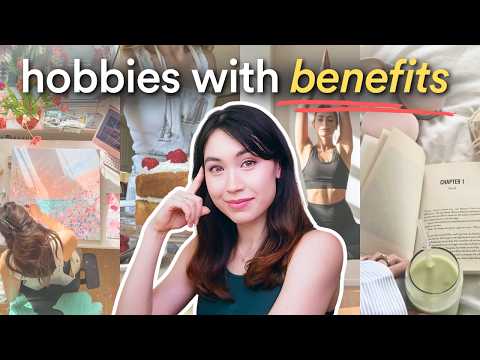
Hobbies: Your Best Defense Against Brain Rot
Dr. Izzy Sealey
24m 38s3,762 words~19 min read
YouTube auto captions
Transcript source
YouTube auto captions
This transcript was extracted from YouTube's auto-generated caption track. The transcript below is server-rendered so it can be read, searched, cited, and shared without opening the original YouTube player.
Pull quotes
[0:00]But that level of consumption doesn't just steal your time and your life, it actually rewires your brain, shortening your attention span and making you reach for your phone the millisecond that you start to feel bored.
[0:00]20 years ago, if you asked someone what their hobbies were, they could probably tell you all sorts of things.
[0:00]Dance classes, maybe they're into gardening or crochet, or they really enjoy volunteering at their local community center.
[0:00]But these days, I've noticed that when I ask people what their hobbies are, they don't really know how to respond.
Use this transcript
Related transcript hubs
Watch on YouTube
Share
MORE TRANSCRIPTS


