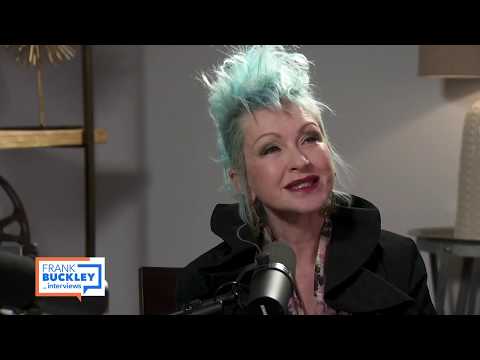
[0:05]Welcome to Frank Buckley interviews. This time on the program, an icon in music whose songs are known around the world. I want to be the one to walk in the sun. I want to have fun. Girls just want to have fun. Just one of her many hits, music that is fun, but empowering. Well, it was a, it was a song that brought three generations of women together. If that's not empowering, I don't know what was. And what I wore, the rhinestones from the old ladies and the chains and the the chains were because we were still chained. It's Cyndi Lauper on her songs, her Broadway musical, Kinky Boots and living and working with psoriasis. Cyndi, this is such a pleasure to have you on the program. Thanks for for being in and please have a sip of water. I'm even drinking enough water. Right. Welcome to Frank Buckley Interviews. It's a pleasure to have you in. Oh, thank you. Thank you. Uh, I want to talk to you about uh, uh, so many things, your music, about your activism, about uh, what you're doing to help people with psoriasis, but I I want to start where it all began. Um, Ozone Park, Queens. I didn't have psoriasis then, it's a dirty trick, that's all I have to say. But you were, would you say that you were unconventional even as a kid? Yeah, I was odd. But I I don't think I was I just saw everything as being really magical. That's all. And I cried a lot, when my father would take photos, but I think that Why did you cry a lot? Well, he would snap a picture and I'd cry it to, you know, and I I guess I just didn't like the bad angles, you know, I I really had to be a good angle, I guess. I don't know.
[2:02]Um, maybe I was Native American, came back, reincarnation, no. But I have no idea. And and I basically sang a lot. And I would, even when I was crawling on the floor, if there were animals, you know, I just was fascinated with the fact that their eyes were like mine, but their body was different. People who are your true fans know about this, others may not, that You were homeless for a period yourself. Yeah, I was. You you grew up. No, but you know why? Because in New York State, if you were under 21, you could not sign a lease. You had to be 21. My mother couldn't sign a lease. My mother was a waitress trying to just survive. I didn't have anybody sign a lease for me. So I was homeless. I went up to Vermont, and I'll be honest, Vermont saved me. I mean, I'm allergic to the cold, and it was a tough one, but I didn't.
[3:16]I got it later on, which is a dirty trick. Um, but You went to this hostel and how did it save your life? Well, they said if you want to get an apartment, I actually went on welfare. So went down to the welfare office like they said, and I just, I went up to the front and I looked at the lady and said, look, Can you just get me a job? I want to work. Get me a job. I don't want to be on welfare. It's not even enough money for toilet paper. You want to get me a job? So she looked at me and immediately because in the seventies, there were programs set up. She sent me in to see this guy who talked to me and said, well, what is it you like to do? I said, well, I love to work with animals. You know, I worked at the racetrack. I was a hot walker, so he got me a job in a kennel. He also helped me get my GED, and I went to college for art. And then I realized, I don't want to be a teacher, I want to be a painter. And then I went back to New York again and worked for some really sexist guys. And this one guy, he want he was a musician and a painter. And I figured, you know, if he could do it, I could do it. And I answered some ads and wanted to be a background singer and just went from there. You know, the the tens of millions of of singles and albums sold. You're an Egot. You know, one one short of an Egot right now. You got the Emmy, you got the Grammy, you got the Tony. Next is the Oscar. People use words like icon to describe you now. When you were that kid in Ozone Park, did you envision this moment or did you expect it someday? I used to practice in front of the shower curtain, taking bows, giving, you know, big performances because it was a curtain. I guess I did. You did? I just was in a another world. Um, whatever wasn't good here, was always good up here. And that's you know, in your brain. That's important for people to have, because if you can imagine something, you can be it. So you did imagine it because some people would say, oh, you just, you think, oh, I I'll become a singer, but you never think you're going to achieve the levels of stardom that you've achieved worldwide fame and all of that stuff. But you you actually saw it. Well, the worldwide thing just happened because that was the path that they put you on. You make a record and then you go to, first thing I did was go to foreign countries, to break out of there.
[6:08]When I went to Japan, it was, uh, it was like another, it wasn't other world. It was fascinating and it was great. And you know, when I was little, I always, my mother would say, go outside, dig a hole to China. And you know, you'd be digging and digging a long time, get the orange dirt and thinking I'm close. I'm close. You know, when you actually go to Japan, then go to China, it's it's a whole, it's a revelation. Yeah. Was this right in 1983 when the first album broke, the the Yes. That's when I when I was in Blue Angel, we sold 12 copies. That was the band that you had before you broke as a as a solo performer. Yes. And so before we get to 83 and the solo performing, let's talk about Blue Angel. You, when you signed your first record deal, you were with this band and I loved it. People kept, yeah, people kept coming after you and saying, we want to sign you as a solo and you said, no, it's got to be with the band. Well, because didn't you ever see what they do to these women? I did. I knew the whole thing going on. And even when I sat down with this guy from Germany, he signed the band and he's talking about the head guy was talking about turning me into like the next Barbra Streisand. I love Barbra Streisand.
[7:29]But I just thought I didn't want to be like somebody else. I could only be a second-rate somebody else, but I could be a first-rate me. And that's what I wanted. When I said to him, listen, can't you get somebody else for that job? Because you know, I really like rock and roll and I think it's good to sing, but because I used to sing a genius producer, who was going to say, and then I'll bring the choir in and I was like, nah, maybe not next time. Hey, I'll call you. Right. Because that's not what I wanted and it wasn't who I was and I just wanted to have authentic experiences with authentic people and sing my best. Frank Buckley Interviews, coming up next. You do feel alone and you don't want to see anybody and you don't want my poor husband and I never felt more unattractive in my whole life. More with Cyndi Lauper when we come back. Frank Buckley Interviews starts now. You have empowered women with so many songs. I don't know, kind of it is. It is, huh? As a, as a performer, and now as a Broadway composer, you've That was an accident. But although there were a few Broadway, like James Lepine, How was it an accident? Because I didn't know what I was doing. I still don't know how I do it. I tried to make it catchy, and I tried to do everything they wanted. Everything Harvey said he wanted, I tried to do. I had a couple of disagreements, like he thought my lyrics were, like, not my father's son. He said, it needs to be more simple, because I was saying things like, um, you know, um, I'm not my father's son, I'm not the image of what he dreamed of with the strength of Sparta and the patience of Job. Still couldn't be the one to echo what he done in mirror what was not in me, but the whole like mirror what was not in me and echo what he's done like other people don't say that stuff. I thought it was normal. But it was okay because it got the message across. It meant something deeper than just words. I'm not as clever as, you know, Rogers and Hammerstein. They're like, they're the ones and West Side Story. That's the one. And let's face it, when they in South Pacific when Rogers and Hammerstein wrote, you got to be taught, to hate and fear, it's got to be drummed in your dear little ear. You got to be carefully taught. That penetrated me as a little kid. You know, you're singing it over and over again. You you hear what it means. Yeah. When I when I did Kinky Boots, I just thought they wanted me to write some pop songs for them because they were looking for authentic pop. So I thought authenticity was the most important thing. And whenever he explained to me what he wanted me to write, I would try and write it. And if it was no good, he'd say, ah, Christina, you know, Cyndi, give me the lyrics. You can rewrite them later, you know. And uh, so it was it was wonderful working on Harvey Fierstein. He was and is a mentor to me. And I really had the dream team. I still take vocal lessons. I still work out as much as I can. I mean, I did 11 minutes of yoga this morning, but at least I did 11 minutes, you know. I think you got to stay healthy. You got to be strong. To have a strong voice, you have to have a strong body. When I was on the Share Tour, I, at first I was doing yoga, then I was doing weights, then I was doing, you know, whatever I could, and then I got, I got psoriasis. It's serious. I mean, because a lot of us don't know that much about it. We've heard of Yeah, you think it's a rash. It's not a rash. And that's the whole thing, that's why I'm here today talking about this campaign that this company Novartus came up with, which I think is really good. Because I had to work with psoriasis. I got pretty creative trying to hide my psoriasis, during performance. I wound up working with Novartus because my team, my lawyer, my manager, the producers of Kinky Boots, they were way fed up with me being sick. And they sent me to a meeting with the doctor and patients, other people who really had it, not like a little rash, not the beginning of it, but like full-fledged, and the National Psoriasis Society, and they changed my mind about everything. It changed, it changed your mindset though, meeting with these folks. Yeah, I wasn't alone. You do feel alone and you don't want to see anybody and you don't want my poor husband and I never felt more unattractive in my whole life. I would listen to these people and the one girl was a ballerina and no one would lift her because they thought it was contagious. So the one thing they told me was, that changed my mind was, first, the guy gives me some soap to use that Leann Rimes had given him because she has psoriasis. And he said, this will make it feel better. And honestly, it did. You know, you want soap that doesn't irritate. If I have psoriasis or I have a family member or friend and you know, they feel alone. They don't know what to do. What should they do right now? There is a webpage now, Psoriasis at work.com. It discusses this situation and you see other people's stories and then you can share your own story on it. Psoriasis at work.com or #PsoriasisAtWork share your story. And that will help you, um, to connect with other people. That's very important. Next, find a doctor who specializes in psoriasis and make sure it's someone you can really talk to and make sure you have your questions before you go. I became part of this because I was very, very sick and I was joking around about it, but I was suffering pretty bad and the people around me start to suffer with me because I'm not a silent sufferer, what can I tell you? You know, um, I think that when the National Psoriasis Foundation.org, you can definitely look that up, because that will really help you too. Because there's many, many options.
[14:18]Still ahead, it's Cyndi Lauper on the story behind Girls Just Want to Have Fun. The original letter of a a head program who told us, Girls Just Want to Have Fun is not um an album oriented song. It'll never make it. It certainly isn't Top 40. She sings way too high.
[14:43]Frank Buckley Interviews, still ahead. You have empowered women with so many songs. Well, Girls Just Want to Have Fun, they said, see if you can make it an anthem with somebody else's song. And they said, you could do whatever you want with it. I said, okay. That's okay with the writer and they said, yeah. So I edited it and moved a few things around and put a melody line someplace to make it, sang it in a key where my voice would sound like a trumpet because you're trumpeting in an idea.
[15:29]I don't have it. My old manager had it and he won't even give me a copy of it. I shouldn't have let him have it because I would have given him a copy of it. What the original notes? The original letter of a a head program who told us, Girls Just Want to Have Fun is not um an album-oriented song. It'll never make it. It certainly isn't Top 40. She sings way too high. Oh, man. And if you want to come in and talk, we can talk about what she should do with her career. Listen to the song. It's catchy. Trust me, I made sure it was catchy. They'll hear the idea, the people that are supposed to hear the idea, the girls, the women, they'll hear it. The gatekeepers, they'll laugh and you'll get past them. Wow. I didn't know that. I just assumed. I was an idiot. No, I was just funny, yeah. Yeah, no, that you were, There's a lot of a lot of under messaging going in there. Yeah. So when you sing that, and you know, that's the the one that always gets the crowd going crazy. Well, it was a, it was a song that brought three generations of women together. If that's not empowering, I don't know what was. And what I wore, the rhinestones from the old ladies and the chains and the the chains were because we were still chained. That's why I had a chain on my ankle. We were still chained. You know, yeah, it was fashion. It went a little deeper. Yeah, I didn't realize that. I mean, the all the symbolism that that you were I love symbolism, don't you? I love with it. I studied art. It was all in art. It was all over the poetry. It was everywhere. Time after time.
[17:23]You will find me. Time after time. They didn't want me to write. They want me just to, you know, sing these songs. They had good arrangements. They kept coming up with good, good, do another one. And I wanted to do a song that I wrote with the guys because we did this whole album and then we did Time After Time, and all of a sudden they were like, Don't let anyone hear this. This is so good. And I was like, then why didn't you let me write anything else for crying out loud. I wrote Chiva with Coro, you know. But it was so hard to get my own work on my own record, so I made sure that any cover song I sang was far superior than what was something I would aspire to write. You have so many uh demands on your time and so many folks who are saying, hey, help us too. That's what my son says. He says, Mom, no, okay. No, but you but you have, there's one area that you have been incredibly helpful in, and that is helping LGBTQ homeless young people who are homeless in this country. Well, it's me and a team, a really wonderful team and Gregory Lewis that heads it up and my manager Lisa Barberis, who hates when I say it, but we've been doing this for years and we, uh, we have a lot of programs for True Colors United. We also bring different organizations together. We collaborate with different organizations. That's why we're called True Colors United, because this issue of the LGBTQ homelessness problem, it's a problem because they're only homeless because they're LGBTQ. That is the only reason. It's not a drug thing. It's not the pregnancy thing. It's not the mental illness thing. Because their families reject them. They either run away at a fear of rejection or violence. It's not just their families, it's the school, the friends that, when when they, when they come out and they're disenfranchised by everyone, including their religion. Now, how'd you like it if even God hated you? Right? That's what it feels like. That is exactly what it feels like. And, you know, you're made to feel awful. So these youth are more vulnerable than the others. Nobody really feels great about themselves out there, but those youth are up to 40%. And say there's 4.2 million people, youth out there, youth, homeless. Well, we're glad that it led you to us and and for everything you've done for us over the years and and the the music and thank you. This has really been an honor and a pleasure, so thank you for being in. Well, I'm here representing the people who have psoriasis because nobody wants to talk about it and I'm here to tell you what we do for True Colors United. Go on TrueColorsUnited.org. You can volunteer. You can contribute. It's your country too. Cyndi, thanks. If you'd like to hear more of my conversation with Cyndi Lauper, I hope you'll check out the Frank Buckley Interviews podcast. It's available wherever you listen to podcasts. Tag me on social media if you have any feedback. I read all of your comments and check us out on YouTube too. Just search for Frank Buckley Interviews. Thanks for watching. We'll see you next time.


