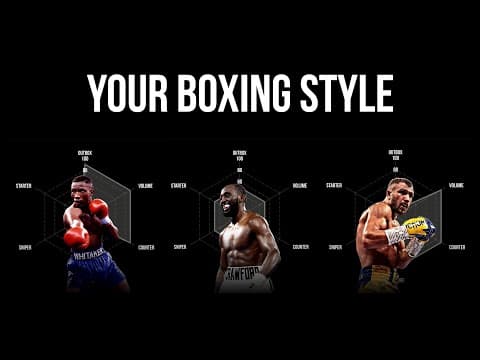
[0:01]Hello Skilloboxers. You've probably heard of the main boxing styles before. The outboxer, the swarmer, the counter puncher, the slugger. The problem with these definitions is that they only encompass one aspect of a fighter. For example, Floyd is both an outboxer and a counter puncher, while Maidana is both a swarmer and a slugger. Then you have other styles like the switch hitter or the boxer puncher. And you can end up with a fighter that is four different styles at once. Outboxer, counterpuncher, switch hitter and boxer puncher. So we have solved this problem by creating our own modern standard of boxing styles. And stay until the end, because we will show you which boxing style you have. And on top of it, we will give you boxes with a similar style and frame to yours so you can study them and improve your game even more.
[1:06]To give an accurate description of a style, we identified three main areas that define a boxer. Ring movement, punching style, attack dynamic. By establishing these three key areas, we will have our eight different boxing styles. Let's break them down. Ring movement. Ring movement determines if the boxer moves mostly forward or backward. Obviously, no boxer moves only in one direction. But this refers to what the boxer is more comfortable with and whether he will push to move forward or allow the opponent to come in. For those who usually move forward, we'll label them as pressure boxers, and for those who usually move backwards, we'll label them as outboxers. Punching style. Punching style determines if the boxer focuses on landing really precise and clean punches, or on landing as much as possible. This refers to the punching style, not just single or combination punches. For example, a combination puncher can throw them in isolated, quick and sharp attacks. But he can also throw them in a constant swarming pace. Those who throw single isolated punches will be labeled as sniper punches, and those who focus on constant punching will be labeled as volume punchers. Attack dynamic. The last part determines if the boxer leads the action or waits to counter it. Again, the dynamics always change. But this refers to the fighter's preference, and if he is more comfortable leading the exchanges or waiting to catch the opponent. Those who like to lead the action will be labeled as starter punchers, and those who like to react to the attacks will be labeled as counter punchers. With these three concepts, we can define a boxer's style much more accurately. So let's go ahead and start with the first style. Outboxer, sniper, counter puncher. This boxing style has great lateral footwork and knows how to change directions and use their legs to circle the opponent. They usually have quick feet and great balance. They feel comfortable simply moving around and they don't panic when pressured. The way they see the fight is with clear attack moments. They are always looking for the perfect shot to land clean and don't mind spending time without throwing. That's why sometimes, for the casual fan, it can be a boring style to watch. But they are also some of the most skilled boxers. They usually let the opponent take the initiative and wait for their moment to attack. They usually fight in spurts. They thrive on their opponent's aggressiveness as they look to accurately counter them. They make you chase with their footwork, wait for you to throw, and then catch you with a quick counter looking to put you down. Outboxer, sniper starter puncher. Same as before, they have great footwork and especially great ring generalship. They use their footwork in an intelligent way, often feinting a lot and keeping the opponent at bay with the threat of an attack. Their attacks usually come out in singles and short sequences, and their jab is often their most important punch.
[5:08]They use it to keep you at bay and not let your offense get going, constantly breaking your rhythm.
[5:22]They like to be the ones to start the attack, instead of countering, they prefer to not let you even get the chance to attack or breaking your rhythm. Whenever they are not the one attacking, they usually will cut the opponent's momentum by clinching. They confuse you with their footwork and frustrate you with their jab, not letting you get close even for a second. They like to be the ones to start the attack, instead of countering, they prefer to not let you even get the chance to attack or breaking your rhythm.
[5:49]Pressure, sniper, counter puncher. Contrary to before, this boxer feels most comfortable going forward. They usually have a great high guard or a greater bobbing and weaving. In either case, they developed the skill of moving forward safely. They want the perfect shot, the shot that will put the opponent's lights out. They sometimes will move forward without throwing for long periods, as they want that perfect shot. They sometimes will move forward without throwing for long periods, as they want that perfect shot. They sometimes will move forward without throwing for long periods, as they want that perfect shot.
[6:54]When you try to back them up by throwing, they catch you with a sharp counter.
[7:02]Pressure, sniper, starter puncher. In this case, instead of pushing their opponents by covering up and getting under shots, they do it with their demeanor and lead hand. They usually have a long reach and use their lead hand to occupy space and push their opponent back. They often have heavy hands and the threat of their power also makes opponents retreat. They look for big power shots. They may use the lead hand to measure or put traffic, but their intention is to strike hard with their punches. They like to push the pace and be first, starting most of the attacks. They slowly but steadily keep pushing the opponent back, not so much with their footwork, but with their power punches. That's what backs the opponent up.
[8:07]These boxers intimidate their opponents one power shot at a time, making them slowly retreat until they have no escape. Outboxer, volume starter puncher. This boxing style relies on really good cardio, as it applies constant movement around the ring while punching. They usually combine both their footwork and their punches in a synced and coordinated way. Many Soviet boxers can fit into this category.
[8:42]In this style, we are talking about boxers whose punching style consists of a constant pace throughout the fight. Their way of attacking is focused on hitting the opponent as much as possible. They will move around the ring while throwing their jab, always throwing without stopping. They will not allow the opponent any breathing room, targeting them constantly to make them reset again and again. This style of boxing is very energy draining, but very effective too. They will move around and pepper you while you try to get to them, constantly tagging you without giving you the slightest opportunity to get your offense going. Outboxer, volume counter puncher. Same as before, this boxing style is very draining, as it requires constant movement of the feet and also a constant punching output. This type of boxer usually maintains a more snapping, less committed approach to punching during the bout. They often whip their punches and can throw them loosely from a low guard. However, contrary to the previous style, they are looking to counter instead of starting the action. This constant volume of punches is mainly used to keep the opponent on the outside, but also to bait them into throwing. When they do, the low key and constant way of punching suddenly changes to a fast and punishing counter attack. They move around the ring tagging you, tagging you, tagging you again until your frustration drives you to attack recklessly, and that's when they catch you. Pressure, volume, starter puncher. They thrive by backing their opponents with constant pressure. They just know one way, and it's forward. While they presssure, they keep a constant pace. They are relentless in their punching, and oftentimes, these boxers carry some natural heavy hands. They are economical and constant with their offensive output.
[11:16]They don't let the opponent off the hook for even a second. They like to start every exchange and break their opponent's little by little. They suffocate you with pressure and punch you without stopping, breaking you down slowly but deadly. Pressure, volume, counter puncher. Same as the boxers before, they feel more comfortable going forward and pushing the pace. They also like to punch in volume, keeping a consistent output throughout the whole fight. However, and this is the biggest difference, while they keep a constant punch output, they are really mindful of their defense and are actively looking for counter opportunities. In fact, their punch volume often acts as a way to bait their opponents into throwing to then counter effectively.
[12:33]They push you back while constantly tagging you, but when you try to turn the momentum, they were waiting to receive you with a sharp counter. Find out your style. Now, what we just looked at are archetypes. However, most boxers don't have such a defined style and will probably be more neutral in some areas. For example, Floyd usually likes to start the action and keep breaking his opponent's rhythm with that stabbing jab. But he is constantly looking for counters too. Now, something similar may happen to you. That's why we have prepared a questionnaire for you so you can find out exactly what your style is. Once you fill it out, we will send you your personalized results within a day, including the fighters that have the most similar style so you can study them and improve your game even more. Once you have filled out the form, come back to the comments and let us know what you think the results will be.


