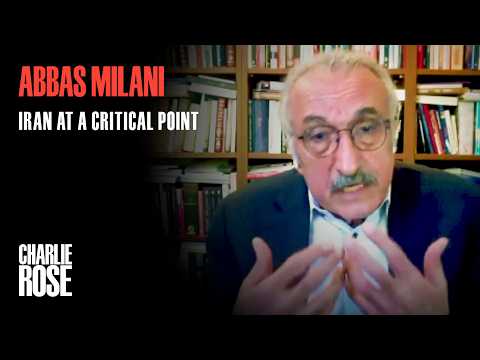
[0:00]We are at a very dangerous point, uh in a sense, because I think uh militarily the Iranian regime has clearly, I think, lost the war. But they haven't uh lost their ability to do damage to the neighbors, to the international uh commerce, uh and to the people of Iran. Uh and how this will unfold, I think, will have a great deal to do with the future of not just Iran but the entire Middle East.
[0:41]Professor Abbas Milani's life and scholarship uniquely position him to understand Iran. Professor Milani is an Iranian-American historian, author and educator whose career has been devoted to studying the political and intellectual history of the country. He is the Hamid and Cristina Mogadam director of Iranian Studies at Stanford University and is a fellow and co-director of the Iran Democracy Project at the Hoover Institution. Professor Milani experienced the tumult of Iran firsthand. He was imprisoned under the rule of Muhammad Reza Shah Palavi and later banned from teaching after the rise of Ayatollah Khomeini. In 1986, he left Iran and built a distinguished academic career. He has written several major works on Iranian history and politics, including his widely acclaimed 2011 biography of Muhammad Reza Shah Palavi. This is a defining moment in Iran's future as politicians, soldiers, and strategists try to understand the survival of the regime, the aspirations of Iranian society, and the trajectories of political change. Our conversation will explore many questions, including what is happening on the ground, the intent of President Donald Trump, and the strength and vulnerabilities of the Iranian regime, the strategic thinking of its leadership, the evolution of Iranian society and opposition movements, and how external pressure from sanctions to regional conflicts are shaping Iran today. I'm pleased to welcome back Professor Abbas Milani. Professor Milani, thank you for joining us. It's a pleasure to have you back. It's always a pleasure to speak with you, sir. Where are we in the Iranian war? We are at a very dangerous point, uh, in a sense, because I think, uh, militarily the Iranian regime has clearly, I think, lost the war, but they haven't, uh, lost their ability to do damage to the neighbors, to the international, uh, commerce, uh, and to the people of Iran. Uh, and how this will unfold, I think, will have a great deal to do with the future of not just Iran but the entire Middle East. We'll talk about all of that, but tell me what factors are at play at the moment? Domestically, uh, we really don't know who is running the economy or the, uh, military, except that it's the IRGC. They claim that there is a successor, uh, but there is no evidence that he is even alive. They have issued a statement on his behalf, but, uh, we know nothing about him, his style of writing, his style of thinking. We know about his style of thinking, the style of thinking is similar to what he has said, but the tone is defiant, uh, but to me it's a defiance born out of, uh, frustration and, uh, fear for the existential collapse of the regime. What is the attitude of Iranians who don't like the regime, but also don't like being bombed? Uh, I think, um, uh, their attitude is that now that this war has begun, and now that this regime has, uh, uh, been, in a sense, militarily defeated, uh, if you leave them in place, uh, they will become even more of a danger to both the people of Iran and to the region. Uh, I was against the idea from the beginning that, uh, Iran's nuclear solution, uh, problem hasn't a military solution. But now that the war has begun, and this regime has gone directly threatening the people of Iran, I mean, over the last two, three days, they've gone on television and literally threatened the people of Iran. If you come out in the streets, we'll shoot you, I mean, almost verbatim translating. So they're afraid of what this regime will do to them if it survives, but they're also afraid of the fact that bombs are falling, uh, you know, the death of, uh, almost 200 innocent girls who were in a school. In a school, incidentally, that the IRGC had placed within a military installation, but it's still a school. It was, by all accounts, a mistake that the U.S. made. But these are tragic facts. Should the United States apologize for that? I think if, I, I think, absolutely, they should apologize for it. If, if it is, as the indications are, that it was a mistake, clearly, if there was a mistake, you have to apologize for it. Why not? I, I don't understand. And not apologizing, uh, only serves, uh, the purpose of the Iranian regime and its supporters who say that there is an arrogance of power.
[5:51]What do you think is the strategy and the strength of the regime? As you have indicated, we don't know who is running the government. We don't know who's running the regime. We know that a number of people, including the Ayatollah, were killed in the initial onslaught. I think the strategy, uh, is to me very clear, and it was very clear from almost the first day. The strategy was that, uh, we can't, uh, find win this war militarily, uh, and the only way we can, uh, win it is increase the economic cost so much, uh, and the damage to neighbors so much, from Saudi Arabia to United Arab Emirate, uh, that they will, uh, put pressure on Israel and the United States to stop, and allow us a chance to survive. And domestically, threatened the people that once this thing ends, if you come into the streets, you'll get more of what you got two months ago when the regime literally killed, at least in its own account, 3177 innocent Iranians. The numbers are probably more in the 30,000s, uh, to make sure that they don't come out in the streets. You believe the numbers of people that were killed in the street by the regime was closer to 30,000, rather than 4,000? Absolutely. I, I, almost every credible source that I have, uh, seen, uh, indicates that, uh, and if you go in the past, whatever the regime has admitted to in the past, there are many times where they've gone and these kinds of killing sprees. None as great as this one. The number they always, uh, admit is a fraction of the reality. This is not a regime that believes in telling the truth. If, in fact, the Ayatollah, the son of the Ayatollah, uh, who lost his wife and his father and, and his child, and, and, you know, which is a devastating blow to happen to any individual.
[8:08]Absolutely. He's a commander, the posts they have given to him, and it's very unclear how this committee met to appoint him. Uh, but even, uh, whatever the circumstances, he is a commander in chief. Uh, he's the most powerful person, and for four days, he hasn't spoken. There isn't a picture of him even. There isn't, uh, two sentence that we can credibly say that it is his. And even if they did put voice on, all we have of him, this is remarkable. All we have of this person who is now in charge of the entire country is about two minutes of, uh, recorded part of a class he taught. Nothing else.
[8:55]We have no other indication, and how this guy sounds. And your argument is or your point is if there was something else to be had, it would be had. Absolutely. Absolutely. If they had, if there, if there is a way to present him, they would, and the way they began the story, they began the story yesterday. They said the son of the president has heard from his buddies that he's well. What the hell kind of a news announcement is this about the most important person in the country? Has heard from his buddies that he's well. Well, that is well, that's really the first official announcement of the Iranian regime, and to me that's very suspicious. What is your assumption about the breakdown between support for the regime and support for regime change? Uh, I think, uh, there is some evidence for that. In, we have polls before all of this happened, before this mass killing. 12% of the people, according to the most reliable poll I have seen, wanted the sustenance of this status quo. In other words, keeping this regime, uh, keeping this regime as it is. My guess is that the number is no more than that. I think if anything, it's 12%. That means that 88% would like a change. Absolutely. That, that, I say absolutely because that's the most reliable empirical evidence we have. There are many other anecdotal evidence, uh, many other ways that people have been telling this regime, we don't want this, this structure. We don't have these values that you have. We don't see these these strategic goals you have placed for us. Among the questions that everybody's asking is, why now? What is your guess? What is your evidence of why now? I have a, a sort of a strategic answer and a tactical answer. The strategic answer is that, uh, Israel clearly has been waiting for a weaker Iran to make it even weaker. Because Iran has been threatening the destruction of Israel. And for third, almost 44 years. And Iran had proxies that it could threaten Israel with, in Syria, in Lebanon, in, uh, Gaza. All of those are now gone. And Netanyahu knew this, and knew this is the weakest point for the regime. Uh, the tactical response, I think, in the sense, the tactical reason was that when people took to the streets, uh, President Trump said to the people, go get them, go occupy the, uh, government offices, help is coming. And when the regime went on that killing spree, uh, I think he was put in a position of trying to offer some help. I thought the best help you could offer was to help Iranian people overthrow this regime, rather than the attack, but he, I think, was put in a position, uh, of not wanting to, having, uh, drawn a red line. How could they have helped overthrow the regime other than by an attack? I, I think, uh, now, more and more people have come to the conclusion that that's the only way that they could. Uh, I think, uh, many people think that my view was, uh, uh, too, uh, uh, optimistic in the sense of the popular power of the people. More and more people are saying, we can't overthrow this regime, we need, uh, outside help. I think that is, uh, one of the other reasons that maybe, uh, uh, accounts for why now. This is the regime at its weakest. And if you're going to get rid of this regime, uh, but the danger is that this regime was on record, uh, one of the reasons for my, uh, hesitation was that this regime was on record, that if you attack us, if you put us in an existential threat, we're going to have an scorched earth policy. And this threat was made to the people of Iran, as well as to the international community. We'll kill as many as we need to stay. We'll burn as much of the territory, destroyed, and not give it, give up. Uh, so, uh, that was, I think, the conundrum. They are now after a scorched earth policy, not just in Iran, but around the world. What do you make of the fact that the President apologized for bombing the Arab countries that are neighbors? The President of Iran. Yes, yes. I know, whether the President, uh, apologized and almost immediately, uh, the right wing, including another member of the leadership committee, Mr. Eji, said it's none of your business. Why did you, uh, uh, apologize? Uh, in the parliament, they attacked them, the conservatives, the IRGC, uh, voices attacked him, says, none of your business. This is our strategic, uh, goal, uh, and this alleged statement by Ha Khamenei, uh, junior, uh, clearly indicates that that is, that was, is and will be their policy of attacking anybody, everywhere. Is Ali, Ali Harajani, the most powerful man in the government today? I, I don't think so. I think the most powerful man, as I think you indicated before, is the IRGC. Uh, I think the IRGC is running the show, uh, to the extent that Larajani, uh, is close to the IRGC, and he has been close, uh, he is, um, powerful, but I think the IRGC command structure, uh, and the IRGC intelligence, which are the sources of Ha Khamenei's support, they are in charge right now. A lot of people believe that the President of the United States, Donald Trump, has, has offered a variety of of reasons and a variety of of explanations, so that there is no clear sense of what he intends to do with this massive military power that he commands. I, I think that's a fair, uh, criticism. I, I think many people don't know. And I think that's one of the reasons why the Iranian regime tried to use the tactics that they used, in negotiations, they did use the delaying tactics. They used the tactic of offering him billions of dollars of economic opportunity. They weren't sure whether he was willing to make peace with them, or whether he was bringing the Armada to actually attack them. Uh, but, you know, I, I sense that, uh, uh, President Trump, uh, looks at these things less as, uh, issues of international relations. The way he manages these things is the way he would manage a real estate deal. Uh, if you never know until the last moment whether he really wants to buy this, or whether he was going to walk away from it, or whether what he's saying is an attempt to, uh, lower the price.
[16:29]So, that's what, I mean, to look at it as, to look at statecraft as a real estate deal, as a transaction, is not necessarily a wise policy. No, I, I don't think it is. I think there, there should be more structure. I think there should be the structures of foreign policy, the international order, the national security apparatus that the United States has. Those have to be more, I think, involved and think about all of these things. But I think that's the style of presidency, the President Trump has. He, he does often. And, uh, and, and but the two people he has chosen as his primary negotiators are a son-in-law, and a, a good friend who's also a real estate magnet in New York. Yes, and I'm not, you know, I'm not privy to what the negotiations were, but, uh, clearly, uh, they were negotiating with people who had been doing this for 20, 30 years. They were very adapt at this, uh, game, uh, and whether, for example, at one time, clearly, there seemed to be, uh, Mr. Litkov particularly thought that he could make a deal with this regime, uh, and, uh, based on what he arrived at that conclusion, uh, I am not sure. And to base all of your judgments, uh, on the advice of these two, I think, uh, is a dangerous process. But that's the way he has handled almost everything, I think. And he was elected President of the United States. He was elected the President of the United States, and a majority of the Republicans in this country still believe that that's the right way to do it. What do you think's going to happen in the straight of Hormuz? Uh, my guess is that, uh, they're going to have to, uh, make sure that they open it.
[18:30]Uh, I, I don't think, um, the international community, uh, is going to, uh, be able to, um, sustain, uh, the idea that the Iranian regime can close this waterway anytime it wants. They can't live with the idea, is what you're saying. I don't think it can. I don't think Saudis can. I don't think anybody can. I don't think the Chinese can. So what, what do they do? I think they're going to have to, uh, make sure that Iran doesn't have the capacity to close it. I think that's what they're going to do. That's my sense. And I think they have, uh, the Iranian regime has actually created the international support for this move that President Trump didn't do. President Trump went to this war almost unilaterally with Israel. He didn't have the Europeans on his side. The Arab states at least nominally publicly said they didn't approve of military solution. Now, almost all of them are saying, we can't allow this to happen. We can't allow Iran to unilaterally close the straight of Hormuz. Do you accept the belief that some have that the war will end when Donald Trump feels the economic pressure from the people in America who elected him? I'm sure that's one of the factors. I'm sure that's one of the factors. He is always very sensitive to what his base is, and there's dissensions within the base. But I think the dimensions of the crisis, the dimensions that it has taken is going to force him to think not just about electoral results, but the global, uh, challenges that he has. Uh, the dealings with China, for example, the dealings with the rest of the Persian Gulf states, the Europe, uh, Russia. All of these things, I think, are now very much on the table. You know, in in some strange way, you could ask yourself, who's winning? The Russians are winning because the price of oil is is much has risen over 100, if not there now. And it provides them the revenue to do to continue the fight. Absolutely. I think the Russians, uh, are the, at least, the short-term winners, uh, uh, country that is fascinating to watch, uh, and who I think is very wise in the ways of, uh, geostrategy, are the Chinese, who are staying out of this, uh, who, Where do you think they're, where do you think they are? What do you think their, what is their reasoning? I, I think their reason is clearly that they don't think this regime can survive. Uh, I, I think that's their long-term strategic view, and if anybody was watching, that's what they have done. Iran offered them a remarkable deal a few years ago. They didn't take that deal. They went to Sanjo, they took it, they normally took it, but they, that went and signed a very lucrative deal with Saudi Arabia, $400 billion deal with Saudi Arabia, and, uh, supported virtually every demand that Saudi Arabia had about the regional politics. In order to have access to oil. Access to oil, access to capital, and, uh, you know, China has a million balls in the air. Uh, association with Iran gets them almost nothing other than trouble. That's why I think they've decided to stay out of this, uh, and, uh, you know,
[22:03]Uh, the Russians have also virtually stayed out, uh, but the Russians are more deeply into this regime. Uh, nobody talks about how deep the Russians, for example, are into Iran's intelligence. Everybody talks about how Mossad is deeply into this intelligence. What about Russia? How deep are they? What do we know about their presence? What do you think and what are the consequences of that? I think there, if you again, look at it historically, Russia has been trying to get a foothold in Iran for 200 years. Now they have that foothold, and to think that Russia will try to infiltrate every intelligence, every political sphere anywhere in the world, but none in Iran, uh, requires a kind of a naivete that no Iranian that I know of has. What questions are you asking? Well, people in Iran, the question that I'm trying to ask is, how's life? Are they safe? What do they think? Do they think the war should end? Uh, but my strategic question is, uh, what is the end game for, uh, the, uh, United States? When is it that they're going to decide to declare victory? I think right now the situation has become so complicated that, uh, if this regime survives, it will be a victory for them, and it will embolden the more radical elements within the regime.
[24:27]So they cannot be allowed to survive. I, I think so. I, I think there's no, uh, you know, uh, there were an attempt, there was an attempt, uh, by some within the regime, who recognized that the game is up. A few weeks ago, and they tried to reach, I think, the Trump administration and say, let's make a deal. But everything that has happened has made that possibility impossible. Uh, the people, uh, within the regime who went on record saying, Mr. Ha Khamenei, you have failed in every policy. Let's try to make a deal with the US. They clearly send messages to the Trump administration in articulation. I don't know about the back rooms, but in what they were saying, right, uh, Rohani, literally, was putting himself up as a candidate to make that kind of a deal. They absolutely with the killing of several thousand people, and then with the beginning of the war, both of these made that solution, uh, the solution of a transition to a more democratic Iran without a war almost impossible. What's the likelihood of a civil war? I, I think the likelihood of civil war exist, unfortunately. I, I don't think, uh, uh, it's the very high, but it exists. And I think, uh, the announcement that the US might arm, or Israel might arm, or together might arm, uh, Kurdish groups to come into Iran, Iraqi Kurdish groups, I think, might well, uh, begin a civil war. But if that happens, uh, civil war is not going to live be limited to Iran, because Turkey has a Kurdish problem, Iraq has a Kurdish problem, and if you get all of that into the mix, you're talking about very convulsive, uh, Middle East. What's the possibility of a war, a wider war that would bring in so many different nations with different interests? I think that possibility, uh, is very little. I think this regime can be a nuisance, but it can't be a military threat to anybody. It isn't. It isn't a military threat. I, I think the regimes military is deeply, deeply, uh, weakened. It still has the capacity for violence, both regionally and domestically.
[27:01]Uh, but it can't be, uh, the source of, for example, a global confrontation unless countries like China and the United, uh, Russia, for example, decide that they've had enough, they're going to come in. I don't see that almost as any possibility. Finally, give me a scenario that you would hope for and that you think has a possibility. Uh, the scenario that I would hope for, and has a smaller possibility today than few weeks ago when I had more hope for that, is that, uh, more people from within the regime, even the IRGC, recognize that this is a futile war. That they're going to have to kill thousands domestically, and destroy the Iranian infrastructure, and the Iranian economy if they want to survive, and say, enough is enough. We'll make a deal. We'll make a deal. We'll give up this stupid path, and we'll try to save, uh, Iran. And keep some, some of some part of proud power. Uh, you know, if I was, uh, part of the, uh, the leadership of an opposition, and I'm not, but I would absolutely make that deal. I, I would say, go outside like, uh, like, you know, dissidents in Chile made a peace with Pinochet, like the dissidents in South Africa made a peace with Africans, saying to them, you can't rule, we can't dislodge you. Let's see if we can save the country. To me that would be the ideal. What do you think about the possibilities of the former Shah's son? I think he is the most popular right now to become the symbol of this kind of a transition. Some of his, uh, followers, uh, think of him as, uh, the next king. I, I, I think in that, uh, mode, his possibility of leading this transition becomes less, but the notion that, uh, I represent, and he does, he's the most popular amongst all the others, still is about 35% popularity, uh, at nobody else even comes close to them.
[29:24]Uh, but he has that, and he has some, uh, international support, some countries very much approve of him. He can be the transitional symbol of this, or the symbol of this transition. Uh, but again, with every passing day, uh, and more violence, uh, I think the possibility of my optimum hope becomes less because, and what's the future of radical Islamic fundamentalism?
[29:52]In Iran, I think it's zero. I think radical Shiism in Iran is already dead. Again, if you look at some of the polls, if you look at some of the social media, uh, if you look at Panahi's most recent film, political Islam, Ha Khamenei, Ha Khamenei little Khamenei's version of radical Shiism is dead. I think, uh, even radical Sunni is a nuisance right now. The future of the Middle East in my view, uh, is much more likely to be a future of the Middle East where Abrahamic Accord are going to be determining the relationship. If, if, and I hope very much that happens, if Israel accepts the two states solution. That won't happen unless there is a state for Palestinians. That will come, I think, because I think that's the only map that will allow the future of the Middle East to realize all of its potential. In Iran, uh, I think political Islam, radical Islam, uh, is, uh, is, uh, is dead. Iran is more secular today, I can say with some certainty, uh, than any Muslim Middle East country, more profoundly secular, more profoundly believing in the need to separate religion from the state. Are the people of Iran, the people of Iran, uh, as pro-American as any Persian Gulf or Middle Eastern country? Uh, that, it certainly, that was certainly the data we had before this war, uh, I, I don't know whether it has changed. I, I haven't seen too many death to America signs in the streets of Tehran in the demonstrations, for example, in after the 12-day war. Uh, I think that is true. I, I think, uh, uh, the Iranian population is probably, uh, with the exception of, uh, Israel, uh, the most favorably inclined towards America in the Middle East. This is very self-serving on my part, but would you tell my audience here the great story of the Iranian filmmaker and poet, uh, who you saw in London, and what he said to you. Um, yes, the name is Ibrahimi Golestan. Um, he is, uh, arguably one of the most towering intellectuals of 20th century Iran. He's a filmmaker, he was a writer, he was a critic, he was an art collector. Uh, his papers are now at Stanford. He was a very dear friend of mine, uh, for many, many years. One day he called me and he said, uh, you know, I've been watching this show. This is really a brilliant show. It's the Charlie Rose. You should watch it. At that time, I already had had the pleasure of being on your program a couple of times. I said, uh, Sir Golestan, I know everybody in America knows Charlie Rose. He's the most important, uh, talk show and I've been, uh, on his show. And I don't think of all the things I said to him, anything impressed him more than hearing that I had been on the Charlie Rose. I just love that story. I mean, I just love the story because I mean, someone being excited about the little work that I do, uh, and not knowing, not knowing anything about it, other than his own personal reaction. His own personal reaction, and he lived in outside London. He lived a fairly, he was dedicated to his reading and writing and, uh, and above all, and he was very peculiar about the shows he watched. Uh, he had extreme, uh, aesthetic sense, and he was just blown away by it as as, I think, millions of people were in America. Thank you for allowing me to indulge that, uh, because it's just one of my favorite stories. Um, thank you for joining us. Um, I'm certain I will come back to you, um, as we watch, you know, and see what the possibilities are and and you have always been a most responsive, and I thank you very much for that. It's always my pleasure. Join me, become a subscriber to Charlie Rose Global Conversations and make it a better experience. Click this link to subscribe.


