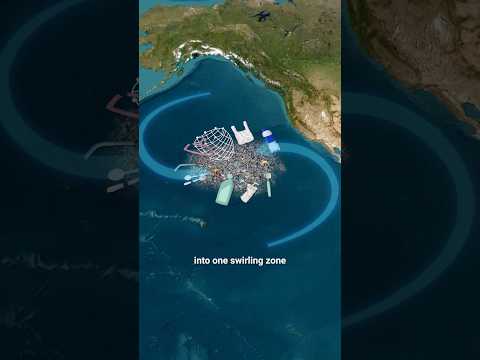
[0:00]Did you know there's a massive floating island in the Pacific Ocean between California and Hawaii? It's called the Great Pacific Garbage Patch and it's made of millions of tons of trash. But why is it there? And why can't we just clean it up? Well, it's not on any map. You can't see it from space because it's not land. It's plastic bottles, fishing nets, toothbrushes and other debris all pulled by ocean currents into one swirling zone. Today it covers 1.6 million square kilometers, that's twice the size of Texas. Moreover, there are five of these giant garbage patches across the world's oceans. But don't picture an island you can walk on. It looks more like a murky plastic soup. Over time the big stuff breaks down into tiny pieces called microplastics, which end up in fish, birds, our food, even the air we breathe. So why not just scoop it up? We're trying, but cleanup systems often catch marine life along with the plastic. And with so much of it spread out or sunk to the seafloor, the job is massive and slow.
The Great Pacific Garbage Patch Is Not What You Think It Is 🤯
Geo Bytes
1m 1s186 words~1 min read
YouTube auto captions
Transcript source
YouTube auto captions
This transcript was extracted from YouTube's auto-generated caption track. The transcript below is server-rendered so it can be read, searched, cited, and shared without opening the original YouTube player.
Pull quotes
[0:00]Did you know there's a massive floating island in the Pacific Ocean between California and Hawaii?
[0:00]It's called the Great Pacific Garbage Patch and it's made of millions of tons of trash.
[0:00]It's plastic bottles, fishing nets, toothbrushes and other debris all pulled by ocean currents into one swirling zone.
[0:00]Moreover, there are five of these giant garbage patches across the world's oceans.
Use this transcript
Related transcript hubs
Watch on YouTube
Share
MORE TRANSCRIPTS


