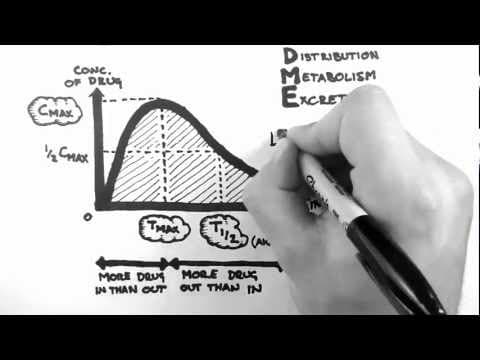
[0:04]Hi, this tutorial is the first in the pharmacokinetics series. So first of all, I should talk about what pharmacokinetics is. Within pharmacology, we often talk about two distinct, but unfortunately unintuitively named branches. These are pharmacokinetics and pharmacodynamics. Briefly, pharmacodynamics is the study of the effects of drugs on the body. That is, what does this drug do to the body? What receptors does it activate? And what other effects does it have? Alternatively, pharmacokinetics is the study of the effect the body has on drugs. In pharmacokinetics, we ask questions like, how does the drug get into the body and where does it go? What does the body do to the drug? And how does the body get rid of the drug? It is this branch of pharmacology that we will be looking at in this series. So let's begin with the pharmacokinetics acronym you'll find in every textbook of pharmacology. ADME. This stands for absorption, which is how the drug gets into the body. Distribution, which is where the drug goes to in the body. Metabolism, which is how the body chemically modifies the drug. And finally, excretion, which is how the body gets rid of the drug. These are four elements we need to consider when talking about the pharmacokinetics of a certain drug. The following tutorials will each talk about a certain aspect of pharmacokinetics. But for the remainder of this tutorial, we are going to discuss some of the more boring, but incredibly important aspects of pharmacokinetics and pharmacology. So I'll begin by drawing a graph. And here on the Y-axis, we have the concentration of drug within the body. And on the X-axis, we have time. So if we give a person a drug at time zero, then we will see the concentration of the drug go up. And then it will fall slowly as the drug is removed from the body. And that's what we see on this graph.
[2:44]So looking at this graph, we can see that in this section, the drug enters the body faster than it is being removed from it. Therefore, the concentration of the drug in the body increases. Then after the peak of this graph, the drug is being removed from the body faster than it is entering. So the concentration of the drug in the body starts decreasing. This point at the top of the graph is important because it is the highest concentration of drug in the body. Therefore, we call this the maximum concentration or Cmax. This is important because knowing the maximum concentration can help project the therapeutic benefit and also the likelihood of side effects. The time at which the maximum concentration occurs is called T-max. Now a slightly more confusing concept is the half-life of a drug. The half-life is by definition, the time it takes to remove half of the current concentration of drug from the body. So let's consider the half-life on this graph. If we begin at T-max, we want to see how much time it takes for the concentration of the drug to decrease from C-max to half of C-max. So here is the half C-max line here. And therefore, the half-life, which is often denoted T half, is the time between T-max and where I've drawn T half here. So just to summarize, the time it has taken for the drug to drop from its maximum level to half of its maximum level is the half-life. On this graph, this is the time between T-max and where I've drawn T-half. There's a lot more to talk about with half-lives, including rate laws and orders of reactions. But that is beyond the scope of this video, so we'll talk about that in a later tutorial. The last thing to look at is the area under the curve. And this I have illustrated by shading in the space under the graph. This represents the total exposure to a drug that the body receives. This is a function of how high the concentration of the drug gets, as well as how quickly it's excreted. And that's an introduction to the basics of pharmacokinetics. In the next video, we'll look at routes of drug administration and how different routes can affect C-max and T-max. If you've enjoyed this tutorial, please help us produce more by making a donation at www.handwrittentutorials.com.


