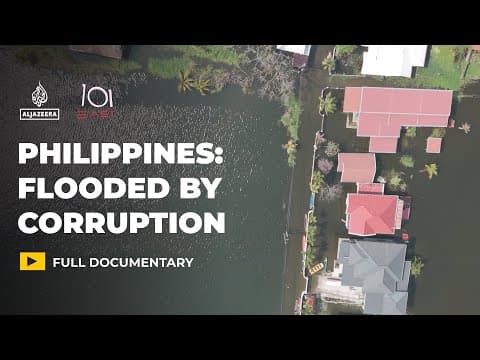
[0:03]Natural disaster prone Philippines is facing its biggest corruption scandal in history. There needs to be accountability for the massive damage and corruption that has occurred. Billions of dollars meant for flood management have been stolen by contractors and government officials. You're appalled, you're angry, you you know, it's really unbelievable to be quite honest. Meanwhile, ordinary Filipinos are left to suffer. It's getting worse every year. Citizens are furious and taking to the streets, led by the youth. We share one anger over our future that has been previously stolen. This corruption scandal will actually make or break his presidency. 101 East investigates how the most vulnerable in the Philippines are being flooded by corruption.
[1:12]37-year-old Ryan Manalo is an insurance agent who lives in the town of Kalumpi in Bulacan Province. This your boat? Yes, ma'am.
[1:23]Just north of the Philippines capital Manila, frequent typhoons cause Ryan's neighborhood to be flooded for six months a year. Do you do this every day? Yes, ma'am. Every day.
[1:35]It's really difficult here in our area because you need to ride a boat every time you go out. Every day we have to bring our children to school. It's twice as hard for those who go to work because they get soaked on their way to work and then again when they come home. The water here rises to almost six feet and above. Ryan was born and raised here, but many of his neighbors have since chosen to leave. He and his wife and two young daughters have no choice but to live on the first floor of their home to escape the water. When we were little, the flood was only three to five days a year. As kids, we used to run all over. We'd play in rice fields. But over the decades, the flood started lasting up to a month. Eventually, we couldn't use the land anymore.
[2:40]That's why I bought the children life vests because it's so risky. Do you wish you could move somewhere else? If you asked everyone here if they'd like to move, I think they'd say, "Yes."
[2:55]The question is, do we have the money to move? The Philippines is one of the countries most at risk from the climate crisis. And Bulacan is among its most flood prone areas. While it's received the highest budget for flood control projects of any province in the country, Ryan says it has made no difference to their lives. You can't help but wonder, is this the worst it will get? Or will it become much worse next year if we don't have effective flood control projects in our area? Every year, Calumpit is all over the news, but we are not...
[3:40]Sorry. Why does it make you sad to talk about it?
[3:48]Because it feels like we're being neglected.
[3:55]You feel neglected by the government? So much.
[4:02]Ever since I was a child, we've been promised that the flooding would be gone. But it never happened. It just gets worse and worse.
[4:17]The flooding is exacerbated by the Pampanga River that runs through the province. When it overflows, surrounding villages are submerged. Since President Ferdinand Marcos Jr. took office three years ago, His government has allocated more than 9.5 billion dollars across nearly 10,000 flood control projects around the country. About 700 of those are here in Bulacan. Now, the province is in the center of a massive corruption scandal. This is one of the most infamous flood control projects in Bulacan. The government allocated 1.3 million dollars to build a river protection structure. Despite official records stating it was completed in 2023, the material used was of such low quality that some sections are already deteriorating. A government engineer has since confessed that every single infrastructure project in this entire district was sub-standard because the funds were stolen. Just up the river, Ryan shows me another project. A dike, worth 1.6 million dollars, meant to prevent overflow. It was marked as finished, but 200 meters of it was never constructed. The flood control barrier they made is high, but it's cut off, which makes this whole flood control project useless because the water can just enter from here.
[5:52]Aside from incomplete and sub-standard structures, further audits have shown that hundreds of projects across the country marked as completed on paper were never even started. The corruption scandal came to national attention when the president raised it in his annual state of the nation address, triggering hearings and investigations. Let's stop pretending. The entire public knows that there is racketeering in the projects.
[6:27]So to those who are conspiring to take the public's funds and steal the future of our citizens, have some shame before your fellow Filipinos. From 2016 to 2025, it's alleged that lawmakers, government engineers, and auditors colluded with contractors to pocket billions of dollars of taxpayers money meant for flood control. They received kickbacks for securing project contracts, sometimes leaving just 30% of the budget for the actual construction. Dozens of government officials now face allegations of corruption, all deny any wrongdoing. How does it make you feel when you personally see projects like these? It's truly infuriating. I hope they all go to jail and be gone. That's the best thing that can happen to those who stole from the government funds.
[7:27]As the scandal grew, President Marcos Jr. replaced the head of the Department of Public Works and Highways, or DPWH, The agency in charge of the government's infrastructure projects. Hi, Natasha. Vince Dizon is the freshly appointed leader who now faces the monumental challenge of cleaning up the organization. How did you feel when you were tapped to head the DPWH, which is described as one of the most corrupt government agencies in the country? Overwhelmed. I will agree with you 100% that it is probably the most corrupt agency in government. It is probably the most difficult and most challenging government position I've ever held. A lot of the problems, unfortunately, that we're experiencing now is partly climate change, but also sadly man-made because of all the corruption that we've seen. And I'm sure this has been going on for decades already. Dizon says the corruption is so systemic, it involves collusion in every step of the process.
[8:33]During national budget deliberations, senators and congressmen lobbied for so-called insertions, which inflated the amounts allocated to flood control projects. It's alleged this was done so there'd be a bigger pot for corrupt lawmakers, DPWH engineers, contractors, and other officials to take home. A lot of the projects that I've actually visited, I asked for a plan. The contractor on site can't even give me, can't even show me a simple drawing of a plan. And I said, how is this even possible? How can a project which will cost upwards of a hundred million pesos, not have a plan? And how did that project get in, even get into the budget, if it doesn't have a plan? So there is a clear pattern from the inception of the project all the way to the execution of the project and to the final payment for that project. And it is a consistent pattern that we've seen. It's so deeply entrenched and deeply rooted, and it involves everybody. You cannot do this without everybody, top to bottom, getting involved. Impossible. And when I say top to bottom, I'm talking about not just bureaucrats or executive officials, but this goes, you know, to legislators, it goes to cabinet secretaries. It goes probably to even people in the Commission on Audit. Tens of thousands of furious Filipinos are taking to the streets to demand accountability. To appease the public, the president set up the Independent Commission for Infrastructure or ICI, Task with probing the anomalies related to flood control projects and recommending charges. Top officials are under investigation. Senate President Francis Escudero was forced to quit. And House Speaker Martin Romualdez, a key ally and first cousin of President Marcos Jr., resigned. They deny any wrongdoing. I'm very glad that I'm uh I was invited to the ICI to share my personal knowledge on the budget process. And of course, any information about the budget insertions on flood control. It's about facts and evidence, and not just political noise or speculation. Can the Filipino public really sincerely believe that higher government officials didn't know? I think whether they knew or not, that's not up to me to say. But this is where I think the wisdom of the Independent Commission for infrastructure comes in. And I think when the President saw and learned about the scale and the breadth and the width of this corruption, I think he said to himself that the only way that cleaning up this process will gain any credibility whatsoever is to have an independent commission. The president is saying all the right things. He has said regardless of who it is, ally or not, he wants them to pay. How can Filipinos trust that this isn't all for show? I think the best judge of the president and all of us, including myself, the president, and all the officials, the ICI, uh will not be based on what they say, it will be based on what they do. And I think the jury is still out there on us. Public anger spiked upon seeing photos of government officials, contractors, and their family members, who flaunted their lavish lifestyles brazenly. I bought this Rolls-Royce because I like that it comes with this umbrella. The interior is Hermes orange. That's the color of Hermes. Much of the frustration is also directed at so-called nepo babies, including children of politicians who show off their worldwide travels and luxury goods online. The controversy has sparked calls for more government transparency, with demands that politicians net worths be publicly available. It's a criminal offense for government officials to provide false information regarding their assets. Every single senator has since released theirs voluntarily, compared to just a tiny fraction of the over 300 members of the House of Representatives. Sir, are you willing to release your SalN? Sir, are you willing to release your SalN? We asked former House Leader Romualdez for his statement of assets, liabilities, and net worth, known as SALN. Sir, are you willing to release your SalN? Sir, are you willing to release your SalN? I will do it at the insistence of the Independent Commission for Infrastructure. While Filipinos await tangible reform amid the flood control controversy, It's Gen Z that's taking matters into their own hands. After the scandal erupted, the House of Representatives is facing a crisis. Many Filipinos have lost trust in this very institution, but there are some who are instigating change within Congress, including one of its youngest members. Congresswoman Renee Co was elected to the house earlier this year. At 28 years old, she is the congressional representative of a political party that advocates for the rights of young Filipinos. I can speak on behalf of many of my friends, many of the youth that this is a tipping point.
[14:17]Now, that we're not simply going back to normal after this, we're not simply accepting that corruption exists, and we just have to live with it. Unlike many of her older peers, Co says that because she considers herself an activist, rather than a politician, she can challenge the system without worrying about her political future. She is one of the few Congress people who have released their net worth. What's the mood been like in the House of Representatives since the allegations surfaced? The tension is high. Yeah. It's bleak and it's unacceptable that the Marcos Jr. administration is proud of what it's achieving.
[15:01]I hope that actual genuine change happens. Do you really think there will be accountability? With how the government is selling it, it's hard to believe. Right now, there's an independent commission on infrastructure, who is supposedly the backbone of the accountability features.
[15:19]But as you can see, the people who are appointed there have ties to different political dynasties or have histories with working with them. That's why we emphasize that the efforts of accountability, it has to come from the people. This issue, it can't die, no. For it to die, it would be a huge disservice, a huge injustice for the communities that were demolished by floods. The injustice has sparked anger among young Filipinos online and beyond. They're channeling their fury into memes, art, and music, all made viral on social media. One of the biggest breakouts is rap group Moro Beats.
[16:06]In September, the group released a song which they say is their message to corrupt government officials. Their video has garnered over 10 million views on social media. A thief in a suit, a vile creature. You have taken advantage of the money of our people. Truly heartless and soulless. They make this country suffer. Thousands of our people, starving and poor. It's a shock you can sleep soundly despite this. The sickness of greed is a sickness of humanity. Freedom remains far from reach.
[16:41]Hi! Hi! Moro Beats rap about social issues afflicting the country. Members include 22-year-old Fatiha Buni, her 25-year-old sister Alia, known as Miss A, and 34-year-old Kristel Hallelujah, who goes by prophecy. How did you first feel when you heard about the flood control corruption scandal? So for us, as younger people, we are so frustrated and we are so mad, but the we can only limit ourselves by expressing it through our songs. And that's the best we can do to like express how we feel about the issue. If you were to speak alone, right, if you were to go outside and I had like a megaphone, I'm like, hey, guys, let's protest, let's protest. No, it's not going to reach that much people and they're going to look at you like you're crazy, but if you do it with a beat and a little bit of rhythm, you know, it reaches more people. The group says the national protest was a defining event for them and that they hope to continue the momentum with their music. It was very emotional because we felt the anger. We felt the emotions that were with with our people.
[17:58]I could see they were almost in tears because it was really that that raw emotion that captured everything. And you felt the power.
[18:10]Producer Muhammad Bansil is known in the hip hop scene as DJ Med Messiah. He founded Moro Beats and is Miss A and Fatiha's father. These are the next generation. If they don't speak, who would follow them? They're next. They know more, they speak up more, they're more blunt. You know, at first, even me, I said like, oh man, there's no hope for this next generation because they like TikTok and all this, but you know, once you see them like really focused on a topic and then when they get angry, they're really researched.
[18:47]For me, I don't want people to idolize them. I want them to research about what they're saying. What is your message to the Filipino youth? I would say keep speaking up and keep yourself vigilant and aware. Let's fight for what's ours because if we don't fight for this, nothing will happen. The truth is, what's happening now, this is it. This is the revolution we've been waiting for. Let's do this. We've started. Let's just keep going. Let's go. Political observers agree that Filipinos' anger this time around feels different. Jean and Sina's Franco, a political science professor at the University of the Philippines in Diliman, believes the crisis is the defining issue of the Marcos' presidency. Corruption has long been a problem in the Philippines. Why do you think this particular scandal has struck a chord among everyday Filipinos? Well, I guess the the sheer amount of money, we're talking about billions here, that's one. The audacity of the alleged perpetrators to commit this huge Mexican cartel like corruption scandal. And also the, you know, their collusion with other members of the bureaucracy, other politicians and also how it was presented before the public in a very visual manner for instance, the memes that were devised by by ordinary netizens, the profligacy of the so-called nepo babies. But also, they are beginning to understand how corruption can actually affect their daily lives. Who do you think is the most guilty? For me, it's the public officials, of course, because public officials, especially the politicians, they are the ones who took an oath of office to protect the people's interests, to uplift the poor from poverty, to make our lives better. But, you know, they just made their net worth higher. The professor also believes that the president revealing the corruption was a damage control strategy. And how he deals with the scandal will ultimately shape his legacy and impact the future of the country. He probably already knew the scope of this and he's afraid that it might boomerang on his administration. And politically speaking, I think he also wanted to change the narrative. Ultimately, the box stops at the president. And it's precisely why he probably had to be the whistleblower of all these, these scandal. What do you think the government should do to regain the trust of Filipinos? I guess the so-called big fish has to be put to jail, not only the contractors. If they happen to be the people closest to him in blood and in politics, he should exert every effort that they should be put to jail. Until that is, um, done, it's very difficult for the Marcos administration to claim that they've changed the narrative of, of, of the Marcos regime. What opportunity does the flood control corruption scandal present the government? Well, it's a very good opportunity to once and for all inform the people, inform the entire world, that the Philippines has had it with corruption. It's also important how politicians, elected officials conduct themselves while they are in office, including being transparent and being accountable to the citizens that actually catapulted them into office.
[22:52]This corruption scandal will actually make or break his presidency. It's young Filipinos who are working to ensure the issue isn't forgotten. Every Friday, university students from across the country have been walking out of their classrooms to protest the ongoing corruption. Today, it's 20,000 students from Manila's Polytechnic University of the Philippines. As Gen Z, we'll be the next generation to take hold of this society. We'll ensure that we fix this, not only in the way of long-term reform, but also by taking to the streets, speaking out and demanding what we rightfully deserve. They should be scared of us because the youth movement in the Philippines toppled a dictator once before, the father of President Marcos Jr.. Among those leading the charge today is Congresswoman Cole. Put the corrupt in jail! The hope of the country! The youth! The hope of the country! I am comforted. I am excited. I am heartened by all of the students that have come out here today, with the understanding that uh it is in our hands. Look at all these people here despite the rain, isn't it so ironic that there's so angry about the flood control corruption, and it's raining? Exactly. And this is the great irony of it all. Um, the weather, the conditions constantly prove that what we're doing is right. The challenge for us is to sustain this momentum. For some, however, it may be too late. The corrupt just pampered their own families. They're the only ones who benefited. So many of us are drowning while they're living the good life. Our life today would be so smooth if those billions were put in the right place.


