[0:03]I'm really delighted to have you all here. Thank you very much for this full house. And um, yes, I would like to start very quickly with a short introduction and you will see it's a kind of study we conducted and it will show you how we structured the day today. And um, how we get into the details of the day. So first of all, um, this is just the program. You will find it also online. We had some, some differences, um, to the first program because we had to change a little bit, um, coming from the, um, situation specifically also from the, um, Iran war. And so, therefore we have very few changes, specifically in the afternoon time with the cruise track. All the other, all the other points will take place today, and I'm very happy to have all these speakers with us today on the stage. First of all, I would like to introduce or to start the day with a short study we conducted, um, for PayPal. And this is a very good point, a very good, um, very good, um, starting point for today to show what we have, um, on this track today and what are the big topics we have to, we, we want to discuss today. So first of all, what we are presenting is a PayPal study. We conducted this year and, um, you will see this possibility for download, a white paper. This is a white paper talking about the entire industry situation. So what we see, first of all, we had the figures compared to 2023, 24, um, compared with the year 24, 25. And it's a really good message for the all, for the whole, um, industry. We have a growth in revenue, that's great. 6% plus and, um, we have, uh, 23.3 billion revenue in Euro, um, and the entire touristic year. We also see, um, uh, million travelers, 22.6 million travelers, but you will see the number did not rise as the revenue. And this shows us, um, not so many travelers are, um, in the industry back, um, since the time of Corona. So what we have to think about in the entire industry is how do we get the travelers back, um, to travel and back to do, um, holidays. And therefore, we also see what is the reason perhaps why we don't see so many travelers. It's the increase in prices. So we have 11% increase in the prices for the entire travel products. And, um, this is, uh, something like 1,080 Euro per, um, person spending in the entire holiday season. This means, um, the catch-up is not since, since Corona is not longer visible.
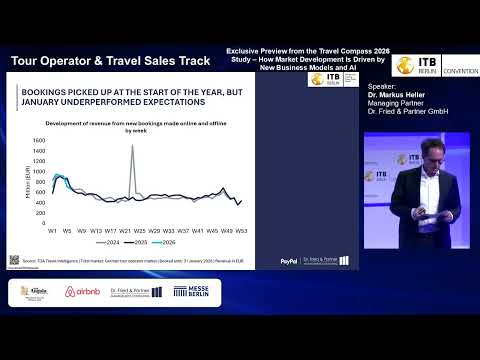
[3:17]So we are eager to to the time before Corona, um, and we also see there is a very strong growth in the, in the higher segments, in the higher price segments. Um, and this is what we see on this picture, on this graph. Quite interesting, we see the industry performing during the years 24, 25 and now 26 with the light blue. And, um, what we see, the industry is back, and just for your for your information, what is the light gray topic, it's the insolvency of FTI in the year of 2024. And in this time, we had a huge number of rebooking. So therefore, this is, um, the booking scale and this shows us how the bookings went up in that year. But as you see over here, in this slide, um, the, uh, the, the beginning of the 2026 is quite okay, but it's not as good as, uh, in the years before. Nevertheless, in the in the year, um, 2025, we had a very good booking situation in the end of the year in November and December. And therefore, in all in one, all in all, we are quite, um, pleased with the situation in the market right now. Coming up, we don't know exactly what's going to happen, um, with the beginning of, uh, the Iran war. So therefore, we all hope, um, that we can move on with a good industry. Um, yes. So what is, what did we see? We see one point is, um, 5% decline in bookings. This is what we see in comparison to 2024. We also see a declining importance of, um, the January as an early booking month. So we saw that the booking started in the end of 2025 already. And what we also see is the booking activity in January mainly is driven by online bookings. And offline state segment as, um, start of year, so is a kind of stagnant, and what we will follow in the industry is how these bookings, um, come up afterwards. And now we are heading to what we are going to talk today, uh, quite a little bit more often. It's all about AI, as you also know, and all the other stages are also facing IAI, um, topics. And we will, well, and we conducted in the study, um, how will travel will be changing with, um, the AI situation in, in booking situations. So, what we see first of all, 40% of the travel travelers used AI, specifically for ideas and planning AI. And, um, they had very specific questions on bookings and stuff and so this is quite interesting to see in general, the ideas are driven by AI. So ideas about booking, ideas about, um, finding, finding out what I want to do during the next holiday. Another point is, um, the creating of the itinerary, there's also a big issue in AI helping the itinerary, the way I want to to go in on vacation, um, is helping, um, is driven by AI in in several times already. And we also see that AI is used for clarifying questions, um, during the, um, the booking specifically also about the destination. And now, what's also very interesting is it's the comparison of prices. So AI will take over a part of pricing strategies and a part of pricing differentiations. And this is also, um, seen in in our study. All in all, we see that 64% of these customers consider, uh, to use the use of AI as a useful, useful thing. So even if we see that, um, AI is sometimes not very assure and not very safe about the results, we also see two-third of the people using AI are saying they're quite confident and they're quite happy to do so. The study also showed up about the, um, the business models and this is exactly what we are talking right now afterwards. Um, first of all, we see there are airline airline holiday models. These are models, um, in the two operator segment driven by airlines to fulfill the capacity needs. We see also the modern airline distribution. This is also to be a topic point today during the afternoon sessions. It's about the one order that enables, um, one record, and it's reducing let, uh, in in in the end the GDS dependency. We also see a new model, um, for the classic two operators. It's not really a new model, this is going to be the keynote on afterwards, um, very quickly about how our classic two operators changing, um, using AI and using, um, digitization, um, to to overcome with their entire business models. The DMC as a two operator is going to change the, the, the travel world as well, because, um, due to new ways of sales and and new sales channels, um, the DMC will be more and more flexible and more and more in this situation to sell, um, two operator packages on their own. And we see the OTAs as well with a very cute new also approach, um, booking.com started with this a few years ago already. Um, we are waiting for the next, uh, next steps, and these are the steps we will discuss right away in the next discussion point. So, this is a very quick overview on a study we conducted for PayPal. You can always, uh, take a, um, download and you can get the travel compass 2026. It's online now.


