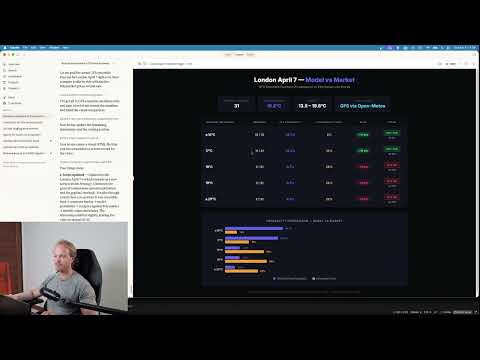
[0:00]What if I told you you could make $50,000 a month, $75,000 a month just predicting the weather? Actually, it's uh, happening right now, and um, people on Polymarket are actually making. So just the last month, we have hand sanitizer made $74,000 predicting the weather. In profit, we have Colmath, $42,000. We have, let's see, Honda Civic $29,000. We have $28,000, $28,000. A lot of people making a lot of money just predicting the weather on Polymarket. And, yeah, if you don't know already, it is possible today to actually bet on what you think the highest temperature for any given day for certain cities will be. For example, if we go to, we can go over here to London. Here you can actually bet what do you think the highest temperature for that day will be, 22, 21, 23 degrees. And it's just like any other binary market. You can buy a yes share, a no share. So, do you think it's going to be 22 degrees? Yes and no. Here, it cost 32 cents. So the implied probability is 32% chance that the highest temperature for that day will be 22. And that's basically the concept between weather prediction on Polymarket. Something people have been talking about for a while now. Even here in Discord, we have a dedicated channel for weather predictions. So we already have a few traders actually trading weather on Polymarket. So it's, it's a thing. And in this video, I'm going to talk about how people are actually doing this. How are they actually making money predicting the weather? Because I think you and I both know that they are not just good at guessing. No, they have certain data sources that they use to their advantage. And that's exactly what I'm going to talk about in this video. And then I'm also going to talk about how you can take those data sources and then actually create automated strategies with a trading bot. Okay, so the first important aspect of, you know, weather predictions and trading the weather is data sources. And this is actually what the, the traders are using. So, we have different agencies around the world, for example, the Global Forecast System, which I think is that's an official agency from the United States that actually creates, creates their own, you know, models, weather models. So this data is actually publicly available, and and it's not just, uh, Global Forecast System that is, but there's also other, for example, a European agency. And I believe that is this one here, the ECMWF, which is also a, uh, an agency that that actually have these very big models that use AI to kind of predict the weather. Now, the thing with these agencies, the data is, you know, it's not real time. The data comes in in certain frequencies. So I believe with these two I just showed you, they they actually uh, release data four times per day. And this is very important to note because this is actually potentially where we can get our edge in our trading strategies. We also have, uh, this one here, Open-Meteo, which is a the accurate weather forecast for any location. So this one is basically an aggregator of different models that you can uh, fetch through their APIs. And it's uh, free to use. The thing with this one is, we kind of in our strategies that I'm going to talk about here after, we need to be fast, okay? So, I I don't know actually how fast Meteo is getting their data from these other models. So, there's two ways you can go about this is, either using an aggregator like Meteo, or you can connect directly with these agencies and their APIs. Alright, so I have Claude here create an example of how we can find an edge that way. So, the GFS have an ensemble forecast. So basically, instead of using the outputs from one model, they actually run the model on different parameters. So you get different results, so that actually means that you can create buckets of predictions and then you basically have the implied probability of the different temperatures. That's kind of the idea behind this. So in this example here, the GFS ensemble forecast have 31 members. And there here we are actually comparing it with the the Polymarket live prices. So with this GFS ensemble forecast, we create all these different buckets, okay? So, uh, less than or equal to 16 degrees, 17, 18, 19, greater than or less than 20 degrees. What these these, uh, this forecast does is all these members of the forecast. So there's 31 members. We derive a temperature that they think the highest temperature for a given day will be, and we put it into these buckets. So you can see here, we have 12 members out of 31. Thinks that the temperature bucket is going to be less than or equal to 16 degree. The next bucket, we have 11 members that thinks it's going to be 17 degrees. And then we have three members 18, three members 19, two members 20 degrees or higher. So from that, we can actually derive the probability from these members. And then, so you can see here, 12 out of 31 is 38.7% in probability. And then when we compare it with Polymarket price, 8 cents, there's actually quite a, a difference, right? 31 points here. And again, we can do it with the 17 degree. So 11 out of 31 members thinks the highest temperature for that, uh, that given day is, uh, 17 degrees. That's an implied probability of 35.5%.
[6:23]And with the Polymarket price of 16 cents, or an implied probability of 16%, we actually have an edge of 19. That's the idea behind it. Of of how we can actually do this. And I'm going to explain a little bit more in detail of these different strategies. So, the first, the first sort of strategy, I'm going to use this example from uh, Hanako here on, on Twitter, X. Um, so basically, it's a, it's a latency arbitrage. You get your data from these models, and from the time the models, they release their data. To the time that the market on Polymarket has actually followed that sort of new prediction, there's most likely some kind of a time gap. So if you are, if you are faster than Polymarket and the traders on Polymarket to figure out the new most up-to-date probability, then there's actually a real edge. Then you can enter the trade before everybody else, and then when the market catches up, that's when you can exit. Here, you're trying to enter and exit within a few minutes after these models release the new data. And this guy here, he, uh, have an example here. So the, uh, New York City frost forecast shifts from 41% to 58% on NOAA weather. Market is asleep at 0.44. So that's a 17-point edge. The bot hits the bid before the headline even hits the feeds. At 190214, market catches up, price spikes to 0.61. And then he exits. So, that's kind of the idea behind it. It's a latency arbitrage. You enter and exit within three to four minutes, because you have data available faster than than Polymarket can catch up to. That's kind of, that's the idea behind it, at least. Now, the, the other strategy is, is a spread strategy and a model consensus strategy. So, the other one, you, you know, the arbitrage, you are trying to just be faster than than Polymarket, than traders on Polymarket. With this strategy here, you're actually trying to find a spread between what the models think that the temperature is going to be and what the market on Polymarket says it's going to be. So with this example here, spread by temperature, buy no 2 to 3° Celsius higher than the forecast in 1 to 2 days ahead. In general, the weather tends to not reach the maximum temperatures, except during the summer period. But the idea here is, you're still using, you're still using the models. You have access to the data models. And if you see that these differ from what Polymarket says, you can see that there's a spread. And then you can enter, and the idea here is actually you hold it until it expires. But the thing is, you can, you can spread your risk around. So if you go back to Polymarket, you can actually see here we have 188 markets, okay, for just temperatures, okay? And, um, so many different cities and many different temperatures that you can trade on. So if you just trade, say, $1 on the on the bid side, so you don't pay any fees, on several different markets, you're actually spreading out your risk a lot. And then the idea is you just collect this, this spread of 1 to 3 cents per trade. Of course, some trades, you're going to lose all of it. All the trades, you're going to win. So if you do this with enough of diversification on all these markets, you should capture this 1 to 3 cents in, in spread. So, that's the idea with the second strategy. So, related to the model consensus, it's also described here in this article on Medium. So, basically, the trading opportunity arises when the models are in strong agreement, but the Polymarket price for that outcome is much lower than it should be. If three models all point to a 6 to 7 degree Celsius high for London tomorrow, and that outcome should reasonably be priced around 70 cents or higher, but you can buy yes shares at 15 cents, you have a massive edge. The market is giving you roughly 7 to 1 odds on something that models suggest has maybe a 75% chance of happening. So, basically, you are using the consensus of the models to basically trade on Polymarket. If you find these mispriced trades, for example, in this example, the models say there's a 70% chance but Polymarket is priced at at 15%, or 15 cents, then that's where you can actually go ahead and buy it.
[11:15]Because the odds, they are, the payout is so high. So you can, you know, stand to lose a little bit on, on on these trades here. But if it's actually realistic to find these misprices, it's, uh, that's hard to say, but it's definitely something that that can be tested out. So today, I am actually working on a new feature to Raven where I will implement a new type of data pipeline that is actually going to connect with all these models that we just talked about, these prediction weather prediction models. And then it's going to be possible to use that for a trading strategy in Raven. So it's something I'm actively working on right now. I'm going to test it later today or tomorrow, and then hopefully, I'm going to push that out to production soon. We are still in Alpha, but soon we're going to launch the beta of Raven. So if you want to get early access, you can go to this website. It's raven.gg, where you can sign up to the wait list and get access to Raven, which is my no-code trading bot builder for prediction markets. I'm building this in public here on YouTube. So if you will, so if you want to follow that journey, you can subscribe, and I'm going to make sure to keep you updated with progress. I also mentioned, we have a Discord channel. So there's a lot of, uh, good Alpha going around in this Discord. It's a free to join Discord community for traders on prediction markets, mostly people building their own trading bots. So, a lot of people here are sharing there both their trades. They are sharing their code. They are sharing how they are building their bots. There's a lot of great Alpha to be found in this Discord. I'm going to make sure to leave a link down in the description below. So, with that said, hope you're going to have a great day, and see you at the next video. Bye bye.


