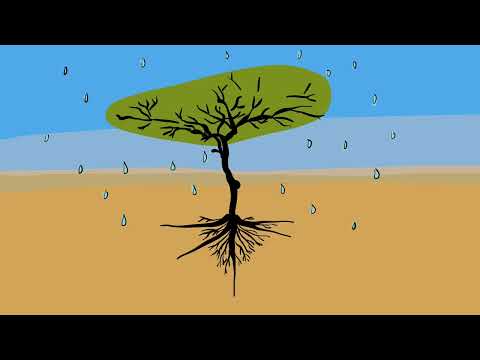
[0:02]Some organisms are really clever. Plants for example, improve their own growing conditions by increasing water infiltration. In this way, they can survive in environments that are actually way too dry. But it also makes them prone to suddenly disappear.
[0:30]In the face of alarming global changes, there has been much talk about such tipping points in Earth system elements.
[0:41]A tipping point can exist when the same environmental conditions can support two different possible ecosystem states, such as a vegetated and a barren state. A stable state is like a ball in a valley.
[0:59]If conditions become drier, this can cause the ecosystem to tip to the bare state. Water input then needs to improve a lot more for the vegetation to tip back into the system. A stable state means that when the vegetation is disturbed, there is a bit less, but this is only temporary. When a disturbance is too large and the system ends up below this dotted line, then it tips to a bare state. Plants can return when they do so in large enough numbers.
[1:43]Tipping is not so convenient for us. Healthy ecosystems are important for people, so we like them to be resilient and not prone to sudden large changes. Luckily, the notion of ecosystem tipping depends a lot on the spatial skill that you're looking at. Some organisms, such as plants in dry environments, can form spatial patterns. As the environmental conditions change, the patterns adjust accordingly. Through these pattern adjustments, the vegetation can adjust freely and gradually through what we call a Busse balloon, avoiding the tipping point. Organisms, especially trees, do take some time to grow back, so if the climate changes too fast, the system can still tip. These insights are obtained mostly from mathematical, physical, and ecological theory. But models are clear, simplified versions of the real world, whereas the world is actually more like a big mess. Such spatial heterogeneity can also cause spatial pattern formation, for example, at the border between savannas and tropical forests. You see, plants can be rather selfish. They worsen conditions for plants of another kind. Tropical forest trees block sunlight so that savanna vegetation cannot grow. And savanna vegetation stimulates fire. Savanna trees are adapted to fire, but tropical trees are not. So savanna plants are bad for forest plants, while forest plants are bad for savanna plants. This results in two alternative stable states. Both savanna vegetation or tropical forest can exist for the same environmental conditions. In a spatially heterogeneous environment, a local disturbance in a patch of tropical forest can lead to stable spatial patterns. These patterns can also adjust to climate change and create stable coexistence states that allow the ecosystem to avoid the tipping point. So in a world with underlying variety, after a disturbance, the system isn't immediately pushed to either the savanna or the tropical forest state, but it ends up in a coexistence state.
[4:12]The underlying environmental heterogeneity is necessary to get this coexistence of states in one spatial domain. We still must be cautionary of changing our Earth's system because tipping can still occur under certain conditions. So it is really important to consider spatial processes when studying tipping points.
[4:41]Research on resilience in a spatial context also shows what happens when we take away space. With limited space for natural processes, ecosystems can still tip.
[4:59]So, if we implement policies that allow space for natural processes, we create landscapes that are actually resilient in the face of climate change.


