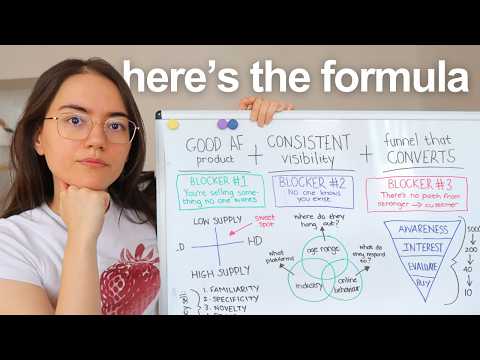
[0:00]Everyone says hitting six figures is hard. It is, but also it's not if you know what matters. I've been behind the scenes of many, many six-figure businesses and the ones that hit 100k aren't doing everything right. But they are following a very specific formula. So let's dive straight into the first part of the formula, which is a good AF product or service, whatever it is you're selling. I am shocked by how many people still rush through creating a good product or service. You can do all the best sales, best marketing, best everything else in the world. But if your product is not good, everything is a million times harder. So, I thought I would take the time and figure out what exactly it means to create a good product. And for me, it means three things. It needs to check these three boxes. The first thing is, it absolutely has to solve a problem that people are willing to pay money to solve. aka it has to be validated. Like, say with me, kids. Validated. And I have done this mistake so many times in the past before, where I didn't even really think about that. I was like, well, I want it. I think it's a great idea. Why wouldn't other people? Because you're a very unique individual. You are a snowflake, really. So, like sometimes I started a sentence, I don't know where it's going. I think that's from Michael Scott. Okay. All right, so class is starting. Welcome to Economics 101. We're going to do a super, super simplified economics lesson. I know, stay with me. If you have a PhD in economics, you're smarter than all of us. You don't need to write me a really long comment telling me about how technically, blah, blah, blah. It's fine. I know. So let's just quickly look at a demand and supply four quadrant situation here. When you create something that is in low demand and low supply, it basically means no one cares about this thing that you are creating. You're not going to make any money, chances are. If you create something that's in low demand and high supply, that means nobody wants it, but everybody's selling it. If your product is in high supply and high demand, it's possible that you might be in a very, very saturated market. And don't worry, we're going to do examples in a second, so stay with me, please. If your product or service is in low supply and high demand, that is where you want to be.
[2:04]That is the cash cow, that is where you make the big bucks, that is the quadrant I want all of us, all of you watching, and me to go towards. Because when demand is greater than supply, you get pricing power. Pricing power basically means you can dictate what price you want to charge because there aren't that many options on the market, so customers kind of have to just go to you. And you can be like, well, it's $300 and they're like, okay, there are no other options, I have to buy your $300 thing, right? However, when supply is greater than demand, you are competing on price most of the time with everybody else in the market. I see this sometimes with beginner freelancers services is everyone's trying to become cheaper and competing on price and that's just not fun. We don't want to be there, that's like red ocean, blood bath, not interesting at all. What is in low supply and low demand? For example, a video editor that only edits with Windows Movie Maker video editor. I don't think I have ever seen a job posting for somebody to edit with Windows Movie Maker. Nobody's interested, and nobody's really offering that. Low supply, low demand. Okay, so what about high supply, low demand? Video editing service, editing anything and everything for everyone. And I will say the most cold pitches I get in my DMs in my inbox are for video editing services and often they use this exact language like I can edit anything in any way you want with any platform you want. And I'm like thinking, I don't want somebody who knows how to edit absolutely everything. I want somebody who knows how to edit exactly for what I am doing. I want somebody really specialized and good at what I specifically want the style and format of my content to be. Okay, so what about high supply, high demand? Maybe that's for a video editor who does basic cuts for YouTube videos. So there is a bit of specialization there, right? They do YouTube videos. Now let's shift into low supply, high demand. Video editors that do a very specific form of editing for a specific type of target client, like the one I want, which is aesthetic video editing, which is cute style, they get the vibe. There was extremely high demand for me for a video editor. I got tons of pitches for video editors, but the specific one I was looking for was in such low supply. I spent ages looking for Maya. I swear I looked everywhere. I was typing in all the keywords, I was on all the freelancing platforms, I was even on Instagram on YouTube looking for editors. And then when we started publishing our YouTube videos, there started to be a lot of comments being like, who does your editing? I love the style of editing. I would love to find an editor who edits in this style. So, that's when Maya and I were like, oh, maybe there's like high demand for this style of editing. Maybe we should start packaging up how Maya edits and selling that as a product. And that is how we tried to find a quadrant for us for this new business that Maya and I started together. But I have an entire video, full length YouTube video, full feature film about validation where I go into way more detail about exactly how to validate. So if you want to and I mean, not even if you want to. You need to start there. I will link the video down below for you and also at the end of this video if you want to watch that after this one. Queue it up. The next thing that makes your product or service good AF, is it has to solve the problem better than anything else on the market. And I call this differentiation. I mean, I don't call it, lots of people call this. Differentiated basically answers the question, why your thing? So then often the question I get to this question is, but Dea, how do I make great money selling something if everybody else is selling the exact same thing? There are lots of ways to differentiate. So we're going to go through a few specific ideas that we had, but there are lots more ways. So let me just go through these quite quickly. The first thing is you can sell familiarity. And we see this a lot of times when celebrity start skin care brands, makeup brands, like for example, Chamberlain Coffee from Emma Chamberlain. I buy matcha from her all the time. So Emma spent years building her YouTube channel, she has millions and millions of subscribers. There's that almost like, oh, she's my friend, I know her, I trust her kind of vibe. So of course, Emma Chamberlain did not invent coffee. There are tons of coffee brands out there in the world. But she is differentiated because she has that level of familiarity with her audience. She spent time building that trust in her personal brand. aka this person is selling their influence saying, this is a good cup. It's not like other cups, this cup is better. And if you trust me, then maybe you're like, oh, Dea says that cup is better. Okay, maybe that cup I look out for next time I'm in the store, you know? Now if you're like, Dea, but I don't have an audience of millions of subscribers, I don't worry. Another way to differentiate is sell specificity. That means sell something that is way more targeted at a niche market. So essentially going all in on a very narrow problem or very narrow subgroup of people. And often when you do this, the message hits harder because you're exuding everyone else. You're saying this is not for everyone. This cup is only for you if you are 30 years old, you own two cats, you love Taylor Swift, and you make YouTube videos. That person's thinking, oh my gosh, this was made exactly for me. It's going to serve me better than this generic thing that's for everybody else. So, Black Girl Sunscreen solved a problem for a subsection of the audience that was struggling with sunscreen that was made for everybody. They solve that problem by creating something that actually blends well with darker skin tones. And bam. And I think often times the issue we get into is we think, oh, it's best if I create something that works for everybody because then I have the most amount of people to sell to. Would you rather resonate 20% with everybody or 100% with a smaller group of people? You don't need that many people to buy from you to have a 100k business. I think sometimes people think, oh, billions of people need to buy from me to have a 100k business. That's not true. 100k is having 1000 people spend $100 with you in one year. It could also be having 100 people spend $1,000 with you in one year. It could be having 10,000 people spend $10 with you in the span of one year. Okay, so you don't need millions of people in your target group. The next way to differentiate is sell novelty. So that's I feel like something we think about more often. So for example, liquid death as a brand is just fascinating. They are literally just canned water, marketed like an energy drink. Okay, except yeah, they have good branding. It's like this really punk branding. It looks very cool. It makes you look kind of a badass. I'm sure it makes you feel like a little badass when you're drinking it. But essentially what they're selling is novelty. It's really good marketing, really good packaging, right? Something where people are like, oh, it's the same thing that I've always had and bought, but there's something cool about it. is could you take something that is ordinary but frame it in a unique way in a new way to peak some curiosity, open that curiosity gap of like, oh, what's that like? I haven't seen that before. We want to break that thought pattern so that people pay attention. Curiosity is so priceless in a crowded market. I mean, I'm in a pretty saturated niche with my YouTube videos and I think of my YouTube videos almost like little products or services that I have to market, right? And we are in a pretty saturated niche in the business niche, so we're always thinking, how can we drive curiosity? How can we do something a little bit new or fresh or novel with our YouTube videos so that people actually give us the time of day. So, for example, this is a hat, right? A hat is not really a differentiated product, but I went across town to buy this hat. Why? Because it says something really funny that called out to me. It says, be your own sugar daddy. And when I saw this, when I saw my friend wearing this, I was like, where did you get that? I have to get that hat. I went across town to buy this hat. Next way to differentiate is selling proof or credibility of some kind. So for example, Olaplex. Olaplex has their own patented bond-repairing formula that's proven to fix damaged hair and have really good before and after results.
[9:25]They're one of the most popular hair care brands because I think they are very backed up by proof. So that is another way of differentiation. People want to buy something that works. So if you have some sort of credibility, some sort of proof in some sort of way and I'm speaking often to my freelancers out there. If your services have proof, you need to be differentiating with that proof. You need to be showing people my thing works and it works so good and it works like this and this is how it's worked and who it has worked for. Great way to differentiate. Another way to differentiate is by selling convenience. Make your product or service easier to consume, to use, to buy than other options. For example, HelloFresh. HelloFresh, we get a delivery every single week. This is going to sound like an ad. It's not. HelloFresh is just groceries. If you really think about it. HelloFresh is just pre-portioned groceries. It's nothing new, but they are selling convenience. They are selling the fact that I don't have to figure out what we're going to eat every single night of every single day. I don't know how everyone does that, honestly. And by the right amount of portions and make sure we don't waste any food. People buy from HelloFresh because it's easier to buy from HelloFresh than it is to go to the store and pick out a bunch of stuff and make that decision. You know what?It's the decision making, the decision fatigue. If you can save people decision fatigue, a lot of people will pay money for that. Could you make your thing, your product or service easier in any way, shape or form for your audience to use compared to your competitor? Another way to differentiate is to sell belonging, to sell community, to sell a sense of feeling. So example, Digital Nomad Girls is a business I love. I have been friends with the founder Jenny for years and years and years. And it's essentially a big community for women who are digital nomads, who travel full time or have some sort of location independent business. And I've been a part of the community for a really long time. So most women don't really want to travel alone with mixed gender groups. Sometimes we just want to travel with the girly, and DNG solved that problem by creating a like-minded all female travel group situation via their retreats. That's a great way to add on value to your product or service is to add that sense of community. Okay, so you can think about that. What is the feeling you want to curate with your product or service? How can you make that feeling more intense for people? People are lonely, so they will pay for that as well. So the third thing that makes a product good AF, it has to be so good, people cannot shut up about it. aka, it has to be exceptional. First of all, there are like bad products where you buy it and like let's say if this comb broke immediately. That would be a bad quality product, right? And then we get to okay products. Okay products do the bare minimum. Like they get the job done, but that's kind of it. Functional, but forgettable. Then we get to good products. Good products solve the problem well, does what it promises. We are happy that we bought it. Now great products. I'm talking exceptional products. They are high quality, they go above and beyond, the promise that was originally made, truly exceptional, creates word of mouth. Are people telling other people about your product or service? If not, chances are you could be working on the quality of your product or service. And I'm not saying that in a way to make you feel bad, like you didn't do a good job. No, no. I think of products and services as a continuous thing you can optimize. Right? You can always make your product or service better. There's that question that Alex Hermozi um mentions in one of his books and I always think about this question, which is what could you offer the person that they would be like, all that? That sounds amazing. I'm in, right? So that's essentially the kind of thinking I try to go to when I'm thinking about products or services is what could I possibly put in this thing that would blow someone's mind? And sometimes what that looks like is brainstorming a big bullet point list of everything that could solve this problem for your person perfectly. And then being like, what can I realistically deliver of this big bullet point list? I'm getting way too fired up. Now a great business is maybe a restaurant where the meal arrives early. It tastes insanely good, server remembers your name, they throw in an extra dessert on the house when it's your birthday because they remember it's your birthday. On the service side, it could be a freelancer who does everything they promise and then goes above and beyond, delivers a little bit more. Suggests improvements that you didn't even think of. They're like, oh my gosh, and I noticed this opportunity, I feel like this would work really well, etc, etc. And organizes everything for you so you don't have to lift a finger to continue this on. All right, so that's the first part of a 100k business. Is a good AF product. Now, the next thing is consistent visibility. This is the second biggest blocker I see all the time that people run into is they have a great thing, or they have a good thing, and they just don't tell anybody about it. They're like, I have the good thing. It's on a website. Where the people banging on my door? People don't know you exist, right? So consistent visibility is your number one job as a CEO before you delegate it to somebody else, maybe. People don't magically find you and they definitely don't buy from you after seeing you once. Even the best product, best service in the world needs consistent visibility for people to be reminded, right? Because we're all in our complex world, we have a million thoughts in our head. So your job is to show up over and over again. Literally become impossible for them to not find you. So a great example is Duolingo. Duolingo has had an insane visibility strategy on TikTok. They hired a really great social media manager, a Gen Z social media manager and they are on everyone's for you page. Before that, I feel like Duolingo was kind of, I mean, I don't want to say it, but like obsolete. Like I didn't really think of them as a brand at all. But once they were starting to kill it on social media, I started thinking about Duolingo regularly. I was reminded of them all the time when they were on my for you page. I'm not even the the target audience really because I'm not learning any language or anything, but they were still so visible that maybe if somebody had asked me about language learning, I would have been like, oh, have you checked out Duolingo? So how do you get consistent visibility? Essentially, you need a marketing system. And I say the word system very intentionally. So a system is comprised of two things. One, a repeatable daily/weekly system for marketing your product and two consistent feedback to make your marketing system better to figure out what's working and what's not working, right? So the first thing is you have to find your people. Where are your people existing? Where do they spawn organically? Where are they chatting? Where are they hanging out? Where do they spend their time? Examples. Let's say you are a matcha cafe. Maybe your marketing system consists of listing on Google Maps and Yelp, posting aesthetic drinks on IG/TikTok. Because that's where your target audience is. Maybe you're sharing about promos in local Facebook groups because there are local like geographical Facebook groups and you want people who are close by to come. Maybe you sponsor local micro influencers, maybe you get on local blogs, maybe you play with some paid ads with like a geo targeting or something like that. Let's say you're a wedding planner. Maybe your target audience is uh 20 to 30 year old brides, then they are probably on Instagram, TikTok. Maybe you show behind the scenes of wedding planning there. Maybe you tag venues that are locally so that people who are just scoping those venues, see the wedding planner that tag that venue. Maybe you create wedding inspo boards on Pinterest because you know your person is pinning on Pinterest. Maybe you're listing on wedding directories, maybe you're providing free value in local Facebook groups for like, you know, there are those groups like Brides of 2025, Brides of 2026. That kind of stuff. Maybe you're running some paid ads. So trying to be everywhere at the same time. I feel like is the fastest way to burn out and get zero results. I hear that from beginner business owners all the time. And I mean, I did this as well in the beginning, so like I definitely was like, I have to do everything because everyone else is doing everything. But you can't do that consistently. So again, we're all about consistency, so I always recommend starting smaller, starting more manageable, so that you're like, okay, I'm getting the hang of this. I'm feeling good about it. I feel like this habit is integrated into my daily routine, and now I can, I don't know, like go and do something else now. So, I want you to pick one, maximum two platforms, commit to it, and post consistently for at least three months. Actually figure out what's working well there, test it. And then if you have like, once again, that habit is ingrained, then you can start doing more and more things. Especially if you're a solopreneur. Like you're only one person. You can't do that many things. So let yourself off the hook for being everywhere all at the same time. Okay, so here's the step-by-step marketing system. Figure out where your target audience is. Where are they hanging out? Where are they chilling? Pick one to two channels to start. Build that daily and weekly routine. What are you going to do every single day? What are you going to do every single week? So for example, if you're like, I'm going to go all in on Instagram. Okay, so what are you doing every single week? Maybe you're working on Instagram 20 to 30 minutes every single day. Depending on your time budget. Do it for a few months, track what's working, what's not working. What, and then learn. So important, learn about the platform that you are committed to, right? Just posting is not enough learning. Like for example, if I just kept posting YouTube videos without learning about YouTube packaging, YouTube content, YouTube retention, all of these things, my YouTube videos would be getting zero views. It's very important to dedicate time in learning to the platform of your choice. Test, tweak, keep going. That is how you get consistent visibility. Amazing. We did it. Okay, let's get to the third part of this formula. The third part of this formula is a funnel that converts. Okay, so convincing someone to buy something from you is a process. And a process can also be called a sales funnel. I know sometimes the idea of a sales funnel can feel intimidating. So I'm going to try to not make it intimidating. A sales funnel is essentially like dating. When you first meet someone, they have no clue who you are, you can't straight up be like, let's go to Vegas, let's get married. Let's elope, right? That's too big of a step. It's like meeting somebody who has no clue who you are, no trust built up. I'm being like, buy my product. It's $1,000. It's great. I promise. You'd be like, huh? You actually wouldn't do that, right? So, sales funnel. First step, awareness, they become aware of you. They're like, oh, interesting. Period. Next one is interest. Oh, that's kind of interesting. Evaluation. Oh, okay, I'm deciding between a few options. I'm curious about your thing. What kind of proof do you have? What's your offer? Blah, blah, blah. Then buy, right? So it really helps people go from who's this, who are you? Why should I care to, I trust you enough to give you my hard earned money, which is the biggest commitment somebody can give you. So example, let's say you're a service-based business. Right? Let's say you're a freelancer, you sell some sort of service, you're a hair dresser, you are social media manager, whatever service-based business. Maybe your first step of awareness is sending a cold pitch about something specific you could help with and add some proof, right? And maybe the first step you take to build some of that trust is to offer a mini trial, a low commitment, something easy for them to say yes to. You said, I would love to help you with this like small thing for like maybe $50 or $100 or something like that. Just to show you what I can do because I would love to work with you. Okay. And then maybe once that works well, then you pitch a longer-term proposal. And if you're like Dea, that could never work. It works. It works all the time and actually Kristen on my team who I've been working with for over a year now, this is exactly the funnel she used on me when I had no clue who she was. I had no clue who she was. I didn't get a referral from anyone about her. I didn't know anything about her. She just appeared in my inbox. Great pitch, great mini trial offer. I took her up on it. She was amazing. Now we've been working together for a year. I've paid her thousands and thousands and thousands of dollars. Really, I don't want you to get fussed with the technicality of the funnel. I want you to be thinking how do I build trust with someone step-by-step? Another example, let's say you have a product-based business. So let's say the visibility strategy you pick is you're going to go all in on YouTube. So you post helpful YouTube videos that solve specific problems for your person. And in those videos, you mention your freebie, your lead magnet in the video and share the link down below. People who are curious can go to it, right? They sign up for the freebie, they get your email sequence. They're starting to get nurtured. They're like, oh, this is what this person's about. Oh, interesting. And then oh, that's her story. Okay, interesting. And this is how she helps. Oh, and she's like really qualified. Blah, blah, blah, blah, blah, right? Building trust. And then slowly you invite them to purchase your product, whether that's a digital product like a program or a workshop, or actually a product. Like maybe you then sell them this cup. So my super important note here, if it wasn't obvious by now, is you cannot and should not promote your products or services right away to a cold person, to a cold stranger. People need to trust you first before they will hear what you are saying. So, there are lots of ways to build trustworthiness, right? Giving genuine value before promoting your product, a great way also to show your credibility, to show like, you know what you're talking about. You're not just in it to try to get money from them ASAP. Showing up consistently without disappearing every other week or month. Again, time, I think is one of the biggest factors to build trust. Like if you think of any good relationship in your life, the ones you trust the person the most, it's probably a factor of time. And it's also why it's so important not to burn yourself out trying to do absolutely everything. Because when you burn yourself out, you can't be consistent. We're playing the long game. I want you to build a sustainable business where you can show up every single week and be excited about everything you're doing. Okay? Oh my God, my throat. Oh, I'm sweating. Oh my God.
[22:27]Oh my God, can you see that? Oh my God, Maya. Like Maya, you didn't tell me. Oh, my I'm scared. Could you see that the whole video? I'm actually scared. I shouldn't have worn this shirt. I should have worn a black shirt. I'm just not gonna move my arm anymore. Okay. Another way to build trust is to give them a chance to test a small part of your offer before they commit. Right? So that's like the free trial thing we see all the time. Replying to DMs and inquiries and emails without treating them as leads that you now have to convince to buy. Right? Just genuinely helping them and being like, let me figure out if this is actually a good fit for you because maybe not, and I would just tell you that honestly. And I do that all the time in my emails is when people email me and they're like, they tell me all this stuff. I'm like, actually, I don't think my product or service is right for you. And I think that's really important. Show you're legit. Post case studies, post reviews, post post testimonials to show people like, I'm not lying about what I am saying. I actually know what I'm talking about. Okay? Show behind the scenes, be real, be authentic. Don't over curate everything. My hands are glued to my side now. I'm not lifting up this arm. Sometimes I feel like over curation leads to a sense of distrust because I'm like, oh, I feel like you're trying to be too perfect, like too polished, too put together. I don't know what's real or what's not. And I think that's why it's important to show the behind the scenes. So, making sales is not magic. It's math. And when I learned this, it kind of changed everything for me because it started to make things less personal. Like if I wasn't getting sales, it's not, oh, something is wrong. Something is wrong with me. Something's really wrong with me. I'm doing something bad. It's just math. You look at the funnel, you look at where people are dropping off. There are standard industry benchmarks for conversion rates, conversion rate. Conversion rates every step of the way. That's what we want to look at. So work backwards. For example, you want to make 100k like I was saying, that is 1000 people spending $100 with you. What would it take to get 1000 people to buy from you? You work backwards by figuring out your sales conversion rate every step of the way. Let's say you know your sales conversion rate is 2 to 3%. That means of 100 people that see your offer, two to three people buy. Okay? So if we now need to get 1000 people to buy, how many people would need to see our offer? Let's do the math. I'm so proud of myself for doing that math backwards. Okay. So, if you need 1000 people to buy from you in a span of a year, because your offer is $100 and you want to make 100k, and you have a 2% conversion rate, then you need 50,000 people in the span of a year to see your offer. 50,000, divided by 12, is 4,166.6 infinite, right? So, the math tells you if you get 4,166 people seeing your offer every single month, then you can hit 100k if your product is $100 and your sales conversion rate is 2 to 3%. So, check your funnel. Two things you could do if things are not happening the way you want them to happen. You're not getting enough sales, you're tons of people are seeing the offer, but they're not buying. Number one, improve the conversion rate of every step of the funnel. Figure out where people are dropping off. If people are hitting your freebie page, but nobody is opting into your freebie, big issue, freebie might not be interesting enough. Work on the freebie first. If people are opting into the freebie, they are joining the email series, but they're not opening the emails, emails are probably the problem, work on your emails. If people are clicking on the emails and going to your sales page, but they're hitting the sales page, they go to checkout. They're not buying. Checkout is probably the problem. So, two things you can do, improve the conversion rate of every step of the funnel, or bring more people into your funnel by increasing traffic by consistent visibility. Okay, visibility strategy system. So that's really the only two things you need to be focused on as a CEO. Make sure your funnel flows, make sure the conversion rates are good, then visibility, bringing people into the funnel. Amazing. Okay. Now you're like, Dea, I have a good product. People are seeing it. My funnel works. What else could there be? What else could I be missing? Arguably the biggest thing, which is the inner work. And I don't want to lose you at this stage. I don't want people clicking out. Because this is the biggest problem, honestly, that I have seen from business owners who are not hitting 100k. They are not doing the inner work that they need to to help themselves get through the mindset hurdles that they are crossing. And it makes everything a million times harder if you are not on top of your mindset. Often times your biggest blocker is not time, it's not money, it's not procrastination, laziness, world, life, the biggest blocker most of the time in my experience, for me as well, it's me. I'm the problem, it's me. So odds are, you already know what you need to do. Especially if you've watched this video this far. You know what you need to do next. So why aren't you doing it? Right? There's some sort of mindset block there. It could be fear of rejection, fear of being cringy, fear of visibility, fear of success, the pressure to keep up, fear of disappointing people, fear of wasting your time, perfectionism disguised as over planning, fear of change, so many things. There's this great quote from a great book, Brianna We, the mountain has you. I have a whole video on it. I highly recommend going to watch that because that one dives into way more detail about all of this stuff if you know that this is your biggest blocker. This great quote is, self-sabotage is what happens when we refuse to consciously meet our innermost needs, often because we do not believe we are capable of handling them. So, often how we protect ourselves is we'll do a bunch of this like not real work that doesn't move the needle to protect us from doing the work that's actually important. So we might over plan the vision of our business for the hundredth time, setting up notion templates to organize our business, redoing our website, our portfolio a million times, over analyzing the strategy for the 30th time, spending way too much time making the logo, the branding, everything, all this stuff that's like, it feels productive, but it is not. When you actually need to maybe learn a skill that makes you a little uncomfortable so you know how to do something, maybe it's emailing five potential customers or leads about your offer cold pitching. Maybe it's pitching your offer in a private community. Maybe it's making your sales page, even if it's not perfect, even if it's a little bit messy. Maybe it's setting up a payment link and actually sending it to that person who was interested in your offer and then you ghosted them. So here are two exercises that really helped me work through mindset blocks. The first exercise is I call the, I reckon exercise. So basically what I do is I write down absolutely everything that's currently holding me back, all the fears, anxious thoughts, all the what if questions that are like ruminating. And then I go through each one and I ask myself, what's probably true or most likely to happen? aka, I reckon blank will happen, right? So for example, if I write down something like fear of judgment, like I'm really afraid that my friends and family are going to cringe at what I'm doing and gossip about it amongst themselves. Then I would write underneath that, I reckon people realistically are too busy with their own lives to really be paying that much attention to what I'm doing. I mean, do I pay that much attention to what other people are doing? Like if some random person is starting a business, am I like obsessed with them being like, that's so embarrassing. Blah, blah, blah. And if I'm doing that, it's a projection, second of all. And they're probably too worried about their own business to care about what I'm doing and putting all that energy into judging me. And you know what? I also reckon, if they are that obsessed with me starting a business, it's something about them and it has nothing to do with you. It's none of my business. I reckon my dreams for my life are maybe more important than what they have to say. Maybe your fear is imposter syndrome. Fear of actually landing a client/customer and not knowing what the heck to do. I hear that all the time. Fear of success is actually a huge issue. I mean, for me as well. So I reckon most people who start their own business don't know it all in the beginning and learn during the process. They don't. You heard it from a credible source. Most people who start their businesses have no clue what they're doing. They are just figuring it out along the way just like you. And learn during the process because they're giving themselves a chance to even try things and learn. That's the only way you can do it. I reckon anything I don't know, I can probably Google and figure out. I reckon I can ask people for help if I bump into something that I don't know. Right? So that's one thing. And the point there is to be really kind and compassionate with yourself, right? It's not to say, I reckon you're going to fail and this will be the worst thing in the world. That's not the point. That's also not realistic, right? That's not a realistic, compassionate voice. The next exercise is my, is it worth it exercise? So I take a piece of paper, I divide it into three columns. On the left I put the fear that I have. In the middle, I put the likelihood of it happening, so low, medium, high. And on the right, I put what success could mean. If I work through this fear, right? So on the left, I might have like, fear I'll waste my time on it and it won't work. Likelihood, I'm like low because I think I'm still going to learn a lot and I can apply that for the future. So, if I succeed at this thing, I get to travel the world, I get to work from anywhere, I get to live my best life, live my dream life. Okay? And then the question you want to ask yourself is, is the risk of whatever you're doing and the likelihood of it worth the rewards, the right side. And only you can answer that. And if you're like, actually, no, the risk is not worth the reward, then maybe you don't do it. Or maybe your fear is you'll get bad feedback. The likelihood of that happening if you're just getting started, maybe is medium. Maybe you will get bad feedback, but if you succeed, you might have the chance to make a lot of money as a freelancer. You will it will allow you to hire others and help them. You will be able to build a completely location independent business. Is that potential reward worth the risk? I think sometimes we just get so sucked up in the risk and the what if, we forget to weigh both equally.
[32:03]We're just looking at this, and that's not really fair.
[32:11]So the big lesson here is you have to do it scared. I know you think there's going to be some moment where you're not scared anymore. You're 100% certain, 100% clear on what you're going, where what you're doing. That moment does not exist. It's not going to happen. I do everything that I do in my business for YouTube scared. Lots of business owners do lots of things scared. It's kind of like expecting yourself to be ready to be a painter when you have never picked up the painting paintbrush. It's so important to show yourself that it is safe to try. Okay, even if you fail, you still tried. That's a huge win. Pick yourself back up. That is a learning, and that is the only way to make any sort of progress. So, build proof you're capable of doing this. Take one tiny step every single day by taking action despite your fear, despite the doubt. You are proving to your brain like, look, I can do this. This is not the end of the world. I know you think we're being hunted by light, I know you think we're being hunted by. I was trying to say lion and tiger at the same time, that's why it wasn't coming out. I know you think you're being hunted by a tiger right now, but actually we're going to survive if somebody doesn't buy our product. We're just going to use that as data to make a better decision in the future to make the product better, to make the offer better. So, tiny steps. This is exactly how I've started almost every single one of my businesses. For my digital product business, January 2020, I told myself every single day I was going to work 15 minutes on my business, whatever that look like. Again, tiny steps. You want it to feel easy. You don't want it to feel like now I have to do a four hour time block every single day because you're probably busy, probably have a lot going on. That is how progress happens, those tiny steps. That's the formula. And now if you're getting stuck on any of the mindset blocks I just talked about, you're afraid of starting, you're afraid of failure, you're afraid of succeeding, you're afraid of being judged, cringy, whatever. Go watch this video. This is one of the best books I have ever read. I buy it for everyone. Normally I'm like no pressure, but now I'm like pressure. And again, as always, thank you so much for watching and I hope to catch you in the next one.


