[0:00]We like to think about Gen AI as being composed of five layers. They are infrastructure, models, platform, agents, and Gen AI powered applications. You're likely most familiar with the Gen AI powered application layer, as it's the user-facing part of generative AI, or the front end. This is the layer that allows users to interact with and leverage the capabilities of AI. Examples of Gen AI powered applications include the Gemini app, Google Workspace with Gemini, or NotebookLM. Next is the agent layer. An agent is a piece of software that learns how to best achieve a goal based on inputs and tools available to it. This layer focuses on autonomous action, which describes the ability to independently set goals and carry them out within a defined environment. Agents analyze situations, use multiple tools and make informed decisions without requiring constant human input. They are also capable of handling multi-step tasks that a model alone cannot, such as researching a topic, troubleshooting code, or accessing a system by chaining together actions. You can have a variety of agents, such as customer agents, code agents, data agents, and many more. The platform layer typically sits between agents and models, providing the infrastructure for them to interact. For now, let's jump ahead and focus on the models themselves, and we'll come back to platform shortly. The brain of the agent is the AI model. These models are complex algorithms trained on vast amounts of data. They learn patterns and relationships in the data, allowing them to generate new content, translate languages, answer questions and much more. The infrastructure layer is the foundation upon which everything else rests. It provides the core computing resources needed for generative AI. This includes the physical hardware, like servers, GPUs and TPUs, and software needed to store and run AI models and training data. Last but not least, let's discuss the platform layer. The platform layer sits above the model and infrastructure layers, providing the necessary tools and infrastructure for AI development. It offers APIs, data management capabilities and model deployment tools. This layer acts as the backbone of the system, bridging the gap between models and agents, while simplifying the complexities of managing the underlying infrastructure. From the foundational infrastructure to the user-friendly applications, each layer of generative AI plays a crucial role in its capabilities. As leaders, it's vital that you understand these layers to effectively guide your teams in adopting and utilizing generative AI. By understanding this interconnected system, you'll be well-equipped to navigate this landscape and harness its power for your own endeavors.
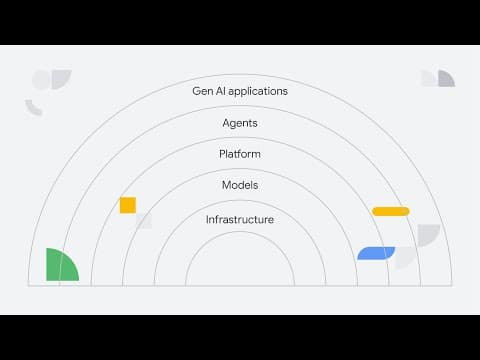
Understanding the building blocks of generative AI
Google Cloud
2m 49s431 words~3 min read
YouTube auto captions
Transcript source
YouTube auto captions
This transcript was extracted from YouTube's auto-generated caption track. The transcript below is server-rendered so it can be read, searched, cited, and shared without opening the original YouTube player.
Pull quotes
[0:00]They are infrastructure, models, platform, agents, and Gen AI powered applications.
[0:00]You're likely most familiar with the Gen AI powered application layer, as it's the user-facing part of generative AI, or the front end.
[0:00]This is the layer that allows users to interact with and leverage the capabilities of AI.
[0:00]Examples of Gen AI powered applications include the Gemini app, Google Workspace with Gemini, or NotebookLM.
Use this transcript
Related transcript hubs
Watch on YouTube
Share
MORE TRANSCRIPTS


