[0:11]Symmetry analysis of designs of various cultures has been addressed by mathematicians since the early part of the 20th century. One example are the designs in the tilings that adorn the Alhambra Palace in Granada, Spain. These are representative of Moorish culture, have been analyzed extensively by several mathematicians, such as Grunbaum and Shepard, for their high degree of planar symmetry. Another example is the stenciled cloth and fabric from the Kakadrove Province in Fiji. Professor Donald Crowe, an American mathematician, has analyzed this cloth for its freeze pattern structure. Our country, the Philippines is rich in cultural heritage. Textile or fabric is very much part of each indigenous community. Whether it is for practical purposes, for expression for instance to reflect status, achievement or religious belief, or a part of social tradition and ceremony. The textile shows artwork and designs unique to each community. Each textile or fabric displays distinct algebraic and geometric structure, which makes each piece interesting to study mathematically. In this presentation, we give a mathematical study of selected textile from the Floy Kinta's collection. We analyze pieces from his Binakol and Pinilian collection, a Gaddang shirt, an Itneg handkerchief, items from his Yakan Saputangan, and Tausug Pisyabit collection. A mathematical study of a repeated pattern in a cultural ornament such as textile or a piece of cloth entails investigating the pattern symmetries.
[2:40]A repeated pattern has a basic discrete design element or a motif.
[2:48]Application of a symmetry, which in mathematics, we refer to as a distance preserving transformation, sends the motif to itself or repeats the motif systematically either along a strip or a planar surface.
[3:09]It can be proven mathematically that there are four symmetries in the plane. One symmetry is the translation. A translation shifts the motif, in this case, a triangle, by a given distance along a line. The symmetry is indicated by a vector as shown to denote the distance and direction of the shift.
[3:40]A reflection on the other hand, moves a motif along a line called a reflection axis producing a mirror image.
[3:52]A rotation moves a motif about a center or fixed point at angular intervals. The symmetry is represented by a point or a polygonal figure that marks the location of the center of rotation. In this case, the square is used to indicate the center of a 90-degree rotation.
[4:21]Finally, a glide reflection is a transformation that is a combination of a translation and a reflection.
[4:35]For planar patterns, three possibilities occur on how a motif is repeated by either one or a combination of these four symmetries. A finite symmetrical design is obtained by repetition of a motif, either using only rotations about the center, or reflections about axis through the center.
[5:13]If a repeating pattern admits translations in one direction, the pattern is called a freeze or strip pattern.
[5:24]There are altogether seven symmetry classes of freezes or strip patterns. If a repeating pattern admits translations in two directions, the pattern is called a wallpaper pattern.
[5:59]There is a total of 17 symmetry classes of wallpaper patterns.
[6:08]All repeating patterns in one or two dimensions can be classified to belong to exactly one of these seven or 17 symmetry classes, respectively. This classification distinguishes geometrically one planar pattern from another.
[6:31]In our study on the mathematics of textile, the goal is to use mathematics to investigate artwork of a particular indigenous community based on the symmetry class of the associated repeated pattern. Let us begin with the analysis of a blanket woven in the Pinilian technique. The design in a blanket woven in this technique is achieved by varying the ways the horizontal weft threads are inserted across the vertical warp threads.
[7:11]The particular blanket that we have analyzed consists of three panels that have been sewn together. There are two primary motifs as shown on the screen and enclosed in blue. The motifs are created using 15 different horizontal weft patterns that are employed in a repeated sequence. Each weft pattern flows from left to right at repeated intervals. The design demonstrates the weaver's ability to fuse horizontal and vertical elements into a pattern giving rise to symmetries which include horizontal and vertical reflections, 180-degree rotations about the centers of each motif, and translations or shifts in two directions.
[8:12]In this work of art, it is important to note that the weaver introduces what we call in mathematics, a symmetry breaking of the blanket's primary design by a change in the warp and weft configuration. At the end of the blanket, the weaver inserts human and horse images making his signature or pattern to the blanket's overall design. In particular, the weaver introduces 23 different weft patterns repeating this sequence twice at the bottom end of the central panel. This highlights the expertise on the part of the weaver in handling warp and weft configurations.
[9:06]The whirlwind or Kasiku's design among the Itnegs demonstrates a clever solution to the problem of depicting concentric circles on a rectangular grid. The arrangement of negative and positive colored threads in the form of graduated rectangles emanating from a central rectangle provide the illusion of movement as of a whirlwind.
[9:37]These motifs are repeated the same distance along horizontal and vertical directions to create 180-degree rotational symmetries with centers at each central rectangle and also between two central rectangles. There are also reflectional symmetries about horizontal and vertical axes as shown.
[10:08]The combination of these geometric elements result in an illusion of swirling circles or ripples, believed to cause dizziness to evil spirits.
[10:25]A very interesting feature of this Gaddang shirt is that the design of the front, the back, as well as the sleeves, is a combination of strip patterns from different symmetry classes. The strip pattern with diamond-like motifs has vertical as well as a horizontal reflectional symmetry and 180-degree rotations with centers where the axis of reflections meet. The thinner strips, such as those colored yellow or white blue yellow, appear like parallel lines from a distance. Looking closely, these are strip patterns that have reflectional symmetries with vertical axis as shown. The intricate beadwork also has a motif, which is repeated along the edges of the garment and around the neck.
[11:41]This Itneg handkerchief shows that even without varying the breadth of the warp and weft yarns, patterns other than checkered or plain designs can be produced.
[12:00]The skillful interplay of green threads in the warp and weft creates an illusion of pentagons, while the manner in which the weft yarns are inserted produces a soceless right triangles. There are no vertical reflections, but there is a reflectional symmetry with horizontal axis passing through the vertex of the isosceles triangles whose bases are vertical. In addition, the points at which pairs of isosceles red triangles intersect at their respective vertices are centers of 180-degree rotations.
[12:51]In our study, we were fortunate to analyze closely four different examples of the Yakan Saputangan. Each saputangan showing a complex geometrical structure.
[13:10]Each of the saputangan shows a center square, four squares of the corners with identical motifs, and strip patterns at the sides. Every finite symmetrical pattern at the center and corner squares adopts the inherent symmetries of a square, which includes a 90-degree rotation about the center of the design, horizontal, vertical reflections and reflections along diagonal lines of the square. Each axis passing through the center. The strip patterns along the borders have vertical and horizontal reflections as well as 180-degree rotations about the points of intersection of the reflection axis.
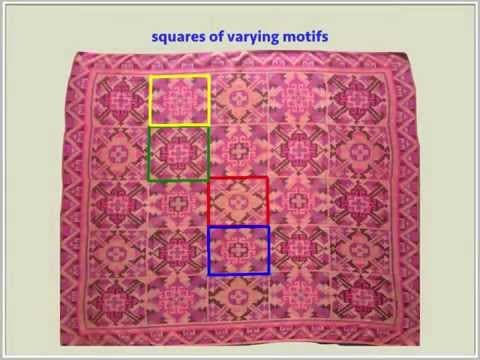
[15:05]The second pishabit that is shown in this presentation, consists mainly of a center square, four squares of the corners and rectangular regions consisting of smaller squares at each side. A motif appearing in each square, such as what is shown has a vertical reflection and horizontal reflection and a 180-degree rotation about the center of the design. Observe that the center square splits into 18 congruent rectangular regions or sections exhibiting two distinct motifs.
[15:57]A motif in each given rectangle also has a vertical reflection, a horizontal reflection and a 180-degree rotation about the center of the design. Strip patterns of blue and white with only translational symmetries surround the center square. There are also two types of strip patterns consisting of zigzag designs with vertical reflectional symmetries that appear at the borders of the pishabit and around the squares and rectangles. Bay Saputangan and a Pishabit are square fabrics.
[16:42]One can admire the artistry and skill of the weaver by the manner in which he puts together rectangles and squares, as well as freezes, each of varying geometric elements to arrive at an overall design, which is highly symmetric.
[17:58]The artwork in the textile reflects not just the expertise but the rich mathematical instincts of the Filipino weaver. Indeed, the Philippine weavers intrinsic mathematical talent is one which we can be truly proud of.
[18:21]For this research, I would like to thank my research collaborators. They are present here today. Dr. Agnes Garciano and Dr. Debbie Marie Verzosa, who are assistant professors from the Department of Mathematics of the Ateneo de Manila University. I would also like to acknowledge on behalf of Agnes and Debbie, Floy Quintos, Emma Abrina of the Yuchenco Museum, Dr. Norma Respiccio and Dr. Analyn Salvador-Amores, Bernadette David, National Commission for Culture and the Arts, and the Loyola Schools of the Ateneo de Manila University.
[19:10]Without their help and support, this presentation would not be possible. Thank you very much for your attention.


